RALEIGH, N.C. (AP) — Rod Brind'Amour didn't see a need to juggle his lineup or massively adjust the scheme after an ugly first period cost the Carolina Hurricanes any chance to win their Eastern Conference Final opener.
No, the issue was as simple as getting to their game, with the precision and edge they had shown in sweeping through the first two playoff rounds.
Following that approach got the Eastern Conference's top seed back into their series against the Montreal Canadiens as play moves to Canada for Monday's Game 3. And it offers the roadmap entering what is now a best-of-five series for a trip to the Stanley Cup Final.
“We just tried to keep it real after Game 1: We needed a better effort,” defenseman K'Andre Miller said Sunday.
“We know how we can play Hurricane hockey and we know we're at our best when we can get to our game. So I think it was just a matter of looking (at) the man in the mirror and bringing your best effort for Game 2.”
The Canadiens won Game 1 by jumping on a team coming off an 11-day break — the longest wait to start a series in more than a century — scoring four goals in the opening 11 1/2 minutes. Montreal repeatedly got loose for clean breakouts and breakaways against Frederik Andersen in that one.
The lone positive from that game was the Hurricanes played more of their preferred style in the second period. Otherwise, Brind’Amour said they needed to toss it and move on, even saying the team wouldn’t go through an on-ice practice.
“It’s not what we need,” he said Friday.
Carolina responded Saturday night by looking closer to its previous playoff form with its aggressive forecheck, controlling the puck in the offensive zone and winning battles along the boards to minimize the chances going the other way. The Hurricanes held the Canadiens to 12 shots on goal while surrendering far fewer unchecked sprints through the neutral zone that led to such Game 1 trouble.
“I think all the way through it was more Carolina Hurricane hockey in Game 2 and we'll try to keep building on that,” captain Jordan Staal said.
Then there is the pressure to break through to the Stanley Cup Final in Carolina's third Eastern final in four years and fourth in the current eight-year postseason run under Brind'Amour. Carolina was swept in this round against Boston in 2019 and Florida in 2023, then fell in five games in last year’s rematch with the Panthers.
The Hurricanes were 1-13 under Brind’Amour in the Eastern Conference Final before winning Game 2 on Nikolaj Ehlers’ overtime goal. And the franchise's struggles in this round go back even to Brind'Amour's playing days in a 2009 sweep against Pittsburgh, with Carolina losing 10 straight home conference-final games since beating Buffalo in Game 7 on the way to hoisting the Cup in 2006 with Brind'Amour as captain.
This is the first time the Hurricanes haven't found themselves in an 0-2 hole in this round since that year, too.
Brind'Amour dismissed talk of past struggles by noting “there's too much to worry about right now” with corralling the young and fearless Canadiens.
“Right now it's so day-to-day focused, shift-focused eventually, that you can't think like that,” Staal said.
The good news for the Canadiens was they continued to show an ultra-opportunistic approach to attacking any opening, down to forcing OT and being a goal away from a 2-0 series lead despite being outplayed most of Saturday.
Josh Anderson's first goal at the 11:11 mark of the opening period came on the Canadiens' first shot on goal, set up by Taylor Hall's failed clear attempt that was kept in at the blue line by Kaiden Guhle. Anderson's second came on a third-period rebound of his own shot in a multi-player scramble in front of the crease after Carolina couldn't get that puck cleared, either.
It's a familiar story for Montreal, notably going back to how they won Game 7 on the road of the first-round series against Tampa Bay despite getting just nine shots on goal. Or how they regrouped from blowing a 2-0 lead in Game 7 at Buffalo to win that second-round series in overtime.
“It can take one play in a game to change the whole mood and the energy,” Montreal captain Nick Suzuki said Sunday. "We've got a lot of opportunistic guys, and we trust the style. ... So if you can get through those moments, there's usually something good on the other side of that.
“We've done that all playoffs, and I don't really see that changing. I think we can win any type of game."
AP NHL playoffs: https://apnews.com/hub/stanley-cup and https://apnews.com/hub/nhl

Carolina Hurricanes head coach Rod Brind'Amour speaks at a new conference following Game 2 of the Eastern Conference final NHL hockey Stanley Cup playoff series against the Montreal Canadiens in Raleigh, N.C., Saturday, May 23, 2026. (AP Photo/Karl DeBlaker)

Carolina Hurricanes' Jordan Staal gets an explanation from referee Kelly Sutherland for a call against the Montreal Canadiens during the second period in Game 2 of the Eastern Conference final NHL hockey Stanley Cup playoff series in Raleigh, N.C., Saturday, May 23, 2026. (AP Photo/Karl DeBlaker)

Montreal Canadiens' Lane Hutson, left, clears the puck from the goal area with Canadiens goaltender Jakub Dobes (75) and Carolina Hurricanes' Andrei Svechnikov (37) nearby during the second period in Game 2 of the Eastern Conference final NHL hockey Stanley Cup playoff series in Raleigh, N.C., Saturday, May 23, 2026. (AP Photo/Karl DeBlaker)
A damaged chemical tank in Southern California may have cracked — potentially lowering the risk of a cataclysmic explosion — though an evacuation order remains in effect for some 50,000 area residents with no timeline on when they can return, fire officials said Sunday.
TJ McGovern, the interim fire chief for the Orange County Fire Authority, said in a video posted on social media that fire officials were able to evaluate the tank more closely overnight and spotted a potential crack that could be relieving some of the pressure inside. But he cautioned that the information is still being vetted and validated.
“With this new information, it could change our trajectory and our strategy to this event," McGovern said. "Last night, this operation that we did gave us positive intel to make educated decisions today in the positive light. We’re not there yet, but this was a step in a right direction.”
Orange County Fire Authority Capt. Wayhowe Huang told The Associated Press earlier Sunday that it does not appear that any of the highly volatile chemicals in the tank have leaked.
“There’s still the danger of a possible explosion. We’re not taking that off the table,” Huang said. “We’re still operating as if that is the risk.”
Firefighters have been spraying the outside of the tank with water in an effort to cool the chemicals inside and prevent an explosion.
The pressurized tank overheated Thursday and began venting vapors at a company site in Garden Grove, about 40 miles (60 kilometers) south of downtown Los Angeles, according to the Orange County Fire Authority.
No injuries have been reported. Air monitoring tests have so far found that air pollution around the evacuation zone is within normal limits, and specialized equipment has been deployed to ensure no gas is released from the compromised tank, state and federal environmental officials said Saturday.
A crack could be a welcome development, as it could mean product or pressure inside the tank is being released, reducing the chance the tank explodes, said Andrew Whelton, an engineering professor at Purdue University.
“Think of a soda can. If you leave it in a hot car it can explode," he said. "But if you put a hole in the can, the product is released and the can itself doesn’t explode.”
But Faisal Khan, head of the chemical engineering department at Texas A&M University, said a crack suggests an explosion could still happen -- just not in the magnitude initially feared.
“Cooling is happening on the surface of the tank while runaway reaction may be occurring deep inside the tank,” he explained. “Yes, reaction is slowed compared to what it started. However, we are not out of explosive release risk.”
Meanwhile, some Garden Grove residents filed a class-action lawsuit on Saturday against GKN Aerospace Transparency Systems, the company that operates the facility where the tank is located.
Lawyers for residents living in the evacuation zone argued in their federal court lawsuit that regardless of what happens next, property values in the surrounding community are sure to be impacted.
Spokespersons for the company didn’t comment on the lawsuit itself, but pointed to a Saturday statement in which they apologized to residents and businesses that have been forced to evacuate.
On Sunday, the company released another statement saying it was monitoring the “condition of the affected material” and “working around the clock to mitigate the risk of a leak.”
Officials said the valves on the tank are broken or “gummed up,” which prevented crews from removing the chemical or relieving the pressure on the tank, said Craig Covey, Orange County Fire Authority division chief.
Firefighters’ first hope is to find a way to cool off the chemical inside the tank so it won’t leak or explode. If that is not possible, Whelton said it would be best if the tank sprang a leak so the chemical could be mostly contained. An explosion that could spread the chemical over a broad area and send shrapnel flying would be the worst-case scenario.
If the temperature inside the tank continues to increase, the pressure will continue to build as the methyl methacrylate converts from a liquid to a gas. Whelton said it’s unlikely that firefighters would consider creating a hole in the tank because of fears that could create a spark that might ignite the volatile and flammable gas.
Drones were monitoring temperatures at 10-minute intervals to watch for any spikes, Covey said on a social media post on X. Containment barriers have been set up to prevent the chemical from getting into storm drains or reaching creeks or the nearby ocean in the event of a spill, Covey said.
The damaged tank is located at GKN Aerospace, which makes parts for commercial and military aircraft. It holds 6,000 to 7,000 gallons (22,700 and 26,500 liters) of methyl methacrylate, used to make plastic parts.
GKN agreed to pay state regulators more than $900,000 in 2025 to settle violations involving recordkeeping, permitting issues and nitrogen oxide emissions, according to a report on the South Coast Air Quality Management District website.
Exposure to methyl methacrylate can cause serious respiratory problems and even render someone unconscious. It can also cause neurological problems and irritate the skin, eyes and throat, according to fact sheets about the chemical. But Orange County health officials said the chemical is easy to smell and residents may notice it over a large area without being harmed.
Whelton said the volume of chemical in the tank is much smaller than in the disastrous 2023 train derailment in East Palestine, Ohio, which he studied when more than 115,000 gallons (435,000 liters) of vinyl chloride was released after officials blew open five tank cars and burned the chemical.
“Many of these are acute, fast-acting effects. But the longer somebody stays in contact with it, the more potential for significant damage that occurs,” Whelton said.
If there is an explosion, officials said they expect “severe structural damage and significant harm” in the blast zone closest to the tank.
If an explosion releases the chemical into the air, Whelton said, it will be crucial to conduct detailed air monitoring specifically for methyl methacrylate and not just generic tests for volatile organic compounds as officials did in East Palestine.
The weather will be an important factor in determining where a plume of chemicals would go in the event of an explosion. Officials were developing maps to predict different scenarios about which areas would be most affected.
Garden Grove is next to Anaheim, home to Disneyland’s two theme parks, which were not under evacuation orders. Park officials said they were monitoring the incident and supporting employees impacted by evacuations.
Marcelo reported from New York.
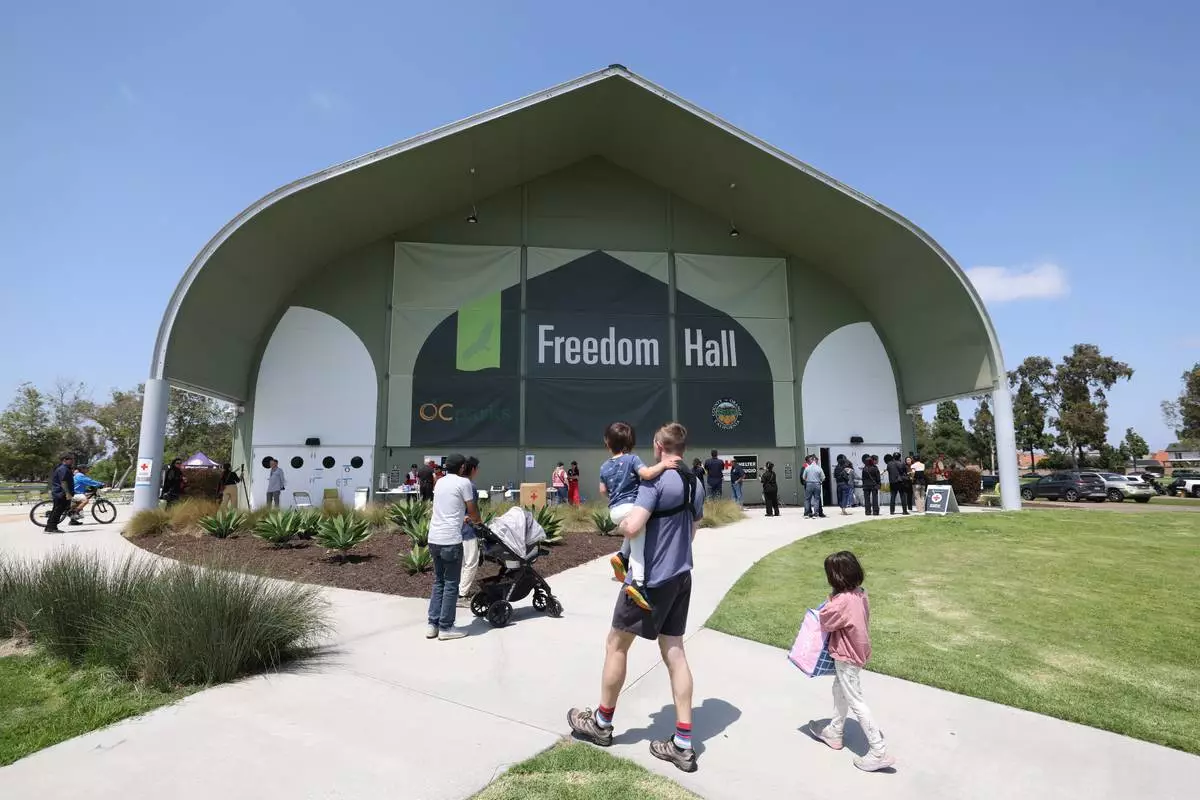
People arrive at Freedom Hall, an evacuation center in Fountain Valley, Calif., after a storage tank containing a chemical used to make plastic parts overheated Thursday at an aerospace plastics facility in Garden Grove, on Saturday, May 23, 2026. (AP Photo/Jill Connelly)
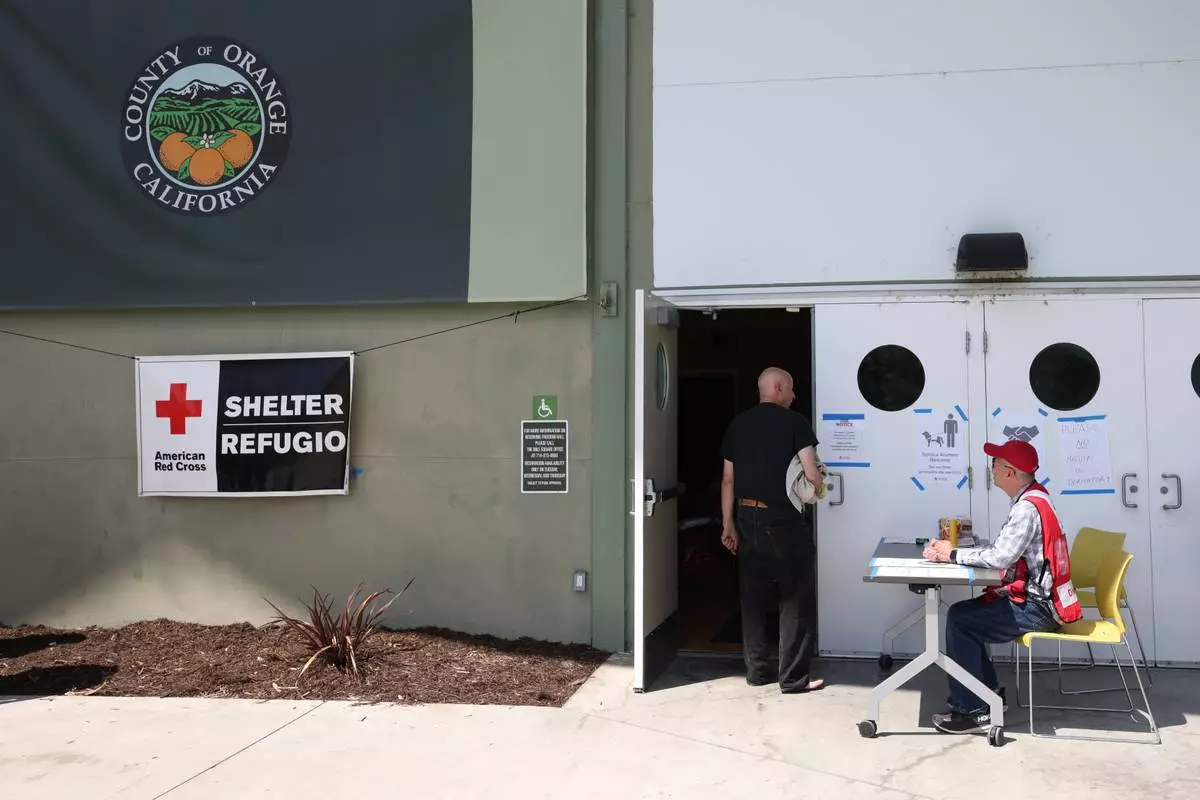
People arrive at Freedom Hall, an evacuation center in Fountain Valley, Calif., after a storage tank containing a chemical used to make plastic parts overheated Thursday at an aerospace plastics facility in Garden Grove, on Saturday, May 23, 2026. (AP Photo/Jill Connelly)
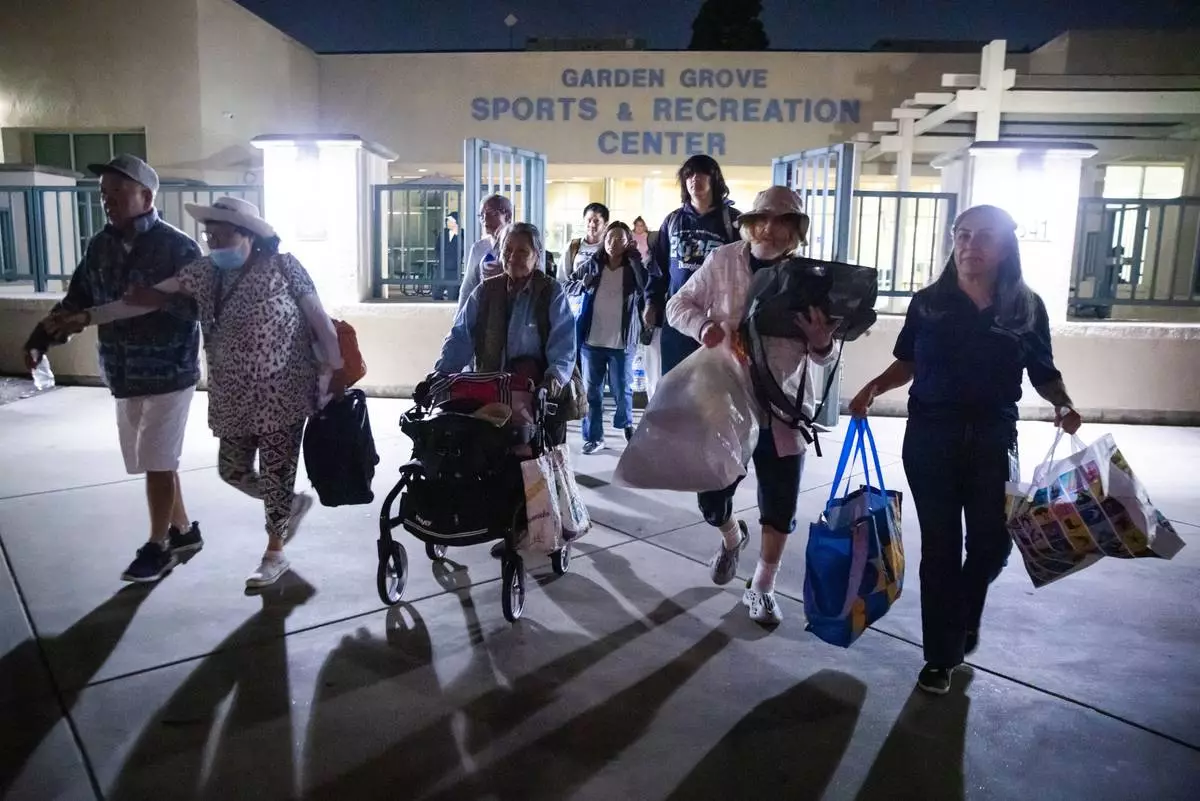
Evacuees from an aerospace chemical plant tank leak move to another shelter after the Garden Grove Sports and Recreation Center closed for the night in Garden Grove, Calif., Friday, May 22, 2026. (AP Photo/Ethan Swope)
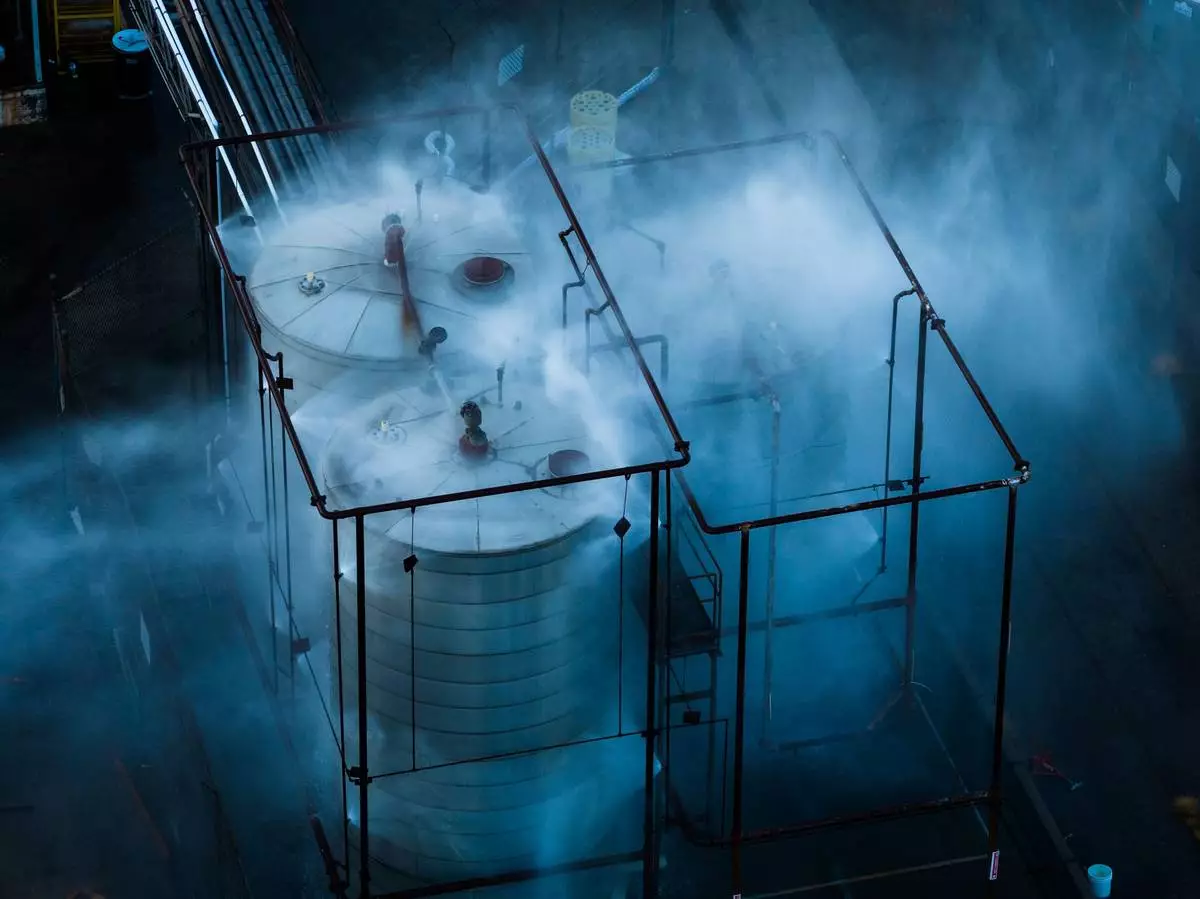
Water is sprayed on a tank that overheated at an aerospace plant in Garden Grove, Calif., Friday, May 22, 2026. (AP Photo/Ethan Swope)