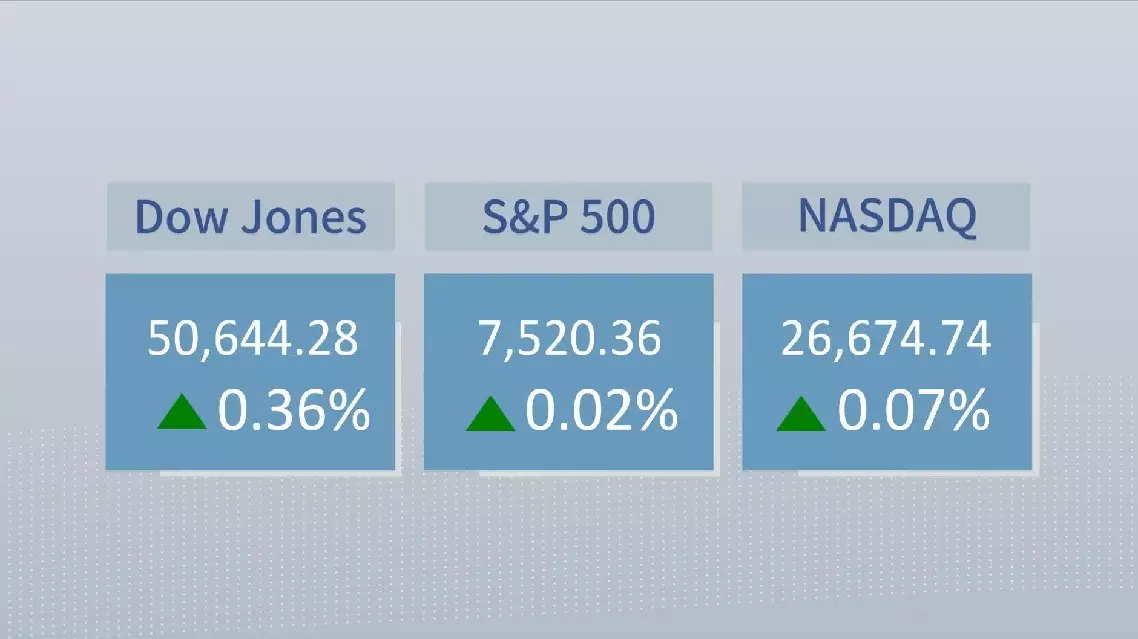
U.S. stocks finished generally higher on Wednesday, with the Dow Jones Industrial Average, Standard and Poor's 500 and Nasdaq Composite Index all setting fresh all-time records.
The blue-chip Dow Jones Industrial Average rose 182.60 points, or 0.36 percent, to a new historic close of 50,644.28. The benchmark Standard and Poor's 500 ticked up 1.24 points, or 0.02 percent, to 7,520.36, while the tech-heavy Nasdaq Composite Index advanced 18.55 points, or 0.07 percent, to finish at 26,674.74.
Market breadth among the 11 primary Standard and Poor's 500 sectors was slightly negative, with six closing in the red. The energy and financial sectors led the laggards, dropping 1.52 percent and 0.82 percent, respectively. Consumer discretionary and consumer staples led the gainers, rising 1.89 percent and 0.97 percent, respectively.
According to a Reuters report citing Iranian state media, Tehran explicitly committed to restoring commercial maritime traffic through the vital Strait of Hormuz back to pre-conflict baseline capacities within a one-month timeframe.
The announcement triggered a sharp sell-off in energy futures. The West Texas Intermediate for July delivery lost 5.21 U.S. dollars, or 5.55 percent, to settle at 88.68 dollars a barrel on the New York Mercantile Exchange. Brent crude for July delivery sank 5.31 percent to settle at 94.29 dollars a barrel on the London ICE Futures Exchange.
In corporate developments, following a massive surge of over 19 percent in the previous session that pushed its market capitalization above 1 trillion dollars, memory chip manufacturer Micron Technology rose an additional 3.63 percent. The equity sustained its upward trajectory as investors continued to digest a highly favorable UBS report highlighting the long-term pricing power secured by memory component suppliers via multi-year supply agreements.
Investment strategists at Goldman Sachs upgraded their year-end target for the Standard and Poor's 500 Index to 8,000 from 7,600, aligning their expectations with peer forecasts at Morgan Stanley and Deutsche Bank. The revised targets imply a total projected return of roughly 17 percent for the benchmark index in 2026, fueled primarily by corporate margin expansions linked to technological efficiencies.
Meanwhile, JPMorgan Chase fell nearly 2.5 percent to drag down the banking industry. The decline followed public commentary from JPMorgan CEO Jamie Dimon, who disclosed during an industry event that the banking giant could potentially deploy up to 20 billion dollars toward a major strategic acquisition over the next couple of years.
U.S. stocks tick up slightly as oil continues to retreat