PARIS (AP) — France’s powerful lower house voted finally to scrub a fundamental slavery-era edict from French law on Thursday.
After the National Assembly voted 254-0 to adopt the bill to repeal Code Noir, it now goes to the Senate, where supporters expect it to be approved as well.
Code Noir — or Black Code — was signed by King Louis XIV at Versailles Palace in 1685 to set the rules for slavery across France’s colonial empire. The code quietly remained on the books even after it lost any authority when France abolished slavery in 1848.
It was described as “the most monstrous legal text of modern times” by French philosopher Louis Sala‑Molins.
Its 60 articles first governed the French Caribbean — Martinique, Guadeloupe and Saint-Domingue, today’s Haiti — and were later extended to French Guiana, Louisiana, and the Indian Ocean islands of Réunion and Mauritius.
France shipped about 1.4 million Africans across the Atlantic in chains — the third-largest slave trade of any European power, after Portugal and Britain.
Most were put to cutting sugar cane and feeding the boiling houses, where the syrup was reduced over open fires, alongside coffee, cotton and indigo.
The work was so deadly that deaths surpassed births. Planters simply replaced the dead with fresh shiploads of Africans.
By 1789, Saint-Domingue — now Haiti — held around 500,000 enslaved people, more than any other Caribbean colony. It produced much of the world’s sugar and coffee, and was fabled to be the richest colony on earth.
Code Noir became toothless when France abolished slavery in 1848, but no one ever formally struck it from the books.
Article 44 called the enslaved “movable property.”
A master could buy them, sell them, mortgage them, or leave them to his children — like land or furniture.
Article 28 said that they could “own nothing that does not belong to their master.”
Anything they earned, and anything they were given, was his.
They had no name in law.
From 1839, each enslaved person in the colonies was given a number, and a registration code.
Only at abolition were the freed given last names.
Article 38 punished people who tried to escape.
The first time, their ears were cut off and one shoulder was branded with a fleur-de-lis — the symbol of the French crown.
The second time, a leg tendon was cut and they were branded again.
The third time, they were put to death.
Article 33 ordered death for any enslaved person who struck a master, his wife or their children hard enough to leave a mark or draw blood — or who struck them in the face.
Such a slave, the article said, “shall be punished by death.”
Before it said a word about the enslaved, the code’s first article expelled every Jew from France’s colonies within three months.
It called them “declared enemies of the Christian name.”
Articles 2 and 3 ordered all enslaved people baptized and raised Catholic.
No other religion could be practiced in public.
A child took the mother’s status.
The child of an enslaved woman was born enslaved — even if the father was free.
Children were enslaved from birth.
Code Noir set their food rations at half an adult’s.
A few articles read like rules to “protect” the enslaved.
Masters were meant to feed and clothe them, not to torture them, and not to sell a husband, wife and small children apart.
Historians say these were widely ignored.
Owners who killed the people they enslaved were almost never punished.

A statue is photographed by French artist Didier Audrat in Paris, Wednesday, May 27, 2026, honoring the memory of the abolition of slavery, depicting Solitude, the daughter of an African slave who was raped by a sailor aboard the ship transporting her to the Caribbean, holding the proclamation of Louis Delgres, an anti-slavery resistance leader calling for resistance and struggle. (AP Photo/Thomas Padilla)
NEW YORK (AP) — The U.S. stock market is pushing to more records Thursday as companies like Dollar Tree, Snowflake and Hormel Foods keep piling up profits. That's even as oil prices continue to swing and more data shows pressure building on the economy because of the war with Iran.
The S&P 500 added 0.6% to its all-time high set the day before after drifting between small gains and losses earlier in the morning. The Dow Jones Industrial Average was up 39 points, or 0.1%, as of 12:23 p.m. Eastern time, and the Nasdaq composite was 0.8% higher after both indexes also set records the day before.
Even with worries about expensive oil and high inflation, the U.S. stock market has run to records largely because U.S. companies keep making more money. Stock prices tend to follow the path of corporate profits over the long term, and companies have been routinely topping analysts' expectations for the first three months of 2026.
Dollar Tree’s stock soared 18.2% after it became the latest to report fatter profit than analysts expected. CEO Mike Creedon said improved store conditions helped the retailer make more profit off each $1 in sales during the latest quarter despite tariffs adding to its costs. The company also gave a forecast for profit over the full year that topped analysts’ expectations.
Kohl’s rallied 16.9% after the retailer reported better results for the latest quarter than analysts had feared, while Best Buy climbed 18.8% following its own better-than-expected profit report. Hormel Foods climbed 9.8% after a strong performance for its Jennie-O ground turkey and exports of its Spam luncheon meat helped it report a better profit than analysts expected.
Snowflake rose 37.6% after saying artificial intelligence continues to be a strong driver of its business, and profit and revenue for the latest quarter exceeded expectations.
They helped offset a dip for Marvell Technology, which fell 1.3% after its profit for the latest quarter only matched analysts' expectations. It also said AI is driving big revenue growth for it, particularly its data center business.
In the oil market, prices ticked higher following their latest U-turns. The price for a barrel of benchmark U.S. crude oil rose 1.1% to $89.61, but only after bouncing between $87 and $92. It's been swinging as hopes rise and fall that the United States and Iran may reach a deal to reopen the Strait of Hormuz and get oil flowing again from the Persian Gulf to customers worldwide.
The latest threat to the ceasefire in the war came after U.S. Central Command said Kuwait had intercepted missiles launched by Iran late Wednesday night. That followed earlier “defensive” strikes by the U.S. military on missile launch sites and minelaying boats in southern Iran.
In the bond market, Treasury yields eased after a report said the measure of inflation that the Federal Reserve likes to use accelerated last month but was roughly within economists’ expectations.
The yield on the 10-year Treasury fell to 4.45% from 4.48% late Wednesday after giving up an earlier gain.
Data also showed how U.S. households are less able to save money, with the personal savings rate down to a four-year low of 2.6%, “pointing up the financial pressure on lower- and middle-income families,” according to Gary Schlossberg, global strategist at Wells Fargo Investment Institute.
U.S. households have been saying they’re feeling discouraged about the economy and inflation, even as the stock market keeps chugging along.
High yields in bond markets worldwide recently have threatened to slow economies and undercut prices for stocks and all kinds of other investments. High yields have already forced the average long-term U.S. mortgage rate to its most expensive level since last summer, and they could curtail companies’ borrowing to build the AI data centers that have supported the U.S. economy’s growth recently.
A report on Thursday said the pace of sales of new U.S. homes unexpectedly slowed last month, as the weight of higher mortgage rates hurts the market.
In stock markets abroad, indexes dipped across much of Europe and Asia. Hong Kong’s Hang Seng fell 1.3% for one of the world’s larger losses.
AP Business Writer Elaine Kurtenbach contributed to this report.

Trader Robert Arciero works on the floor of the New York Stock Exchange, Friday, May 22, 2026. (AP Photo/Richard Drew)

A person looks at an electronic stock board showing Japan's Nikkei index at a securities firm Monday, May 25, 2026, in Tokyo. (AP Photo/Eugene Hoshiko)

FILE - A person stands in front of an electronic stock board showing Japan's Nikkei index, seen through the glass wall of an office building in Tokyo, May 7, 2026. (AP Photo/Eugene Hoshiko, File)
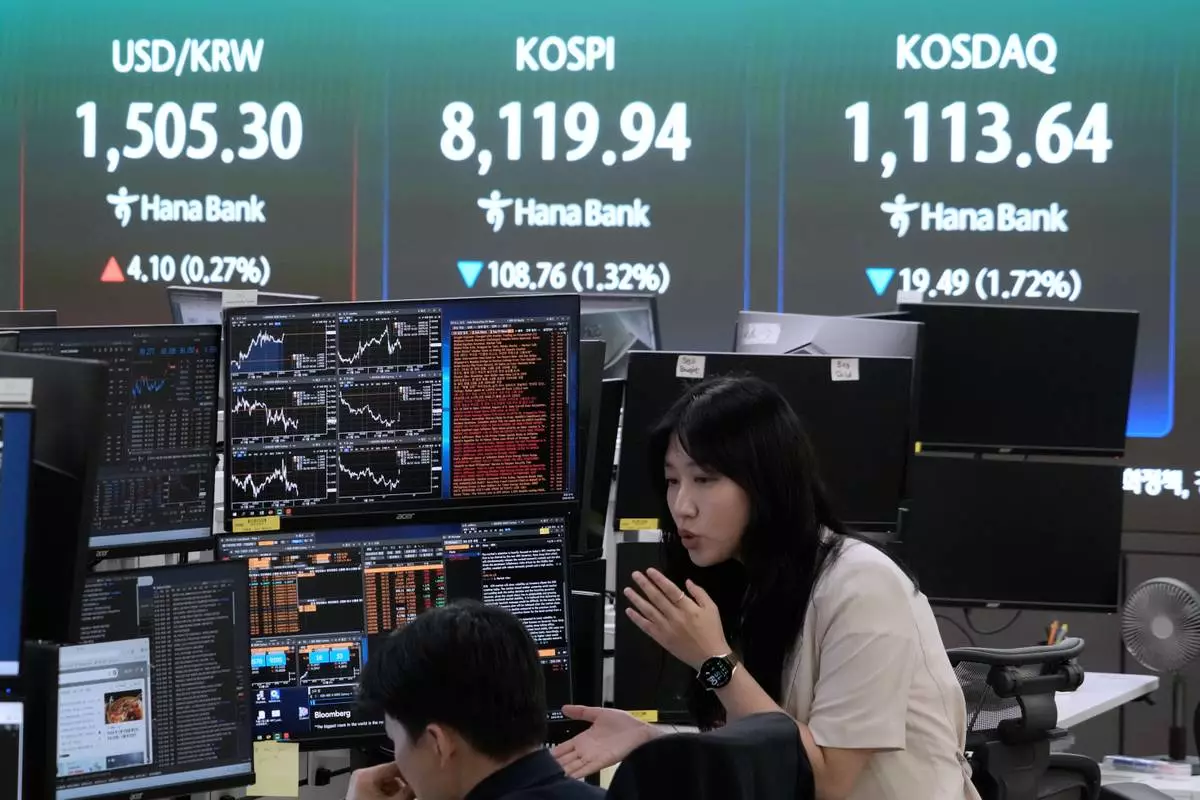
Currency traders work near a screen showing the Korea Composite Stock Price Index (KOSPI), top center, and the foreign exchange rate between U.S. dollar and South Korean won, top left, at the foreign exchange dealing room of the Hana Bank headquarters in Seoul, South Korea, Thursday, May 28, 2026. (AP Photo/Ahn Young-joon)
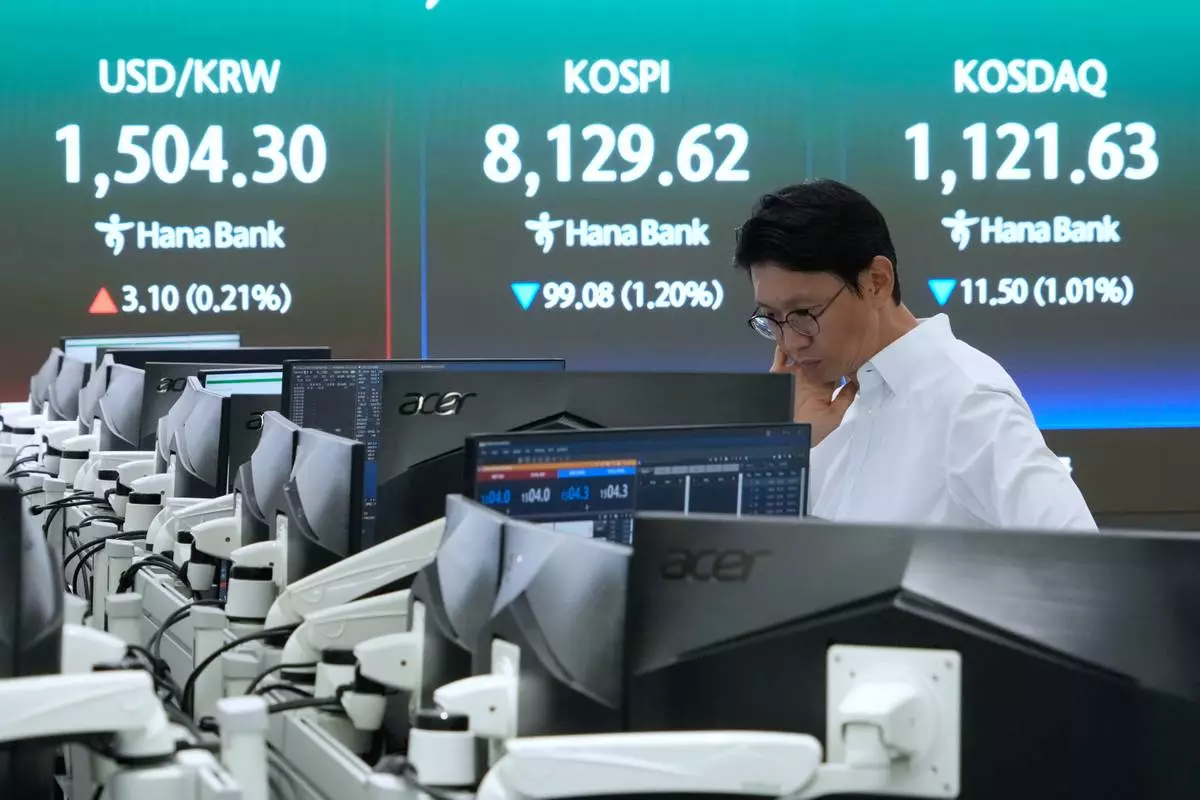
A currency trader watches monitors near a screen showing the Korea Composite Stock Price Index (KOSPI), top center, and the foreign exchange rate between U.S. dollar and South Korean won, top left, at the foreign exchange dealing room of the Hana Bank headquarters in Seoul, South Korea, Thursday, May 28, 2026. (AP Photo/Ahn Young-joon)
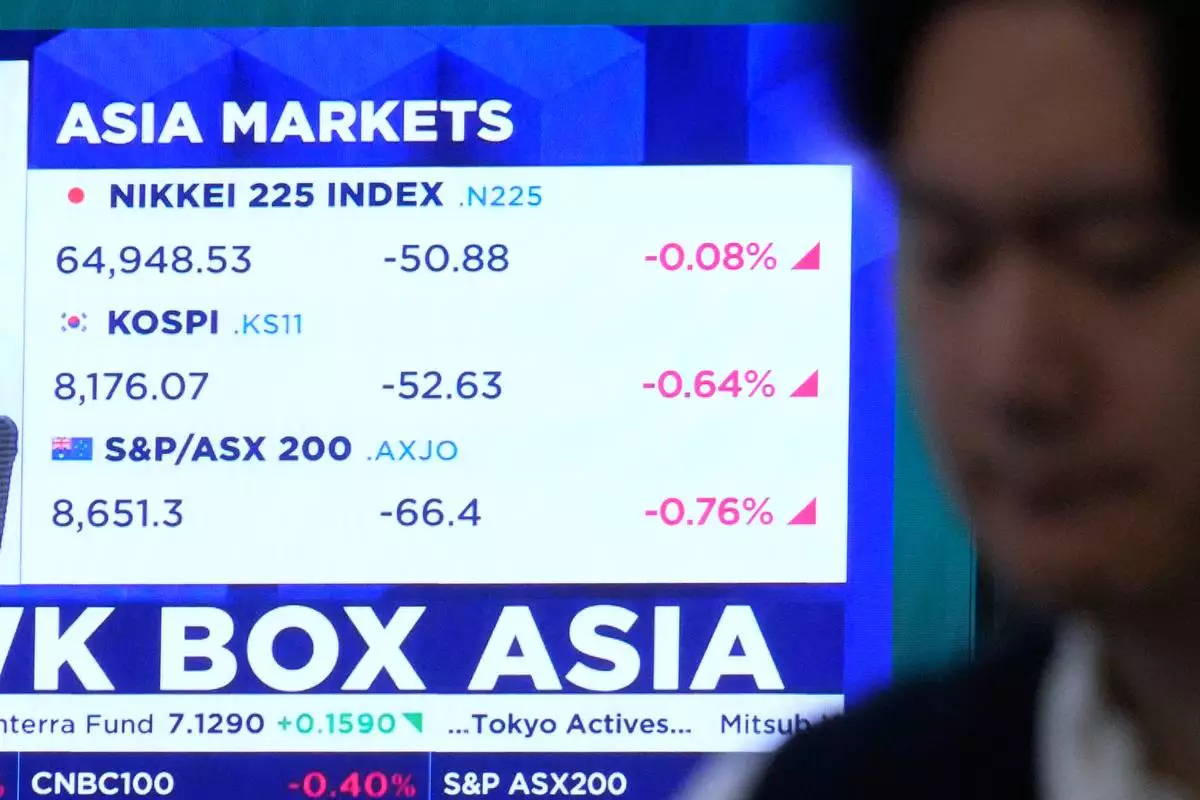
Asia markets index of Japan, South Korea and Australia is seen on a screen at the foreign exchange dealing room of the Hana Bank headquarters in Seoul, South Korea, Thursday, May 28, 2026. (AP Photo/Ahn Young-joon)