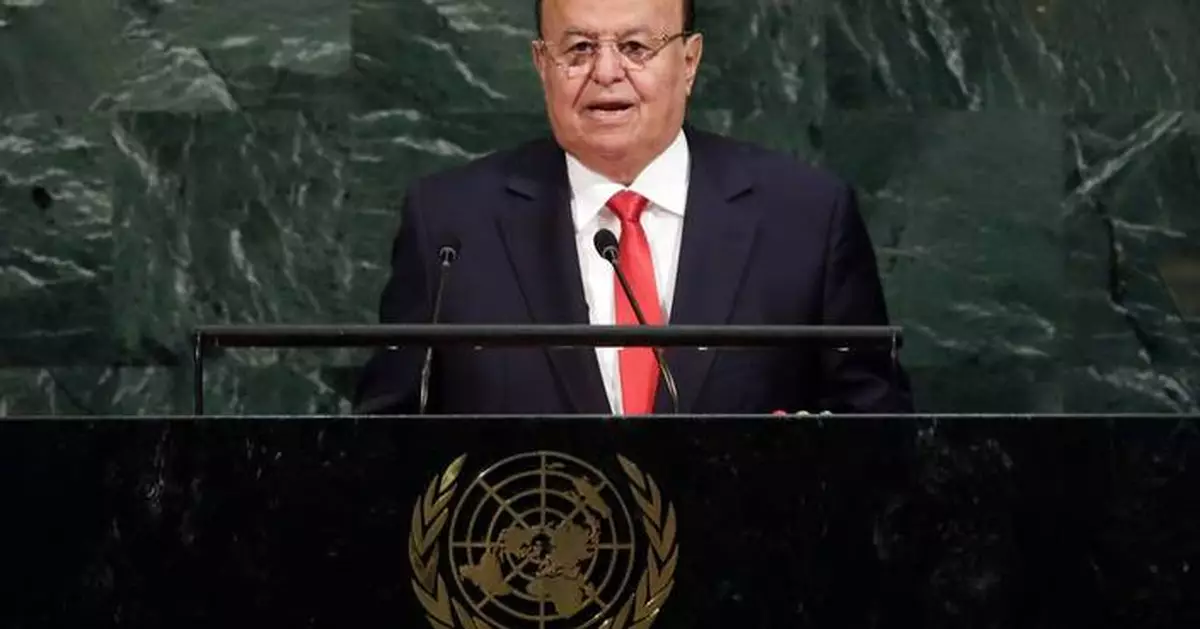
ADEN, Yemen (AP) — Abdrabbuh Mansour Hadi, the internationally recognized president of Yemen who led a fractured government mostly from exile for eight years as the country descended into civil war and famine before stepping down in 2022, died on Thursday. He was 80.
State-run Yemeni TV said that he died at his residence in Riyadh, the capital of Saudi Arabia, but gave no other details.
Rashad al-Alimi, the head of the Presidential Leadership Council — the leadership body of Yemen’s internationally recognized government — said Hadi believed in the Yemeni people’s “right to a just state, freedom and human dignity.”
“He led the battle to defend the republican system," al-Alimi said on X.
The government announced three days of mourning, during which flags will be flown at half-staff.
Hadi became president in 2012 after the resignation of longtime leader Ali Abdullah Saleh during the Arab Spring uprisings. Backed by the United States and Gulf states, Hadi emerged as a compromise candidate in a one-person election meant to guide Yemen through a political transition.
But his presidency soon got bogged down in unrest.
During his first years in office, Hadi tried to implement wide-reaching reforms, including the unification of the country’s various armed factions.
His opponents accused him of favoring the country’s eastern oil-rich provinces at the expense of the mountainous heartlands dominated by Houthis, the Iran-aligned movement.
Another challenge came from al-Qaida in the Arabian Peninsula, long considered one of the global network’s most dangerous branches. The group carried out a bombing in Sanaa in 2012 that killed more than 100 people.
The defining moment of Hadi’s presidency came in 2014, when Houthi fighters swept south from their northern strongholds and captured Sanaa amid growing public anger over economic hardship and political instability.
With support from forces loyal to Saleh, Houthi forces took control of Yemen’s presidential palace in January 2015. Hadi resigned and escaped to Aden. But he later withdrew his resignation, and a Saudi-led coalition entered the conflict in March 2015 in a bid to restore Hadi’s government.
Although Hadi remained the internationally recognized president, much of the real decision-making was influenced by Saudi Arabia and the United Arab Emirates, the coalition's main players.
His authority weakened further as divisions emerged in the anti-Houthi alliance.
Tensions with the UAE deepened after Hadi dismissed senior Emirati-backed figures, including Aidarous al-Zubaidi, who led the separatist Southern Transitional Council, or STC.
The STC eventually took control of Aden and parts of southern Yemen, leaving Hadi’s government confined to exile in Riyadh and to scattered territories in the east.
While the STC stopped short of openly demanding Hadi’s removal, it refused to place its forces under his command and accused his government of accommodating Islamist factions linked to the Islah party, Yemen’s branch of the Muslim Brotherhood. The STC was dismantled earlier this year.
Hadi spent his final years in office largely out of public view in the Saudi capital. In April 2022, shortly after a U.N.-brokered ceasefire was announced, he transferred power to al-Alimi, who began leading the newly formed presidential council backed by Saudi Arabia.
Mansour Hadi was born Sept. 1, 1945, in Yemen’s coastal Abyan province at a time when the southern of the half country was a British protectorate. His family was part of the influential Al-Fadl tribe, one of the largest and most established in the south.
After completing school, Hadi pursued a career in the army, graduating from the United Kingdom's Sandhurst military academy. His early military years saw him serve in Egypt and Russia, before returning to Yemen.
Hadi was a senior officer when civil war erupted in 1986, following a fallout between rival factions of Southern Yemen’s then governing Socialist party. He sided with President Ali Nasser Mohammed, fleeing with him to northern Yemen, then an independent state.
In the immediate years after Yemen’s reunification in 1990, Hadi was promoted first to the rank of general and later to defense minister by Saleh. As a reward for leading numerous successful military campaigns against southern separatists in 1994, Saleh appointed Hadi as vice president of the new republic.
Hadi is survived by his wife, Hala, and six children. Funeral arrangements weren't yet known.
Fatma Khaled reported from Cairo. Jack Jeffery provided reporting for this story from Cairo before leaving The Associated Press.
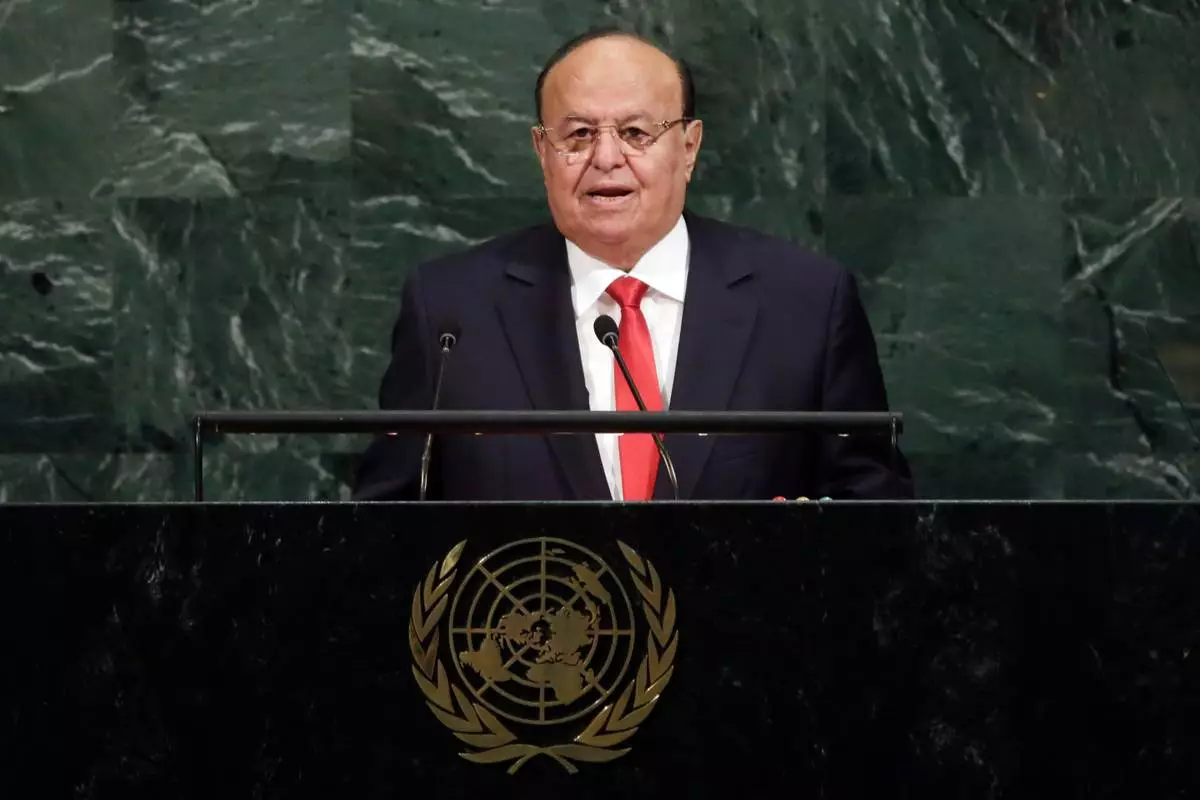
FILE - President Abdrabbuh Mansour Hadi of Yemen addresses the United Nations General Assembly, at U.N. headquarters, Thursday, Sept. 21, 2017. (AP Photo/Richard Drew, File)
MINNEAPOLIS (AP) — In a city that often seems to be staggering from one crisis to the next, the sudden resignation of police Chief Brian O’Hara after a finding he likely interfered in a misconduct investigation has left Minneapolis searching again for a way forward.
O’Hara was an outsider brought in with a mandate to reform the police department after the 2020 killing of George Floyd, which led to federal and state investigative findings of excessive force and racist policing practices. O’Hara had spent most of his career in Newark, New Jersey, where he instituted changes after that department was put under a federal consent decree for patterns of excessive force and unconstitutional stops and searches.
The challenges in Minneapolis were clear before O'Hara arrived in late 2022. For a time, it had seemed the department itself might not survive. In 2021, more than 43% of voters supported disbanding the department as the city reeled from Floyd’s killing and the massive protests and widespread rioting that followed.
Policing experts had noted the monumental task that faced the city’s next police chief, who would have to rebuild community trust and a department whose morale had dipped so low that it was hemorrhaging officers.
“I don’t think there was a bigger challenge to any American city than what Minneapolis faced when he arrived,” said Chuck Wexler, executive director of a Washington think tank, the Police Executive Research Forum. “They had gone from 850 to 500 officers, violent crime was significantly up, trust with the community was broken, a police station had burned down and a federal consent decree would face the next chief. Then you had the politics of Minneapolis.”
Coming in as an outsider to lead a large department is daunting, even without being asked to reform and rebuild, said Renée Hall, president of the National Organization of Black Law Enforcement Executives who moved from Detroit to lead the Dallas Police Department from 2017 to 2020.
“It’s extremely challenging to walk into an organization, where you don’t even know where the light switches are, where the bathrooms are. And that’s just the basics,” Hall said. “You have to learn the officers, the community, the politics of that particular city, and try to learn and navigate the existing relationships, like unions or officer associations and who is tied to whom and who is fighting for whom.”
Hall said outside hires can face resentment from those within an organization who supported internal candidates. They also have to earn the trust of the community, which she said takes time.
After the police disbandment measure failed, O'Hara joined the bureaucracy of a deeply progressive city that is regularly buffeted by political battles between the mayor and the City Council, and among council members.
Those battles were on full display Wednesday, when a City Council news conference about O'Hara's resignation quickly turned into an opportunity for the council's resolute progressives to attack Mayor Jacob Frey, who has long portrayed himself as a “pragmatic progressive.”
The resignation “is a symptom of a much larger problem, which is simply that Mayor Frey continues to be unable to effectively manage the Minneapolis Police Department,” said Council member Robin Wonsley, a cornerstone of the council's progressive bloc.
Frey, who just weeks ago pushed to have O'Hara reappointed as chief, fired back at criticism that he didn’t move aggressively enough when allegations of the chief's potential misconduct emerged.
“I don’t make decisions based on rumors and anonymous complaints,” he said in a statement, adding that he would work with the council to find a replacement. “I took action promptly after receiving the investigative report. … Decisions this serious have to be grounded in facts, evidence and completed investigations. Anything less would be irresponsible.”
O'Hara did not return a message seeking comment Wednesday. His attorney, Doug Kelley, released a statement touting successes during O'Hara's tenure, including diversifying and increasing the department's ranks, the decreasing violent crime rate and mitigating violent clashes during the immigration crackdown.
“The circumstances of Chief O’Hara’s departure should not define his service," Kelley wrote. "He was proud to serve Minneapolis, remains grateful to the officers and community partners who did difficult work under extraordinary pressure, and hopes the city continues moving forward. He understandably looks forward to returning to his young family in New Jersey.”
The resignation came just months after Minneapolis was plunged into the national spotlight amid a federal immigration surge that left three civilians shot, two fatally. O'Hara faced criticism he hadn't done enough to stop the crackdown.
Violence plagued the city in 2025, including deadly attacks on state politicians in the Minneapolis suburbs; gunfire that erupted at a popular city picnic spot; and a shooting during Mass at the Church of the Annunciation that left two children dead and more than a dozen people injured. O’Hara called the church attack a “ truly unthinkable tragedy. ”
Critics say dozens of complaints were filed against O'Hara, from accusations that he was rude to the public to the recent investigation into an ultimately unproven allegation he had a sexual relationship with a city employee. Most of the complaints have not been made public, and 17 complaints are still being investigated. Investigators closed 17 more without any disciplinary actions.
An independent investigator did not find evidence to substantiate the alleged sexual relationship with a city employee, but a second report released this week said O'Hara likely deleted the employee's contact from his phone during the investigation and that he talked to another employee about the probe despite being told it was not to be discussed.
That recent report led to a written reprimand; Frey told O'Hara he would be disciplined and that he could be terminated. Frey said O'Hara chose to resign instead.
Lauer reported from Philadelphia.
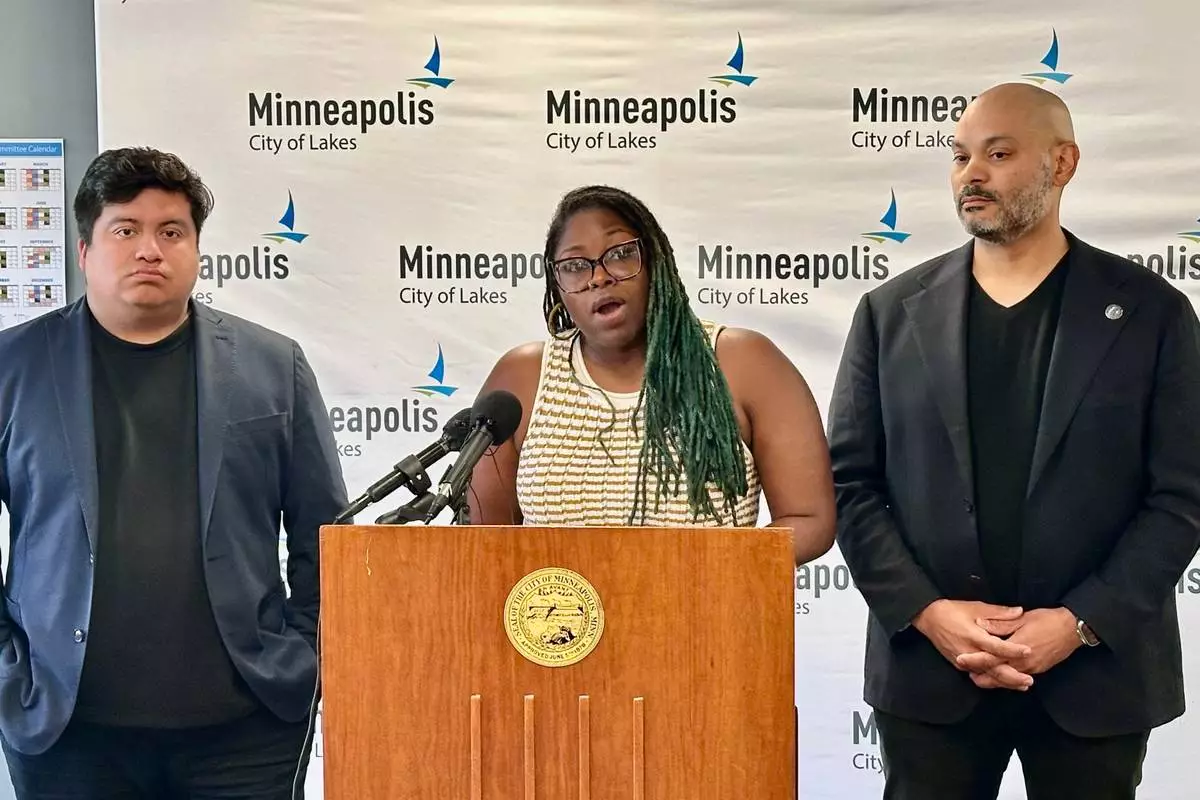
Minneapolis City Council Members, from left, Jason Chavez, Robin Wonsley and Council President Elliot Payne speak to reporters about the resignation of Police Chief Brian O'Hara on Wednesday, May 27, 2026 at City Hall in Minneapolis. (AP Photo/Mark Vancleave)
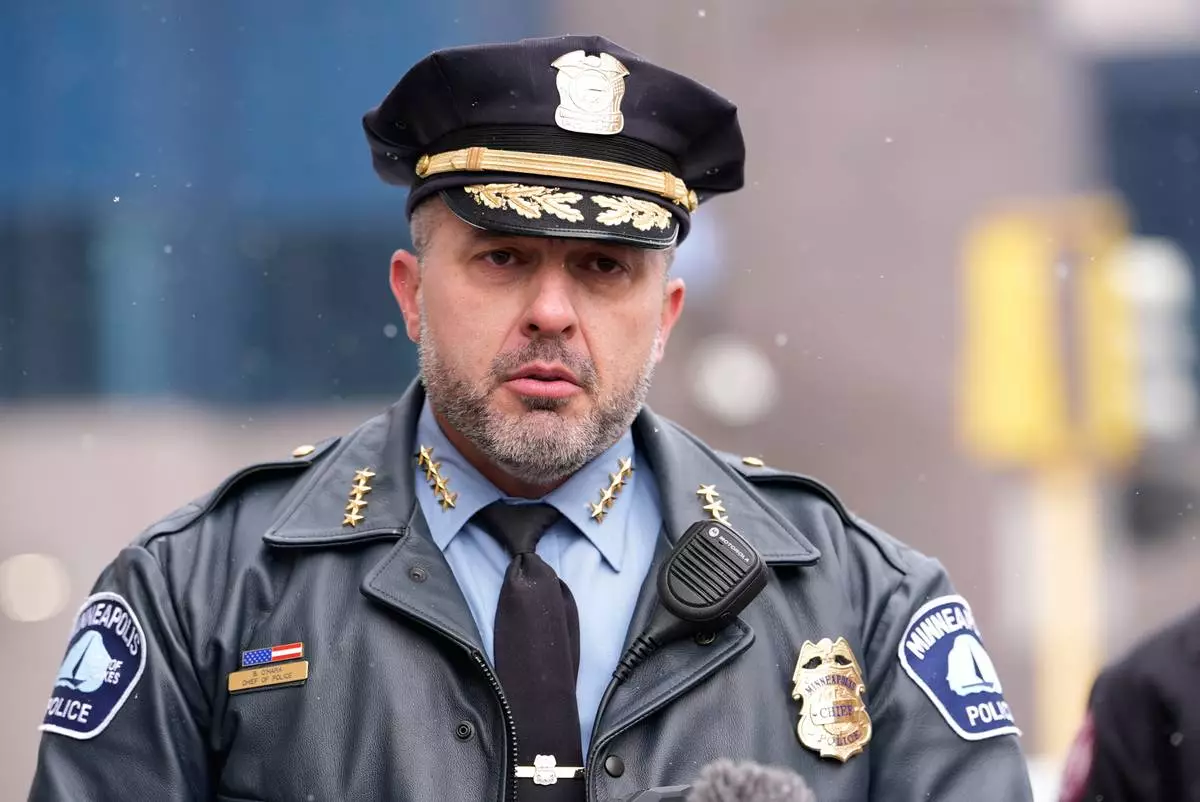
FILE - Minneapolis Police Chief Brian O'Hara speaks during a news conference, Jan. 10, 2026, in Minneapolis. (AP Photo/Jen Golbeck, File)