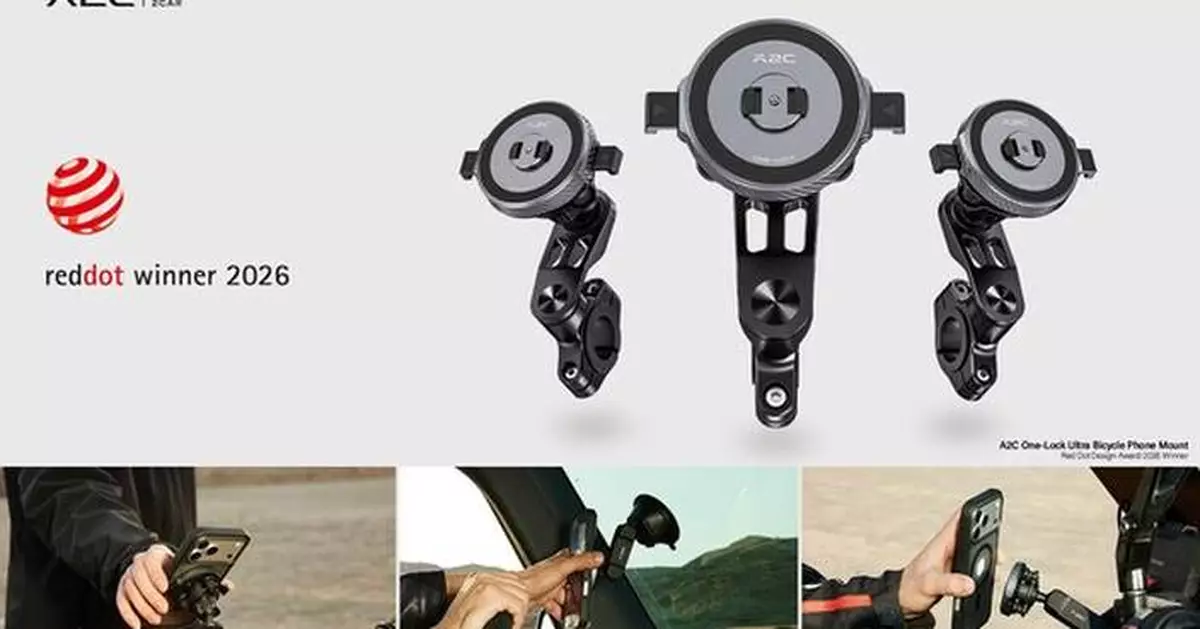
LOS ANGELES, May 29, 2026 /PRNewswire/ -- For most users, a phone mount is not something they actively think about. It becomes part of the setup on a motorcycle, a bicycle, or inside a vehicle, and over time it simply fades into the background.
In real use, attention is short and functional. A quick glance at navigation while stopped at a red light. A brief check of direction while filtering through traffic. A momentary look at speed or route information while driving over uneven roads. After that, the phone is no longer really the focus.
What actually defines the experience is what happens between those moments.
The expectation is simple. Once mounted, the phone should stay exactly where it is. No shifting. No constant rethinking. Ideally, no need to interact with it at all.
The A2C One-Lock Ultra Series is built around that expectation, not in controlled environments, but in real motion that is messy, repetitive, and never exactly the same twice.
It combines magnetic alignment, a mechanical locking system, and multi-layer vibration damping into a single structure, designed to reduce the need to think about the mount once the ride begins, even as road conditions constantly change underneath it.
Commuting: Where Small Frictions Show Up First
Commuting is rarely smooth. Traffic moves in short bursts, with constant stop-and-go flow, sudden braking, quick acceleration, and last-second lane changes. On motorcycles and bicycles, it often becomes a split-second glance between what's ahead and the route on screen. In cars, it turns into repeated quick looks at navigation between stops, often without much thought.
This is usually where small weaknesses in equipment start to appear. A mount that requires careful alignment or frequent tightening doesn't stay out of mind for long. After a few adjustments, and then a few more, even small corrections start to stand out. It breaks the rhythm more than most riders expect.
The One-Lock Ultra is designed to remove that moment entirely.
The phone is guided into position magnetically, and in the same motion it clicks into a mechanical lock. There is no fine adjustment step, and no need to stop and confirm alignment. Even with gloves on, or while paused at a light with one hand on the bar, the motion stays the same: drop in, a clear click, and continue riding.
Once locked, the system is built to handle the constant physical noise of urban movement. Broken pavement. Repeated braking. Curb drops. The low, continuous vibration that most riders stop noticing—but devices don't. The goal here is not perfect stillness. It's consistency that doesn't break the flow of riding.
Long Distance: When Vibration Stops Being Occasional
On longer rides or extended drives, vibration stops feeling like an occasional disturbance. It becomes part of the baseline experience. Engine resonance is always present in the background. Road texture is constantly shifting under the tires. Tire feedback slowly builds up over time. Wind pressure increases as speed rises. None of these feel extreme on their own, but together they create a constant mechanical environment that the phone sits inside without ever really escaping it.
Over time, this doesn't show up as a sudden issue. It shows up in smaller, more subtle ways. The map becomes just slightly harder to read. The screen doesn't feel completely still anymore, even when the mount is secure. After a while, there is a kind of visual fatigue that only appears during longer rides or extended driving sessions.
The One-Lock Ultra addresses this through layered damping instead of relying on a single point of absorption.
Rather than trying to stop vibration in one place, it spreads vibration across multiple internal layers. What this means in practice is that different parts of the system handle different types of movement. Low-frequency motion comes from road undulations that slowly lift and drop the vehicle. Mid-frequency vibration comes from the interaction between engine, frame, and chassis. High-frequency micro-shake comes from road texture at speed and airflow hitting the device.
When these forces are separated instead of being concentrated in a single structure, less of that overall vibration makes its way to the mounted phone.
In real use, the effect is not dramatic, but it is noticeable. Navigation becomes easier to read during longer rides and rougher road conditions, especially on longer stretches where vibration normally builds up without you really paying attention to it.
It also helps reduce long-term mechanical stress on internal components such as camera modules and optical stabilization systems. You don't really notice this in short rides, but over time, in everyday use, these small effects tend to accumulate quietly in the background.
Weekend Rides: Conditions That Never Stay the Same
Weekend rides rarely stay consistent for long. A smooth highway can suddenly break into patched city streets. Asphalt gives way to uneven, worn-down surfaces. Cycling routes can shift from clean pavement to gravel within just a few minutes of riding.
Each change brings a different kind of load to the system. And this is usually where small issues start to show up in many mounts. A slight shift in angle after a rough section. A bit of looseness that wasn't noticeable before. Over time, a gradual feeling that the mount isn't as tight as it was at the start of the ride.
The One-Lock Ultra is designed to hold position through exactly these kinds of transitions. The mechanical locking system keeps tension even under repeated directional force, while the internal structure distributes impact across the entire body instead of concentrating it at a single joint.
In real use, what you notice is simple. The phone stays where you set it. Even after rough sections of road, there is no need to stop and re-check alignment. The viewing angle remains consistent while everything underneath it keeps changing. It doesn't try to constantly adjust itself. It just stays locked to the original reference.
Designed for Movement, Not Static Conditions
Across motorcycles, bicycles, and vehicles, the pattern is surprisingly consistent. People don't really interact with phone mounts all the time. They set them up quickly, use them for a moment, and then mostly forget they are even there. That simple behavior ends up shaping how the One-Lock Ultra is designed.
Magnetic alignment makes setup feel almost automatic. The mechanical locking system adds a clear sense of physical security once the phone is in place. Multi-layer damping takes care of the constant variation that comes from real roads, whether it is small vibrations or more sudden impacts.
Together, these elements remove the small but repeated interruptions that usually define everyday use. Things like slight re-adjustments during a ride. Tiny corrections after hitting uneven ground. Or that quiet, ongoing awareness of whether the phone has shifted at all.
Over time, the mount stops feeling like something you are actively using. It becomes part of the movement itself. Something that does not ask for attention, but still feels reliably "right" every time you look at it.
The One-Lock Ultra does not really feel like a separate phone accessory anymore. It behaves more like a fixed interface between the device and the motion around it.
Availability
The A2C One-Lock Ultra Series is now available globally through the official A2C website and selected retail partners.
In addition to the One-Lock system, A2C also offers a Universal Adapter solution, designed to expand compatibility across a wide range of smartphone models and mounting setups, providing greater flexibility when switching devices or integrating different mounting environments across motorcycles, bicycles, and vehicles.
As part of the launch period, readers can receive 10% off the One-Lock Ultra Series using the code PR-Newswire-10%.
https://link.apps2car.com/pr-newswire
About A2C
A2C was founded in 2011 with a focus on solving real-world mounting challenges through engineering-led design. The company develops products for motorcycles, bicycles, and automotive applications, with an emphasis on stability, usability, and long-term durability in everyday use.
Rather than treating phone mounts as standalone accessories, A2C approaches them as part of a larger movement system, designed to perform consistently across changing road and environmental conditions.
Over the years, A2C has received the Red Dot Design Award, reflecting its work at the intersection of functional engineering and industrial design within the mobility space.
Contact:
Ocean Yu
A2C
pr_collaboration@apps2car.com
** This press release is distributed by PR Newswire through automated distribution system, for which the client assumes full responsibility. **
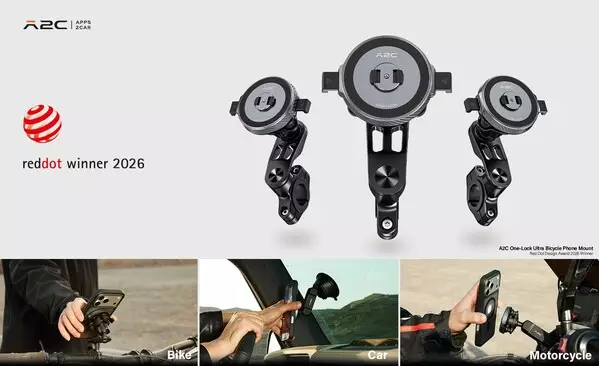
How Users Mount Their Phones in Real Conditions: Commuting, Cycling, and Driving with the A2C One-Lock Ultra Series