
Skip to Content Facebook Feature Image

Ukraine keeps up assault on Russian oil sites as Kyiv expects more strikes

News

Ukraine keeps up assault on Russian oil sites as Kyiv expects more strikes
News

News

Ukraine keeps up assault on Russian oil sites as Kyiv expects more strikes

2026-05-30 23:51 Last Updated At:05-31 00:00

Ukrainian drone strikes caused fires at more Russian oil facilities overnight into Saturday, Russian officials said, in what appeared to be the latest attack on Moscow’s vital oil industry.

Authorities in Russia’s Rostov region said falling drone debris sparked a fire that damaged an oil depot and tanker in the port of Taganrog, while officials in the neighboring Krasnodar region reported a fire breaking out at an oil depot in Armavir for the same reason.

“Another facility of Russia’s oil industry has been reached — Armavir,” Ukrainian President Volodymyr Zelenskyy wrote on X, referring to the Krasnodar attack, and noting that Armavir is “500 kilometers from our state border.”

“We are rightfully bringing the war back to where it came from,” he wrote.

Ukraine has expanded its mid- and long-range strike capabilities, deploying drone and missile technology that it has developed domestically to battle Russia’s 4-year-old invasion. Attacks on Russian oil assets that play a key part in funding the invasion have become almost daily occurrences.

For its part, Russia has used its long-range ballistic missiles to damage Ukraine’s power grid and hammer its cities. The Ukrainian capital is bracing for further heavy bombardments after what the Russian Foreign Ministry said earlier this week would be upcoming “systemic strikes” on Kyiv.

Zelenskyy said Thursday that he’s being “very persistent” in pressing the United States to provide his country with more Patriot air defense missiles that can counter devastating Russian ballistic missile attacks.

The attacks on Russian oil infrastructure came a day after a Russian drone that was part of an attack on Ukraine struck an apartment building in eastern Romania, injuring two people in the NATO member country. The incursion added to concerns that the war could spread across the alliance’s borders, and drew strong condemnation across Europe.

Meanwhile, Russia’s state-owned nuclear energy company Rosatom said Saturday that a ​Ukrainian drone struck the Russian-controlled ‌Zaporizhzhia nuclear power plant.

There was no damage to key equipment, but the attack left a hole in the ​wall of a turbine hall, Rosatom CEO Alexei Likhachev said. He was quoted as saying by Russian state media that the fact that the drone was controlled via fiber optics “completely rules out the possibility of an accidental impact.”

Ukraine did not immediately comment on the incident.

The plant is in an area under Russian control since early in Moscow’s full-scale invasion of Ukraine and is not in service, but it needs reliable power to cool its six shutdown reactors and spent fuel to avoid any catastrophic nuclear incidents.

The International Atomic Energy Agency has repeatedly expressed alarm about the nuclear plant, Europe’s biggest.

Follow the AP’s coverage of the war in Ukraine at https://apnews.com/hub/russia-ukraine
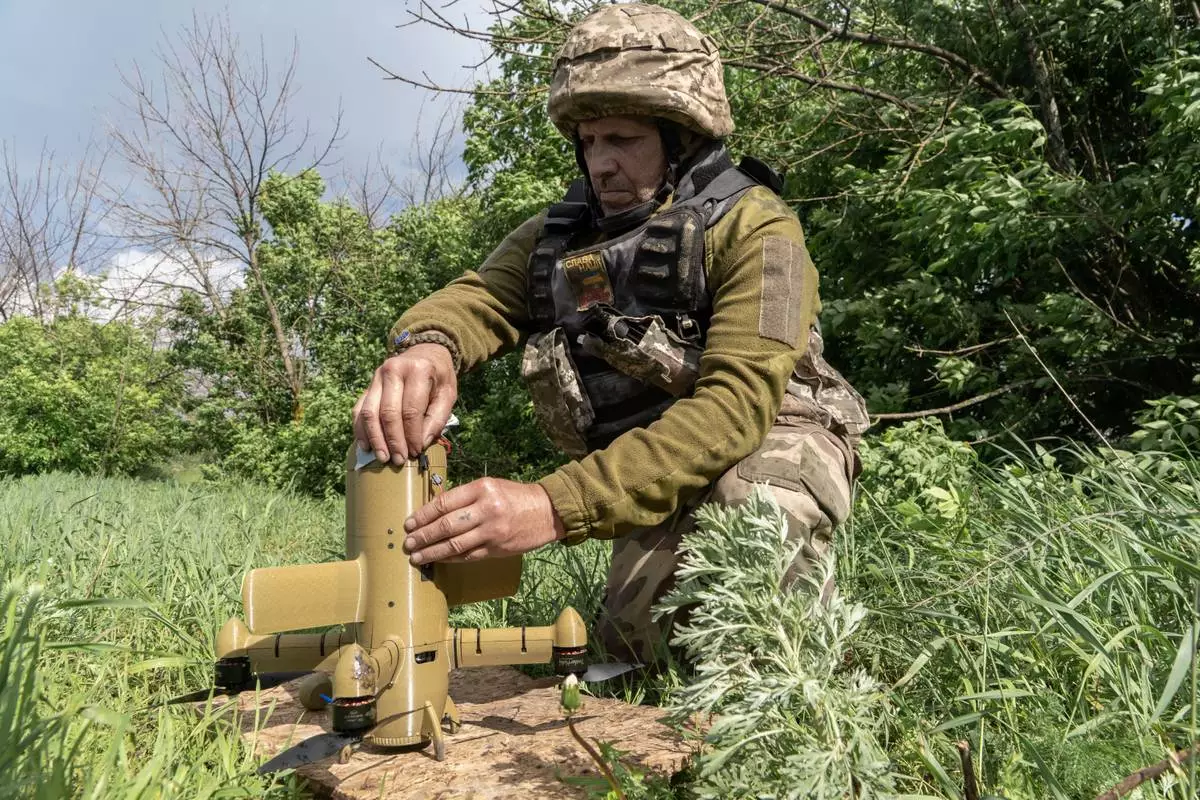
A Ukrainian soldier prepares an interceptor drone during a Russia's aerial attack at an undisclosed location near Kharkiv, Ukraine, Monday, May 25, 2026. (AP Photo/Andrii Marienko)

A Ukrainian soldier prepares an interceptor drone during a Russia's aerial attack at an undisclosed location near Kharkiv, Ukraine, Monday, May 25, 2026. (AP Photo/Andrii Marienko)

Red Cross volunteers help an injured woman in a shelter after a Russian strike on a residential neighborhood in Kyiv, Ukraine, on Sunday, May 24, 2026. (AP Photo/Evgeniy Maloletka)


Red Cross volunteers help an injured woman in a shelter after a Russian strike on a residential neighborhood in Kyiv, Ukraine, on Sunday, May 24, 2026. (AP Photo/Evgeniy Maloletka)

WASHINGTON (AP) — The U.S. military has stopped another merchant vessel trying to break through the American blockade of Iranian ports, a U.S. official with knowledge of the situation told The Associated Press on Saturday.

The Gambia-flagged bulk carrier Lian Star ignored multiple warnings from U.S. forces overnight as it tried to enter an Iranian port, the official, who spoke on condition of anonymity to discuss military operations, said. The ship was disabled by U.S. aircraft in the Gulf of Oman and remains adrift there, the official said, adding that U.S. forces have not boarded it.

With the latest action, U.S. military has stopped six ships trying to breach the blockade. One was allowed to proceed.

The U.S. launched the blockade on April 17 in response to Iran effectively closing the strait after the war began with U.S. and Israeli strikes on Feb. 28. A fragile ceasefire has held since April 7. Now the region and wider world await word on whether a deal is being reached to extend it by 60 days while new talks would be held on Iran’s disputed nuclear program.

Events in the Strait of Hormuz between Iran and Oman have shaken the global economy, with shipments of significant amounts of oil, natural gas and related supplies like fertilizer largely stranded, increasing the strain on consumers and food producers.

The U.S. blockade seeks to limit Iran’s own shipments and further weaken its access to cash, creating more pain for its long-weakened economy.

U.S. President Donald Trump met with advisers on Friday but has yet to decide on whether to move ahead with a deal to extend the ceasefire and reopen the strait. Iran has said the deal had not been finalized.

Commercial traffic has quietly continued to flow through the strait, despite Iran's assertions that it must approve any transits, though at a much lower volume than before the conflict.

“Any violation of these regulations will place the security of their passage at serious risk,” Iran's joint military command said Saturday in a statement carried by state TV, warning that any military vessels trying to interfere with that would be targeted.

Iran has even charged tolls for transit as high as $2 million, which experts have called a violation of a principle of international maritime trade: freedom of peaceful navigation.

Qatar's deputy prime minister, Sheikh Saoud bin Abdulrahman bin Hassan bin Ali Al Thani, on Saturday said the Gulf nation opposes charging fees to transit, “but for certain times when they say they are going to use it for mine clearing or some usage of the fees for a temporary time, this is something that is negotiable, and it could be something that will help the transit of the Strait of Hormuz to be back to normal stage.”

The U.S. official previously told the AP that the U.S. has not found or destroyed any mines in the strait.

Pro-government Iranian demonstrators wave Iranian flags and a portrait of the Supreme Leader Ayatollah Mojtaba Khamenei, right, and his slain father Ayatollah Ali Khamenei in a gathering at a square in Tehran, Iran, Friday, May 29, 2026. (AP Photo/Vahid Salemi)

Pro-government Iranian demonstrators wave Iranian flags and a portrait of the Supreme Leader Ayatollah Mojtaba Khamenei, right, and his slain father Ayatollah Ali Khamenei in a gathering at a square in Tehran, Iran, Friday, May 29, 2026. (AP Photo/Vahid Salemi)

Recommended Articles