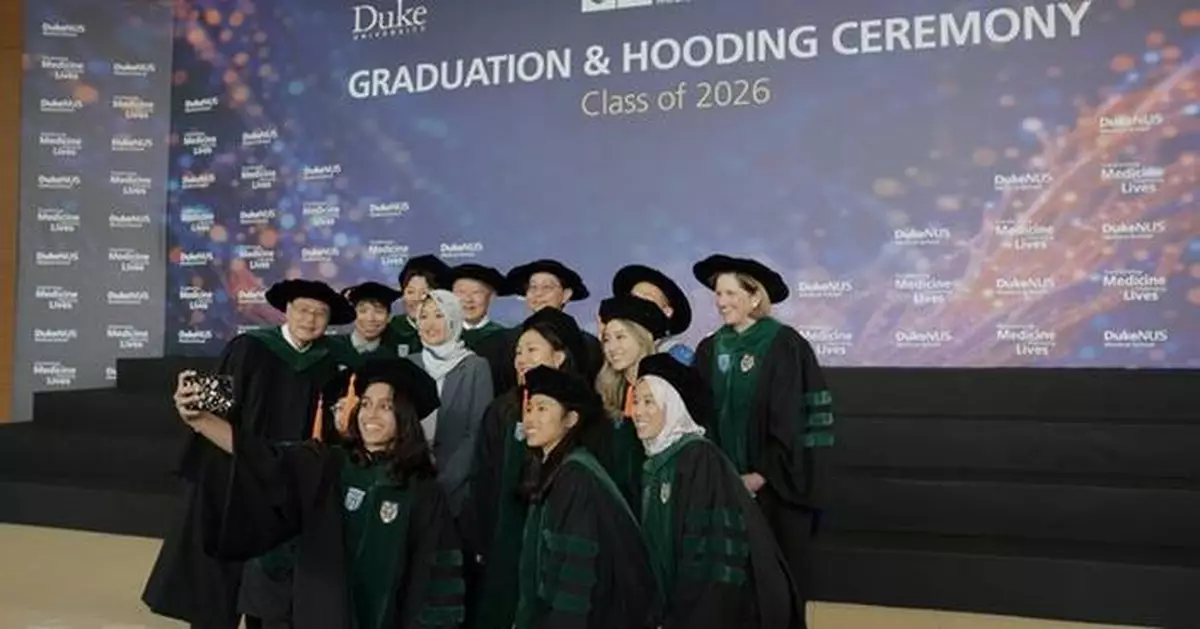
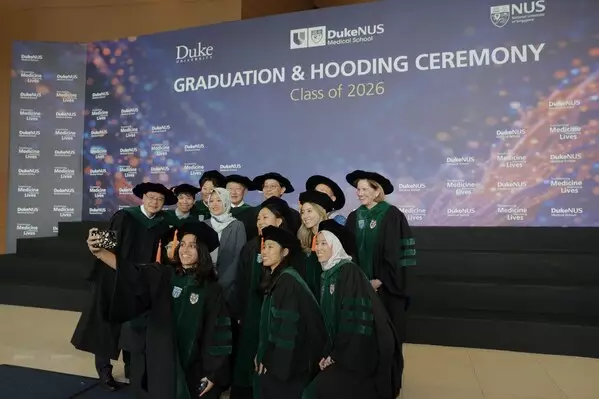
At his first graduation as Dean, Patrick Tan presides over a record class of 135 graduates, with Guest of Honour Mdm Rahayu Mahzam and keynote speaker Dr Robert Califf
SINGAPORE, May 30, 2026 /PRNewswire/ -- From engineers and business graduates to literature and communications majors, Duke-NUS Medical School's largest graduating class to date reflects the widening range of backgrounds now flowing into medicine in Singapore. A total of 135 graduates crossed the stage on Saturday, including 78 new doctors from the MD programme.
The commencement ceremony, the first to be led by Dean Professor Patrick Tan, was attended by Guest of Honour Mdm Rahayu Mahzam, Minister of State for Digital Development and Information and for Health, and featured keynote remarks by Dr Robert Califf, who spoke about the extraordinary opportunities and upheavals now reshaping medicine, healthcare and biomedical science.
The Class of 2026 comprised 72 graduates from the MD programme, 6 MD-PhD graduates, 38 PhD graduates from Duke-NUS' Integrated Biology and Medicine, Quantitative Biology and Medicine, and Clinical and Translational Sciences programmes, and 19 graduates from the Master's in Patient Safety and Healthcare Quality. Among the MD graduands, there was an even split of 39 men and 39 women.
Another hallmark of Duke-NUS' graduate-entry model is the breadth of experience its students bring into medicine. In the Class of 2026, that range includes graduates from engineering, product development, computer science, multimedia, business, accountancy, linguistics, psychology, history, communications, literature and the sciences.
A defining feature of Duke-NUS' graduate-entry model is its emphasis on research. MD students devote their entire third year to research, and the Class of 2026 leaves behind a substantial body of published work across topics such as artificial intelligence in healthcare, predictive clinical tools, biological discovery, diagnostic innovation and population health. Together, the class produced 71 papers, including in journals such as Cell, The Lancet Microbe, Nature Communications, and npj Digital Medicine.
One of the standout papers, by MD-PhD graduate Charles Kevin Dee Tiu, described a rapid test that identified infection-blocking antibodies within hours to support Singapore's COVID-19 response. Published in Nature Biotechnology, the paper has been cited 1,392 times.
Dean Professor Patrick Tan said, "When the School was established, the aim was not simply to add another medical school to Singapore. It was to create something different by design: a graduate-entry medical school that brings together the strengths of Duke and NUS and is deeply embedded in Singapore's healthcare system through SingHealth. That vision is reflected in this class. Our graduates bring intellectual range, a strong sense of service and the ability to think across disciplines at a time when medicine is being reshaped by science, technology and wider societal change."
Community service also stood out strongly in the Class of 2026. Across their years at Duke-NUS, students took part in at least 14 community projects in Singapore and overseas.
These included school-readiness programmes for families, overseas medical missions to Nepal and Sri Lanka, Healthy-To-Thrive, a project which offers public health screening for chronic diseases for migrant workers, and community initiatives such as the Paediatric Solid Brain Tumour Awareness Day and Camp SIMBA, an annual camp for children whose loved ones are living with cancer.
Dr Jiang Qianfeng, graduating speaker of the MD Class of 2026 and recipient of both the Ngee Ann Kongsi Distinguished Scholars Programme and the Mount Elizabeth-Gleneagles Graduate Scholarship, said, "Our Class of 2026 demonstrated a deep commitment to service across diverse communities, from rural outreach programmes in Nepal and Sri Lanka, to local initiatives supporting children with brain tumours, migrant workers, community health and women's health. These experiences reminded us that medicine doesn't start and end within hospital walls and they strengthened our commitment to serve wherever the need is greatest."
Among the initiatives shaped during the class's time at Duke-NUS was Project WISE (Women's Integrated Screening & Education), a programme that provides women with blood pressure and body mass index screenings, alongside education on mental health and breast cancer awareness. It is organised by the Women in Medicine student interest group, founded by MD graduand Dr Chan Kai Lin, and supported by the Association of Women Doctors (Singapore).
As Patrick Tan's first graduating class as Dean, the Class of 2026 signals where Duke-NUS is headed: educating doctors and scientists who not only have their strengths in clinical practice, but are also able to work across research, innovation, technology and broader challenges shaping health today.
About Duke-NUS Medical School
Duke-NUS is Singapore's flagship graduate-entry medical school, established in 2005 with a strategic, government-led partnership between two world-class institutions: Duke University and the National University of Singapore (NUS). Through an innovative curriculum, students at Duke-NUS are nurtured to become multi-faceted 'Clinicians Plus' poised to steer the healthcare and biomedical ecosystem in Singapore and beyond. A leader in ground-breaking research and translational innovation, Duke-NUS has gained international renown through its five Signature Research Programmes and ten Centres. The enduring impact of its discoveries is amplified by its successful Academic Medicine partnership with Singapore Health Services (SingHealth), Singapore's largest healthcare group. This strategic alliance has led to the creation of 15 Academic Clinical Programmes, which harness multi-disciplinary research and education to transform medicine and improve lives.
For more information, please visit www.duke-nus.edu.sg
** This press release is distributed by PR Newswire through automated distribution system, for which the client assumes full responsibility. **
Duke-NUS graduates biggest class yet, with new doctors drawn from business, engineering and the humanities
|
AUGSBURG, Germany, May 30, 2026 /PRNewswire/ -- MakerWorld's first user-initiated charity design contest has completed: winners have now been selected from 2,056 models submitted by 1,008 creators worldwide. Created in support of the Pieksekisten project, the contest drew more than 250,000 unique visitors and is helping turn digital designs, platform points, and community goodwill into 3D-printed gifts for children in cancer wards.
From a Personal Journey to a Shared Mission
Pieksekisten, literally "comfort boxes" in German, are small boxes filled with gifts for children who have just undergone treatment, examinations, or stressful hospital appointments. They are not grand presents, but they can offer something kind in a difficult moment. After a shot or a blood draw, a small object a child gets to choose for themselves can mean everything.
The project began in February 2023, in the day clinic of the Augsburg Pediatric Oncology Center, where Pascal Neumann's son Thore was being treated for Grade IV medulloblastoma, an aggressive pediatric brain tumor. Pascal's partner Silke began asking how small positive moments could be created for children on the ward, after a defining instance one day: a song played on the radio after Thore's MRI examination, and it became achingly clear how exhausting clinical routine truly is for young children, not only medically, but emotionally.
The first Pieksekisten arrived at the clinic in March 2023, filled with classic small gifts. 3D printing was added later, when Pascal noticed something his son did with the rough early prints from his beginner-level 3D printer:
"For me, it was a failed print. For him, it was something his father had made for him. He was happy about things I myself would have thrown away long before."
Thore passed away in October 2023, at just five years old.
The project is carried today by Pascal and Silke together, with a clear division of work: Silke coordinates with the hospital ward, including appointments, on-site handovers, direct communication with clinical staff, and Instagram documentation, while Pascal handles the technical infrastructure, including the website, MakerWorld and Bambu Lab communications, model curation, and printing. Early on, the pediatric clinic acknowledged the project in an official letter of thanks, explicitly recognizing the real-world effect of these small positive moments on children during difficult treatments. The hospital and pediatric oncology context is included here as the personal and real-world background that inspired and shaped the project, not as a statement of formal institutional hospital involvement or official partnership.
As word spread through the MakerWorld community, a platform where 2 million users share, remix, and download models daily, designers began spontaneously contributing models. Even before any formal contest, Pascal had documented permissions from more than 50 designers, secured one by one through forum messages and direct conversations. The growing enthusiasm caught the attention of the MakerWorld team, who reached out to Pascal to formalize what was already happening organically.
"MakerWorld was the first place where all of this came together: people already designing exactly the right kinds of things, an active printing community, real practical feasibility, and a platform where an idea could very quickly become something tangible and useful." — Pascal
Why Not Just Mail Toys? — A Controlled Pipeline of Goodwill
Every model that enters a Pieksekiste begins as a file on a creator's workstation, often on the other side of the world. A designer uploads a file to MakerWorld. Pascal clicks download. Seconds later, the file is on his printer, building layer by layer. It's like sending a fax, but what's transmitted isn't text; it's warmth you can hold in your hand.
International shipping of a physical toy typically costs $20–50 per parcel and takes 2–6 weeks, plus customs forms. The same care, sent as a file and printed locally? Within a day. Less than a dollar. Nearly zero carbon footprint.
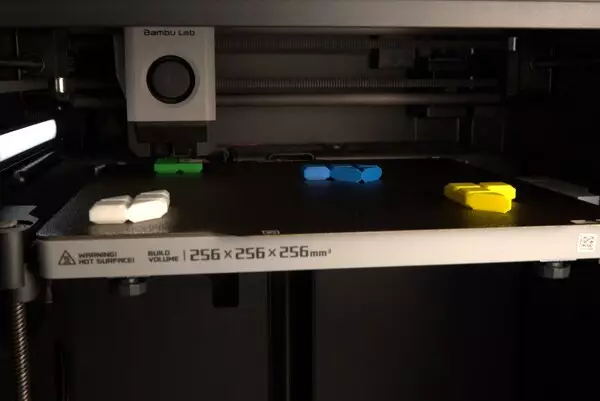
On MakerWorld, models are designed to work seamlessly with Bambu Lab printers, and many come with ready-to-use print profiles. Pascal currently runs three Bambu Lab P1S Combo systems, identical units expanded over time for reliability, achieving a 98% usable production rate in daily operation.
These are not items pulled from a warehouse shelf. As Pascal puts it, they are consciously made, with time, attention, and the thought of giving one child a small positive moment. What children pick first on the ward, what gets handled most often, and what staff see working in practice feeds directly back into the next round of model selection, creating a closed loop between bedside reality and production planning.
And the designs themselves remain freely available. Anyone can download and print their own version, imagining it now in the hands of another child fighting their own battle somewhere in the world.
But controlled goodwill is not only about logistics. It is also about how a gift reaches a child. The Pieksekisten are not open toy boxes. They are placed at specific points within the treatment workflow — the finger-prick room and examination rooms 3 and 5 — and used only under nurse supervision. After a procedure, a child chooses one small object for themselves, with staff present.
"The boxes are a deliberately placed and controlled point of handover within everyday clinical life," Pascal explains. "Not an open toy offering."
This level of control is medical, not organizational. Many of the children on the ward are severely immunocompromised. For now, Pascal accepts no externally printed finished pieces, only digital files transformed into physical objects through his own equipment, on PLA filament, with every print visually inspected before it leaves his hands.
"As soon as material quality, production quality, or safety can no longer be reliably verified, the sustainability of the project itself would immediately be at risk."
A Charity Contest That Broke New Ground
On April 2, 2026, MakerWorld launched the Pieksekisten Design Contest, the platform's first charity contest, co-developed by a community member in partnership with MakerWorld. While the contest page was formally "Hosted By U: @JamesDaRock," the initiative grew from a true meeting of minds: designers had already been contributing for weeks, and the MakerWorld team built the contest framework together with Pascal to give that goodwill a proper home.
Within three weeks, 1,008 creators submitted 2,056 distinct models, with the contest page drawing more than 250,000 unique visitors. Before the contest, the project had run on permissions from roughly 50 designers, gathered one by one over many months through Bambu Lab forum messages and direct conversations. In three weeks, that creative pool expanded roughly 40-fold. Today, about half of the documented production batches in active circulation already trace back to contest submissions.
Each submission was reviewed by Pascal for safety, child-appropriateness, and print reliability. Throughout, he applied the same standard he had used from day one: no model enters a Pieksekiste without clear, documented permission from its designer.
"A model is not just a file. It is the time, experience, and creative work of a person — and that is exactly how it should be treated."
"Just because you can print something does not automatically mean you should simply take it."
Winners Announced
The top three winning designs reflect the practical and emotional range of the brief:
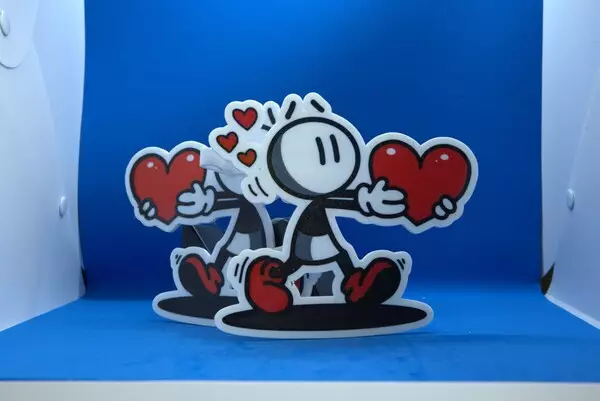
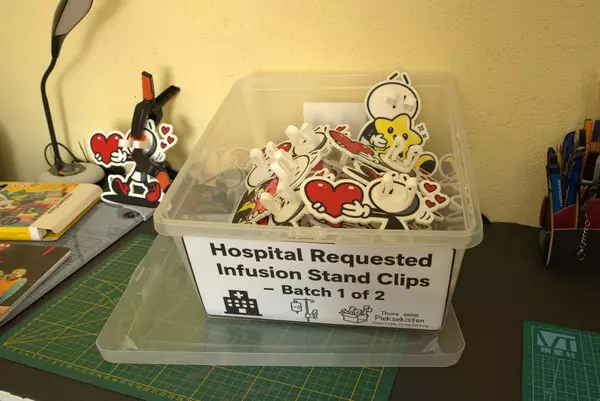
- 1st Place: Wall Decor & IV Stand Clip Pieksekisten x Art Zig by @La Forge d'Orion
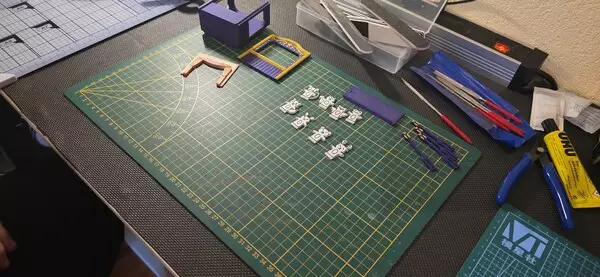
- 2nd Place: Puppet Theater with Puppets and Scenery by @berri3D
- 3rd Place: Brain Teaser Puzzle Board | 48 Challenges | 5 Levels by @PrecisionCrafts
The Community Favorite award went to Pieksi – A friend from a syringe @DIY Wizard.
The Kids Choice selection is still underway. Finalists will be introduced to children in the ward, and the designs that spark the greatest smiles will be announced publicly on the MakerWorld contest page once the children's voting process is complete.
"Every model submitted carried someone's time, care, and imagination, and many of them will continue to be reviewed, printed, and tested in the real everyday life of the ward. To everyone who contributed: thank you for helping us create more of those moments."
— Pascal Neumann
Points Donation — Converting Earned Credit into Bedside Gifts
Throughout the competition, participants repeatedly asked whether they could help beyond submitting models. The community itself surfaced the answer: could there be a way to donate points directly to support Pascal? Just three days later, on April 30, MakerWorld launched its first charitable Points Donation feature. On day one alone, 8,000 points were raised.
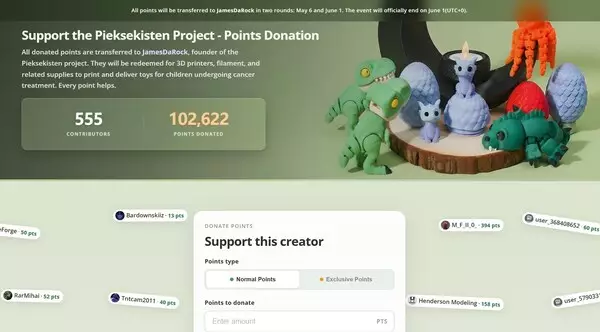
As of May 26, 555 contributors have donated 102,622 points, that represents about more than $8,300 in platform credit — enough to redeem more than 400 rolls of PLA Basic filament, or approximately 13 units of P2S. The donation pool remains open until June 1, 2026.
Donated points will be converted directly into filament, printers, and production resources, with MakerWorld facilitating delivery to Pascal. Three P1S printers currently sustain the two-week production-to-clinic cadence and are running near full capacity. As donated points convert into additional equipment and materials, that cadence is expected to accelerate meaningfully, keeping pace with growing internal demand: the Augsburg puncture rooms, the Stupfzimmer, have recently requested their own dedicated 3D boxes.
MakerWorld's Role — Infrastructure the Community Could Use
For MakerWorld, what's worth sharing here is not only goodwill itself, but what existing platform infrastructure made possible once a member-led cause found a clear workflow. The contest used MakerWorld's standard competition framework, adapted with Pascal into the platform's first charity design contest. When the community asked how to do more, the first Points Donation feature shipped within days, turning a recurring forum question into a productized support path. The same systems that normally reward creators for downloads and community activity became a bridge from digital credit to bedside hardware, without Pascal building custom tooling or running parallel logistics.
How to Be Part of This
Looking Ahead
On June 1, MakerWorld will formally close the Pieksekisten Points Donation pool. After the campaign ends, MakerWorld will publish a follow-up impact report summarizing final donation totals, converted materials, and project delivery progress.
Pascal is deliberately cautious about scaling beyond Augsburg.
"Pediatric oncology wards are protected for very good reasons — and they should be. The real bottleneck is access, not production. The goal is first to build a model that works reliably here, and only then to consider whether it could responsibly be transferred elsewhere." — Pascal
"This project showed us something we'd never seen before: a charity that runs on creativity instead of logistics. Designers contributed from São Paulo, Berlin, and beyond — and their gifts printed themselves across the world. We're proud to have built the infrastructure that lets a community's care travel directly from a designer's screen to a child's hand."
—Qianye, Creator Operation of MakerWorld
About MakerWorld
MakerWorld is the world's largest 3D model sharing, downloading, and printing community, operated by Bambu Lab. With over 2 million free models and thousands of new designs added daily, MakerWorld is accessible directly through its website or via Bambu software such as Bambu Studio, championing a mission of community-driven, technology-for-good. Learn more at makerworld.com
About Bambu Lab
Bambu Lab is a consumer-tech company focusing on desktop 3D printers. Its state-of-the-art 3D printers offer a feature-rich first-class experience for a global community of 3D printing makers, aiming to break the barriers between the digital and physical worlds and bring creativity to a whole new level. Bambu Lab sells its 3D printers, filaments, and accessories on its official website, serving customers across 30+ countries.
Learn more at Bambu Lab Official Website
For those who wish to explore further
AUGSBURG, Germany, May 30, 2026 /PRNewswire/ -- MakerWorld's first user-initiated charity design contest has completed: winners have now been selected from 2,056 models submitted by 1,008 creators worldwide. Created in support of the Pieksekisten project, the contest drew more than 250,000 unique visitors and is helping turn digital designs, platform points, and community goodwill into 3D-printed gifts for children in cancer wards.
From a Personal Journey to a Shared Mission
Pieksekisten, literally "comfort boxes" in German, are small boxes filled with gifts for children who have just undergone treatment, examinations, or stressful hospital appointments. They are not grand presents, but they can offer something kind in a difficult moment. After a shot or a blood draw, a small object a child gets to choose for themselves can mean everything.
The project began in February 2023, in the day clinic of the Augsburg Pediatric Oncology Center, where Pascal Neumann's son Thore was being treated for Grade IV medulloblastoma, an aggressive pediatric brain tumor. Pascal's partner Silke began asking how small positive moments could be created for children on the ward, after a defining instance one day: a song played on the radio after Thore's MRI examination, and it became achingly clear how exhausting clinical routine truly is for young children, not only medically, but emotionally.
The first Pieksekisten arrived at the clinic in March 2023, filled with classic small gifts. 3D printing was added later, when Pascal noticed something his son did with the rough early prints from his beginner-level 3D printer:
"For me, it was a failed print. For him, it was something his father had made for him. He was happy about things I myself would have thrown away long before."
Thore passed away in October 2023, at just five years old.
The project is carried today by Pascal and Silke together, with a clear division of work: Silke coordinates with the hospital ward, including appointments, on-site handovers, direct communication with clinical staff, and Instagram documentation, while Pascal handles the technical infrastructure, including the website, MakerWorld and Bambu Lab communications, model curation, and printing. Early on, the pediatric clinic acknowledged the project in an official letter of thanks, explicitly recognizing the real-world effect of these small positive moments on children during difficult treatments. The hospital and pediatric oncology context is included here as the personal and real-world background that inspired and shaped the project, not as a statement of formal institutional hospital involvement or official partnership.
As word spread through the MakerWorld community, a platform where 2 million users share, remix, and download models daily, designers began spontaneously contributing models. Even before any formal contest, Pascal had documented permissions from more than 50 designers, secured one by one through forum messages and direct conversations. The growing enthusiasm caught the attention of the MakerWorld team, who reached out to Pascal to formalize what was already happening organically.
"MakerWorld was the first place where all of this came together: people already designing exactly the right kinds of things, an active printing community, real practical feasibility, and a platform where an idea could very quickly become something tangible and useful." — Pascal
Why Not Just Mail Toys? — A Controlled Pipeline of Goodwill
Every model that enters a Pieksekiste begins as a file on a creator's workstation, often on the other side of the world. A designer uploads a file to MakerWorld. Pascal clicks download. Seconds later, the file is on his printer, building layer by layer. It's like sending a fax, but what's transmitted isn't text; it's warmth you can hold in your hand.
International shipping of a physical toy typically costs $20–50 per parcel and takes 2–6 weeks, plus customs forms. The same care, sent as a file and printed locally? Within a day. Less than a dollar. Nearly zero carbon footprint.
On MakerWorld, models are designed to work seamlessly with Bambu Lab printers, and many come with ready-to-use print profiles. Pascal currently runs three Bambu Lab P1S Combo systems, identical units expanded over time for reliability, achieving a 98% usable production rate in daily operation.
These are not items pulled from a warehouse shelf. As Pascal puts it, they are consciously made, with time, attention, and the thought of giving one child a small positive moment. What children pick first on the ward, what gets handled most often, and what staff see working in practice feeds directly back into the next round of model selection, creating a closed loop between bedside reality and production planning.
And the designs themselves remain freely available. Anyone can download and print their own version, imagining it now in the hands of another child fighting their own battle somewhere in the world.
But controlled goodwill is not only about logistics. It is also about how a gift reaches a child. The Pieksekisten are not open toy boxes. They are placed at specific points within the treatment workflow — the finger-prick room and examination rooms 3 and 5 — and used only under nurse supervision. After a procedure, a child chooses one small object for themselves, with staff present.
"The boxes are a deliberately placed and controlled point of handover within everyday clinical life," Pascal explains. "Not an open toy offering."
This level of control is medical, not organizational. Many of the children on the ward are severely immunocompromised. For now, Pascal accepts no externally printed finished pieces, only digital files transformed into physical objects through his own equipment, on PLA filament, with every print visually inspected before it leaves his hands.
"As soon as material quality, production quality, or safety can no longer be reliably verified, the sustainability of the project itself would immediately be at risk."
A Charity Contest That Broke New Ground
On April 2, 2026, MakerWorld launched the Pieksekisten Design Contest, the platform's first charity contest, co-developed by a community member in partnership with MakerWorld. While the contest page was formally "Hosted By U: @JamesDaRock," the initiative grew from a true meeting of minds: designers had already been contributing for weeks, and the MakerWorld team built the contest framework together with Pascal to give that goodwill a proper home.
Within three weeks, 1,008 creators submitted 2,056 distinct models, with the contest page drawing more than 250,000 unique visitors. Before the contest, the project had run on permissions from roughly 50 designers, gathered one by one over many months through Bambu Lab forum messages and direct conversations. In three weeks, that creative pool expanded roughly 40-fold. Today, about half of the documented production batches in active circulation already trace back to contest submissions.
Each submission was reviewed by Pascal for safety, child-appropriateness, and print reliability. Throughout, he applied the same standard he had used from day one: no model enters a Pieksekiste without clear, documented permission from its designer.
"A model is not just a file. It is the time, experience, and creative work of a person — and that is exactly how it should be treated."
"Just because you can print something does not automatically mean you should simply take it."
Winners Announced
The top three winning designs reflect the practical and emotional range of the brief:
- 1st Place: Wall Decor & IV Stand Clip Pieksekisten x Art Zig by @La Forge d'Orion
- 2nd Place: Puppet Theater with Puppets and Scenery by @berri3D
- 3rd Place: Brain Teaser Puzzle Board | 48 Challenges | 5 Levels by @PrecisionCrafts
The Community Favorite award went to Pieksi – A friend from a syringe @DIY Wizard.
The Kids Choice selection is still underway. Finalists will be introduced to children in the ward, and the designs that spark the greatest smiles will be announced publicly on the MakerWorld contest page once the children's voting process is complete.
"Every model submitted carried someone's time, care, and imagination, and many of them will continue to be reviewed, printed, and tested in the real everyday life of the ward. To everyone who contributed: thank you for helping us create more of those moments."
— Pascal Neumann
Points Donation — Converting Earned Credit into Bedside Gifts
Throughout the competition, participants repeatedly asked whether they could help beyond submitting models. The community itself surfaced the answer: could there be a way to donate points directly to support Pascal? Just three days later, on April 30, MakerWorld launched its first charitable Points Donation feature. On day one alone, 8,000 points were raised.
As of May 26, 555 contributors have donated 102,622 points, that represents about more than $8,300 in platform credit — enough to redeem more than 400 rolls of PLA Basic filament, or approximately 13 units of P2S. The donation pool remains open until June 1, 2026.
Donated points will be converted directly into filament, printers, and production resources, with MakerWorld facilitating delivery to Pascal. Three P1S printers currently sustain the two-week production-to-clinic cadence and are running near full capacity. As donated points convert into additional equipment and materials, that cadence is expected to accelerate meaningfully, keeping pace with growing internal demand: the Augsburg puncture rooms, the Stupfzimmer, have recently requested their own dedicated 3D boxes.
MakerWorld's Role — Infrastructure the Community Could Use
For MakerWorld, what's worth sharing here is not only goodwill itself, but what existing platform infrastructure made possible once a member-led cause found a clear workflow. The contest used MakerWorld's standard competition framework, adapted with Pascal into the platform's first charity design contest. When the community asked how to do more, the first Points Donation feature shipped within days, turning a recurring forum question into a productized support path. The same systems that normally reward creators for downloads and community activity became a bridge from digital credit to bedside hardware, without Pascal building custom tooling or running parallel logistics.
How to Be Part of This
Looking Ahead
On June 1, MakerWorld will formally close the Pieksekisten Points Donation pool. After the campaign ends, MakerWorld will publish a follow-up impact report summarizing final donation totals, converted materials, and project delivery progress.
Pascal is deliberately cautious about scaling beyond Augsburg.
"Pediatric oncology wards are protected for very good reasons — and they should be. The real bottleneck is access, not production. The goal is first to build a model that works reliably here, and only then to consider whether it could responsibly be transferred elsewhere." — Pascal
"This project showed us something we'd never seen before: a charity that runs on creativity instead of logistics. Designers contributed from São Paulo, Berlin, and beyond — and their gifts printed themselves across the world. We're proud to have built the infrastructure that lets a community's care travel directly from a designer's screen to a child's hand."
—Qianye, Creator Operation of MakerWorld
About MakerWorld
MakerWorld is the world's largest 3D model sharing, downloading, and printing community, operated by Bambu Lab. With over 2 million free models and thousands of new designs added daily, MakerWorld is accessible directly through its website or via Bambu software such as Bambu Studio, championing a mission of community-driven, technology-for-good. Learn more at makerworld.com
About Bambu Lab
Bambu Lab is a consumer-tech company focusing on desktop 3D printers. Its state-of-the-art 3D printers offer a feature-rich first-class experience for a global community of 3D printing makers, aiming to break the barriers between the digital and physical worlds and bring creativity to a whole new level. Bambu Lab sells its 3D printers, filaments, and accessories on its official website, serving customers across 30+ countries.
Learn more at Bambu Lab Official Website
For those who wish to explore further
** This press release is distributed by PR Newswire through automated distribution system, for which the client assumes full responsibility. **
MakerWorld's First User-Initiated Charity Contest Names Winners, Bringing Global Creators' Goodwill Directly to Cancer Wards
MakerWorld's First User-Initiated Charity Contest Names Winners, Bringing Global Creators' Goodwill Directly to Cancer Wards
MakerWorld's First User-Initiated Charity Contest Names Winners, Bringing Global Creators' Goodwill Directly to Cancer Wards
MakerWorld's First User-Initiated Charity Contest Names Winners, Bringing Global Creators' Goodwill Directly to Cancer Wards
MakerWorld's First User-Initiated Charity Contest Names Winners, Bringing Global Creators' Goodwill Directly to Cancer Wards