NEW YORK (AP) — New York City Mayor Zohran Mamdani did not attend an annual parade honoring Israel on Sunday, breaking with a decades-long political custom because of his support of Palestinian rights.
Though it has gone by different names over the years, the Israel Day parade has always been a must-attend event for mayors, governors and other political leaders eager to win over the throngs of flag-waving revelers who congregate on Fifth Avenue to celebrate the birth of the Jewish state in 1948.
Click to Gallery
A parade participant smiles up at spectators during the Israel Day Parade, Sunday, May 31, 2026, in New York. (AP Photo/Emil T. Lippe)
A parade participant cheers on the crowd during the Israel Day Parade, Sunday, May 31, 2026, in New York. (AP Photo/Emil T. Lippe)
Parade participants wave flags to the crowd during the Israel Day Parade, Sunday, May 31, 2026, in New York. (AP Photo/Emil T. Lippe)
Spectators cheer on parade participants during the Israel Day Parade, Sunday, May 31, 2026, in New York. (AP Photo/Emil T. Lippe)
Not so for Mamdani. Two weeks ago the mayor's office released a video commemorating the Nakba, an Arabic word for “catastrophe” that is used to describe the displacement of an estimated 700,000 Palestinians during the 1948 Arab-Israeli war that followed Israel’s establishment.
“I said on the campaign trail that I wouldn’t be attending the parade, and I’ve made my views on the Israeli government abundantly clear,” Mamdani said at a news conference Thursday.
But he also promised a robust police presence to make sure it went off “seamlessly and peacefully.”
The city’s police commissioner, Jessica Tisch, who is Jewish, did attend the parade.
“It is the mayor’s decision not to march, and it is my decision to march proudly,” she had said Thursday, stood alongside Mamdani at police headquarters.
The mayor's absence, though long expected, has given fresh fuel to opponents who view his criticism of the Israeli government as antisemitic.
Rabbi Marc Schneier, founding senior rabbi of The Hampton Synagogue on Long Island and president of the Foundation for Ethnic Understanding, which advocates for better relationships between Jews and Muslims, called Mamdani’s decision to not attend the parade “a slap in the face to all Jewish New Yorkers.”
“Do us a favor, stay home,” he said. “We don’t need you. We don’t want you.”
Schneier also slammed Mamdani’s Nakba video as “propaganda,” echoing concerns from other Jewish leaders who said it excluded context about Jewish peoples’ displacement during the period.
The video, which appeared to be the first such recognition from a sitting New York City mayor, featured the story of a woman who was displaced at 9 years old, interspersed with text about the Nakba, as she described a feeling of missing home, saying “it’s the soft hills of Palestine that actually touched me.”
“I’ve lived in different places, and I’ve always been an outsider,” said the woman, Inea Bushnaq.
Supporters of Israel were outraged, saying the video should have acknowledged the mass displacement of Jews from Muslim-majority countries or the role that the mass slaughter of Jews in the Holocaust played in the drive to establish a Jewish state.
Mayors in New York City, which has America’s largest Jewish population, have long been visible supporters of Israel, often visiting the country.
Support for Israel among Americans has deeply eroded in recent years, though, a trend that accelerated amid the outcry over Israeli military action in Gaza..
Mamdani, the city’s first Muslim mayor, has remained steadfast in his pro-Palestinian advocacy.
He has said he believes Israel has a right to exist but not as a hierarchy that favors Jewish citizens. Simultaneously he has pledged to protect Jewish New Yorkers and highlighted the work of the city’s Office to Combat Antisemitism.

A parade participant smiles up at spectators during the Israel Day Parade, Sunday, May 31, 2026, in New York. (AP Photo/Emil T. Lippe)

A parade participant cheers on the crowd during the Israel Day Parade, Sunday, May 31, 2026, in New York. (AP Photo/Emil T. Lippe)

Parade participants wave flags to the crowd during the Israel Day Parade, Sunday, May 31, 2026, in New York. (AP Photo/Emil T. Lippe)

Spectators cheer on parade participants during the Israel Day Parade, Sunday, May 31, 2026, in New York. (AP Photo/Emil T. Lippe)
Graham Platner’s wife called reports that her husband had previously exchanged sexually explicit text messages with several women “shameful" over the weekend, the latest controversy to hit the Maine Democrat’s whirlwind campaign.
Platner, an oyster farmer and combat veteran, posted a video taken by his wife, Amy Gertner, who reportedly told his campaign of the text messages last year. In the five minute video, Gertner avoided speaking directly about her husband's reported texts, dubbing the broader coverage as “gossip" and saying that “being married is hard.”
“I find it really shameful that there’s a group of media outlets and people who are willing to spread gossip,” she said in the informal, selfie-style video where she walked along a road. “No marriage is perfect, and I don't want a perfect marriage. I want my marriage.”
Platner is seeking the Democratic nomination for one of the most closely-watched Senate races as Democrats hope to defeat longtime Republican Sen. Susan Collins in the party's efforts to win control of the closely divided Senate. The Maine primary is June 9.
The texts were first reported by The Wall Street Journal, which wrote that Gertner had told the campaign in August about the messages she had found on Platner's phone earlier in their marriage. The New York Times, which also published a story Saturday about the texts, named former aide Genevieve McDonald as one of the then-campaign staffers who confirmed the messages.
Both newspapers reported that Gertner wanted to ensure the texts didn't pose a political liability to the novice candidate. Platner's campaign team eventually decided that the texts were private and being handled by the couple, who were married in 2023. The two are in counseling, Gertner has said.
Platner's campaign on Sunday did not specifically confirm the text messages to The Associated Press, but issued a statement from Gertner saying the disclosure of the conversations she had with a campaign aide was a betrayal that “deeply hurt.”
“I trusted this person with the most private chapter of our lives — the early days of our marriage before any campaign was on our mind," she wrote.
Platner, who has never held public office, has a gruff, less buttoned-up approach on the campaign trail, fashioned a platform around economic equality and has already had to navigate statements that surfaced from his past.
The candidate had a tattoo recognized as a Nazi symbol, which he said he didn't realize until he was several weeks into the campaign. There's also been much attention on his former Reddit posts, which were dismissive of military sexual assaults and used homophobic slurs, for which he has apologized.
Platner's campaign weathered those earlier revelations in what had been considered one of the most competitive Democratic primaries before Gov. Janet Mills dropped out of the race in late April due to a lack of campaign funds. Mills, a two-term governor, had been seen as one of the Democrats' top 2026 recruits when she entered the Senate race before her campaign fizzled out.
Platner has still pulled support from big name Democrats, including Sens. Bernie Sanders, Elizabeth Warren and Ruben Gallego as well as U.S. House Rep. Ro Khanna. The latter is scheduled to rally with Platner Friday.
Questions over whether additional controversial information about Platner could still surface have added to some Democrats' anxiety over his chances in a general election against Collins, who has represented Maine in the Senate since 1997.
In October, after the revelation that he once had a totenkopf tattoo on his chest and promptly had it covered, the AP asked him if other scandals were on the horizon.
Platner said he was expecting his opponents were “going to keep dragging things up.”
“They’re go to keep making things up,” he said “I fully expect people to just lie about me at this point.”
Voters are familiar with the couple's struggles, including with infertility and travelling out of the country to afford IVF treatment, which they've discussed on the campaign trail.
In late April, Platner shared that Gartner had suffered a miscarriage, and he’s discussed his own mental health struggles and the role of his family and therapist in helping.
McDonald initially worked on Platner’s campaign as his political director and resigned a few months later when his now-deleted Reddit posts began surfacing, saying she couldn’t stand behind him as a candidate. She later declined a severance offer from the campaign in exchange for signing a non-disclosure agreement.
On Saturday, McDonald wrote on Facebook that Platner’s campaign had “demanded” she retract her statements she had made to The Wall Street Journal or his team would accuse her of violating the couple's trust. That’s when she said she made the choice to be publicly named in The New York Times story.
McDonald did not immediately respond to a text and phone call from the AP on Sunday.
“His consultants greatly overestimate how much I do not aspire to be them,” she wrote on Facebook.
After resigning from Platner’s campaign, McDonald moved to help Democrat Jordan Wood’s congressional campaign in Maine’s second district. McDonald submitted her resignation from Wood’s campaign Saturday morning, according to Wood’s campaign.
Wood endorsed Platner after Mills dropped out.
Bedayn reported from Austin, Texas and Kruesi reported from Providence, Rhode Island.
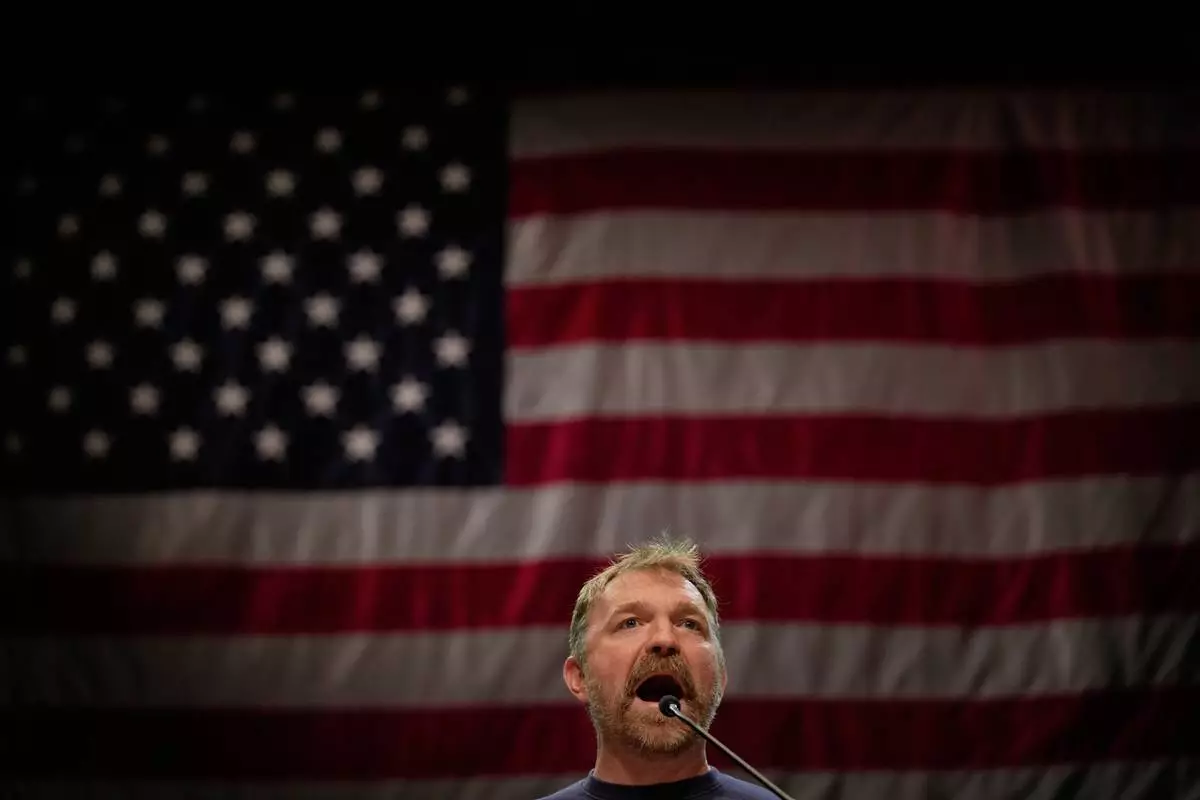
Graham Platner, Democratic candidate for U.S. Senate, speaks at an event hosted by Sen. Bernie Sanders in Orono, Maine, Sunday, May 24, 2026. (AP Photo/Robert F. Bukaty)