OKLAHOMA CITY (AP) — When the Western Conference finals started, Victor Wembanyama watched Shai Gilgeous-Alexander hoist a Most Valuable Player trophy that the San Antonio Spurs star desperately wanted.
Wembanyama left the series with an MVP trophy of his own — and a whole lot more.
The French standout — in just his third season — has led the Spurs to the NBA Finals. The newly crowned Western Conference finals MVP had 22 points in a Game 7 win at Oklahoma City, one that gave San Antonio a chance to play for the NBA title for the first time since 2014. It'll be San Antonio vs. New York in the NBA Finals, starting Wednesday night.
“Winning the Larry O’Brien, it’s a childhood dream,” Wembanyama said, referring to the name of the trophy given to the NBA champions. “And having a real shot at it, having a chance, a tangible chance at winning it and realizing a dream … it’s a lifetime chance. You never know when it’s going to happen again.
“It’s hard to put into words. It’s almost like the meaning of my life now.”
He averaged 27.3 points and 10.9 rebounds in the series, scoring at least 20 points in every game. He set the tone with a 41-point effort in a Game 1 win, then did a little of everything — dunks, blocks, playing point guard even — to keep control on the way to the Game 7 win. He was the unanimous pick as series MVP, which should be no surprise. He carried that trophy into the locker room after the game, screaming in joy at supporters and teammates.
“You work all these hours, it’s for these type of emotions,” Wembanyama said. “I want to win so bad. It’s like my life depends on it.”
On the night he was drafted, Wembanyama talked about all the things he knew about San Antonio. Breakfast tacos, which he couldn’t wait to try. Spanish, which he said he wanted to learn. The culture, which he said he wanted to embrace.
And, of course, the winning.
“The ring,” Wembanyama said that night.
The ring. The championship ring. Not even three years since leaving France and coming to the U.S., Wembanyama is about to get his first chance to play for it.
“The best player in the world,” Spurs forward Keldon Johnson yelled at no one in particular, but making clear everyone knew who he was talking about.
He didn’t get that NBA MVP trophy. But it wouldn’t be difficult to say Wembanyama indeed is the best player in the world. Or at the very least, will be soon. He might not even be near his prime yet. The Spurs are young and built for the long haul.
Translated: This may just be the start.
“When you step into a game in regular season, you don’t even look at the big picture of the season. You look at what you need to do tonight, what you have to do in the first half, on the first possession,” Wembanyama said. “And when you lay a brick like this every time you get a chance and you lay it perfectly fine, at the end of the day you get a big castle — a beautiful house and we just did. This, it’s just like the entry hall of our castle right here.”
AP NBA: https://apnews.com/nba

San Antonio Spurs forward Victor Wembanyama walks over to Spurs fans as he holds his MVP trophy as he celebrates after Game 7 of the Western Conference finals of the NBA basketball playoffs series win against the Oklahoma City Thunder, Saturday, May 30, 2026, in Oklahoma City. (AP Photo/Tony Gutierrez)

San Antonio Spurs forward Victor Wembanyama walks over to Spurs fans as he holds his MVP trophy as he celebrates after Game 7 of the Western Conference finals of the NBA basketball playoffs series win against the Oklahoma City Thunder, Saturday, May 30, 2026, in Oklahoma City. (AP Photo/Tony Gutierrez)

San Antonio Spurs forward Victor Wembanyama holds the MVP trophy as he celebrates with teammates after Game 7 of the Western Conference finals of the NBA basketball playoffs series win against the Oklahoma City Thunder, Saturday, May 30, 2026, in Oklahoma City. (AP Photo/Tony Gutierrez)
Over four years ago, Belarus' authoritarian President Alexander Lukashenko allowed longtime ally Russia to use his territory to invade Ukraine. Now officials in Kyiv are warning that Lukashenko could again allow his land to serve as a launchpad for more attacks by the Kremlin's forces.
While Belarus has not contributed troops to battle, Lukashenko has backed President Vladimir Putin’s war effort by hosting Russia’s nuclear weapons and military infrastructure, as well as producing components for Moscow’s military industries. Earlier this month, the countries held joint drills of nuclear forces involving Russian weapons deployed in Belarus.
Lukashenko, in power for over three decades, has ruled the nation of 9.5 million with an iron fist, relentlessly cracking down on dissent and relying on its close ties with Russia, as well as subsidies from the Kremlin's coffers, to counteract repeated Western sanctions.
Military cooperation between Moscow and Minsk is increasingly worrying Ukraine’s allies.
When Putin began the full-scale invasion of Ukraine on Feb. 24, 2022, Russian troops that gathered in Belarus under the guise of drills dashed toward Kyiv, only about 90 kilometers (56 miles) south of the border.
Putin’s hope of capturing Kyiv quickly was shattered by staunch Ukrainian resistance, and convoys of Russian tanks stretching along narrow roads became easy prey.
A little over a month after the invasion, Russian troops that suffered heavy losses and struggled to maintain their supply lines pulled back from Kyiv and other areas they captured in northeastern Ukraine in what the Kremlin cast as a “goodwill gesture.”
When Moscow tried to negotiate a quick end to the conflict weeks after its start, Belarus hosted the first talks between Russian and Ukrainian delegations. The talks moved to Istanbul but failed to produce a deal.
As the conflict became a war of attrition, Belarus has played a key role in supporting Moscow’s war effort. Belarusian plants have produced important components, including microchips and other electronics, optical guidance systems, artillery munitions and heavy trucks that carry Russian ballistic missiles.
Ukraine’s presidential envoy on sanctions policy, Vladyslav Vlasiuk, said fragments of an Oreshnik ballistic missile that Russia fired at Ukraine on May 24 contained microchips from Belarus. He urged Western allies to tighten sanctions enforcement against Belarus.
Belarus also provided training grounds for Moscow's troops, hosted joint drills and offered its hospitals to treat wounded Russian soldiers.
BELPOL, a group of former military and law enforcement officers who oppose Lukashenko, said the Belarusian industries have effectively been integrated into the Kremlin’s war machine. It says that over 500 Belarusian industrial plants are involved in manufacturing weapons and ammunition, repairing military equipment and providing logistics.
“Lukashenko’s regime is quite seriously involved in the war,” BELPOL head Uladzimir Zhyhar told The Associated Press. “Lukashenko is helping Russia in every way he can.”
In the Gomel region that borders Ukraine, construction has begun of a big firing range and barracks for large numbers of troops, Zhyhar said. Ukraine has been forced to maintain many forces at the border with Belarus, he added, keeping them from fighting Russian troops along the more than 1,000-kilometer (600-mile) front line.
Belarus, which also borders NATO members Latvia, Lithuania and Poland, has hosted some of Russia's tactical nuclear weapons. In December, Russia announced that its latest intermediate range nuclear-capable Oreshnik missile system entered service in Belarus.
Russia has used a conventionally armed version of the Oreshnik to strike facilities in Ukraine three times — in November 2024 and then again in January and earlier this month.
In 2024, the Kremlin revised its nuclear doctrine, placing Belarus under the Russian nuclear umbrella. Putin has said that Moscow will retain control of its nuclear weapons deployed in Belarus but would allow its ally to select the targets in case of conflict.
Earlier this month, Russia and Belarus held massive drills that included the delivery of nuclear warheads to missile units and launch preparations. As part of the exercise, a Belarusian missile crew test-fired a nuclear-capable Iskander missile from a range in southern Russia.
“Belarus lacks military sovereignty, and as soon as Moscow sees it as necessary for its strategy, Moscow will naturally use Belarus as a launchpad for a new invasion of Ukraine or some kind of armed conflict with NATO countries,” Zhyhar said, noting that Belarus offers a “very convenient springboard” for such an invasion.
Last week, Ukrainian President Volodymyr Zelenskyy said his intelligence services had learned Moscow recently stepped-up efforts to “draw Belarus much deeper into the war and launch additional aggressive operations precisely from Belarusian territory." He said the target could be along the Chernihiv-Kyiv area or against a NATO country bordering Belarus.
Zelenskyy said he ordered the military and security agencies to prepare a response and strengthen northern defenses.
Lukashenko has denied any aggressive plans, declaring Belarus will not enter the conflict unless attacked.
Sergei Shoigu, Russia's former defense minister and now secretary of its Security Council, also rejected Zelenskyy’s claim, describing it as a scare tactic to attract more Western aid for Kyiv.
But in a sign of growing Western concern, French President Emmanuel Macron spoke to Lukashenko on May 24 to underscore the risks for Belarus of being dragged into the war, their first call since the invasion began. Lukashenko said that next week he will host a French envoy for talks on European security and prospects of easing EU sanctions.
Andrii Demchenko, a spokesman for Ukraine’s Border Guard Service, said last week that while intelligence data indicate that Russia has increasingly pressured Belarus to directly enter the war, Ukrainian forces haven’t yet spotted any buildup of troops and weapons near the border.
Belarus’ opposition leader-in-exile, Sviatlana Tsikhanouskaya, visited Kyiv last week and emphasized that “Belarus must never again become a springboard for aggression.”
“Russian tanks must never again march through Belarus to Chernihiv, Zhitomir, Rivne, or Kyiv,” Tsikhanouskaya told AP. “Ukraine is fighting for itself and for all the peoples who have lived in the shadow of empire for too long. It is fighting for the right to live in peace. And the fate of my country, Belarus, also depends on Ukraine’s success.”
According to official data, Belarus' armed forces have 48,600 troops, a tiny force compared with Russia's 1.5 million. In case of war, Belarus is prepared to mobilize 290,000, but they would need weapons and training to become combat-ready.
“The Belarusian army is unfit for offensive action,” said Alexander Alesin, a Minsk-based military analyst. “An attack from Belarus would require ... mobilizing up to 500,000 troops."
That would mean taking all the men from the national economy and then finding arms for them, he said, adding: "I consider this option unlikely.”
Ukraine has built heavy fortifications on the border with Belarus and planted mines that would easily stymie any attempted incursion, he said.
“Even with a small force, the Ukrainians can easily defend themselves and inflict heavy losses on the Belarusian army,” Alesin said. “From a military perspective, it’s impossible to launch an attack from Belarusian territory without suffering heavy losses.”
Lukashenko is comfortable with Belarus’ position as a key supplier of military equipment and would strongly oppose direct involvement in the war, he added.
“The last thing Lukashenko wants is to fight, and he’ll cling to his current position at any cost, so he can avoid fighting while profiting handsomely from the war,” Alesin said.
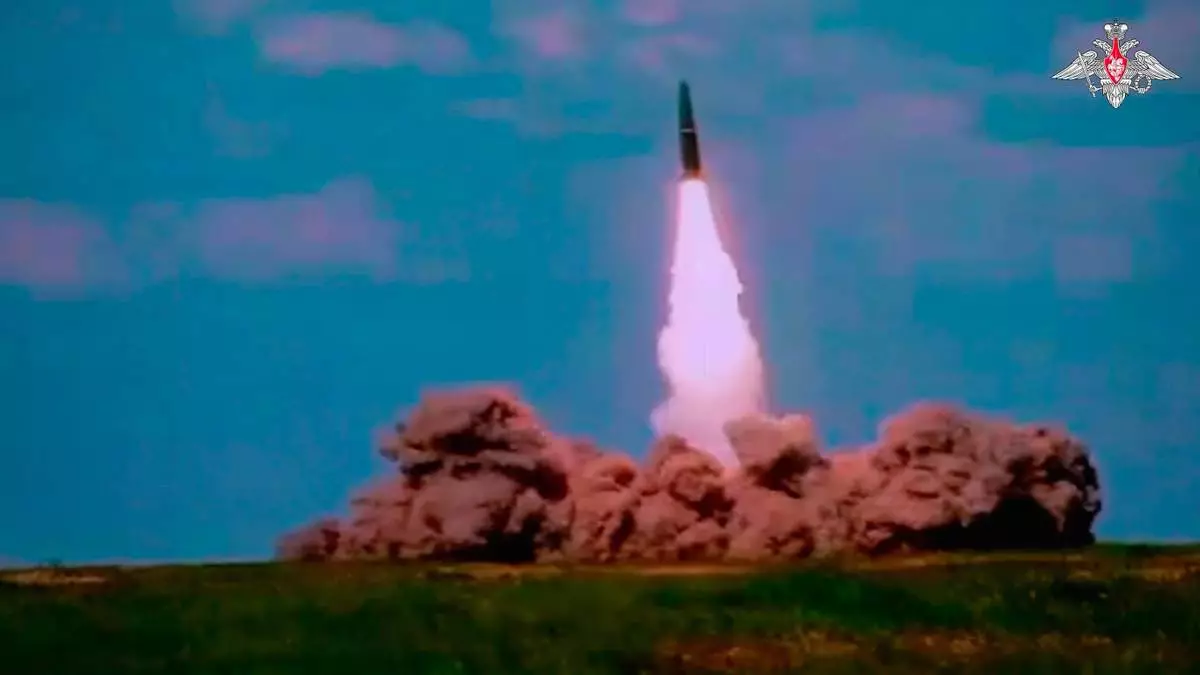
In this image made from video provided by Russian Defense Ministry Press Service on Thursday, May 21, 2026, an Iskander missile is launched by a Belarusian crew from the Kapustin Yar firing range in Russia, during joint nuclear drills conducted by Russian and Belarusian militaries. (Russian Defense Ministry Press Service via AP)
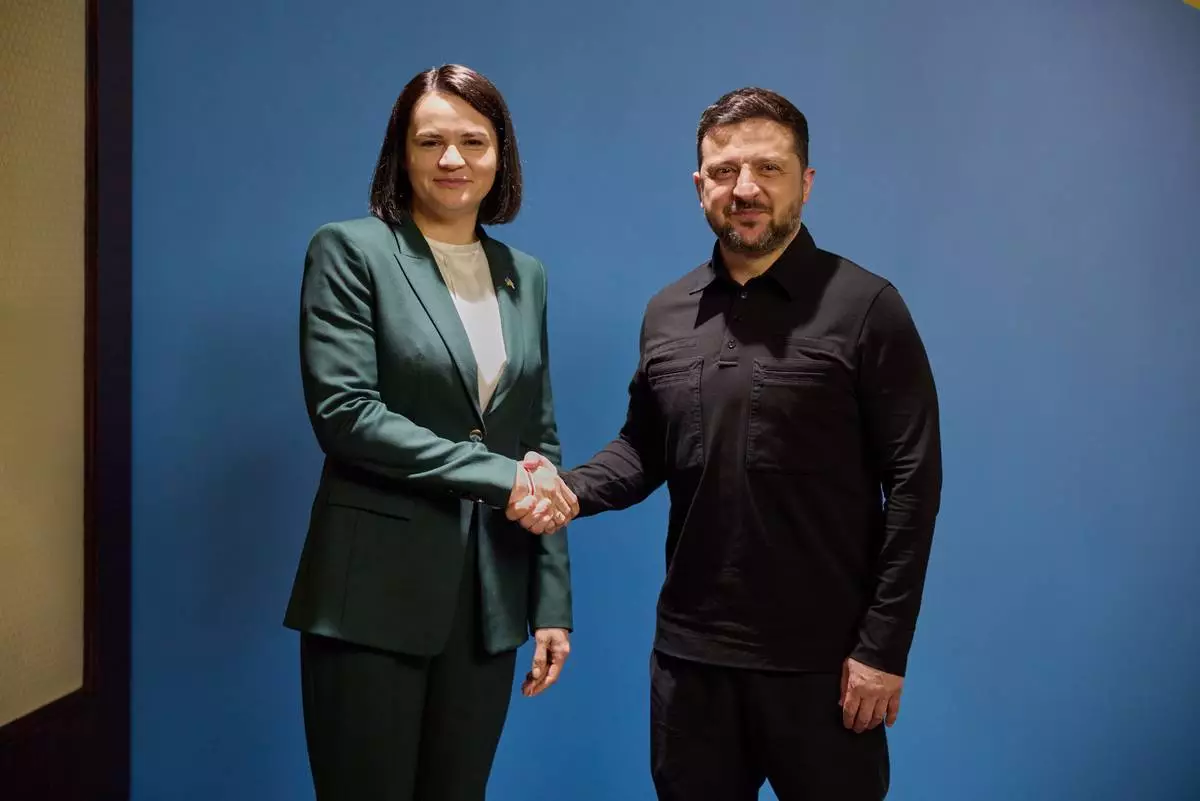
In this photo, provided by the Ukrainian Presidential Press Office, Ukrainian President Volodymyr Zelenskyy, right, shakes hands with Belarusian opposition politician Sviatlana Tsikhanouskaya in Kyiv, Ukraine, Tuesday, May 26, 2026. (Ukrainian Presidential Press Office via AP)
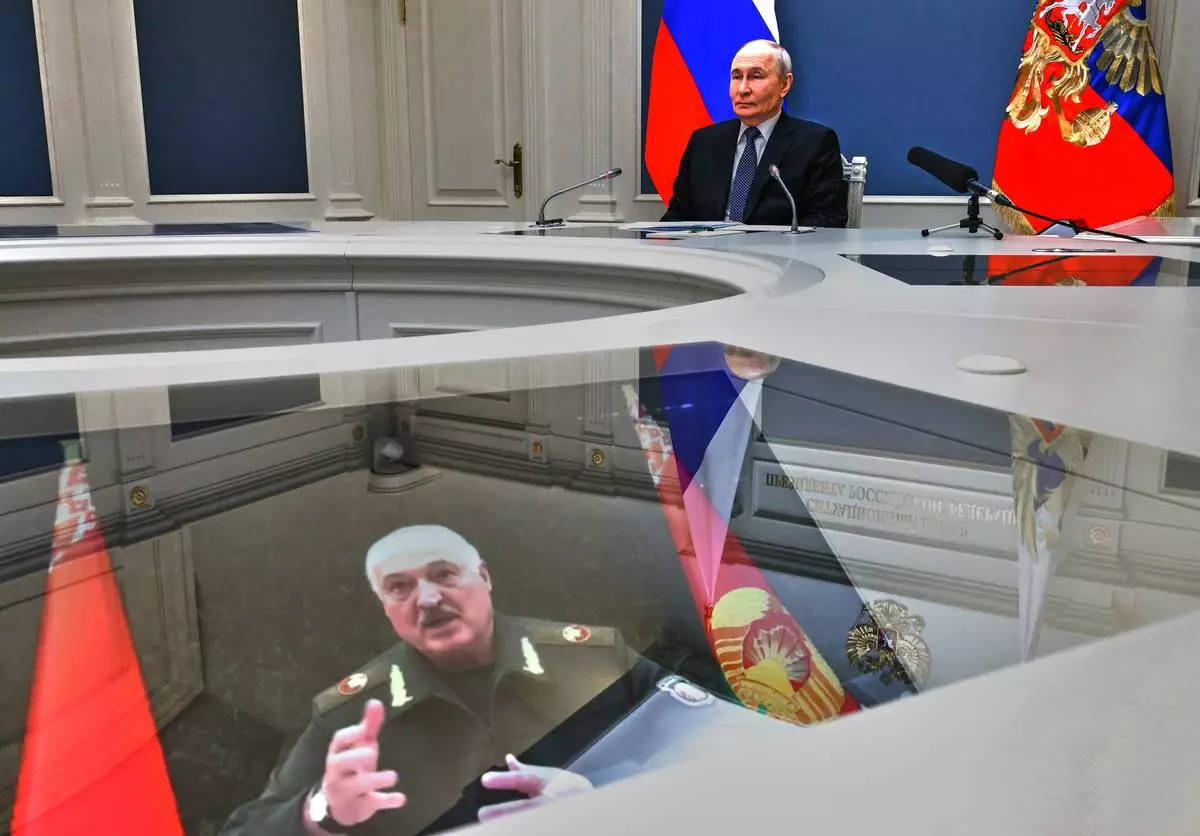
Russian President Vladimir Putin and his Belarusian counterpart Alexander Lukashenko, seen at the screen, take part in a video call as part of joint nuclear drills at the Presidential Situation Centre at the Kremlin in Moscow, Thursday, May 21, 2026. (Mikhail Metzel/Sputnik, Kremlin Pool Photo via AP)
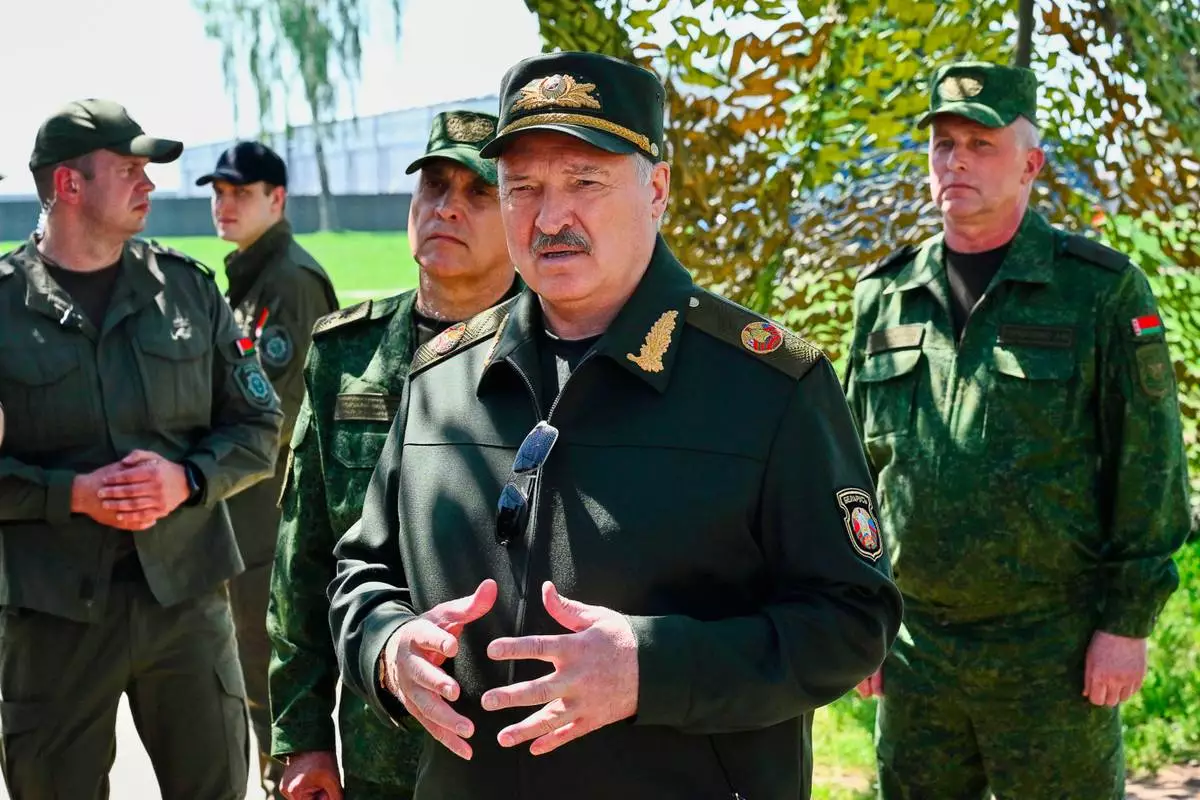
In this photo, released by Belarusian Presidential Press Service, Belarus' President Alexander Lukashenko, center, speaks to officers as he attends joint nuclear drills held by Russian and Belarusian armed forces in Asipovichy district of Belarus, Thursday, May 21, 2026. (Belarusian Presidential Press Service via AP)