Brazil has extended emergency measures for two months to contain fuel price increases caused by volatility in the global oil market amid the war involving the United States, Israel and Iran, the government said Saturday.
The measures, extended by President Luiz Inacio Lula da Silva, will remain in effect until July 31.
According to an official statement, the move continues government actions adopted in response to turbulence in the global oil market since the start of the conflict in the Middle East.
The measures include a subsidy of 1.12 reais, or about 20 U.S. cents, per liter of diesel for domestic refiners and importers, fully financed with federal funds.
The Finance Ministry also created a compensation mechanism for diesel producers and importers, replacing a temporary exemption from federal taxes that was in effect until May 31.
Mines and Energy Minister Alexandre Silveira said the measures are aimed at preventing the impact of the war from being passed on to Brazilian consumers.
"We are being proactive and providing effective responses that will help contain fuel prices and ensure supply in Brazil," he said.
Planning and Budget Minister Bruno Moretti said the government will continue monitoring the international situation and adjust measures if uncertainty persists in global energy markets.
Authorities said the policies could be reviewed again at the end of July, depending on international oil prices.

Brazil extends emergency measures to contain fuel prices amid war-driven volatility
The Chinese People's Liberation Army (PLA) Navy's hospital ship "Silk Road Ark" departed a military port in Zhanjiang City of south China's Guangdong Province on Sunday morning on a mission to provide medical services for naval personnel stationed in the South China Sea.
It marks the third time for the Silk Road Ark to carry out a mission to provide medical services for Chinese naval personnel stationed in the country's territorial waters, since the vessel entered service in 2024.
This mission will focus on common health issues among island-based troops, including neck, shoulder, lower back, and leg pain, skin diseases, and chronic conditions. A combination of shipboard consultations, island visits, and doorstep medical services will be offered. These include free check-ups, physical examinations, traditional Chinese medicine therapy, surgical procedures, and health education for stationed soldiers and their families.
The mission team is primarily made up of 70 medical staff from military hospitals and the Naval Medical University. A naval cultural service team under the PLA Southern Theater Command has also joined the voyage.
"During the voyage, we will conduct maritime casualty evacuation drills with experience-sharing sessions among medical personnel, and with medical equipment maintenance and repair, etc. Our goal is to bridge the 'last mile' of medical services along China's coastal frontiers and effectively enhance our frontline medical support capabilities," said Zhang Chuanyong, a lieutenant colonel with the medical service team.
The Silk Road Ark is China's second domestically designed and constructed 10,000-tonne-class standard ocean-going hospital ship. It just concluded a 234-day "Mission Harmony-2025" on April 26.
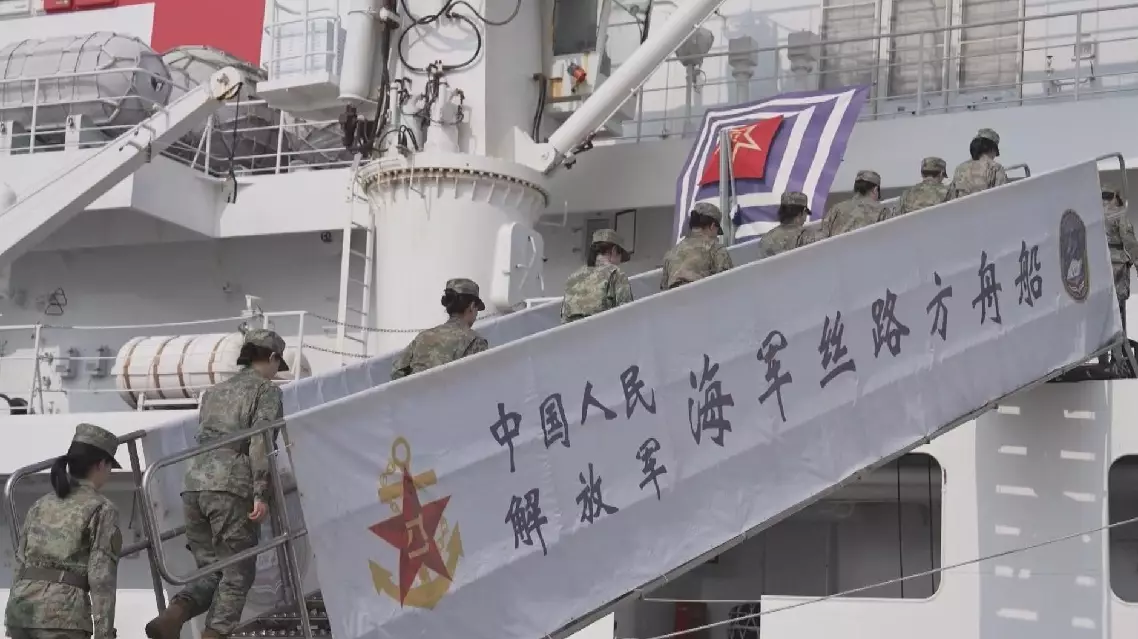
Chinese navy's hospital ship deploys to South China Sea to provide medical services for troops