TAIPEI, June 2, 2026 /PRNewswire/ -- Life science research is entering an AI era, but most discovery teams still cannot use frontier models at scale. Advanced AI models, molecular simulation tools, scientific databases, inference optimization and GPU infrastructure remain fragmented across separate systems. For many pharmaceutical companies, ingredient innovators, biotech teams, and research groups, this makes AI adoption slow, costly, and technically demanding.
NYB.AI, a Singapore Artificial Intelligence (AI) technology startup developing infrastructure for molecular discovery and life science research, aims to address this gap with Vecura, its agentic AI platform that connects scientific models, biological data, molecular analysis tools, and GPU accelerated computing into a unified discovery workflow.
Vecura 2.0 builds on the original Vecura 1.0 platform, which provided access to AI models and scientific tools for molecular discovery. With the new agentic layer, Vecura 2.0 moves beyond tool access toward workflow execution. It is designed to help research teams define scientific objectives, retrieve relevant context, activate suitable models, compare outputs, and generate structured decision support with less manual coordination.
From model access to agentic workflows
Vecura was built around a simple premise: the next barrier in AI for science is not access to more models. It is the ability to make those models work together in discovery settings. The original Vecura platform brought hundreds of AI models, scientific tools, biological data, and molecular analysis capabilities into connected workflows, helping research teams move across compound analysis, target exploration, formulation research, toxicity assessment, and translational R&D without relying on separate systems at every step.
Vecura 2.0 extends this foundation with an agentic AI layer. The upgraded platform is designed to reason across the workflow by understanding research objectives, retrieving relevant scientific context, selecting suitable models, coordinating execution, comparing outputs, and generating structured next step recommendations. This evolves Vecura from a workflow platform into a more intelligent discovery system that can assist scientists at scale, closer to how real research decisions are made.
This agentic approach allows scientists to focus on research direction rather than infrastructure management. It also supports NYB.AI's broader vision to democratize molecular discovery by making advanced AI models, scientific tools, and GPU intensive workflows more accessible to teams beyond large pharmaceutical organizations and specialized computational labs.
Scaling access through NVIDIA technologies
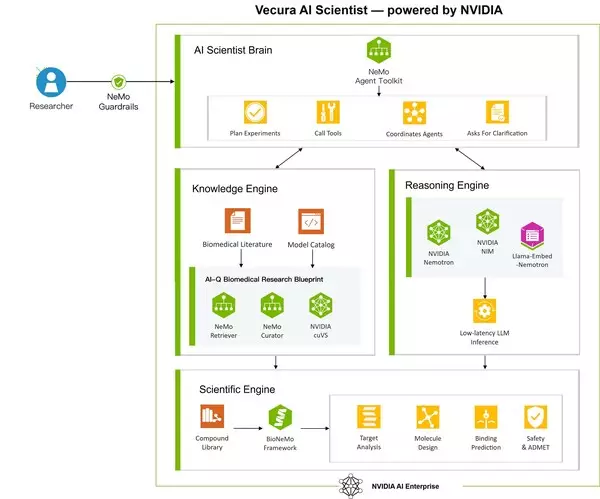
NYB.AI is strengthening Vecura's agentic architecture for scientific discovery using NVIDIA technologies. As a member of the NVIDIA Inception program for startups, NYB.AI received access to NVIDIA Hopper GPUs through NVIDIA Innovation Lab, along with engineering guidance to advance Vecura's ability to plan, execute, and coordinate complex research tasks. This support enables Vecura to move beyond isolated model execution toward connected workflows where scientific context, model selection, inference, comparison, and decision support operate as one system.
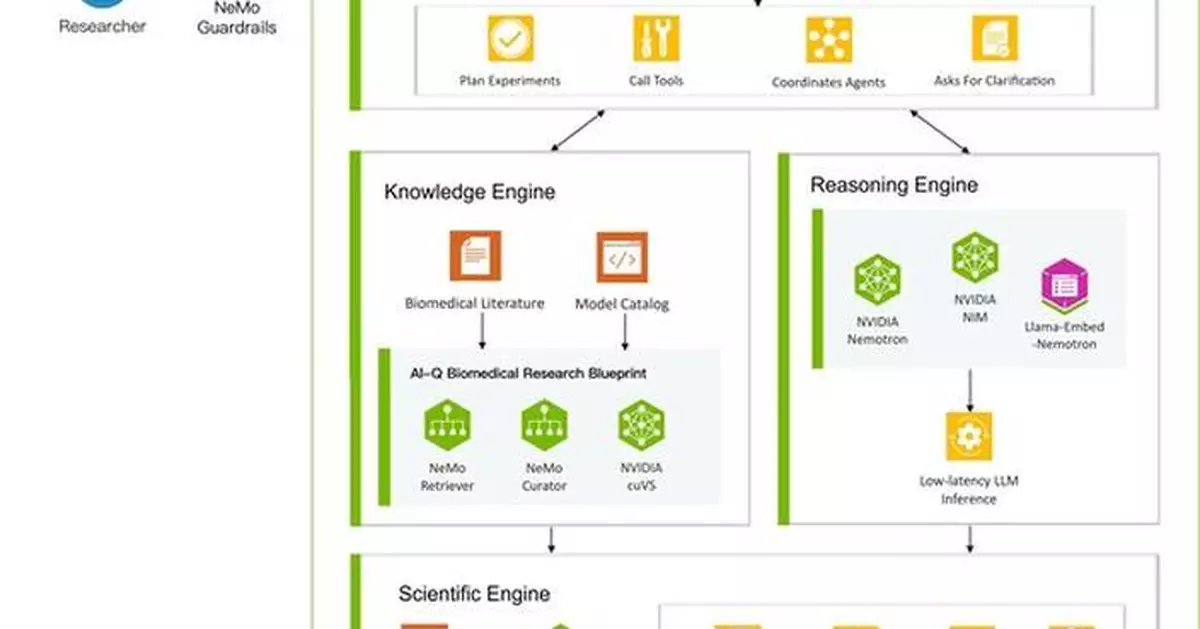
Vecura is powered by NVIDIA technologies spanning agentic orchestration, scientific modeling, data and retrieval, and production deployment - all running on NVIDIA accelerated computing.
NYB.AI is also developing a token based access model for Vecura 2.0. Through platform credits, biopharma companies, ingredient companies, and research teams can access AI powered discovery workflows such as compound screening, bioactivity prediction, and molecular docking. This model allows users to run compute intensive scientific tasks through NYB.AI's platform without needing to build or operate their own infrastructure.
What's next?
NYB.AI is bringing Vecura 2.0 to the NVIDIA Inception Startup Showcase at the Inception Pavilion during InnoVEX 2026 (June 2–5, 2026, Taipei Nangang Exhibition Center). The showcase will give NYB.AI an opportunity to validate Vecura 2.0 with enterprise leaders, investors, ecosystem partners, and international buyers, and strengthens its visibility within NVIDIA Inception ecosystem — demonstrating how agentic AI can move beyond model experimentation into usable research infrastructure for molecular discovery teams.
At InnoVEX 2026, NYB.AI will demonstrate how Vecura 2.0 can support molecular discovery and life science research across pharmaceuticals, nutraceuticals, cosmetics, food science, functional ingredients, and consumer health. The platform reflects NYB.AI's broader mission to make advanced AI discovery infrastructure more usable, scalable, and accessible across the life science ecosystem.
About NYB.AI
NYB.AI is an AI biotechnology company developing infrastructure for molecular discovery and life science research. Its flagship platform, Vecura, is an agentic AI platform that connects AI models, scientific tools, biological data, retrieval systems, accelerated computing, and autonomous workflows to help life science teams shorten discovery cycles and prioritize high-potential candidates.
** This press release is distributed by PR Newswire through automated distribution system, for which the client assumes full responsibility. **
NYB.AI Launches Vecura 2.0, Bringing Agentic AI Workflows to Molecular Discovery, with NVIDIA
- Built on Qwen 3.5/3.6 and tuned for institutional and enterprise use
- Dnotitia releases DNA 3.0, a family of AI language models built on Qwen 3.5/3.6 and enhanced through proprietary post-training
- The model family is designed to help organizations adapt AI to their own data, workflows, and response policies
- DNA models are already integrated into Seahorse Cloud, Dnotitia's AI data platform for enterprise Q&A and AI agent applications
- The lineup ranges from 0.8B to 122B-A10B, supporting use cases from edge environments to enterprise AI agents
SEOUL, South Korea, June 2, 2026 /PRNewswire/ -- Dnotitia Inc. (Dnotitia), a company specializing in long-term memory AI and semiconductor-based AI infrastructure technologies, today announced the release of DNA 3.0, an enterprise-ready AI language model family, on Hugging Face.
DNA 3.0 is built on Qwen 3.5/3.6, a large language model family released by Alibaba Cloud. Dnotitia applied its own post-training and tuning to the models, enabling organizations to adapt them to their data, workflows, and response requirements.
The release reflects Dnotitia's approach to making open models more useful in real enterprise environments. Rather than using an open model as-is, DNA 3.0 is tuned to deliver more consistent responses, reflect organizational context, and support practical AI agent use cases.
Dnotitia also applied persona training to DNA 3.0, allowing the model to better reflect company information and product context. This is designed to support organizations that want AI models to respond in line with their internal knowledge, service policies, and business requirements.
DNA 3.0 has also been post-trained to reduce certain response constraints and language-mixing issues that may appear when adapting Qwen-based models. This improves usability in Korean-language enterprise and institutional environments, where stable question-answering and workflow support are critical.
The DNA model family is currently integrated into Seahorse Cloud, Dnotitia's AI data platform. Seahorse Cloud converts enterprise documents and unstructured data into AI-ready knowledge assets, enabling semantic search, context-aware answer generation, and AI agent workflows based on enterprise data.
Through DNA 3.0, Dnotitia plans to further strengthen Seahorse Cloud's ability to support enterprise data-driven AI agents. The goal is to help organizations move beyond storing and searching data, and instead turn their information assets into a usable AI knowledge layer for real business workflows.
The DNA 3.0 lineup includes models ranging from lightweight versions to mid- and large-scale Mixture-of-Experts (MoE) models. Released models include 0.8B, 2B, 4B, 9B, 27B, 35B-A3B, and 122B-A10B, allowing users to choose models based on deployment environment, performance needs, and cost considerations.
The 35B-A3B and 122B-A10B models use a MoE architecture, which activates only selected expert modules for each query. This approach helps deliver large-model capabilities while reducing the computational load required for inference. DNA 3.0 also inherits key capabilities from previous generations, including long-context handling, reasoning trace preservation, tool use, and coding support.
"Institutions and enterprises need AI models that can be adapted to their own data and workflow context," said MK Chung, CEO of Dnotitia. "By integrating DNA 3.0 with Seahorse Cloud, we will continue to expand enterprise AI agent capabilities powered by organization-specific data."
Dnotitia has continued to expand its DNA model family since the release of DNA 1.0 in December 2024, followed by DNA-R1, a Korean reasoning-focused model, and DNA 2.0, a Korean agentic AI language model. DNA 3.0 builds on this progression by strengthening enterprise-oriented tuning and product integration through Seahorse Cloud.
SEOUL, South Korea, June 2, 2026 /PRNewswire/ -- Dnotitia Inc. (Dnotitia), a company specializing in long-term memory AI and semiconductor-based AI infrastructure technologies, today announced the release of DNA 3.0, an enterprise-ready AI language model family, on Hugging Face.
DNA 3.0 is built on Qwen 3.5/3.6, a large language model family released by Alibaba Cloud. Dnotitia applied its own post-training and tuning to the models, enabling organizations to adapt them to their data, workflows, and response requirements.
The release reflects Dnotitia's approach to making open models more useful in real enterprise environments. Rather than using an open model as-is, DNA 3.0 is tuned to deliver more consistent responses, reflect organizational context, and support practical AI agent use cases.
Dnotitia also applied persona training to DNA 3.0, allowing the model to better reflect company information and product context. This is designed to support organizations that want AI models to respond in line with their internal knowledge, service policies, and business requirements.
DNA 3.0 has also been post-trained to reduce certain response constraints and language-mixing issues that may appear when adapting Qwen-based models. This improves usability in Korean-language enterprise and institutional environments, where stable question-answering and workflow support are critical.
The DNA model family is currently integrated into Seahorse Cloud, Dnotitia's AI data platform. Seahorse Cloud converts enterprise documents and unstructured data into AI-ready knowledge assets, enabling semantic search, context-aware answer generation, and AI agent workflows based on enterprise data.
Through DNA 3.0, Dnotitia plans to further strengthen Seahorse Cloud's ability to support enterprise data-driven AI agents. The goal is to help organizations move beyond storing and searching data, and instead turn their information assets into a usable AI knowledge layer for real business workflows.
The DNA 3.0 lineup includes models ranging from lightweight versions to mid- and large-scale Mixture-of-Experts (MoE) models. Released models include 0.8B, 2B, 4B, 9B, 27B, 35B-A3B, and 122B-A10B, allowing users to choose models based on deployment environment, performance needs, and cost considerations.
The 35B-A3B and 122B-A10B models use a MoE architecture, which activates only selected expert modules for each query. This approach helps deliver large-model capabilities while reducing the computational load required for inference. DNA 3.0 also inherits key capabilities from previous generations, including long-context handling, reasoning trace preservation, tool use, and coding support.
"Institutions and enterprises need AI models that can be adapted to their own data and workflow context," said MK Chung, CEO of Dnotitia. "By integrating DNA 3.0 with Seahorse Cloud, we will continue to expand enterprise AI agent capabilities powered by organization-specific data."
Dnotitia has continued to expand its DNA model family since the release of DNA 1.0 in December 2024, followed by DNA-R1, a Korean reasoning-focused model, and DNA 2.0, a Korean agentic AI language model. DNA 3.0 builds on this progression by strengthening enterprise-oriented tuning and product integration through Seahorse Cloud.
** This press release is distributed by PR Newswire through automated distribution system, for which the client assumes full responsibility. **

Dnotitia Releases DNA 3.0, an Enterprise-Ready AI Language Model Family