Statement by EDB on SMS incident of Central Allocation for Primary One Admission
The Education Bureau (EDB) today (June 2) clarified the incident of erroneous SMS notifications regarding Primary One Admission (POA) sent to Hong Kong parents, and expressed its deepest apologies for any inconvenience caused.
An EDB spokesperson said that according to preliminary investigations, the results of the Central Allocation for POA, originally scheduled to be announced starting tomorrow (June 3), were mistakenly sent ahead of schedule today due to an operational error in the sending procedure of the system. Upon learning of the incident, the EDB immediately took action to correct the procedure.
To safeguard the interests of every student, the EDB immediately conducted a comprehensive and rigorous review of the allocation information for all students after the incident. The EDB hereby clarifies to parents that the SMS notifications this morning do not affect the allocation results.
The EDB also notified parents via SMS this morning, advising them to disregard the earlier SMS notifications regarding POA. The EDB also appealed to parents not to contact the schools hastily. The EDB has immediately set up dedicated hotlines (telephone: 2832 7700/2832 7740) to respond to parents' enquiries. All official POA results with complete and accurate registration details will be released as originally scheduled, starting from 7.30am tomorrow (June 3).
The spokesperson emphasised that the EDB's information systems have been operating reliably. After an immediate and thorough check by the technical team, it was confirmed that the systems were not subject to any cyberattack or hacker intrusion. The core database remains intact. This incident is entirely unrelated to information security or cybersecurity. The personal data of parents and students are highly encrypted and protected.
The EDB attaches great importance to this incident and has immediately set up a crisis management team to follow up on the matter, and will conduct a comprehensive review of the systems, procedures, and manpower support. If any negligence by personnel or procedural errors is found, the EDB will seriously follow up the matter. The EDB will further enhance the monitoring processes of the systems and dissemination mechanisms to prevent similar incidents from recurring.
The EDB once again thanks schools and parents for their understanding and will make every effort to ensure the smooth release of the official allocation results tomorrow.

Source: AI-found images
Digital Policy Office introduces initiatives to promote cybersecurity in 2026
The Digital Policy Office (DPO) introduced the key initiatives for the second half of the year and reviewed the work onpromoting cybersecurity in the first half of theyear at the 2026 Cybersecurity Initiatives Briefing today (June 2). Representatives from the Cyber Security and Technology Crime Bureau (CSTCB) of the Hong Kong Police Force, the Hong Kong Computer Emergency Response Team Coordination Centre (HKCERT) and the Hong Kong Internet Registration Corporation Limited (HKIRC) also shared the latest cybercrime trends and a series of measures to enhance the overall cybersecurity defence capabilities of the community.
The Acting Commissioner for Digital Policy, Mr Daniel Cheung, stated that in the face of the opportunities and challenges brought by the deep integration of emerging technologies, such as AI, into daily life and business operations, the Government has adhered to a strategy that places equal emphasis on security and development. It has adopted a multipronged approach to continuously strengthen Hong Kong's overall cyber resilience. Reviewing the DPO's cybersecurity efforts in the first half of the year, Mr Cheung stated that the DPO, in collaboration with industry partners, launched various cybersecurity activities across campuses, enterprises and the community. These initiatives included the debut of a phishing email exercise for secondary school students, phishing SMS exercises, the launch of the CyberDefenders' Alliance Card Game and an AI-generated four-panel comic contest, all aimed at raising public awareness of the latest cyber risks and introducingpractical protective measures.
In response to the growing adoption of AI technology, the DPO will focus on launching a number of key AI-related cybersecurity initiatives in the second half of the year, ensuring that the general public and organisations possess adequate security awareness and literacy when utilising AI. These include co-ordinating with the HKIRC to introduce the Secure AI@Work Enablement Campaign to assist enterprises in building a secure and compliant AI ecosystem, as well as collaborating with the industry to host the AI x Cybersecurity Challenge to leverage the potential of driving AI-powered threat detection and resilience while advancing cybersecurity talent development. Concurrently, the DPO will continue to deepen enterprise support and practical drills. In addition to co-ordinating with the HKIRC and HKCERT to launch the enhanced Cybersec One+ and enrich the Cybersecurity Service Providers Connect Programme, the DPO will also continue to take the lead in organising the third Hong Kong Cybersecurity Attack and Defence Drill. Furthermore, this December will mark the first-ever grand consolidation of the Cyber Security Summit Hong Kong and the Cybersecurity Symposium into a single integrated Cybersecurity Symposium and Summit, co-organised with the HKIRC and the Hong Kong Productivity Council (HKPC), with an aim to synergise forces from all sectors of the community to jointly build a safe and efficient smart city.
At the briefing, the Chief Superintendent of the CSTCB, Mr Lam Cheuk-ho, pointed out that cyber threat intelligence targeting Hong Kong continues to rise. In the first quarter of this year, the Cyber Security Centre under the CSTCB analysed over 330 000 pieces of related intelligence, with phishing being the most rampant. He emphasised that to address these increasingly severe challenges, the CSTCB will adopt a multipronged strategy to deepen international law enforcement co-operation externally, while internally strengthening intelligence sharing and collaborative defence with various sectors, including critical infrastructures. Concurrently, the CSTCB will actively apply AI and big data technologies to enhance cyber threat detection, early warning analysis, and incident response capabilities. Furthermore, the Hong Kong Police Force and Cyberport have established the Smart Policing Joint AI Lab to develop anti-deepfake and network defence technologies, working together to fortify the local cybersecurity ecosystem.
Speaking on behalf of HKCERT, the Chief Digital Officer of the HKPC, Mr Edmond Lai, stated that HKCERT will deepen public education and talent cultivation in AI and cybersecurity through various publicity campaigns. Among these initiatives, the winning entries from the recently organised AI-generated four-panel comic contest will be featured in a tram body advertising campaign. Concurrently, HKCERT will raise public awareness of cybersecurity through AI-generated short videos and posters, and will subsequently host the AI x Cybersecurity Challenge along with the 7th HKCERT Capture the Flag Challenge. Furthermore, HKCERT is optimising the exclusive platform under the Cybersecurity Service Providers Connect Programme with two new functions, namelydemand matching and tag classification,to help local enterprises more efficiently look for appropriate cybersecurity solutions.
The Chief Executive Officer of the HKIRC, Mr Wilson Wong, also shared the findings of a survey on the current state of AI adoption and security in the workplaces of Hong Kong enterprises. He pointed out that while the penetration rate of AI in the workplace is exceptionally high, most organisations still face security risks regarding governance, tool usage and training. To address these issues, the HKIRC will launch the Secure AI@Work Enablement Campaign, which will assist organisations in plugging governance gaps through training, AI strategy and policy formulation tools and advisory services.
In conclusion, Mr Cheung emphasised that security is the prerequisite for development, and development is the guarantee of security. A robust and reliable cyber environment serves as the foundational cornerstone for driving the development of a smart city and the digital economy, whereas maintaining cybersecurity requires the collective effort of the entire society. Looking ahead, the DPO will continue to comprehensively strengthen Hong Kong's cyber defence capabilities and resilience through a diverse range of activities and training initiatives. He also appealed for media support to widely disseminate key cybersecurity messages and work with the Government to foster a safer and more secure digital environment.
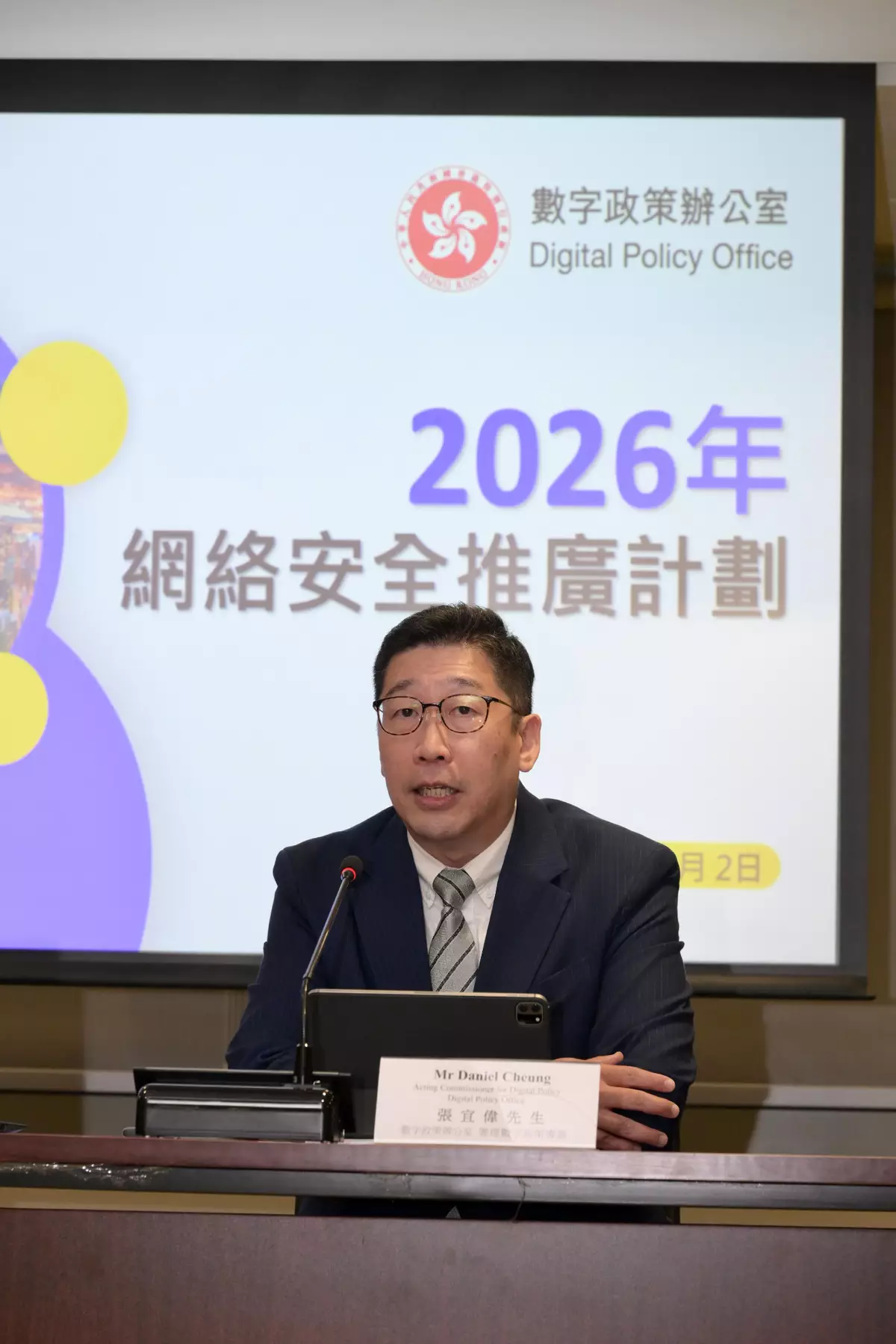
Digital Policy Office introduces initiatives to promote cybersecurity in 2026 Source: HKSAR Government Press Releases

Digital Policy Office introduces initiatives to promote cybersecurity in 2026 Source: HKSAR Government Press Releases