BETHESDA, Md.--(BUSINESS WIRE)--Jun 4, 2026--
Walker & Dunlop, Inc. announced today that it has arranged more than $223 million in bridge financing for five multifamily communities across the Southeast on behalf of Madison Capital Group.
This press release features multimedia. View the full release here: https://www.businesswire.com/news/home/20260604151651/en/
Walker & Dunlop Capital Markets Real Estate Finance arranged the loans with multiple debt fund lenders for multifamily assets located throughout North Carolina, South Carolina, and Florida. Led by Walker Layne, Austin Sneed and Tyler Evenson, the five financings closed over the past nine months, totaling 1,345 units, and highlight continued liquidity for well-positioned multifamily properties in high-growth Sun Belt markets.
“We are proud to support Madison Capital Group as they expand and strengthen their multifamily portfolio across some of the country’s fastest-growing markets,” said Layne, managing director of Capital Markets Real Estate Finance at Walker & Dunlop. “By structuring flexible floating-rate bridge financing, we were able to provide a tailored execution strategy that aligned with the business plans for each asset while maximizing optionality in an evolving capital markets environment.”
The portfolio includes:
Collectively, the financings were secured by market-rate multifamily communities located near major employment centers, transportation corridors, and retail destinations throughout the Southeast. The bridge loan structures provide Madison Capital Group with additional flexibility as the firm continues to execute its multifamily investment strategy across high-growth markets.
“We continue to see strong fundamentals across Sun Belt multifamily markets, particularly in communities benefiting from sustained population growth, employment expansion, and long-term housing demand,” said Collin Ross, senior vice president of portfolio management at Madison Capital Group. “Walker & Dunlop’s market knowledge and lender relationships helped us efficiently execute these financings while positioning the portfolio with flexibility to capitalize on continued growth opportunities throughout the Southeast.”
In 2025, Walker & Dunlop’s Capital Markets team sourced over $22 billion from non-Agency capital providers, including nearly $16 billion for multifamily properties. This vast experience has made them a top advisor on all asset classes for many of the industry’s top developers, owners, and operators. To learn more about Walker & Dunlop’s broad financing options, visit our website.
About Walker & Dunlop
Walker & Dunlop (NYSE: WD) is one of the largest commercial real estate finance and advisory services firms in the United States and internationally. Our ideas and capital create communities where people live, work, shop, and play. Our innovative people, breadth of our brand, and our technological capabilities make us one of the most insightful and client-focused firms in the commercial real estate industry.

Madison Shores. Photo Credit: Madison Capital Group
TOKYO (AP) — Japan’s stock benchmark tumbled more than 6% after trading opened Friday, and other Asian stocks also declined following a widespread sell-off of issues related to artificial intelligence on Wall Street.
Tokyo's benchmark Nikkei 225 recouped some of those initial losses, trading 5.7% lower at 57,576.63 by midday. Australia's S&P/ASX 200 lost 1.0% to 8,973.00. South Korea's Kospi dropped 7.4% to 4,985.99, as Samsung Electronics shares shed 7.9% in morning trading. Hong Kong's Hang Seng fell 0.7% to 24,630.03, while the Shanghai Composite dipped 1.3% to 3,642.10.
Stock markets around the world have been feeling pressure from continued declines for companies that have benefited from the boom in the artificial-intelligence technology industry. Such stocks have been swinging for months on worries that the construction of AI data centers may slow because of how expensive it’s become to borrow money. Critics also say AI stock prices had shot too high and were in a bubble.
Toyota stock declined sharply after the Japanese automaker reported lackluster profits the previous day. Nintendo, which also reported earnings the previous day, saw its stock price fall amid the overall market tumble. Sony Group stock fell slightly. The company reported booming results on the back of the success of its latest Spider-Man movie.
On Wall Street, the S&P 500 fell 4.4% Thursday for its worst day since U.S. President Donald Trump shook markets worldwide in April 2025 with his “Liberation Day” tariffs. The wipeout more than erased the U.S. stock market’s gain from the day before, which was its best in three months.
The Dow Jones Industrial Average sank 1,833 points, or 3.4%, while the Nasdaq composite tumbled 5.5%. The Nasdaq, which is full of AI-related and other tech stocks, sank 11.9% below its all-time high set last month. Stock geeks call a loss of more than 10% a “correction.”
Tuesday’s U.S. midterm elections added another challenge. The nationwide victories for Democrats raised the possibility that governments could force pauses in construction of more data centers. Voters across political parties say they’re wary about AI and don’t like the increases to power bills caused by data centers.
Any slowdown in construction of AI data centers would mean fewer purchases of AI chips, not to mention electricity and other products and services that are getting vacuumed up in the AI frenzy, which is driving much of the U.S. economy’s growth.
Nvidia, the chip company that quickly became the face of the AI boom, fell 9.3% and was by far the heaviest weight on the S&P 500. It’s now down 2.6% for the year so far following annual gains of roughly 39%, 171% and 239% in the last three years.
Advanced Micro Devices tumbled 17.3%. CoreWeave, a company that rents access to AI chips to customers over the cloud, fell 9.8%. GE Vernova, which has been helping to power data centers, sank 7.5%.
Compounding the pain for investors, AI chip stocks are some of Wall Street’s most influential because they’ve become some of the largest. A 1% move for Nvidia, for example, has more effect on the S&P 500 than a 1% move for nearly any other U.S. stock.
Stock prices tend to follow where corporate profits and interest rates go over the long term, depending on them much more than on who controls what in Washington.
All told, the S&P 500 fell 334.89 points to 7,353.73. The Dow Jones Industrial Average dropped 1,833.06 to 51,523.06, and the Nasdaq composite sank 1,421.52 to 24,315.00.
In energy trading, benchmark U.S. crude added 0.65% to $91.11 a barrel. Brent crude, the international standard, gained 1.4% to $99.73 a barrel. Uncertainty still reigns about what will happen in the war with Iran and when the global energy industry can return to normal.
In the bond market, Treasury yields continued to tumble Thursday. The yield on the 10-year Treasury fell to 4.84% from 4.90% late Wednesday. It had been at 4.95% on election night and above 5.30% last month. That could be a signal that investors are herding into U.S. Treasury bonds in search of something that’s safer to own as stock prices tumble.
The drop in yields came despite some encouraging reports on the U.S. economy. Fewer U.S. workers applied for unemployment benefits last week.
In currency trading, the U.S. dollar rose to 157.97 Japanese yen from 157.68 yen. The euro cost $1.1209, down from $1.1219.
AP Business Writer Stan Choe contributed.
Yuri Kageyama is on Threads: https://www.threads.com/@yurikageyama

A trader works on the floor of the New York Stock Exchange, Friday, Nov. 6, 2026, in New York. (AP Photo/Yuki Iwamura)
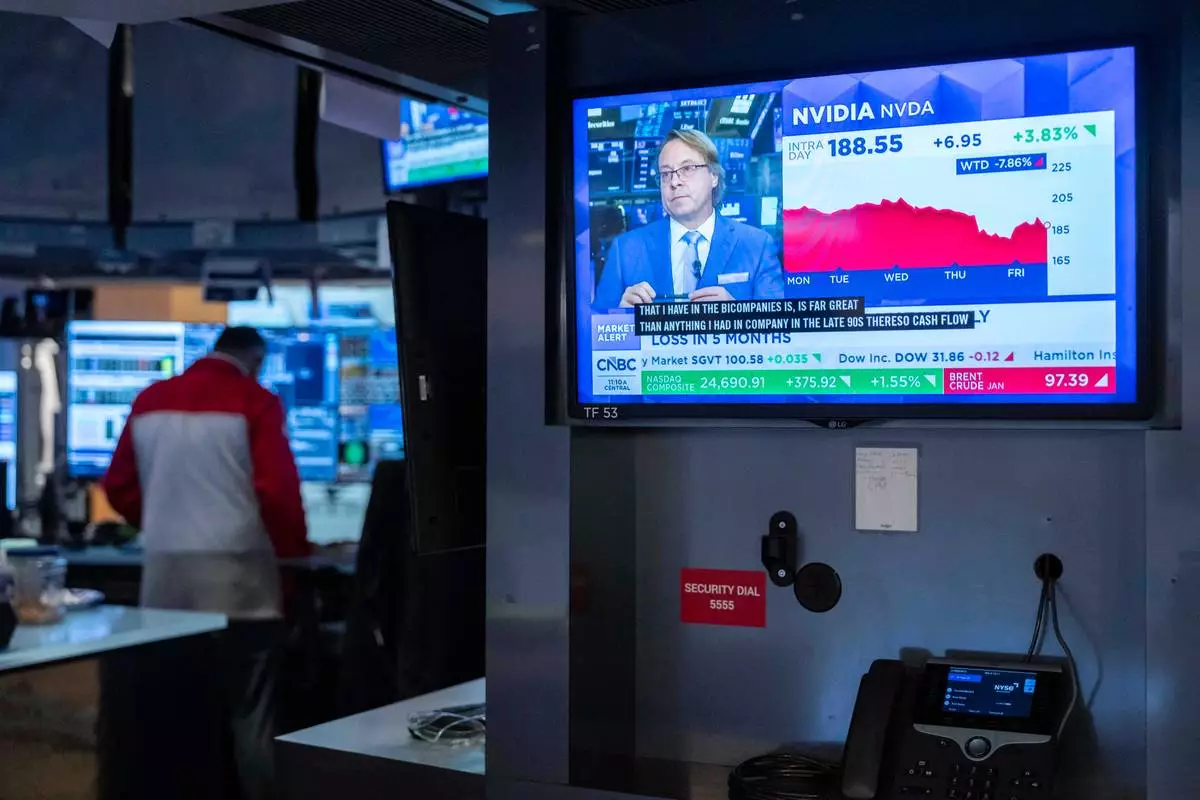
A screen on the floor of the New York Stock Exchange displays news about the Nvidia stock price, Friday, Nov. 6, 2026, in New York. (AP Photo/Yuki Iwamura)

Market information is displayed on screens on the floor of the New York Stock Exchange, Friday, Nov. 6, 2026, in New York. (AP Photo/Yuki Iwamura)
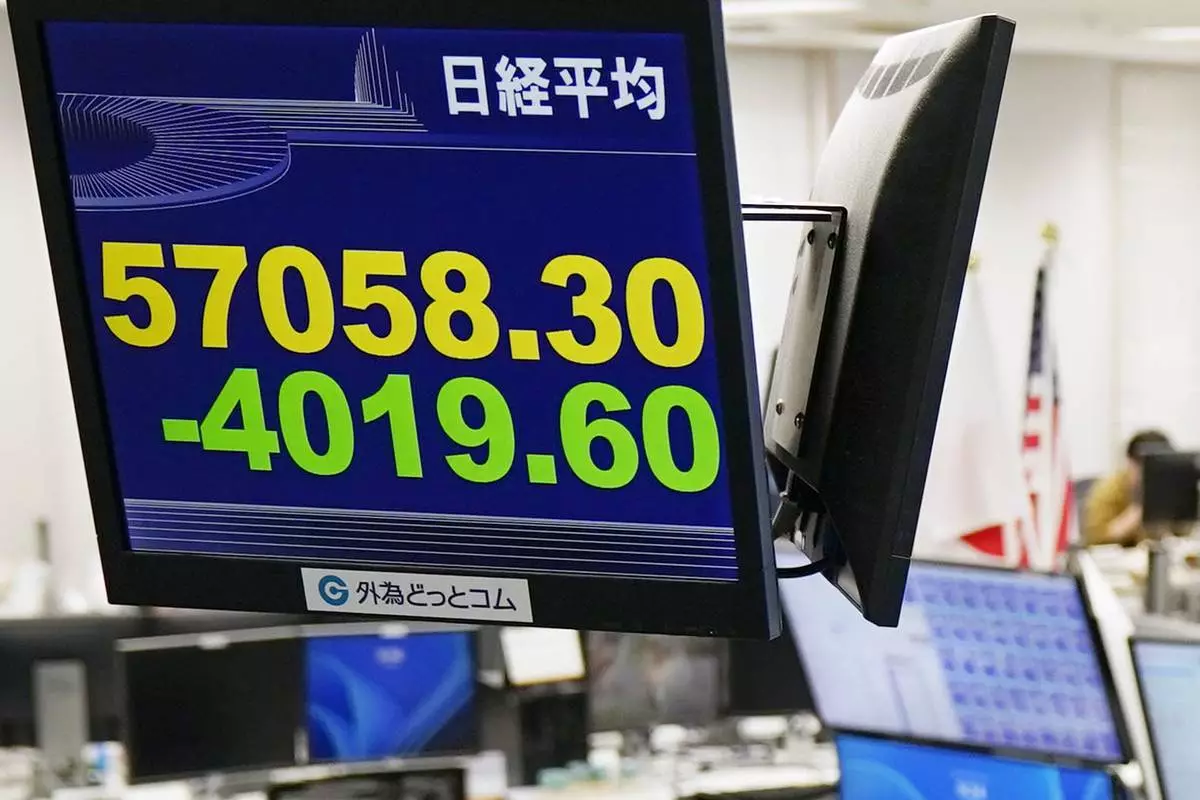
An electronic board shows Japan's benchmark Nikkei 225 index at a foreign exchange dealing company Friday, Nov. 6, 2026, in Tokyo.(Kyodo News via AP)

The screen shows the Korea Composite Stock Price Index (KOSPI) at a dealing room of Hana Bank in Seoul, South Korea, Thursday, Nov. 5, 2026. (AP Photo/Lee Jin-man)

TV cameraman films near the screens showing the foreign exchange rates at the Korea Exchange in Seoul, South Korea, Friday, Nov. 6, 2026. (AP Photo/Lee Jin-man)

TV cameraman films near the screens showing the stock prices at the Korea Exchange in Seoul, South Korea, Friday, Nov. 6, 2026. (AP Photo/Lee Jin-man)

The screen showing the Korea Composite Stock Price Index (KOSPI) is seen at the Korea Exchange in Seoul, South Korea, Friday, Nov. 6, 2026. (AP Photo/Lee Jin-man)
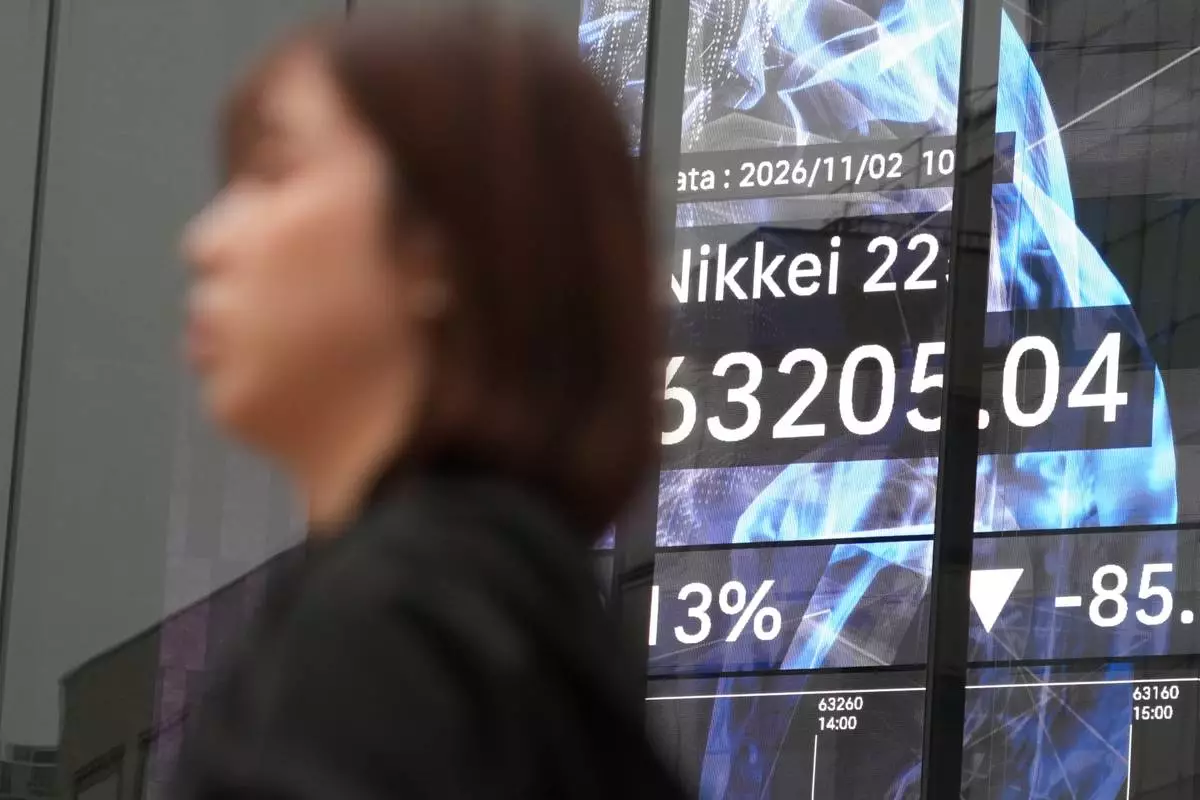
A person walks in front of an electronic stock board showing Japan's Nikkei index at a securities firm, Monday, Nov. 2, 2026, in Tokyo. (AP Photo/Eugene Hoshiko)