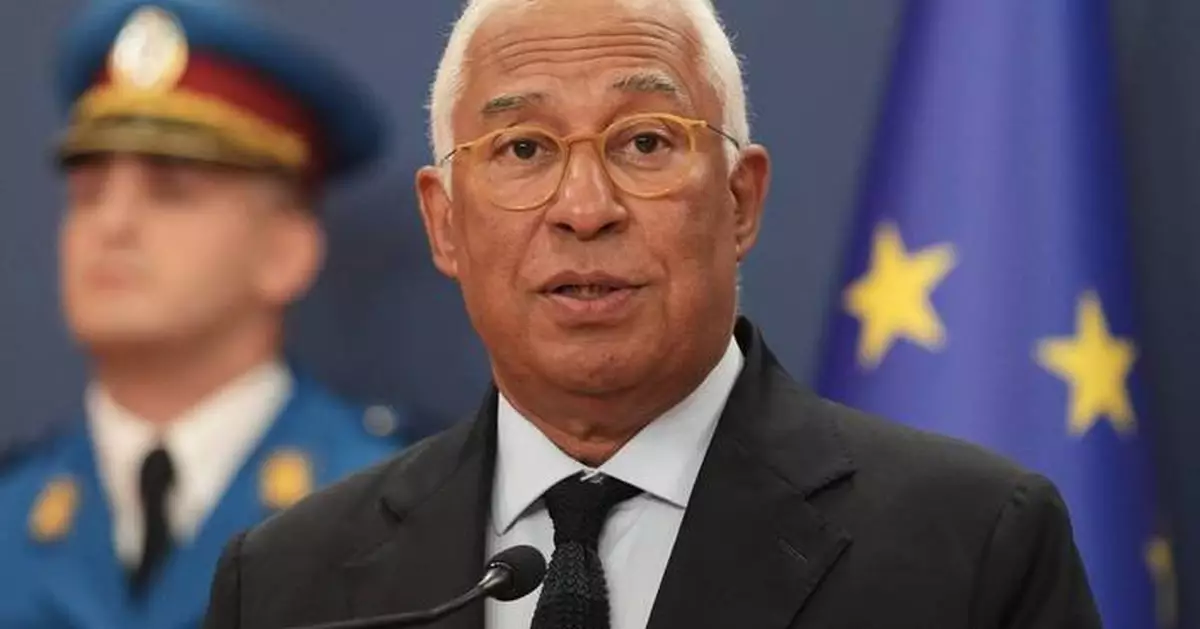
BELGRADE, Serbia (AP) — The European Union will look for new ways to speed up the membership process for six candidate countries from the Western Balkans at an upcoming summit, European Council President Antonio Costa said on Thursday.
Albania, Bosnia-Herzegovina, Kosovo, North Macedonia, Serbia and Montenegro have been seeking to join the bloc for years but are yet to complete the merit-based process. The EU has recently sought to encourage reform in the candidate nations, fearing the growing influence of Russia and China.
Costa said at a news conference in Serbia’s capital Belgrade that “if you want to boost the trust between each other, we cannot create this feel of frustration" over apparent slow progress toward membership. It doesn't mean it will be easier, Costa added, “but it means how we can deliver together more rapidly.”
The summit on Friday in the Montenegrin coastal town of Tivat will gather top European leaders and officials from the candidate countries. They are all at different stages, with Montenegro and Albania leading the way.
Candidate countries must bring their laws into line in 35 policy areas or “chapters,” ranging from justice standards to farm and fishing rules. All 27 EU members must agree before each chapter can be opened, and then again for it to be closed.
The EU has also said Serbia and Kosovo must normalize relations in order for their membership applications to progress.
Kosovo was a Serbian province until NATO’s 78-day bombing campaign in 1999 ended a war between Serbian government forces and ethnic Albanian separatists. Serbia does not recognize Kosovo’s independence, proclaimed in 2008.
Costa said that “tomorrow the European leaders will discuss with the leaders of the Western Balkans how we can improve our methodology to move forward faster and better.”
“The enlargement is not a utopia but it is something that could be real in the coming years,” Costa insisted. “For this we need to work harder and faster.”
Costa on Thursday wrapped his pre-summit tour of the Western Balkan candidate nations before traveling to Montenegro. He told Serbian populist President Aleksandar Vucic that his government must boost democratic reform and align its foreign policies with those of the EU in order to move forward.
Serbia has been warned it could lose access to around 1.5 billion euros ($1.8 billion) in EU funds if it fails to halt democratic backsliding, including in the judiciary. It has also been told to improve media freedom and the conditions for free and fair elections.
Ukraine and Moldova also are seeking to join the EU, along with the Western Balkan countries.
Serbia remains the only European nation that has not imposed sanctions on Russia because of the war in Ukraine and maintains friendly ties with Moscow, as well as China where Vucic recently traveled.
“We want and we are ready to do more,” Costa said. “But let me be clear, the pace of progress depends on Serbia’s own resolve.”
Increasingly authoritarian Vucic has faced continued youth-led street protests that first started in November 2024 after a train station accident in the country's north killed 16 people. He pledged on Thursday to push the reform with “new enthusiasm” and keep Serbia on the EU path.
Vucic travels to Tivat a day after Montenegro banned 87 Serbs from entering the country, citing security concerns. The men had communication equipment and banners reading “Serbia wins,” police said. Vucic uses the slogan in his public appearances.
It was not immediately clear why the men had traveled to Montenegro.

Serbian President Aleksandar Vucic, right, shakes hands with European Council President Antonio Costa prior to their meeting at the Serbia Palace in Belgrade, Serbia, Thursday, June 4, 2026. (AP Photo/Darko Vojinovic)
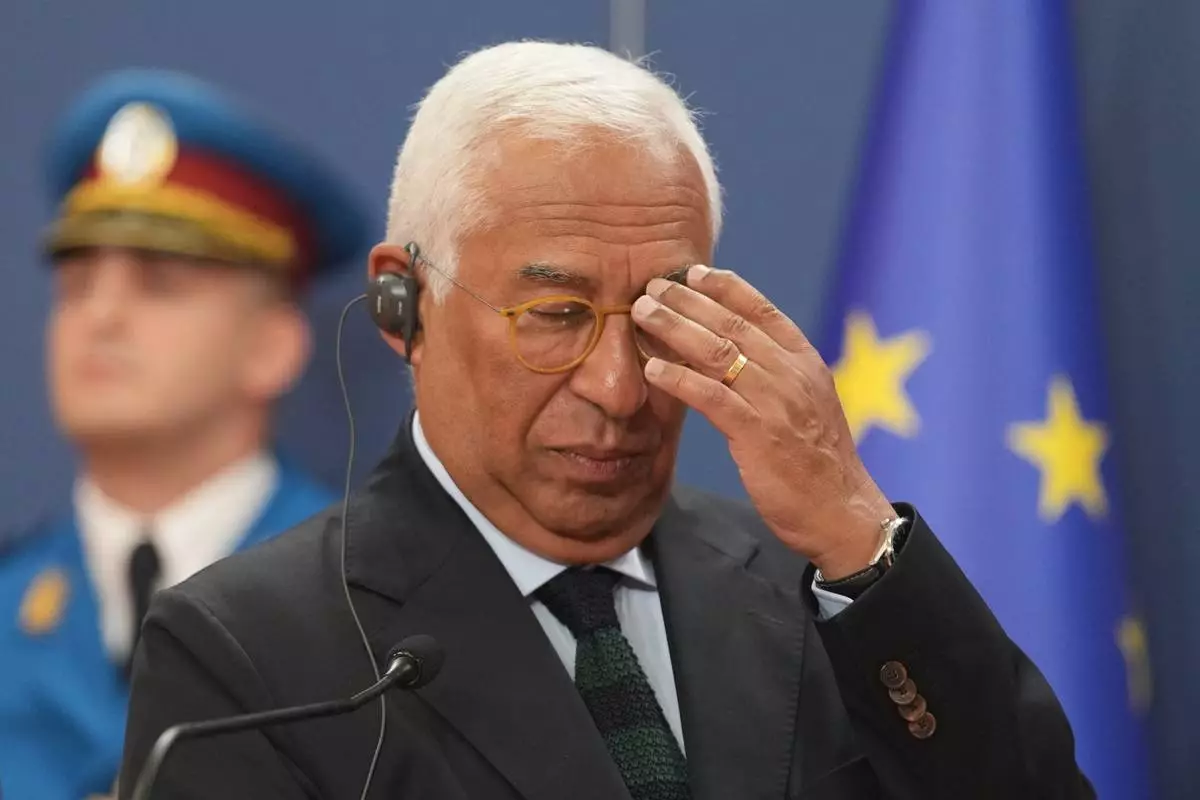
European Council President Antonio Costa listens to Serbian President Aleksandar Vucic during a news conference at the Serbia Palace in Belgrade, Serbia, Thursday, June 4, 2026. (AP Photo/Darko Vojinovic)
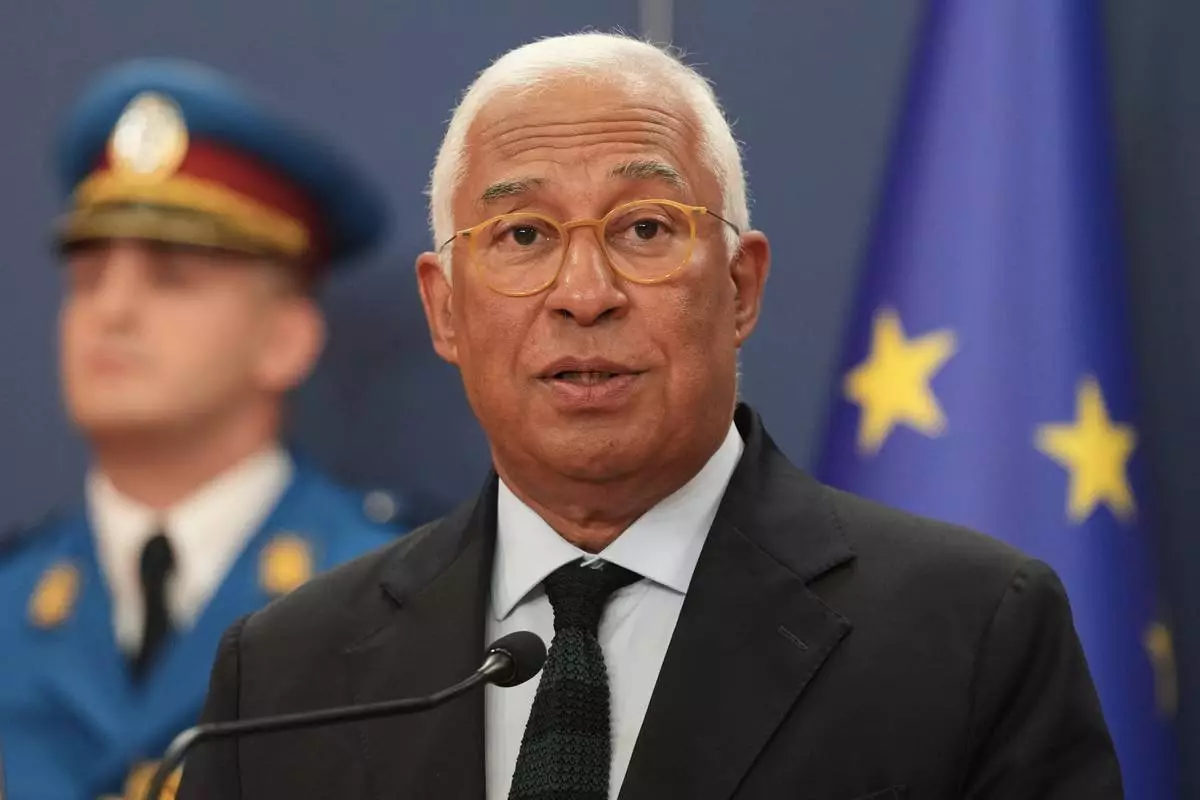
European Council President Antonio Costa speaks during a news conference with Serbian President Aleksandar Vucic at the Serbia Palace at the Serbia Palace in Belgrade, Serbia, Thursday, June 4, 2026. (AP Photo/Darko Vojinovic)
GENEVA (AP) — The Champions League's Cinderella club Bodø/Glimt is one game away from returning to the 36-team main draw being made Thursday alongside the wealthy giants of European soccer like title holder Paris Saint-Germain, Real Madrid and Bayern Munich.
With the final seven Champions League entries to be decided in playoffs this week, the Norwegian fishing town team holds a 3-1 lead hosting Dutch debutant NEC Nijmegen at its Arctic Circle home on Tuesday.
Norway could have two teams advance as domestic champion Viking hosts Dinamo Zagreb on Wednesday with the teams tied at 2-2. The Croatian champion wasted an early two-goal lead in the first leg last Tuesday.
The Champions League draw ceremony starts at 6 p.m. local time (1600 GMT) Thursday in Monaco, when the local team will be preparing to kick off about 10 minutes’ drive away in the Conference League playoffs.
Monaco defending a 3-2 first-leg lead over Gornik Zabrze is among 36 playoff second legs this week in the second-tier Europa League and third-tier Conference League to finalize lineups for those draws being made Friday.
After winning games against Manchester City, Atletico Madrid and Inter Milan in last season’s Champions League, Bodø/Glimt started this time in qualifying needing to advance through two rounds in August.
Glimt has scored three goals in each of its three games so far, first eliminating Union Saint-Gilloise 6-5 on aggregate score. Almost its entire squad was retained with just one big-money exit, selling Denmark forward Kasper Høgh to Celtic for a reported 11 million pounds ($15 million).
Høgh and Celtic also are in action Tuesday, taking a 3-0 first-leg lead to Austria against LASK.
Israel’s champion Hapoel Beer-Sheva has a 2-1 lead going to Azerbaijan to face Sabah, a club which was created just nine years ago.
Lyon, now owned by U.S. investor Michele Kang, hosts Fenerbahce on Wednesday tied at 1-1.
Pot 1: Paris Saint-Germain (France), Bayern Munich (Germany), Real Madrid (Spain), Liverpool (England), Inter Milan (Italy), Manchester City (England), Arsenal (England), Barcelona (Spain), Atletico Madrid (Spain).
Pot 2: Borussia Dortmund (Germany), Roma (Italy), Sporting Lisbon (Portugal), Aston Villa (England), Porto (Portugal), Manchester United (England), Club Brugge (Belgium), Real Betis (Spain), PSV Eindhoven (Netherlands).
Pot 3: Feyenoord (Netherlands), Lille (France), Napoli (Italy), Leipzig (Germany), Villarreal (Spain), Shakhtar Donetsk (Ukraine), Galatasaray (Turkey) — possibly Slavia Prague (Czech Republic).
Pot 4: Stuttgart (Germany), Como (Italy), Lens (France). Seven playoff winners are yet to be decided.
The draw sees UEFA's software program allocate eight opponents to each team, with two coming from each seeding pot.
The first round of games is played over three evenings from Sept. 8-10 — the only games before the new and expanded four-game international break for national teams that starts Sept. 24.
The Champions League resumes Oct. 13 with the second round. The sixth round is played Dec. 8-9 before a break until January. The eighth and final round with all 36 teams playing simultaneously is Jan. 27.
The Europa League has a stronger look than last season with AC Milan, Juventus and Bayer Leverkusen waiting in the draw Friday for the eight-round league phase.
So too are a curious group from England — Conference League title holder Crystal Palace, European debutant Bournemouth and Sunderland, which last played in a UEFA competition 53 years ago.
The prize for lifting the trophy next May in Frankfurt, Germany, is a ticket to the Champions League.
Second legs in the qualifying playoffs are on Thursday with some played during the Champions League draw.
Those games include Mo Salah’s Trabzonspor trailing 1-0 before going to Hungary to face Ferencvaros, plus former European Cup winners Benfica and Red Star Belgrade.
It has been a tough season for some of the feelgood story domestic title holders who were already eliminated in Champions League qualifying rounds.
Swiss champion Thun — edged out of Champions League qualifying by Dinamo Zagreb — lost 7-0 at Lech Poznan in the first leg of its Europa League playoff. Sweden’s Mjällby goes to Salzburg on Thursday after a 1-0 loss at home.
All losers in Europa League playoffs get places in the Conference League main phase played over just six rounds until December.
The Conference League also has teams that identify as Champions League regulars: Ajax, Atalanta, Monaco.
Freiburg drops down a level after being the Europa League beaten finalist in May while Brighton aims to make it three straight English winners after Chelsea and its main rival Palace.
No one gets a free pass into the six-round league stage and all must navigate the playoffs round this week.
Atalanta, the 2024 Europa League winner, looks most at risk after a 0-0 draw in the first leg at home to Hapoel Tel-Aviv. The return is in neutral Hungary.
Andorra shapes to have a first-ever team in a main phase, with Inter Escaldes hosting Drita of Kosovo tied at 2-2. Larne of Northern Ireland takes a 2-0 lead into its home leg against Lincoln Red Imps of Gibraltar.
See AP’s full soccer coverage here

Trabzonspor's Mohamed Salah in action during the Turkish Super Lig soccer match between Kasimpasa and Trabzonspor in Istanbul, Turkey, Saturday, Aug.15, 2026. (AP Photo/Khalil Hamra)

Celtic's Camilo Duran celebrates after scoring their side's second goal during the Champions League play-off first leg match between Celtic and LASK in Glasgow, Scotland, Wednesday, Aug. 19, 2026. (Andrew Milligan/PA via AP)

FILE - PSG's head coach Luis Enrique celebrates after the Champions League final soccer match between Paris Saint-Germain and Arsenal in Budapest, Hungary, Saturday, May 30, 2026. AP Photo/Armin Durgut, File)