Skip to Content Facebook Feature Image

Chinese troops unveil unmanned systems in joint drills with Mongolian counterparts

China

China

China

Chinese troops unveil unmanned systems in joint drills with Mongolian counterparts

2026-06-07 16:56 Last Updated At:18:37

Chinese and Mongolian troops on Saturday wrapped up their "Steppe Partner 2026" joint drills in north China's Inner Mongolia Autonomous Region, with the drills featuring the adoption of Chinese unmanned systems.

Before the closing ceremony, the two sides conducted a live-fire exercise on the subject of joint operations against illegal armed groups, as a test for the week-long joint training sessions.

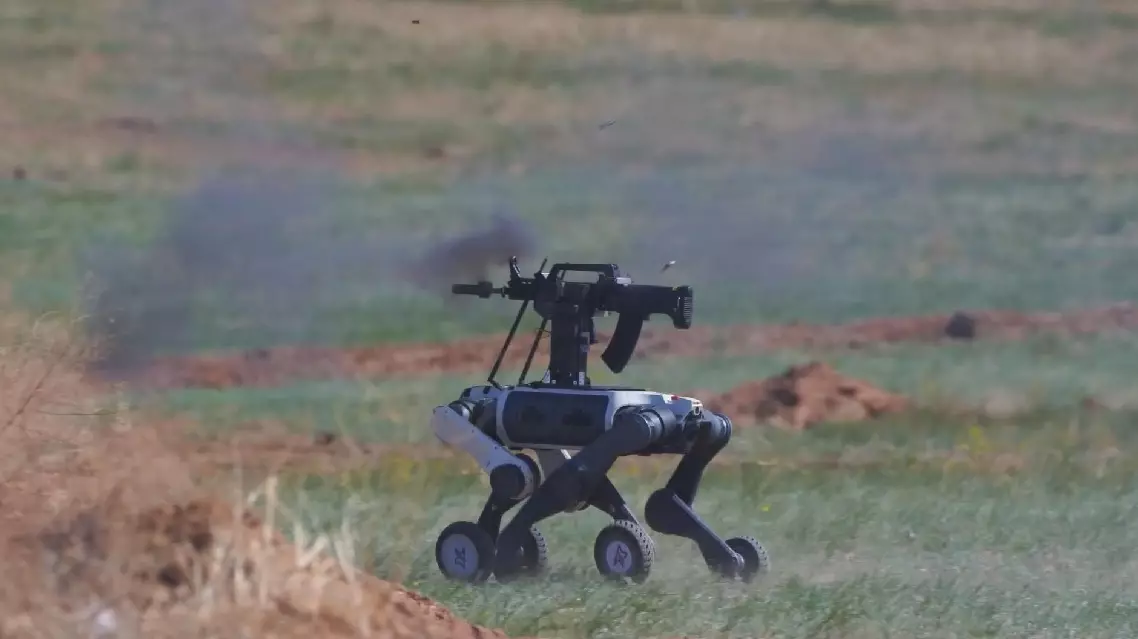
At 09:00, the Chinese troops participating in the training deployed drones and "robotic wolves" to conduct joint reconnaissance of the simulated enemy's outer perimeter positions in coordination with participating Mongolian forces.

Inside the joint command post, commanders from both sides conducted comprehensive analysis based on the transmitted intelligence and jointly directed their troops to complete the operation.

During the exercise, "enemy" combatants used fortified bunkers to launch a counterattack and set up temporary obstacles in front of their positions. Commanders from both China and Mongolia adjusted their deployments, leveraging the fire control advantages of the joint assault group's armored equipment to construct a fire network.

The "robotic wolves" that carried assault rifles on them smoothly crossed the obstacles and maneuvered precisely toward "enemy" guard positions with suppressive fires. Artillery fire teams, in coordination with the mobile assault team, annihilated the entire "enemy" force.

"Both China and Mongolia deployed multiple combat units, including reconnaissance, firepower, and air defense units, and various types of weapons and equipment to jointly complete tasks such as aerial reconnaissance and fire strikes. Relying on a joint command post, the two sides shared information in real time and conducted joint reconnaissance, joint planning, and joint clearing and crackdown operations according to the progress of the operation," said Lieutenant Colonel Ge Changyong, a member of the participating Chinese troops.

The joint exercise, in its second edition this year, was first held in 2024.
Chinese troops unveil unmanned systems in joint drills with Mongolian counterparts
Chinese troops unveil unmanned systems in joint drills with Mongolian counterparts

Major breakthroughs by Chinese scientists have laid the foundation for a future where space-based solar power stations are capable of wirelessly transmitting energy to Earth and spacecraft, though significant engineering problems remain.

A research team from Xidian University in northwest China's Shaanxi Province has made significant progress on the Sun Chasing project, or "Zhuri" in Chinese. The team has developed a ground-based test system for wireless power transmission that can charge multiple moving targets at the same time.

In recent tests, the system achieved a wireless power transmission efficiency of 20.8 percent from direct current to direct current over a distance of 100 meters. It delivered 1,180 watts of power. The team has also built a wireless charging system for drones. In a test, a drone flying at 30 kilometers per hour was able to receive 143 watts of stable power from 30 meters away.

A space solar power station works exactly as its name suggests: a huge array of solar panels placed in orbit. It would collect sunlight in space, where the sun always shines, and then convert that energy into microwaves or lasers to beam down to Earth or directly to satellites and spacecraft. This could address two significant issues: supplying uninterrupted power for space missions and alleviating energy shortages on the ground.

"The construction of space solar power stations could become a major undertaking in the future. One potential benefit is access to a virtually unlimited power supply. Because energy can be collected continuously in space 24 hours a day, electricity could be supplied on an uninterrupted basis," said Fan Guanheng, an associate professor at the School of Mechano-Electronic Engineering at Xidian University.

"Secondly, it could reduce our dependence on fossil fuels, thereby lowering carbon emissions and helping protect the environment. Thirdly, it could support the development of charging infrastructure in space and enable wireless microwave charging for spacecraft, changing the way power is supplied to space vehicles," the professor added.

In 2018, the research team launched the first phase of the Sun Chasing project to build a ground test system. By June 2022, they had completed the world's first full-link, full-system ground validation system for a space solar power station. Now, the team has moved to phase two. The goal now is to solve the challenges of generating high power in space and transmitting it efficiently over long distances.

According to Duan Baoyan, an expert at Xidian University and an academician of the Chinese Academy of Engineering, recent breakthroughs include improving the efficiency of solar energy collection and conversion, increasing the precision of microwave beam control to reduce energy loss, and making the transmitting and receiving antennas smaller and lighter, which is critical for space application.

The team has also solved the problem of how to power multiple moving targets at once using a single transmitter. This means that in the future, one space power station could potentially supply electricity to several satellites or ground vehicles at the same time, Duan said.

Despite the advances in ground-based validation, a series of technical challenges must still be overcome before the technology can be deployed in space.

"The first issue that needs to be addressed is the adaptability of components to the space environment, as conditions in space are completely different from those on Earth, including radiation exposure and extreme temperatures. Another challenge involves the deployment and retraction design of transmitting and receiving antennas. We also need to develop thermal management systems to cope with extreme temperatures and temperature fluctuations in space. These are all areas where further breakthroughs are needed," said Qian Sihao, an associate professor at the School of Mechano-Electronic Engineering at Xidian University.

"We have now completed the development and validation of a ground-based test system, and our next step is to carry out in-orbit wireless microwave power transmission," Fan said.

With ground validation complete, the team now turns its attention to overcoming the harsh realities of space, aiming to demonstrate in-orbit wireless power transmission and bring the vision of orbital solar energy closer to reality.

Space-to-earth solar power moves closer to reality although hurdles remain: scientists

Space-to-earth solar power moves closer to reality although hurdles remain: scientists

Recommended Articles