NINGBO, China, June 8, 2026 /PRNewswire/ -- Robotics, semiconductor equipment, and intelligent automation systems are evolving at an accelerating pace, placing OEM manufacturers under growing engineering and supply chain pressure. Product development cycles continue to shorten while system complexity keeps rising. Expectations for validation efficiency, long term reliability, and cost control are becoming increasingly demanding across the industry.
The competitive landscape of motion control manufacturing is also undergoing a fundamental shift. OEM manufacturers are placing greater attention on whether motor suppliers can quickly understand application requirements, shorten validation cycles, and maintain stable collaboration throughout continuously evolving development processes.
With more than 30 years of experience in motion control manufacturing, Smooth Motor has continued expanding across robotics, semiconductor systems, laboratory automation, and precision equipment industries, driven by rapid engineering response capability built through decades of accumulation. The company has steadily evolved into a deeper engineering partner involved throughout customer development processes.
In recent years, global demand for high precision, compact, and customized motion solutions has continued growing across industries ranging from semiconductor equipment and laboratory automation to robotic actuation systems. More projects now require motion control systems capable not only of delivering precision and reliability, but also of supporting faster validation and adapting to constantly changing structural requirements.
Smooth Motor has remained focused on stepper motor and precision motion technologies for decades. Its portfolio covers hybrid stepper motors, linear stepper motors, can stack motors, voice coil motors, compact stepper motors, geared motors, smart integrated motors, coreless motors, as well as transmission components and customized motion modules. Supported by accumulated product development and machining expertise, the company is able to respond more efficiently to customer requirements involving structure, performance, and operating environments.
For a growing number of OEM manufacturers, rapid response is no longer simply about delivery speed.
It also reflects whether engineering, manufacturing, and supply chains can move together under the same rhythm while continuously adapting to rapidly changing market demands.
According to Smooth Motor, this capability is not built through short term expansion, but through long term accumulation in engineering experience, manufacturing investment, and supply chain coordination systems.
Today, approximately 30 percent of the company's technical and production staff have remained with Smooth Motor since its early years. The stability of the long standing core team has allowed process knowledge, machining expertise, and engineering collaboration capability to continue accumulating over time. In high precision automation industries, continuity in engineering experience often directly affects validation efficiency, manufacturing consistency, and long term operational reliability.
At the same time, Smooth Motor reinvests approximately 20 percent of its annual profits into research and development, manufacturing upgrades, and production optimization. The company has gradually established a flexible manufacturing system capable of supporting small batch production, multiple specifications, and customized development requirements. This helps customers shorten development and validation cycles while improving cost predictability and supply stability.
As robotics and intelligent manufacturing industries continue expanding rapidly, OEM expectations toward motor suppliers are also changing. Rather than maintaining conventional component purchasing relationships, more manufacturers are seeking motor suppliers capable of participating in collaborative development, adjusting solutions quickly, and supporting long term project coordination.
Backed by years of technical accumulation, Smooth Motor has gradually developed integrated motion control capabilities covering motors, drive control systems, and motion modules. The company continues participating in projects related to robotic actuation systems, semiconductor equipment, laboratory automation, and miniature drive technologies. At the same time, Smooth Motor continues strengthening cooperation with international customers and supply chain partners to improve product consistency and global delivery capability.
"Customers today are no longer simply looking for motor suppliers. They are looking for long term partners capable of participating in engineering collaboration and continuously supporting product evolution," said Leon C, CMO of Smooth Motor. "Rapid engineering response is ultimately the result of long term accumulation across motor manufacturing experience, engineering systems, and supply chain capability."
As global manufacturing continues advancing toward intelligent production, higher precision, and deeper system integration, motion control systems are becoming increasingly important across robotics, medical equipment, semiconductor manufacturing, and advanced automation industries. For motion control manufacturers, long term competitiveness is no longer defined only by products themselves, but by the ability to sustain rapid collaboration, stable manufacturing capability, and long term engineering support.
About Smooth Motor
Founded in 1994 and headquartered in Ningbo, China, Smooth Motor is a motor manufacturer specializing in precision motion control solutions, certified under ISO 9001, RoHS, and CE standards. With more than 30 years of experience in stepper motor and linear motion technologies, the company provides hybrid stepper motors, linear stepper motors, can stack motors, voice coil motors, compact stepper motors, geared motors, smart integrated motors, coreless motors, transmission components, and customized motion modules for industries including robotics, medical equipment, semiconductor manufacturing, laboratory automation, and industrial automation.
Website: www.smoothmotor.com
Email: info@smoothmotor.com
** This press release is distributed by PR Newswire through automated distribution system, for which the client assumes full responsibility. **

Smooth Motor Advances Across Robotics and Intelligent Automation Industries Through 30 Years of Rapid Engineering Response
|
- International bookings to 16 North American host cities surge nearly 70% year-on-year
- Japan's travel demand explodes +250%, more than double the growth rate of any European nation
- Mexican hotel bookings for Monterrey up 40X, Guadalajara up 12X, Mexico City up +150%.
MEXICO CITY, June 9, 2026 /PRNewswire/ -- A major football tournament spanning the United States, Canada and Mexico (11 June – 19 July) is set to drive a surge in international travel to North America this summer, with Trip.com booking data revealing year-on-year growth of nearly 70% across the 16 host cities.
As football fans across Asia-Pacific and Europe commit to their summer plans months in advance, the data paints a vivid picture of where travellers are going, how long they are staying, and exactly what sort of trip they are on.
The Football Effect: Demand Nearly Doubles in June Versus July
The scale of football-driven travel demand becomes clear when the two tournament windows are compared directly. During the Group Stage period, total international bookings to host cities are up almost 70% year-on-year. By the Knockout Rounds, that growth rate falls to around 40%, still substantial, but a sharp contrast that reflects the concentrated urgency of fans following their national teams during the opening weeks of competition.
The Group Stage is the must-travel moment. Fans are not waiting to see how their teams perform. They are booking early, decisively, and around the fixtures that matter most to them.
Japan Leads the World
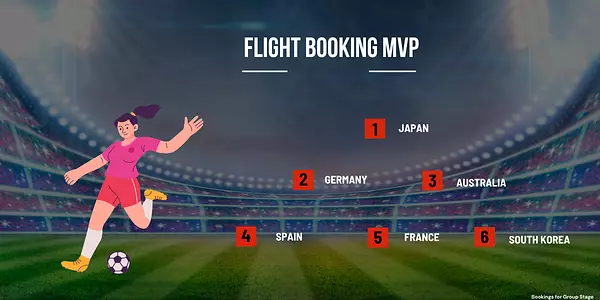
No market tells the 2026 story more dramatically than Japan. Japanese fans are booking flights to host cities at a rate +250% year-on-year for the Group Stage, more than two and a half times the volume of the previous year and more than double the growth rate of any European nation in the same period. Even for the Knockout Rounds, Japan records over +100% growth, the highest of any market analysed.
This is not a general holiday demand dressed up in football colours. It is fixture-following travel at its purest. Japan's Group Stage matches are scheduled across Dallas and Monterrey, and the booking data mirrors this precisely. Dallas is Japan's single most-booked host city for flights in the Group Stage, a city that barely registered on the Japanese outbound travel map twelve months ago. By the Knockout Rounds, when fixtures shift, Los Angeles becomes Japan's top destination.
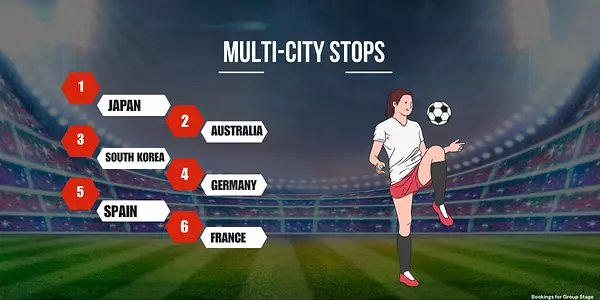
The Japan story does not stop at flight bookings. Japanese travellers are also the most adventurous when it comes to itinerary planning. Over 30% of Japanese Group Stage travellers book more than one host city, the highest multi-city rate of any market by a significant margin. Close to 10% cross two or more host countries during the Group Stage, a direct consequence of Japan's fixtures being distributed across North America.
Japan's top multi-city pairings during the Group Stage tell the story clearly: Dallas + Los Angeles, Dallas + Monterrey and Mexico City + Monterrey. These are not sightseeing routes but carefully planned travel itineraries around match schedules.
The Mexican Cities: The Less Talked About Accommodation Story
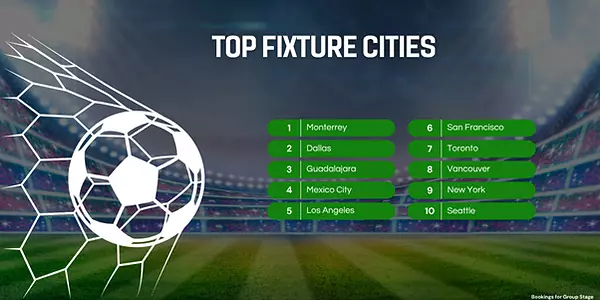
While US and Canadian host cities attract predictable attention, the Mexican venues Guadalajara, Mexico City and Monterrey are generating some exciting booking results across the tournament.
Monterrey's hotel bookings are up over 40X year-on-year during the Group Stage. Guadalajara is up over 10X. Mexico City is up over 150%. These are not incremental gains but represent a near-total transformation of international accommodation demand in cities that were barely on the inbound travel radar before.
The driver is fixture scheduling. Japan, South Korea, and Australia's schedules are drawing fans into a North American travel corridor that extends deep into Mexico.
Dallas tells a complementary story from the US side. Hotel bookings in Dallas are up by more than 1400% during the Group Stage, driven overwhelmingly by Japanese and Korean demand.
The Football Road Trip Is a Myth
Despite the romance of a cross-continental football adventure, the data tells a more pragmatic story. The majority of fans book travel to just one host destination per trip.
Multi-market travel is highest among Japanese fans in the Group Stage and lowest among South Korean fans in the Knockout Rounds.
In every other market and period, single-market trips dominate, with travellers focusing on 1 or more cities within a single North American country.
Lead Times and Loyalty: The Forward Planners vs. The Late Deciders
The gap in booking behaviour between the Group Stage and the Knockout Round is fascinating. Travelling fans booking for July, the later, more uncertain tournament phase, are planning further in advance than those booking for June.
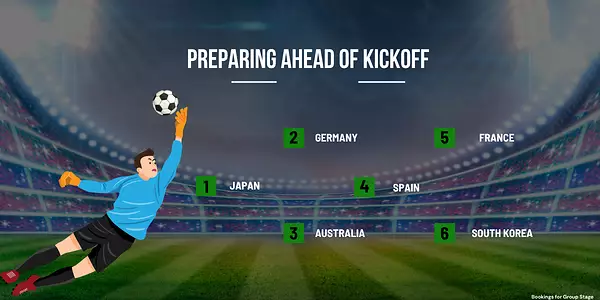
For the Group Stage, flight booking lead times across markets range from 80 to 95 days. For the Knockout Rounds, the same markets are booking 96 to 127 days out.
Germany leads both periods, booking hotels an average of 138 days before travel. That's nearly five months in advance of a match whose participants are not yet confirmed.
This pattern suggests that Knockout Round travellers represent a highly committed segment, with fans hoping their team will advance. Attractions bookings tend to show the opposite trend, with shorter lead times across all markets, suggesting fans finalise their non-football plans on a wait-and-see basis.
Beyond the Stadiums: What Fans Are Doing When the Final Whistle Blows
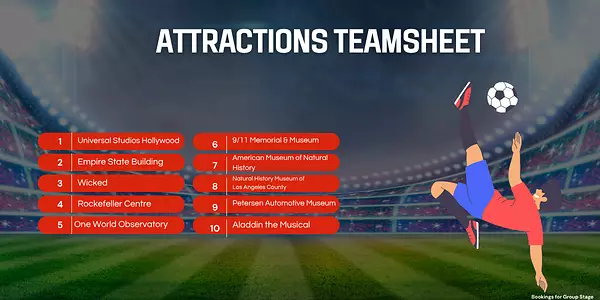
The most-booked attraction is Universal Studios Hollywood, which tops the rankings. The Empire State Building, Rockefeller Centre, and the American Museum of Natural History dominate New York bookings, while Japanese travellers show a distinct appetite for Broadway, with Wicked and Aladdin the Musical both featuring in the top ten attractions overall.
Trip Duration: From Short Breaks to Extended Holidays
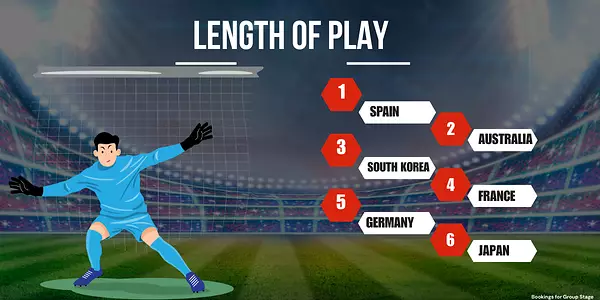
Average trip lengths vary dramatically by market. Japanese travellers take the shortest trips, averaging just 8 days in the Group Stage and 11 days in the Knockout Rounds, reflecting a fixture-focused, time-efficient approach. Spanish fans take the longest, averaging 24 days in the Group Stage and 17 days in July.
Australian fans average 23 days in the Group Stage before falling to 18 days in July. French fans remain consistent at 18 days across both periods. The relative stability of European trip durations across both windows suggests that these travellers are building fixed-length North American itineraries centred on football.
Hotel Preferences: Budget Dominates, But Premium Emerges in July
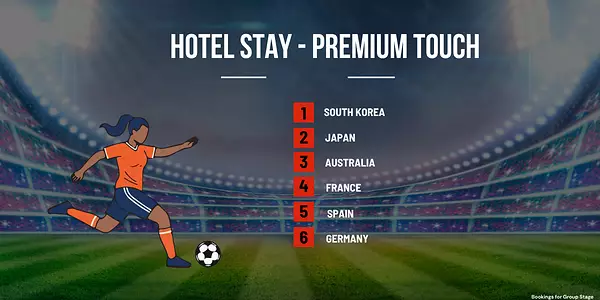
Across most markets, 3-star and 4-star hotels account for the vast majority of bookings, with 5-star demand showing single-digit growth. Japan is the most budget-conscious, with over 61% of Group Stage hotel bookings at the 3-star level. South Korea is the most luxury-oriented in the Group Stage.
In the Knockout Rounds, 5-star demand increases across almost every market compared to the Group Stage. France leads the way with the largest increase in 5-star hotel bookings.
New York dominates as the preferred city for 4-star and 5-star bookings across the majority of markets in both periods, cementing its status as the tournament's prestige destination.
About Trip.com
Trip.com is an international one-stop travel service provider, available in 27 languages across 48 countries and regions in 44 local currencies. Offering an extensive hotel and flight network of more than 1.7 million hotels and flights from over 680 airlines, along with over 350,000 in-destination activities, Trip.com covers 3,500 airports in 220 countries and regions. Trip.com's world-class 24/7 multilingual customer service helps to 'create the best travel experience' for its millions of customers worldwide. To book your next trip, visit Trip.com.
- International bookings to 16 North American host cities surge nearly 70% year-on-year
- Japan's travel demand explodes +250%, more than double the growth rate of any European nation
- Mexican hotel bookings for Monterrey up 40X, Guadalajara up 12X, Mexico City up +150%.
MEXICO CITY, June 9, 2026 /PRNewswire/ -- A major football tournament spanning the United States, Canada and Mexico (11 June – 19 July) is set to drive a surge in international travel to North America this summer, with Trip.com booking data revealing year-on-year growth of nearly 70% across the 16 host cities.
As football fans across Asia-Pacific and Europe commit to their summer plans months in advance, the data paints a vivid picture of where travellers are going, how long they are staying, and exactly what sort of trip they are on.
The Football Effect: Demand Nearly Doubles in June Versus July
The scale of football-driven travel demand becomes clear when the two tournament windows are compared directly. During the Group Stage period, total international bookings to host cities are up almost 70% year-on-year. By the Knockout Rounds, that growth rate falls to around 40%, still substantial, but a sharp contrast that reflects the concentrated urgency of fans following their national teams during the opening weeks of competition.
The Group Stage is the must-travel moment. Fans are not waiting to see how their teams perform. They are booking early, decisively, and around the fixtures that matter most to them.
Japan Leads the World
No market tells the 2026 story more dramatically than Japan. Japanese fans are booking flights to host cities at a rate +250% year-on-year for the Group Stage, more than two and a half times the volume of the previous year and more than double the growth rate of any European nation in the same period. Even for the Knockout Rounds, Japan records over +100% growth, the highest of any market analysed.
This is not a general holiday demand dressed up in football colours. It is fixture-following travel at its purest. Japan's Group Stage matches are scheduled across Dallas and Monterrey, and the booking data mirrors this precisely. Dallas is Japan's single most-booked host city for flights in the Group Stage, a city that barely registered on the Japanese outbound travel map twelve months ago. By the Knockout Rounds, when fixtures shift, Los Angeles becomes Japan's top destination.
The Japan story does not stop at flight bookings. Japanese travellers are also the most adventurous when it comes to itinerary planning. Over 30% of Japanese Group Stage travellers book more than one host city, the highest multi-city rate of any market by a significant margin. Close to 10% cross two or more host countries during the Group Stage, a direct consequence of Japan's fixtures being distributed across North America.
Japan's top multi-city pairings during the Group Stage tell the story clearly: Dallas + Los Angeles, Dallas + Monterrey and Mexico City + Monterrey. These are not sightseeing routes but carefully planned travel itineraries around match schedules.
The Mexican Cities: The Less Talked About Accommodation Story
While US and Canadian host cities attract predictable attention, the Mexican venues Guadalajara, Mexico City and Monterrey are generating some exciting booking results across the tournament.
Monterrey's hotel bookings are up over 40X year-on-year during the Group Stage. Guadalajara is up over 10X. Mexico City is up over 150%. These are not incremental gains but represent a near-total transformation of international accommodation demand in cities that were barely on the inbound travel radar before.
The driver is fixture scheduling. Japan, South Korea, and Australia's schedules are drawing fans into a North American travel corridor that extends deep into Mexico.
Dallas tells a complementary story from the US side. Hotel bookings in Dallas are up by more than 1400% during the Group Stage, driven overwhelmingly by Japanese and Korean demand.
The Football Road Trip Is a Myth
Despite the romance of a cross-continental football adventure, the data tells a more pragmatic story. The majority of fans book travel to just one host destination per trip.
Multi-market travel is highest among Japanese fans in the Group Stage and lowest among South Korean fans in the Knockout Rounds.
In every other market and period, single-market trips dominate, with travellers focusing on 1 or more cities within a single North American country.
Lead Times and Loyalty: The Forward Planners vs. The Late Deciders
The gap in booking behaviour between the Group Stage and the Knockout Round is fascinating. Travelling fans booking for July, the later, more uncertain tournament phase, are planning further in advance than those booking for June.
For the Group Stage, flight booking lead times across markets range from 80 to 95 days. For the Knockout Rounds, the same markets are booking 96 to 127 days out.
Germany leads both periods, booking hotels an average of 138 days before travel. That's nearly five months in advance of a match whose participants are not yet confirmed.
This pattern suggests that Knockout Round travellers represent a highly committed segment, with fans hoping their team will advance. Attractions bookings tend to show the opposite trend, with shorter lead times across all markets, suggesting fans finalise their non-football plans on a wait-and-see basis.
Beyond the Stadiums: What Fans Are Doing When the Final Whistle Blows
The most-booked attraction is Universal Studios Hollywood, which tops the rankings. The Empire State Building, Rockefeller Centre, and the American Museum of Natural History dominate New York bookings, while Japanese travellers show a distinct appetite for Broadway, with Wicked and Aladdin the Musical both featuring in the top ten attractions overall.
Trip Duration: From Short Breaks to Extended Holidays
Average trip lengths vary dramatically by market. Japanese travellers take the shortest trips, averaging just 8 days in the Group Stage and 11 days in the Knockout Rounds, reflecting a fixture-focused, time-efficient approach. Spanish fans take the longest, averaging 24 days in the Group Stage and 17 days in July.
Australian fans average 23 days in the Group Stage before falling to 18 days in July. French fans remain consistent at 18 days across both periods. The relative stability of European trip durations across both windows suggests that these travellers are building fixed-length North American itineraries centred on football.
Hotel Preferences: Budget Dominates, But Premium Emerges in July
Across most markets, 3-star and 4-star hotels account for the vast majority of bookings, with 5-star demand showing single-digit growth. Japan is the most budget-conscious, with over 61% of Group Stage hotel bookings at the 3-star level. South Korea is the most luxury-oriented in the Group Stage.
In the Knockout Rounds, 5-star demand increases across almost every market compared to the Group Stage. France leads the way with the largest increase in 5-star hotel bookings.
New York dominates as the preferred city for 4-star and 5-star bookings across the majority of markets in both periods, cementing its status as the tournament's prestige destination.
About Trip.com
Trip.com is an international one-stop travel service provider, available in 27 languages across 48 countries and regions in 44 local currencies. Offering an extensive hotel and flight network of more than 1.7 million hotels and flights from over 680 airlines, along with over 350,000 in-destination activities, Trip.com covers 3,500 airports in 220 countries and regions. Trip.com's world-class 24/7 multilingual customer service helps to 'create the best travel experience' for its millions of customers worldwide. To book your next trip, visit Trip.com.
** This press release is distributed by PR Newswire through automated distribution system, for which the client assumes full responsibility. **
Global Football Tournament Drives Travel Surge, with Group Stage Booking Growth Nearly Double Knockout Round's: Trip.com Data
Global Football Tournament Drives Travel Surge, with Group Stage Booking Growth Nearly Double Knockout Round's: Trip.com Data
Global Football Tournament Drives Travel Surge, with Group Stage Booking Growth Nearly Double Knockout Round's: Trip.com Data
Global Football Tournament Drives Travel Surge, with Group Stage Booking Growth Nearly Double Knockout Round's: Trip.com Data
Global Football Tournament Drives Travel Surge, with Group Stage Booking Growth Nearly Double Knockout Round's: Trip.com Data
Global Football Tournament Drives Travel Surge, with Group Stage Booking Growth Nearly Double Knockout Round's: Trip.com Data
Global Football Tournament Drives Travel Surge, with Group Stage Booking Growth Nearly Double Knockout Round's: Trip.com Data

Global Football Tournament Drives Travel Surge, with Group Stage Booking Growth Nearly Double Knockout Round's: Trip.com Data