LAS VEGAS--(BUSINESS WIRE)--Jun 8, 2026--
Organizations delivering agentic artificial intelligence (AI) successfully do so by rethinking existing processes to support a culture of collaboration and innovation that maximizes project benefits, according to new research from Pegasystems Inc. (NASDAQ: PEGA), the enterprise AI software company for mission-critical work. The study, conducted with research firm Savanta, was unveiled at PegaWorld®, the company’s annual conference in Las Vegas. It identified more than 500 business and IT decision makers across enterprises worldwide who have already implemented agentic AI projects and surveyed them on the secrets behind their success.
This press release features multimedia. View the full release here: https://www.businesswire.com/news/home/20260608557645/en/
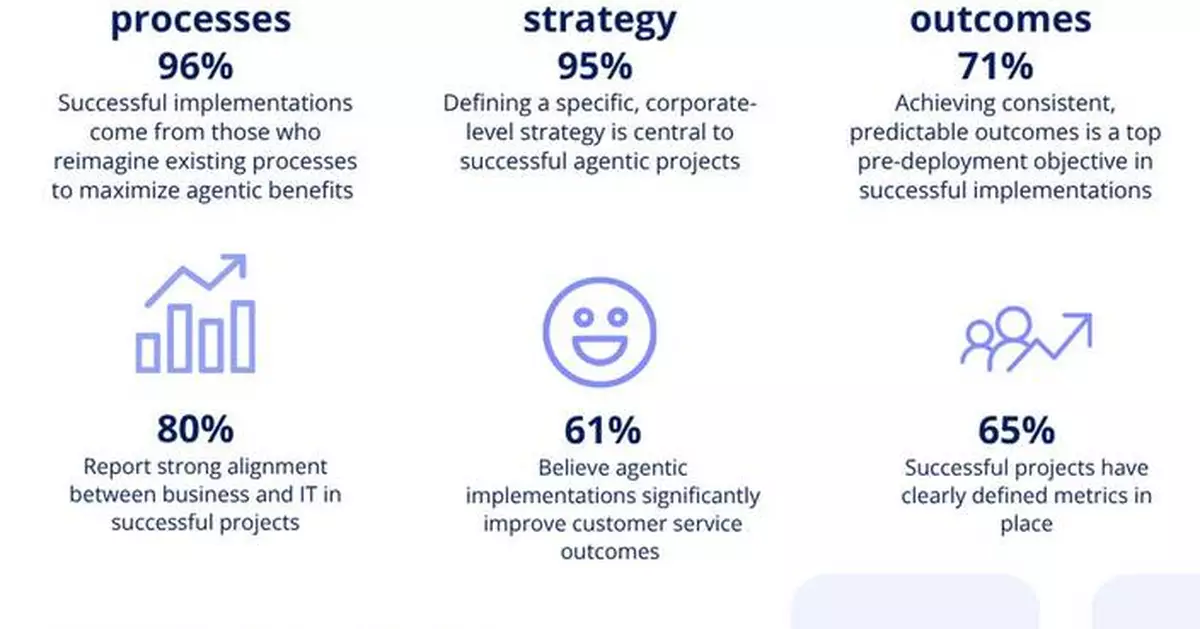
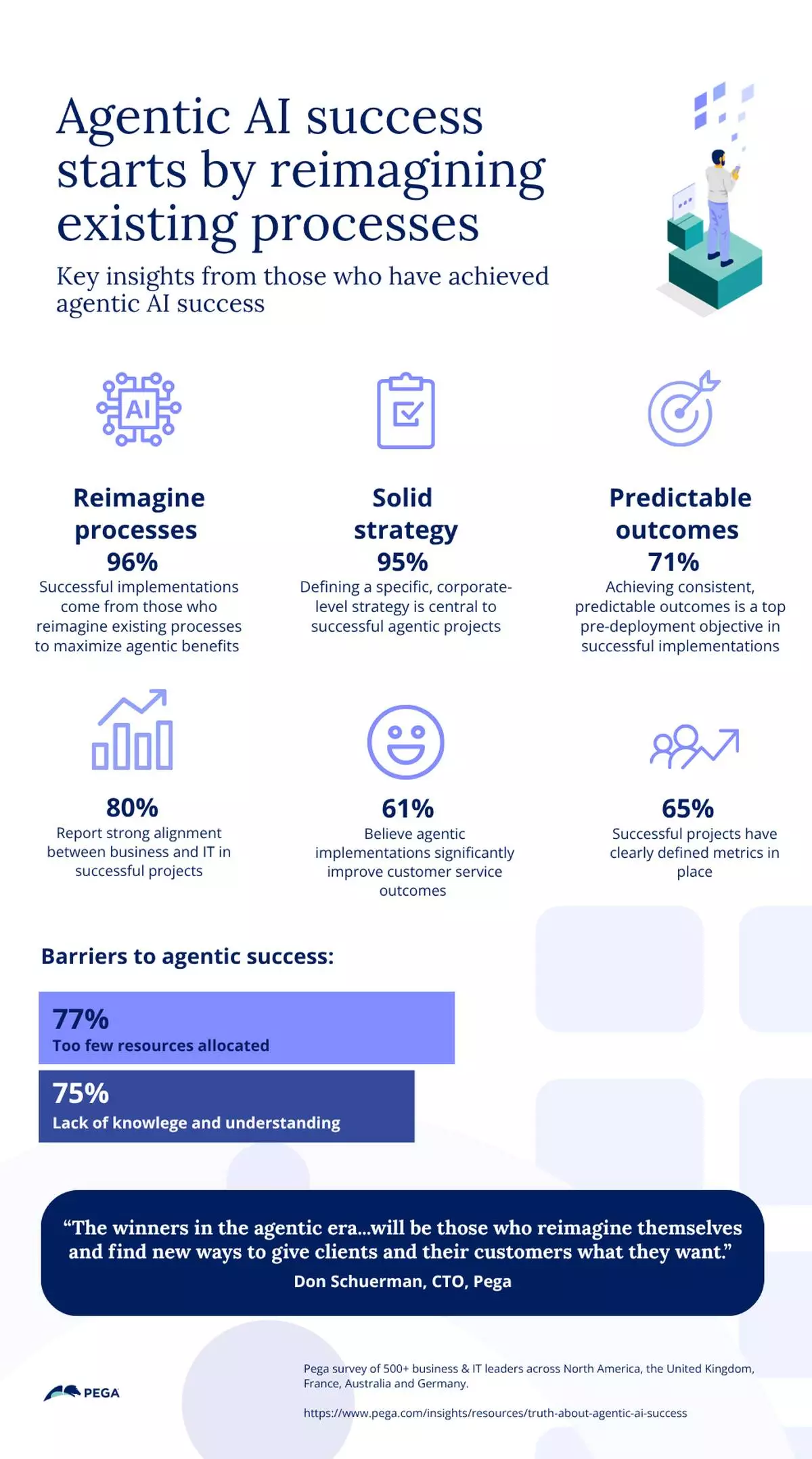
The study revealed the vast majority (96%) of those who successfully implemented agentic AI had rethought existing processes, sparking a new culture of collaboration and innovation. More than half (53%) said they’ve done so to a ‘significant’ extent, by reimagining everything their organization does to gain maximum benefit from their agentic implementations. Eighty percent agreed business and IT were willing to embrace new technology, innovation, and ideas to explore new possibilities – a further sign of revisiting traditional ways of thinking and finding new ways to collaborate and ensure project success.
This newfound commitment to rethinking old methods to ensure success is driven largely by a desire to provide more consistent, predictable outcomes. Three quarters (71%) of successful agentic AI implementers said one of their top two pre-deployment objectives was to automate and simplify complex processes, so they work consistently and predictably across systems and platforms. Almost half (45%) ranked this as their top priority. Over half (58%) also reported their execution aligned with these objectives had already been rewarded with predictable outcomes, reduced complexity, and improved customer experiences.
Other findings from the research highlighted some of the key behaviors of those who have achieved agentic AI success, including:
Quotes & Commentary
“We’re fast reaching a tipping point with agentic AI where adoption is high within organizations, but maturity is not,” said Don Schuerman, chief technology officer, Pega. “The value will come from rethinking ways of working and aligning culture around what AI makes possible. Those changes are what separates the promise of AI technology from the reality of creating truly transformational benefits.
The winners in the agentic era will not be those who deploy agents wherever and whenever they can. They will be those who reimagine themselves and find new ways to give clients and their customers what they want. Businesses that don’t will be left behind.”
Notes
Pega surveyed more than 500 business and IT decision makers worldwide who had successfully implemented agentic AI projects. It explored their motivations for embracing the technology, the most common factors in delivering success, and barriers to achieving their goals. The results included responses from North America, the United Kingdom, France, Australia, and Germany.
Additional Resources
About Pega
Pega delivers the platform to reimagine, run, and evolve the processes and decisions an enterprise can't afford to get wrong. We combine AI with proven architecture to keep mission-critical operations governed, scalable, and continuously adaptable. Since 1983, the world's largest organizations have trusted Pega to turn transformation ambition into durable results. Learn more at pega.com.
All trademarks are the property of their respective owners
Agentic AI Success Starts by Reimagining Existing Processes, Says Research
Israel struck Iran on Monday after being targeted by missiles, while a U. S. military base in Saudi Arabia came under fire in the most serious exchange of hostilities since an April ceasefire, raising the possibility of a return to heavy fighting and complicating mediation efforts to end the war.
Iranian state television reported the sound of explosions being heard in Isfahan, Tabriz and Tehran, without immediately elaborating. Earlier, Iran had launched missiles at Israel in the first such bombardment since a fragile ceasefire took effect in early April, raising the possibility of a return to heavy fighting and complicating mediation efforts to end the war.
Tehran had warned of retaliation after Israel struck Beirut’s southern suburbs without warning earlier Sunday in defiance of Washington’s request days ago to stand down. Israel said the Iranian-backed Hezbollah fired at northern Israel earlier in the day.
Saudi Arabia sounded missile alert sirens Monday morning in an area home to an air base that hosts U.S. forces.
The Israeli strikes came in apparent defiance to President Donald Trump who urged Israeli Prime Minister Benjamin Netanyahu that he doesn’t think Israel needs to respond further.
Speaking to The Financial Times, U.S. President Donald Trump before the Israeli strike on Iran insisted he dictated terms to Israeli Prime Minister Benjamin Netanyahu on how the war should be prosecuted.
“He won’t have any choice,” Trump told the newspaper in a telephone interview. “I call the shots. I call all the shots. He (Netanyahu) doesn’t call the shots.”
Here's the Latest:
Israel’s rescue services said there were no reports of casualties or impacts from the launch from Yemen.
Israel’s military updated its guidelines for civilians on Sunday evening, limiting large gatherings and canceling school across the country.
It is the first time school has been canceled across Israel since the earlier round of fighting with Iran in April, though schools in Israel’s northern border had been closed for much longer due to the threat of Hezbollah fire.
Israel said Monday that it detected a missile launched from Yemen targeting the country. Sirens sounded across Israel after the Yemen missile fire warning.
Yemen is home to the Iranian-backed Houthi rebels. The Houthis have fired missiles at Israel during the Israel-Hamas war and later, but haven’t been fully involved in the Iran war.
Saudi Arabia sounded missile alert sirens Monday morning in an area home to an air base that hosts U.S. forces. Saudi state media reported the alert around its Al Kharj governorate, home to Prince Sultan Air Base.
It did not elaborate. The alert came after Israel launched strikes targeting Iran.
Speaking to The Financial Times, U.S. President Donald Trump before the Israeli strike on Iran insisted he dictated terms to Israeli Prime Minister Benjamin Netanyahu on how the war should be prosecuted.
“He won’t have any choice,” Trump told the newspaper in a telephone interview. “I call the shots. I call all the shots. He (Netanyahu) doesn’t call the shots.”
The White House did not respond to messages Sunday about the strikes and whether they were done in coordination with the U.S.
Iran closes airspace around Tehran’s Imam Khomeini International Airport, country’s main airfield, after Israeli attack.
Israel says it strikes central and Western Iran after missile fire; Tehran says explosions heard in several cities

A woman walks past a mural depicting a U.S. aircraft carrier under missile attack in downtown Tehran, Iran, Monday, June 8, 2026. (AP Photo/Vahid Salemi)

Israeli security forces examine a fragment of an intercepted Iranian missile in northern Israel, early Monday, June 8, 2026. (AP Photo/Rami Shlush)

A projectile streaks through the sky over central Israel during an Iranian missile attack, Sunday, June 7, 2026. (AP Photo/Ohad Zwigenberg)