Speech by SJ at Asia-Pacific Economic Cooperation Anti-Corruption and Transparency Experts Working Group Workshop
Following is the speech by the Secretary for Justice, Mr Paul Lam, SC, at the Workshop on Promoting Integrity for Economic Prosperity organised by the Asia-Pacific Economic Cooperation's Anti-Corruption and Transparency Experts Working Group today (June 9):
Honourable Vice Chairman Fu (Vice Chairman of the National Commission of Supervision of China (NCS) Mr Fu Kui), Commissioner Woo (Commissioner of the Independent Commission Against Corruption (ICAC), Mr Woo Ying-ming), distinguished guests, ladies and gentlemen,
Good morning. It is my great pleasure to speak at this Anti-Corruption and Transparency Experts Working Group Workshop cohosted by the National Commission of Supervision, China and the Independent Commission Against Corruption of Hong Kong, China. To begin with, I would like to welcome all of you, in particular those coming from other economies.
The theme of today's workshop, namely, promoting integrity for economic prosperity, is plainly of great significance and common interest. In my view, it involves two primary questions: first, the relationship between integrity and economic prosperity; second, how to promote integrity.
Let me begin with the meaning of integrity. The United Nations Office on Drugs and Crime defines this term as follows: "Integrity is the practice of being honest, being respectful, adhering to our values, and consistently making positive decisions - even when no one else is looking".
Undoubtedly, there is an important interplay between the culture of integrity and economic development. In this respect, we look forward to hearing from eminent speakers coming from different economies to speak at the three sessions of this workshop on strengthening integrity for better livelihoods; building stronger financial systems through integrity; and promoting cross-border investment and trade with integrity.
The way I look at the matter is this. On the one hand, a culture of integrity would create a fair and transparent level playing field where people would feel confident and comfortable to take part. This is naturally and logically conducive and essential to economic growth and social development. However, at the same time, economic growth might induce some people to pursue their own interests by resorting to corrupt behaviours. The long and short of it is that social and economic growth will not be sustainable unless it is coupled with a strong culture of integrity.
The big question is, therefore, how to promote a culture of integrity. Integrity is a rather elusive concept incapable of precise definition. Hence, it is necessary to convert the concept into a set of rules, which are reasonably clear, to guide and regulate people's behaviour. It is equally necessary that this set of rules be faithfully and effectively enforced. This set of rules is our laws. The point that I wish to make is that the rule of law is the indispensable means to promote a culture of integrity.
Hong Kong, China provides a good example to demonstrate how promotion of integrity by the rule of law may contribute to economic prosperity. Hong Kong, China experienced an economic boom since about the 70s in the last century. It is telling that it was also in the late 70s that Hong Kong, China introduced fundamental changes to its legal regime to tackle the then serious corruption problems. Hong Kong, China has now become an international financial, trading and shipping centre; it is also now one of the least corrupt places in the world and renowned for its strong rule of law. This cannot be a sheer coincidence.
The Prevention of Bribery Ordinance (POBO), which is still the main piece of legislation to combat corruption, was enacted in 1971. The POBO introduced new offences and wide powers of investigation. For example, section 10 of the POBO creates the offence of "possession of unexplained property", which imposes upon a public office holder the burden of giving a satisfactory explanation if he maintains a standard of living above that which is commensurate with his present or past emoluments.
Apart from the POBO and other statutes, our common law includes the criminal offence of misconduct in public office, which is a powerful anti-corruption legal tool. The essence of the offence is the abuse of public trust by a public officer. Let me cite one precedent as an example: receiving large sums of money in anticipation of appointment to a senior public office as a "general sweetener" for favourable inclination while in office.
Criminal offences are supplemented by civil liabilities. For example, the common law of constructive trusts has been used to compel corrupt public officials to surrender illegal benefits derived from corruption to the government.
Corruption in the private sector is also subject to both criminal and civil liabilities. Under our criminal law, one example is section 9 of the POBO, which makes it an offence for a person to offer an agent, or for an agent to solicit or accept, an advantage in return for him doing an act in relation to his principal's affairs or business. Insofar as civil law is concerned, under our common law, agents or employees would owe a general implied fiduciary duty or duty of fidelity, which in essence requires them to act in good faith in the best interests of their principals or employers. Breach of such duties would result in liabilities to pay loss and damages, and surrender any improper benefits received, to the principals or employers.
Having all these, no matter how comprehensive the laws are, they can only achieve their intended purposes if they can be, and are in fact, enforced effectively. The establishment of the ICAC in 1974 was a turning point. Apart from enjoying very wide investigation and related powers, the most crucial feature is its independence in that it is not subject to the direction or control of any person other than the Chief Executive. The significant contributions made by our strong and independent judiciary, which adjudicated corruption-related cases, whether civil or criminal, fairly and expeditiously, must, of course, be borne in mind.
The existence of a comprehensive anti-corruption legal regime not only deters and punishes corrupt behaviours; it also provides a significant propaganda effect to cultivate a culture of integrity. This is important because corrupt behaviours are mostly secretive, and hard to detect. Ultimately, the effectiveness of the laws depends on people's self-awareness, readiness and willingness to abide by them. I am proud to say that the people of Hong Kong, China have zero tolerance for corruption. According to the ICAC Annual Survey 2025, about 98 per cent of the public believed maintaining a corruption-free society is crucial to Hong Kong's overall development. It is no exaggeration to suggest that anti-corruption has already become an integral part of the "genetic makeup" of the people of Hong Kong, China.
Ladies and gentlemen, Hong Kong, China's journey in the past few decades shows how integrity has contributed to sustainable social development and economic prosperity. It is a never-ending journey, which cannot be walked alone. While each economy would need to find its own way to promote integrity for the purpose of advancing social and economic prosperity by reference to its own peculiar circumstances, knowledge and experience sharing as well as mutual legal assistance among economies are not only desirable but also necessary, in particular, having regard to the fact that many challenges are common and transboundary. I wish to make it crystal clear that Hong Kong, China stands ready to serve as a good companion with other economies on our respective journeys in this respect.
May I conclude by wishing you two days of productive and inspiring discussions. I would also encourage friends coming from other economies to take some time to experience Hong Kong, China as a safe, friendly and interesting place where integrity and prosperity coexist. Thank you.

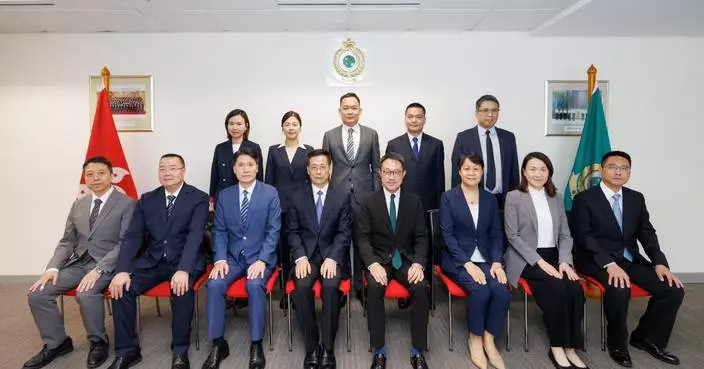
The Secretary for Justice, Mr Paul Lam, Photo source: reference image