Skip to Content Facebook Feature Image

Service industries see significant growth in business receipts for Q1 2026 compared to Q1 2025.

HK

Service industries see significant growth in business receipts for Q1 2026 compared to Q1 2025.
HK

HK

Service industries see significant growth in business receipts for Q1 2026 compared to Q1 2025.

2026-06-09 16:30 Last Updated At:16:43

Quarterly business receipts indices for service industries for first quarter of 2026

Business receipts in value terms of almost all major service industries showed increases of varying magnitudes in the first quarter of 2026 when compared with the first quarter of 2025, according to the provisional figures of business receipts indices released today (June 9) by the Census and Statistics Department (C&SD).

Comparing the first quarter of 2026 with the first quarter of 2025, double-digit increases were recorded in business receipts indices of the import/export trade (+33.3%), insurance (+31.0%), financing (except banking) (+19.5%), wholesale (+17.4%), retail (+12.1%) and banking (+11.7%) industries. On the other hand, the warehousing and storage industry recorded a decrease of 2.0% in business receipts index during the same period.

Analysed by service domain, business receipts index of the computer and information technology services domain increased by 103.3% year-on-year during the same period, while that of the tourism, convention and exhibition services domain also increased by 8.3% year-on-year.

On a seasonally adjusted quarter-to-quarter comparison, business receipts in value terms of many major service industries recorded increases of varying magnitudes in the first quarter of 2026 when compared with the fourth quarter of 2025. In particular, double-digit increases were recorded in business receipts indices of the insurance (+31.8%), import/export trade (+29.9%), wholesale (+16.9%) and banking (+15.4%) industries. On the other hand, business receipts index of the financing (except banking) industry decreased by 12.1% during the same period.

Analysed by service domain, comparing the first quarter of 2026 with the fourth quarter of 2025 on a seasonally adjusted basis, business receipts index of the computer and information technology services domain increased by 41.2%, whereas that of the tourism, convention and exhibition services domain decreased by 0.8%.

Commentary

A Government spokesman said that business receipts of almost all service industries increased in the first quarter of 2026 over a year earlier. In particular, the import/export trade, insurance, financing (except banking), wholesale, retail and banking industries saw double-digit growth in their business receipts.

Looking ahead, businesses of service industries in general should continue to expand. The ongoing economic expansion and notable increase in inbound visitors should provide support to various service industries. The Government will remain vigilant to the potential downside risks stemming from evolving geopolitical tensions and uncertainties in the external environment.

Further information

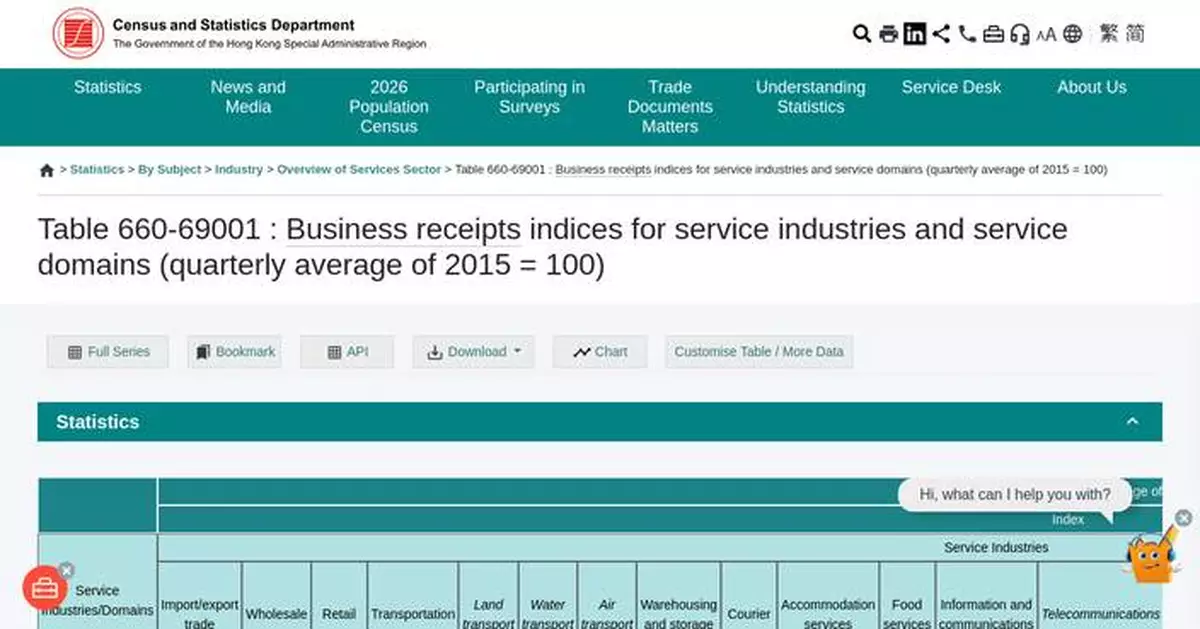
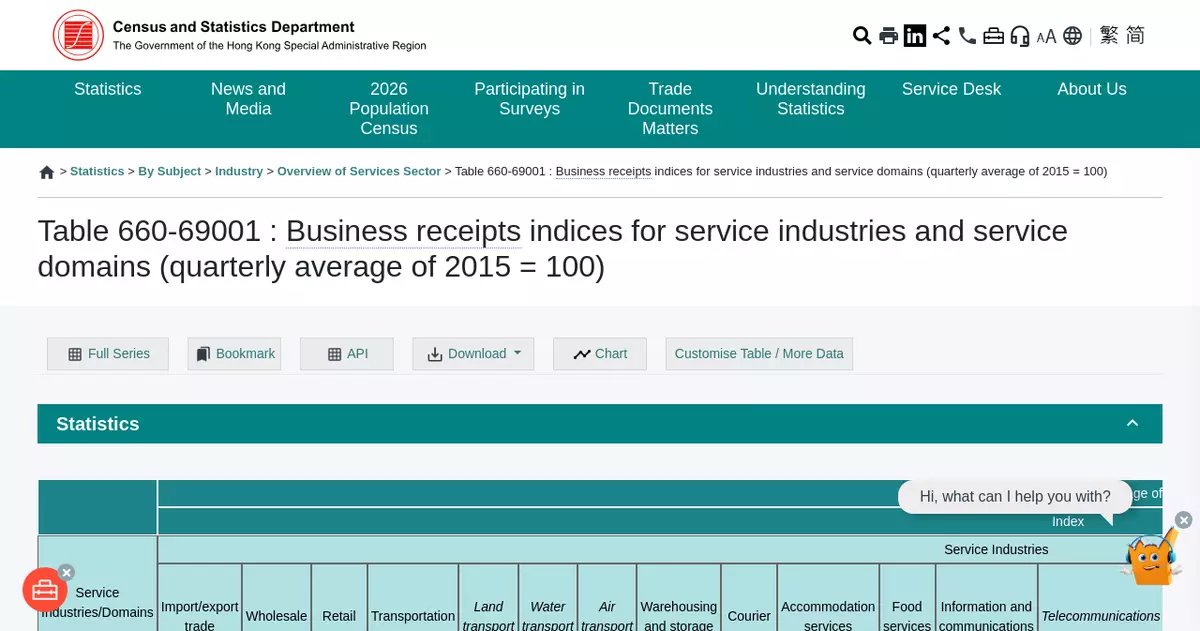
Table 1 presents the business receipts indices and their corresponding year-on-year rates of change in respect of selected service industries and service domains for the recent five quarters, while Table 2 shows the corresponding quarter-to-quarter rates of change in the business receipts indices for the recent five quarters based on the seasonally adjusted series.

The revised figures of business receipts indices for the first quarter of 2026 will be released at the website of the C&SD (www.censtatd.gov.hk/en/web_table.html?id=660-69001) on July 17, 2026.

Data for compiling the business receipts indices are mainly based on the Quarterly Survey of Service Industries conducted by the C&SD, supplemented by relevant data provided by the Hong Kong Monetary Authority and the Hong Kong Tourism Board.

A service domain differs from a service industry in that it comprises those economic activities which straddle different industries but are somehow related to a common theme. It may include all activities carried out by all companies in a service industry that is closely related to the domain. For a service industry that is less closely related, however, only a portion of the companies in the industry or even only part of the economic activities of the companies is related to the domain. Taking the tourism, convention and exhibition services domain as an example, it includes all services of convention and exhibition organisers, short-term accommodation services and services of travel agents, and some of the services (only those involving visitors as customers) of restaurants, retailers and transport operators.

The classification of service industries follows the Hong Kong Standard Industrial Classification Version 2.0, which is used in various economic surveys for classifying economic units into relevant industry classes.

More detailed statistics are given in the report "Quarterly Business Receipts Indices for Service Industries, First Quarter 2026". Users can browse and download this publication at the website of the C&SD (www.censtatd.gov.hk/en/EIndexbySubject.html?pcode=B1080006&scode=520).

For enquiries about the business receipts indices, please contact the Business Services Statistics Section of the C&SD (Tel: 3903 7274 or e-mail: business-receipts@censtatd.gov.hk).
Source: AI-found images


Source: AI-found images

Making of Subsidiary Legislation under Safeguarding National Security Ordinance

The Chief Executive in Council today (June 9) approved the making of the Safeguarding National Security (Procedural Matters) Regulation (Procedural Matters Regulation) under section 110 of the Safeguarding National Security Ordinance (SNSO), to state clearly the classification mechanism under the Law of the People's Republic of China on Safeguarding National Security in the Hong Kong Special Administrative Region (HKNSL) and the SNSO for "other offences endangering national security under the law of the HKSAR", in order to reflect the legislative intent of the HKNSL and the SNSO, and to better carry into effect the relevant provisions of the HKNSL and the SNSO. The Procedural Matters Regulation was gazetted on the same day and came into operation immediately.

To fulfil the constitutional responsibility to continue to improve the legal system and enforcement mechanisms for safeguarding national security, the Government of the Hong Kong Special Administrative Region (HKSAR) has been continuously reviewing the current legal system and enforcement mechanisms of the HKSAR. Should there be any area for improvement or any need to clearly provide for a mechanism, the HKSAR Government will introduce legislative proposals in a timely manner.

Based on the legislative intent of the HKNSL, the meaning of "offence endangering national security" under section 7 of the SNSO and the relevant case law of the Court of Final Appeal, offences endangering national security include the offences stipulated in the HKNSL, the Implementation Rules for Article 43 of the Law of the People's Republic of China on Safeguarding National Security in the Hong Kong Special Administrative Region and the SNSO, as well as "other offences endangering national security under the law of the HKSAR" referred to in section 7(d) of the SNSO, i.e. other offences under other laws of the HKSAR in respect of which the criminal act concerned in a particular case is in the nature of endangering national security. In this connection, the HKSAR Government considers it necessary to state clearly the classification mechanism under the HKNSL and the SNSO for "other offences endangering national security under the law of the HKSAR" by way of subsidiary legislation, in order to better carry into effect section 7(d) of the SNSO and the provisions applicable to offences endangering national security in the HKNSL, the SNSO and other laws.

The mechanism stated by the Procedural Matters Regulation is as follows: if the Chief Executive issues a certificate under Article 47 of the HKNSL or section 115 of the SNSO to certify that the act concerned in a criminal case involves national security, then the case is a case concerning offence endangering national security mentioned in Article 41 of the HKNSL, and the offence in respect of such act which is the subject of investigation, arrest or charge is an offence endangering national security under section 7(d) of the SNSO.

The relevant provisions on certificates issued by the Chief Executive are entirely consistent with the common law principles. The courts in common law jurisdictions such as Hong Kong, the United Kingdom, etc are all of the view that the executive authorities are in a better position than the courts to make appropriate assessments and judgements on matters of national security issues. Therefore, the judicial authorities defer to the assessments and judgements of the executive authorities in this respect.

A HKSAR Government spokesperson said, "The mechanism for the Chief Executive to issue a certificate under Article 47 of the HKNSL or section 115 of the SNSO to certify whether an act involves national security, as well as the provisions applicable to offences endangering national security in laws such as the HKNSL and the SNSO, are all existing provisions that have been operating effectively. The Procedural Matters Regulation does not alter these provisions. It does not alter the scope of application of the HKNSL and the SNSO and the definition of 'offence endangering national security'. Nor does it create any new offence, penalty or enforcement power.

"The making of the Procedural Matters Regulation aims to state clearly the classification mechanism under the HKNSL and the SNSO for 'other offences endangering national security under the law of the HKSAR', thereby refining details of relevant procedural matters and bringing greater certainty to the implementation of the relevant provisions under the HKNSL, the SNSO and other laws. The relevant provisions under the HKNSL, the SNSO and other laws are only applicable to a small number of criminals who commit an offence endangering national security, and will not affect the lives of the general public, or the normal operation of organisations and institutions. Therefore, law-abiding individuals, organisations and institutions will by no means be affected by the Procedural Matters Regulation."

Source: AI-found images

Source: AI-found images

Recommended Articles