WASHINGTON (AP) — Teddy Roosevelt boxed. Richard Nixon bowled.
Dwight D. Eisenhower put in a putting green. George H.W. Bush added a horseshoe pit. Herbert Hoover played a game named for himself to get more exercise, while George W. Bush threw open the space for youth T-ball.
Click to Gallery
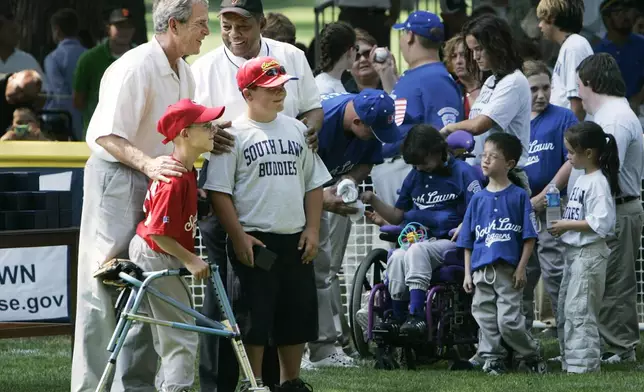
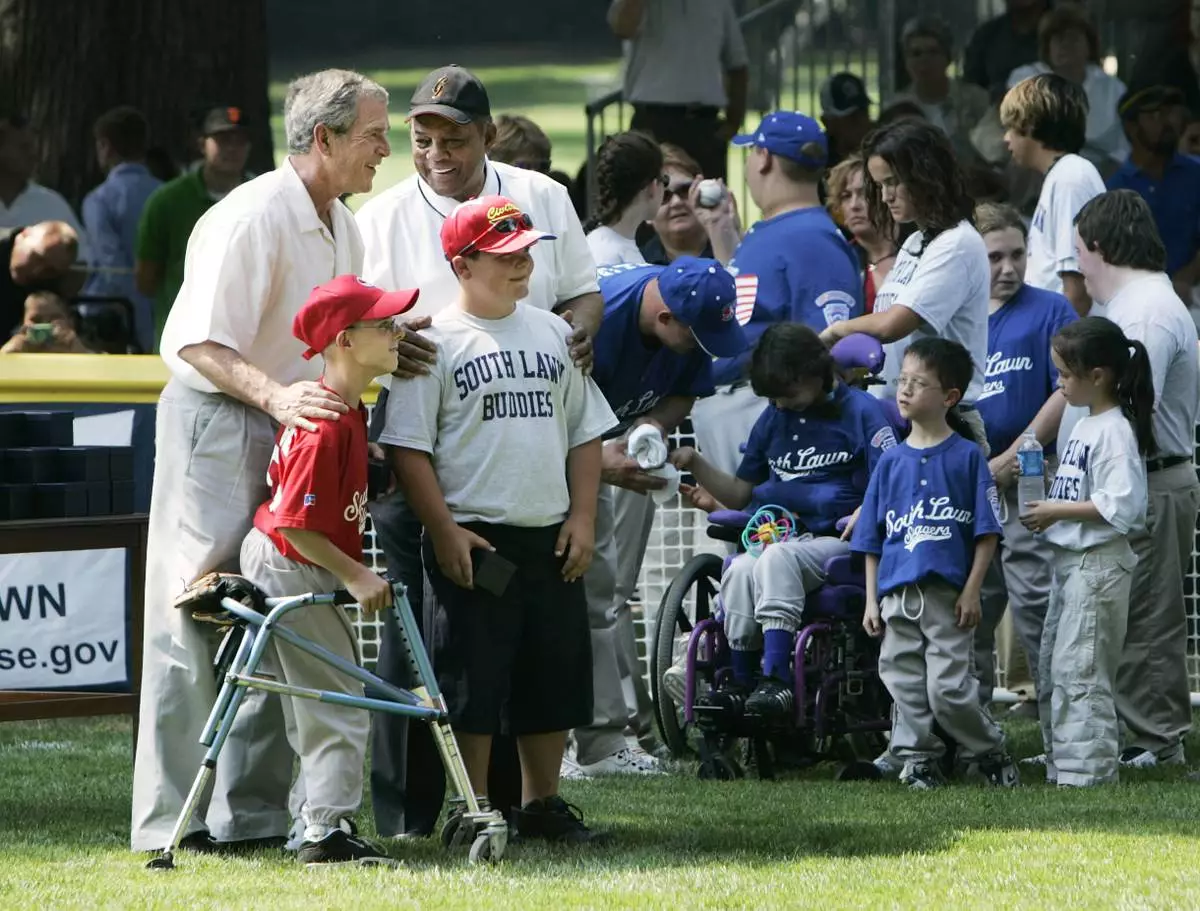
FILE - President George W. Bush, left, and National Baseball Hall of Fame member Willie Mays, back right, pose with Robert Shaffer and Colin Schildt, of Challengers from Thurmont Little League and Civitan Club of Frederick in Thurmont , Md., during a ceremony at the conclusion of the White House Tee Ball Game on the South Lawn, Sunday, July 30, 2006, in Washington. (AP Photo/Manuel Balce Ceneta, File)
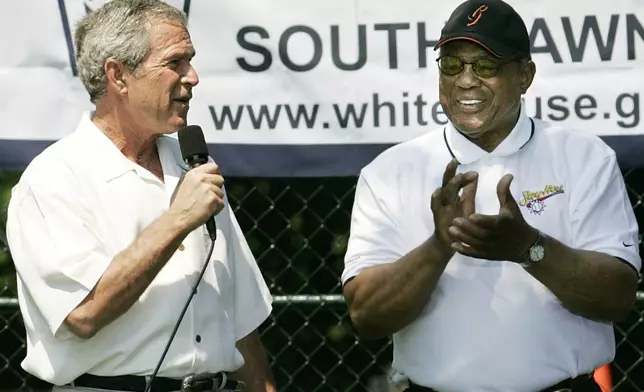
FILE - President George W. Bush, left, and National Baseball Hall of Fame member Willie Mays open the White House Tee Ball Game on the South Lawn, Sunday, July 30, 2006, in Washington. (AP Photo/Manuel Balce Ceneta, File)
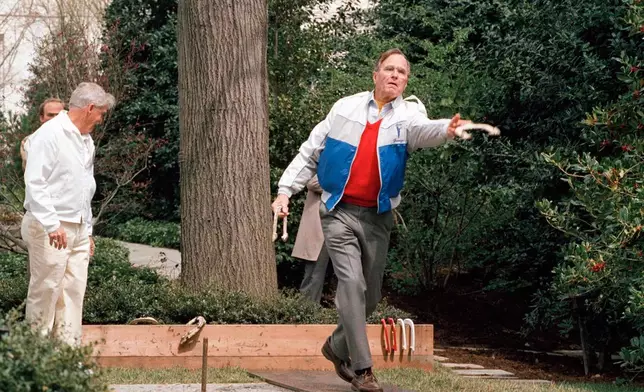
FILE - President George H.W. Bush lets loose of a horseshoe during the dedication of the new horseshoe pit on the White House lawn Saturday April 1, 1989, in Washington. (AP Photo/Barry Thumma)
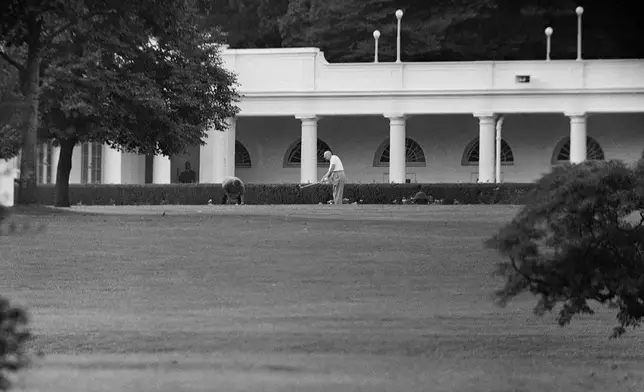
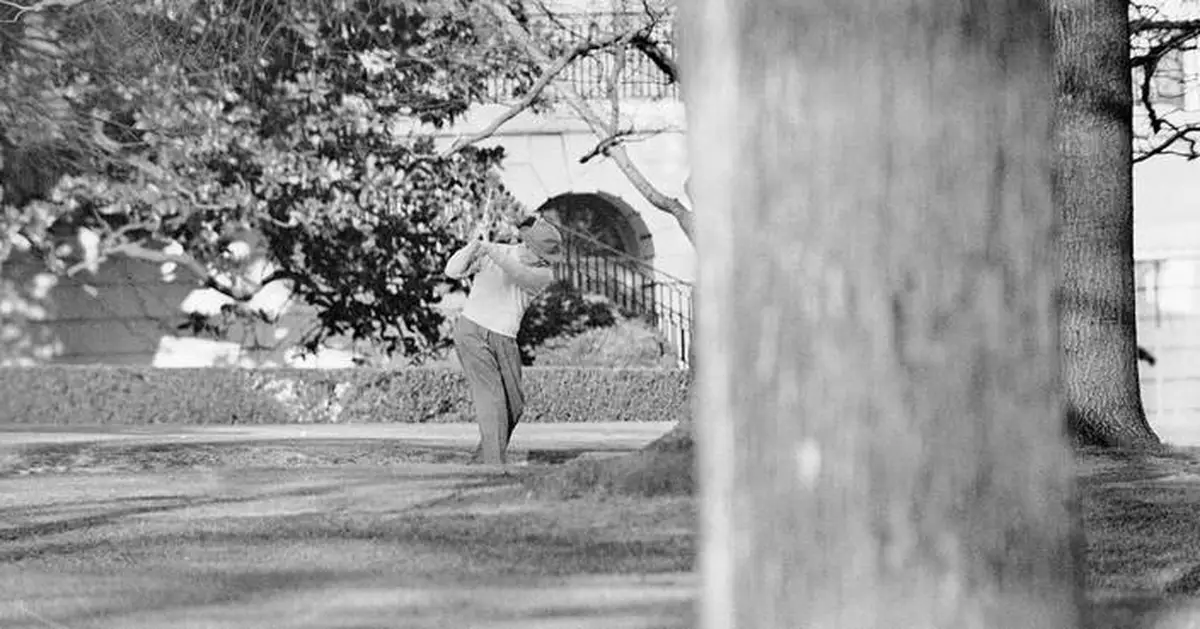
FILE - President Dwight D. Eisenhower, getting in a final bit of relaxation on the eve of the visit by Soviet Premier Nikita Khrushchev, practices a few iron shots the South Lawn of the White House in Washington, Sept. 14, 1959. (AP Photo, File)
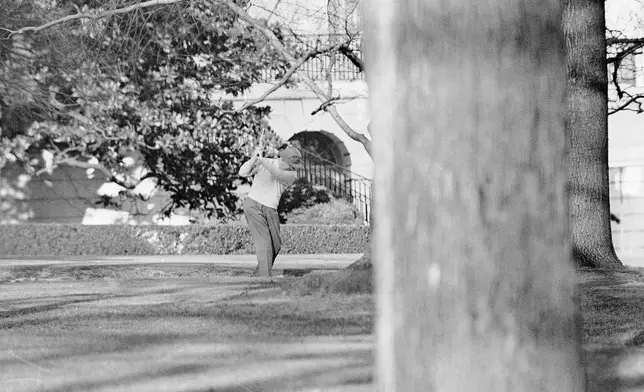
FILE - President Dwight Eisenhower brushes up on his golf game near the putting green on the lawn of the White House, Jan. 13, 1959, in Washington. (AP Photo, File)
The White House and its storied South Lawn are no strangers to sporting events. But they've never seen anything like the UFC show President Donald Trump is hosting to celebrate his 80th birthday on Sunday or the eight-sided, wire-mesh cage complete with an open overhead dome featuring large screens that are surrounded by thousands of arena seats.
Sometimes called America’s backyard, the South Lawn was until now known for low-contact sports and joyful events geared toward children or bipartisanship, like the annual Easter Egg Roll or the congressional picnic.
The same space being used for blood sport, feting a president who relishes it and playing out in a hulking structure featuring a complicated overhead lighting scheme known as The Claw, illustrates yet another of the White House norms that Trump is gleefully laying to rest — or, in UFC parlance, forcing to tap out.
That the president has begun suggesting that he could make the cage-fighting venue a permanent South Lawn fixture further underscores just how far from T-ball the White House has come.
“Sports has been central to presidents. I don’t know that it’s been quite the spectacle that it is with the Trump administration,” said Michael Patrick Cullinane, senior historian at the Theodore Roosevelt Presidential Library.
Many early presidents were talented athletes before taking office. Abraham Lincoln and William Howard Taft were celebrated young wrestlers. John Quincy Adams was fit enough to take daily naked swims in the Potomac River while in office.
But Teddy Roosevelt was the first to make sports a large part of White House life, installing a tennis court on the lawn. His wife, Edith, was concerned about his workload, and the grass court outside his office was meant to force more relaxation.
Cullinane, who is the author of “Theodore Roosevelt and the Tennis Cabinet" and is a history professor at Dickinson State University, said Roosevelt loved tennis and, though he didn't play well, he did so “long and vigorously."
Roosevelt would take the court daily at 3 p.m., rain or shine, for seemingly endless six-game sets against top aides. He also boxed, holding bouts in the White House that were far more intimate affairs than Sunday's UFC fight. While sparring with his military aide Col. Daniel T. Moore in 1905, Roosevelt detached the retina of his left eye.
During a recent New York Post interview, Trump was asked about Roosevelt and replied that he “had a lot of energy, loved the outdoors.” He indicated that he knew about Roosevelt's having boxed at the White House but didn't comment on how the UFC event might compare.
Hoover used the lawn to play a combination of tennis and volleyball involving 6-pound (2.7-kilogram) medicine balls that White House physician Adm. Joel T. Boone was credited with inventing to improve his fitness. The game eventually became known as Hoover-ball.
His successor, Franklin D. Roosevelt, had an indoor pool built for polio therapy. Harry S. Truman ordered an old horseshoe pit removed from the White House grounds, but the first President Bush reinstalled it in 1989.
His son hosted T-ball on the South Lawn beginning in 2001 and presided over 20 games, with his last featuring Little Leaguers who were the children of active-duty military personnel.
Eisenhower used the putting green outside the Oval Office frequently enough to leave golf-spike marks on the floors inside. Barack Obama had White House tennis facilities repainted as a basketball court, though they were converted back as part of a pavilion improvement project overseen by first lady Melania Trump during her husband’s opening term.
Playing, or at least being avid fans of, sports has long given presidents ways to connect to everyday voters while also projecting vitality.
John F. Kennedy largely hid his skill as a golfer because he was afraid of bad political optics. But he promoted footage of himself and his family playing touch football and frolicking in the surf, seeking to convey his youth and energy.
Nixon had a single-lane bowling alley built in the White House yet spoke much more frequently in public about his love of football, trying to appeal to sports fans in ways that his advisers initially feared might alienate some. Obama made an event of filling out NCAA brackets with his predicted tournament winner each year.
Trump has attended a series of major sporting events, including Monday's trip to the NBA finals in New York. The UFC coming to him, however, is unlike anything the presidency has seen.
“There’s definitely precedence for athletic events, but this is a combination of athletic event and a celebrity event,” said Tevi Troy, a presidential historian and senior fellow at the Reagan Institute.
Troy noted that, as the bevy of musical acts pulling out of the Trump-led celebration to mark America's 250th birthday illustrates, “The entertainment world is just hostile to Republicans and Trump. So he goes to find his celebrities where he can."
Trump has been a UFC fan for decades. His 2024 presidential campaign showcased his friendship with the league's chief, Dana White, and Trump also attended bouts around the country, hoping to energize voters not usually interested in politics.
UFC’s cage matches mirror Trump’s bare-knuckled approach to politics and sometimes can overlap with his policy initiatives. In making the case for his immigration crackdown, Trump once told White to consider setting up a league in which migrants could fight one another — with the winner then squaring off against the UFC champion. He suggested the “migrant guy might win.”
Cullinane noted that the “UFC is dominated by men and this idea of masculinity,” which means “whenever you aim for a certain demographic, you are almost naturally politicizing the sport.”
The South Lawn's octagon was built in a matter of weeks and designed to be temporary, unlikely to survive prolonged exposure to the elements. But that hasn't stopped Trump from musing about leaving it up permanently.
The president has likened his birthday party to an international celebration of yore and The Claw to an architectural marvel in France. He noted on TikTok that Paris’ Eiffel Tower was built to be a temporary structure for the 1889 World’s Fair but then, “They said, ‘You know we sort of like it,’" and eventually, “They never took it down.”
“You know, we’re building something in front of the White House that’s quite attractive to a lot of people,” Trump said before adding, "And I’m looking at it, and maybe we’ll never, ever take it down.”
Troy said that, 20 years from now, the spectacle that is the UFC on the White House lawn may feel normal as accepted traditions on celebrity and sports shift. If so, Trump's tradition-busting will have played a role.
“Trump, I think, is more willing than other presidents to be asked that question: ‘Why aren’t you doing it the way the previous presidents did?’” Troy said. “Breaking the precedent doesn't bother him.”
Associated Press writer Darlene Superville contributed to this report.
FILE - President George W. Bush, left, and National Baseball Hall of Fame member Willie Mays, back right, pose with Robert Shaffer and Colin Schildt, of Challengers from Thurmont Little League and Civitan Club of Frederick in Thurmont , Md., during a ceremony at the conclusion of the White House Tee Ball Game on the South Lawn, Sunday, July 30, 2006, in Washington. (AP Photo/Manuel Balce Ceneta, File)
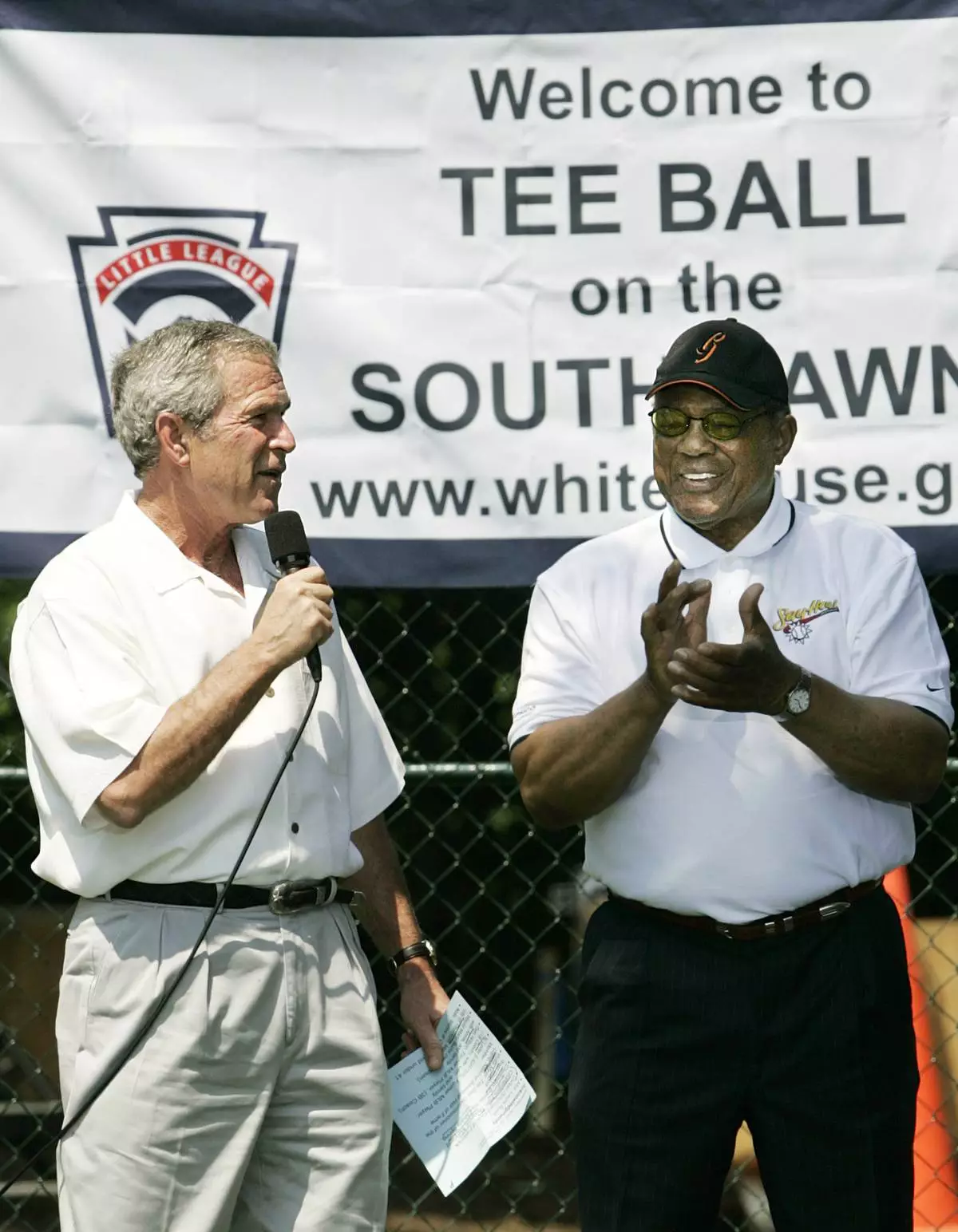
FILE - President George W. Bush, left, and National Baseball Hall of Fame member Willie Mays open the White House Tee Ball Game on the South Lawn, Sunday, July 30, 2006, in Washington. (AP Photo/Manuel Balce Ceneta, File)
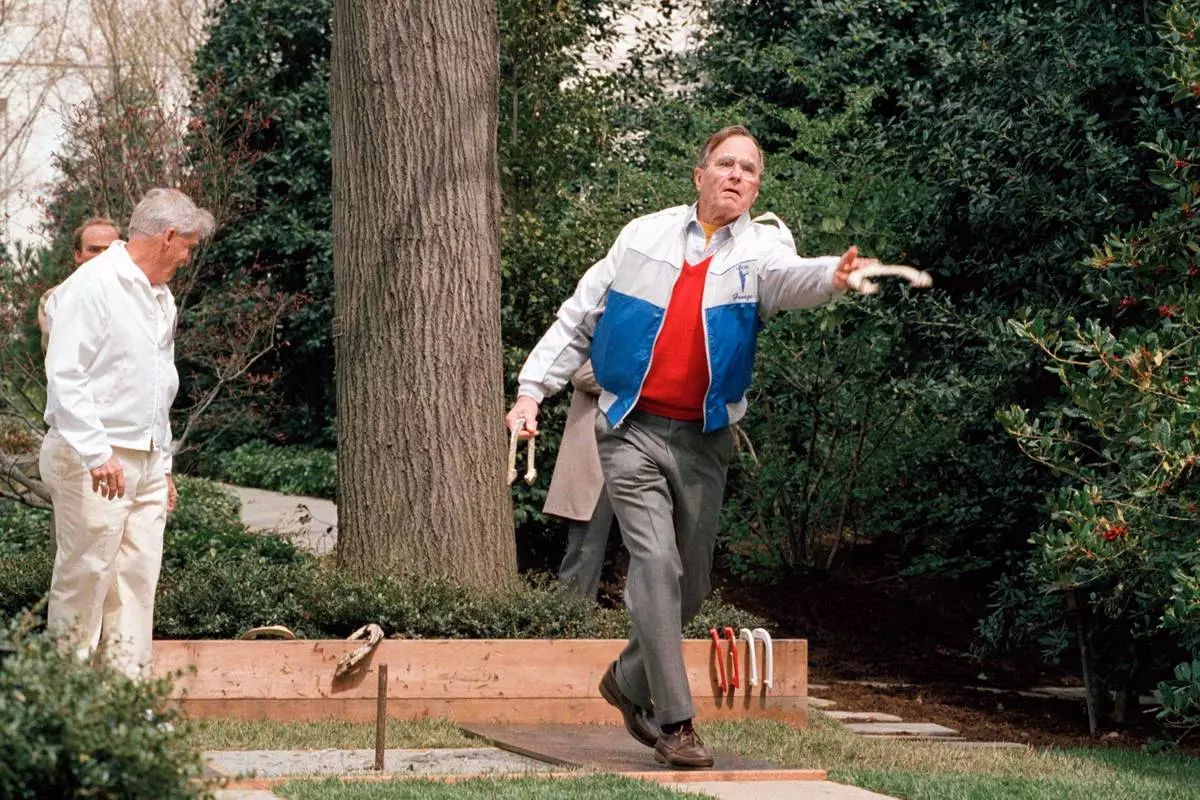
FILE - President George H.W. Bush lets loose of a horseshoe during the dedication of the new horseshoe pit on the White House lawn Saturday April 1, 1989, in Washington. (AP Photo/Barry Thumma)
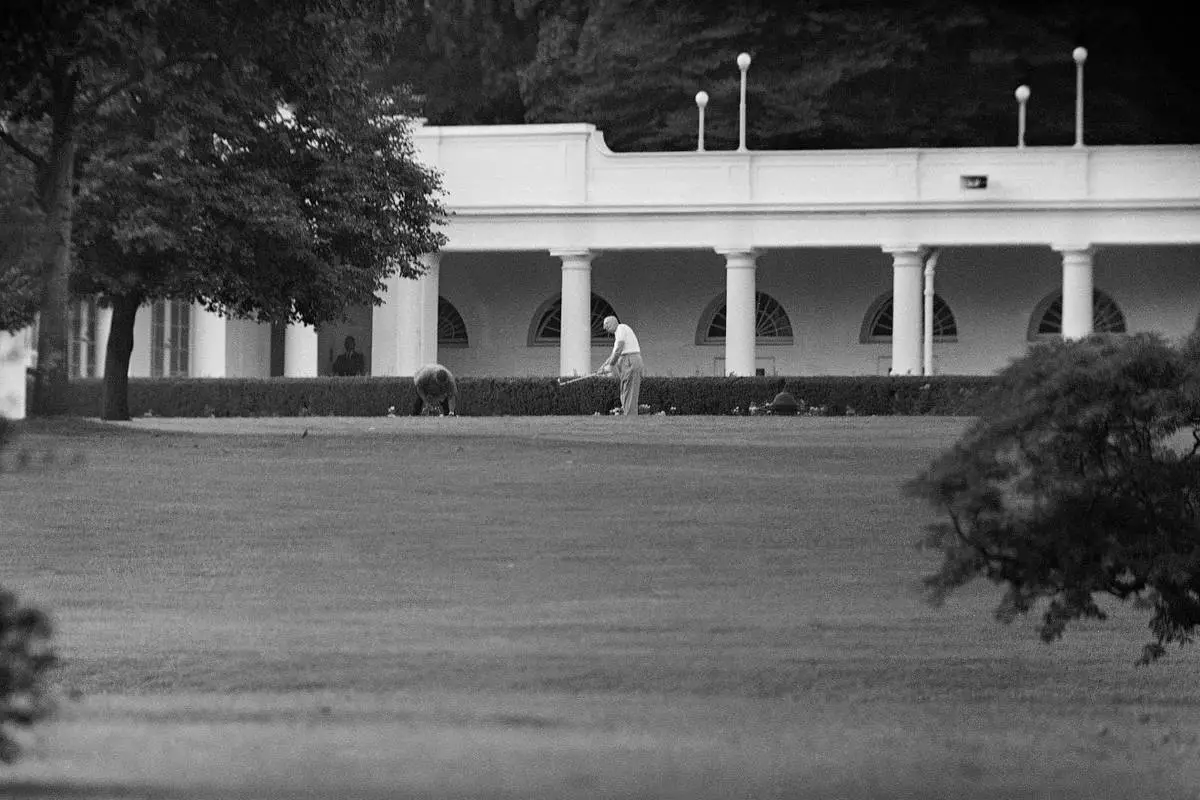
FILE - President Dwight D. Eisenhower, getting in a final bit of relaxation on the eve of the visit by Soviet Premier Nikita Khrushchev, practices a few iron shots the South Lawn of the White House in Washington, Sept. 14, 1959. (AP Photo, File)
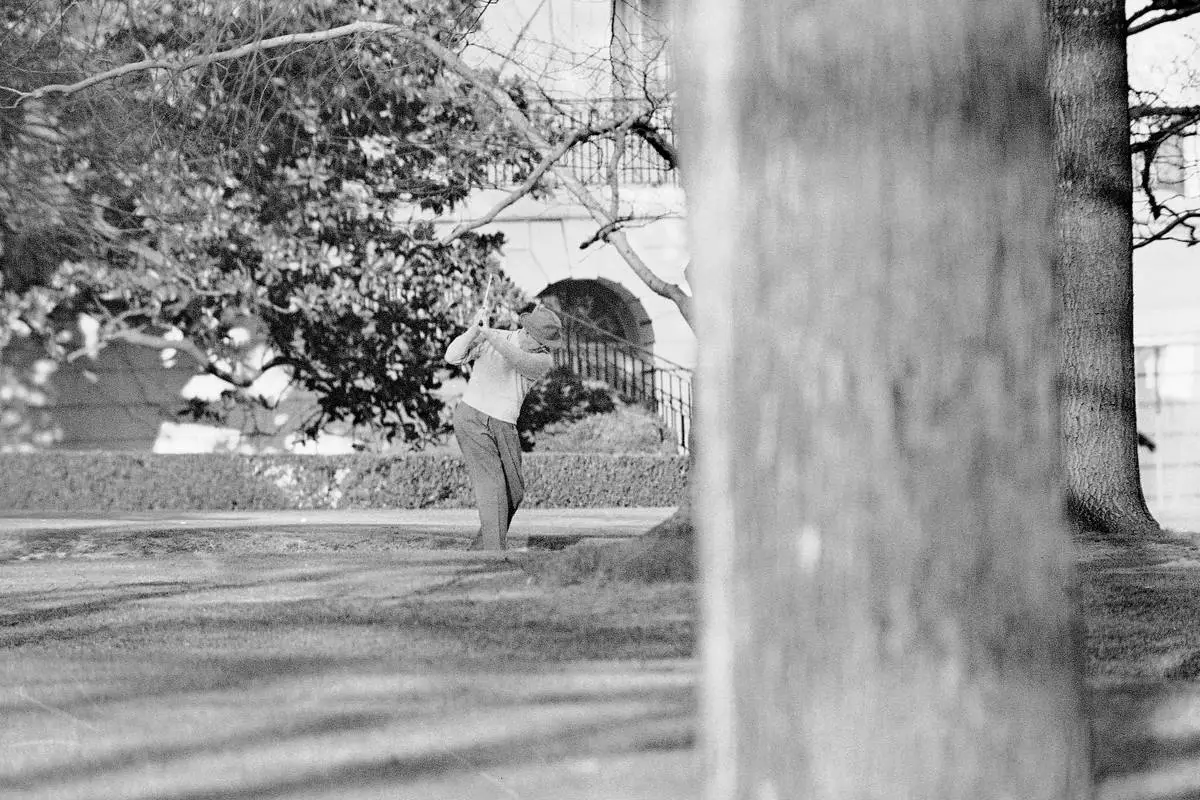
FILE - President Dwight Eisenhower brushes up on his golf game near the putting green on the lawn of the White House, Jan. 13, 1959, in Washington. (AP Photo, File)