Skip to Content Facebook Feature Image

Mantle Posts 27% RWA Growth in Q1 2026, Reaching $247.5M, According to Messari

Business

Mantle Posts 27% RWA Growth in Q1 2026, Reaching $247.5M, According to Messari
Business

Business

Mantle Posts 27% RWA Growth in Q1 2026, Reaching $247.5M, According to Messari

2026-06-09 20:30 Last Updated At:20:45

DUBAI, UAE, June 9, 2026 /PRNewswire/ -- Mantle, the distribution layer for real-world assets connecting traditional finance and on-chain liquidity, today released its Q1 2026 ecosystem performance report. The quarter marked simultaneous advances on two strategic fronts: RWA TVL grew 27.4% quarter-over-quarter to $247.5M through integrations with Aave, Maple Finance and xStocks, while Mantle shipped a full AI agent infrastructure stack including ERC-8004 agent identity, AI Agent Skills, Agent Scaffold, and x402 payments via QuestFlow. The results reflect Mantle's execution on a dual thesis: institutional asset distribution today, and autonomous agent commerce infrastructure for what comes next.

$247.5M in RWA TVL: Institutional Assets Go On-Chain

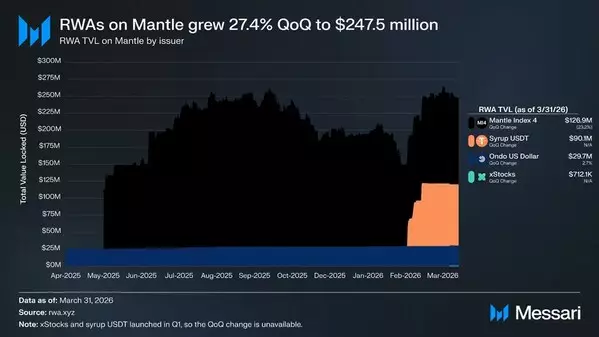
The deployment of Maple Finance's syrupUSDT through Aave brought institutional lending yield on-chain on Mantle, reaching $90.1M in TVL by Q1 2026. It also expanded access to fixed-income opportunities for a broader on-chain audience.

xStocks followed with the launch of ten digitally issued US equities, including TSLAx, NVDAx, and AAPLx, covering major technology stocks and ETFs. The addition of tokenized equity alongside institutional lending yield makes Mantle's RWA stack one of the broadest available on any single L2 network.

The 27.4% quarter-over-quarter increase to $247.5M reflects continued directional momentum in institutional adoption of Mantle's infrastructure. Backing that growth is the $2.4B Mantle Treasury, the largest DAO treasury globally and one of the largest crypto treasuries overall, which provides the institutional credibility that RWA issuers require when evaluating deployment targets.

Full AI Agent Infrastructure Stack: Identity, Tooling, and Payments in One Quarter

Mantle shipped four foundational components for autonomous agent commerce in Q1: ERC-8004 for agent identity, AI Agent Skills, Agent Scaffold, and x402 payments via QuestFlow, the core infrastructure an autonomous agent requires to operate on-chain

The report positions Mantle as a settlement layer for the agent economy before that market scales. Where most networks are evaluating whether to build agent infrastructure, Mantle has the primitives live. Developers building agent-native applications now have identity, tooling, and payments on a single network, without needing to bridge across infrastructure layers to assemble a functional stack.

The timing is deliberate. As AI agent activity moves from research to production deployment, the networks with live primitives will attract the first cohort of builders. Mantle's Q1 infrastructure release is a direct bid for that position.

Where Institutions and Agents Meet

Mantle's thesis is that the same infrastructure serving institutional-grade assets today will serve autonomous agents transacting on their behalf tomorrow. Q1 was the quarter both tracks became operational simultaneously.

"Q1 delivered on both fronts simultaneously, institutional-grade assets through Maple and xStocks, and the full infrastructure stack for autonomous agents. The network institutions trust for asset distribution is the same one developers will build agent commerce on. No other L2 has both live at once." said Emily Bao, Key Advisor at Mantle and Spot Executive at Bybit.

"Most L2s are competing on throughput or developer tooling. Mantle is competing on asset distribution. The combination of $247.5M in RWA TVL and a full AI agent infrastructure stack shipping in the same quarter suggests a network that has made a deliberate choice about what kind of activity it wants to anchor." Said Eric Manoukian,  Crypto Research Analyst at Messari.

About Mantle

Mantle positions itself as the premier distribution layer and gateway for institutions and TradFi to connect with on-chain liquidity and access real-world assets, powering how real-world finance flows. With over $4B+ in community-owned assets, Mantle combines credibility, liquidity and scalability with institutional-grade infrastructure to support large-scale adoption. The ecosystem is anchored by $MNT within Bybit, and built out through core ecosystem projects like mETH, fBTC, MI4 and more. This is complemented by Mantle Network's partnerships with leading issuers and protocols such as Ethena USDe, Ondo USDY, and OP-Succinct.

For more information visit mantle.xyz.
For more social updates, please follow: Mantle Official X & Mantle Community Channel

For media enquiries, please contact: contact@mantle.xyz

About Bybit

Bybit is the world's second-largest cryptocurrency exchange by trading volume, serving a global community of over 80 million users. Founded in 2018, Bybit is redefining openness in the decentralized world by creating a simpler, open, and equal ecosystem for everyone. With a strong focus on Web3, Bybit partners strategically with leading blockchain protocols to provide robust infrastructure and drive on-chain innovation. Renowned for its secure custody, diverse marketplaces, intuitive user experience, and advanced blockchain tools, Bybit bridges the gap between TradFi and DeFi, empowering builders, creators, and enthusiasts to unlock the full potential of Web3. Discover the future of decentralized finance at Bybit.com.

For more details about Bybit, please visit Bybit Press
For media inquiries, please contact: media@bybit.com

DUBAI, UAE, June 9, 2026 /PRNewswire/ -- Mantle, the distribution layer for real-world assets connecting traditional finance and on-chain liquidity, today released its Q1 2026 ecosystem performance report. The quarter marked simultaneous advances on two strategic fronts: RWA TVL grew 27.4% quarter-over-quarter to $247.5M through integrations with Aave, Maple Finance and xStocks, while Mantle shipped a full AI agent infrastructure stack including ERC-8004 agent identity, AI Agent Skills, Agent Scaffold, and x402 payments via QuestFlow. The results reflect Mantle's execution on a dual thesis: institutional asset distribution today, and autonomous agent commerce infrastructure for what comes next.

$247.5M in RWA TVL: Institutional Assets Go On-Chain

The deployment of Maple Finance's syrupUSDT through Aave brought institutional lending yield on-chain on Mantle, reaching $90.1M in TVL by Q1 2026. It also expanded access to fixed-income opportunities for a broader on-chain audience.

xStocks followed with the launch of ten digitally issued US equities, including TSLAx, NVDAx, and AAPLx, covering major technology stocks and ETFs. The addition of tokenized equity alongside institutional lending yield makes Mantle's RWA stack one of the broadest available on any single L2 network.

The 27.4% quarter-over-quarter increase to $247.5M reflects continued directional momentum in institutional adoption of Mantle's infrastructure. Backing that growth is the $2.4B Mantle Treasury, the largest DAO treasury globally and one of the largest crypto treasuries overall, which provides the institutional credibility that RWA issuers require when evaluating deployment targets.

Full AI Agent Infrastructure Stack: Identity, Tooling, and Payments in One Quarter

Mantle shipped four foundational components for autonomous agent commerce in Q1: ERC-8004 for agent identity, AI Agent Skills, Agent Scaffold, and x402 payments via QuestFlow, the core infrastructure an autonomous agent requires to operate on-chain

The report positions Mantle as a settlement layer for the agent economy before that market scales. Where most networks are evaluating whether to build agent infrastructure, Mantle has the primitives live. Developers building agent-native applications now have identity, tooling, and payments on a single network, without needing to bridge across infrastructure layers to assemble a functional stack.

The timing is deliberate. As AI agent activity moves from research to production deployment, the networks with live primitives will attract the first cohort of builders. Mantle's Q1 infrastructure release is a direct bid for that position.

Where Institutions and Agents Meet

Mantle's thesis is that the same infrastructure serving institutional-grade assets today will serve autonomous agents transacting on their behalf tomorrow. Q1 was the quarter both tracks became operational simultaneously.

"Q1 delivered on both fronts simultaneously, institutional-grade assets through Maple and xStocks, and the full infrastructure stack for autonomous agents. The network institutions trust for asset distribution is the same one developers will build agent commerce on. No other L2 has both live at once." said Emily Bao, Key Advisor at Mantle and Spot Executive at Bybit.

"Most L2s are competing on throughput or developer tooling. Mantle is competing on asset distribution. The combination of $247.5M in RWA TVL and a full AI agent infrastructure stack shipping in the same quarter suggests a network that has made a deliberate choice about what kind of activity it wants to anchor." Said Eric Manoukian,  Crypto Research Analyst at Messari.

About Mantle

Mantle positions itself as the premier distribution layer and gateway for institutions and TradFi to connect with on-chain liquidity and access real-world assets, powering how real-world finance flows. With over $4B+ in community-owned assets, Mantle combines credibility, liquidity and scalability with institutional-grade infrastructure to support large-scale adoption. The ecosystem is anchored by $MNT within Bybit, and built out through core ecosystem projects like mETH, fBTC, MI4 and more. This is complemented by Mantle Network's partnerships with leading issuers and protocols such as Ethena USDe, Ondo USDY, and OP-Succinct.

For more information visit mantle.xyz.
For more social updates, please follow: Mantle Official X & Mantle Community Channel

For media enquiries, please contact: contact@mantle.xyz

About Bybit

Bybit is the world's second-largest cryptocurrency exchange by trading volume, serving a global community of over 80 million users. Founded in 2018, Bybit is redefining openness in the decentralized world by creating a simpler, open, and equal ecosystem for everyone. With a strong focus on Web3, Bybit partners strategically with leading blockchain protocols to provide robust infrastructure and drive on-chain innovation. Renowned for its secure custody, diverse marketplaces, intuitive user experience, and advanced blockchain tools, Bybit bridges the gap between TradFi and DeFi, empowering builders, creators, and enthusiasts to unlock the full potential of Web3. Discover the future of decentralized finance at Bybit.com.

For more details about Bybit, please visit Bybit Press
For media inquiries, please contact: media@bybit.com

** This press release is distributed by PR Newswire through automated distribution system, for which the client assumes full responsibility. **
Mantle Posts 27% RWA Growth in Q1 2026, Reaching $247.5M, According to Messari


Mantle Posts 27% RWA Growth in Q1 2026, Reaching $247.5M, According to Messari

SHENZHEN, China, June 9, 2026 /PRNewswire/ -- The Closing & Awards Ceremony of the 10th Huawei ICT Competition Global Final was held today in Shenzhen. This year's competition attracted more than 220,000 university students and faculty members from over 2,000 institutions across more than 100 countries and regions, making it the largest edition in its history. Following national and regional rounds, 177 teams from 49 countries and regions advanced to the Global Final and received awards.

At the Closing & Awards Ceremony, Ritchie (Honghua) Peng, President of Huawei ICT Strategy & Business Development Department, said the competition reflects the company's long-standing commitment to using technology for good and for sustainable social and environmental development. Peng added that the Innovation Competition demonstrated the value of learning through competition as a tool to address real-world challenges, and that participants in the Practice and Programming Competitions stood out for their dedication, curiosity, and deep technical focus. He also announced the introduction of a new Ascend AI Operator Development Track in the Chinese mainland for the next edition. The track is designed to help young developers engage more directly with cutting-edge industry technologies through task-based challenges.

Dr. Shafika Isaacs, Director a.i. of UNESCO Institute for Information Technologies in Education and Chief of Section for Technology and AI in Education, praised the partnership between UNESCO and Huawei and commended the participants for their performance. She highlighted that the future of AI requires collaboration among governments, international organizations, academia, and industry. She also noted that UNESCO and Huawei have been working together through initiatives such as AI capacity building programs in Arab countries and ICT education partnership programs in Central Asia and the Caucasus. These efforts aim to strengthen higher education and vocational training systems and develop future-ready talent. She said students in this year's Huawei ICT Competition demonstrated their ability to tackle real-world challenges across cultural boundaries by applying emerging technologies – showing not only creativity but also a responsible approach to technology that embodies the purpose of education.

This year marked the 10th edition of the Huawei ICT Competition. After the Practice, Innovation, and Programming Competitions, 18 outstanding teams from eight countries were awarded the Grand Prize:

  • Practice Competition—Network Track Grand Prize: Algerian team, Brazilian team, Nigerian team, and Shenzhen Polytechnic University
  • Practice Competition—Cloud Track Grand Prize: Egyptian team, Algerian team, Central South University of Forestry and Technology, and Kenyan team
  • Practice Competition—Computing Track Grand Prize: Egyptian team, Henan Institute of Economics and Trade, Dominican Republic team, and Algerian team
  • Practice Competition—Ascend AI Track Grand Prize: Shenzhen Polytechnic University
  • Innovation Competition Grand Prize: Wuhan University of Technology, Ahmadu Bello University, National University of Singapore, and Fujian Normal University
  • Programming Competition Grand Prize: Wuhan Vocational College of Software and Engineering

Special awards were also presented during the ceremony. The Women in Tech Award went to seven all-female teams from Azerbaijan, Nigeria, Kenya, China, and Bahrain; while the Green Development Award was won by two teams from Ghana and China. Ten students from China received Fast Passes to the Huawei Future Business Leader Track. The Most Valuable Instructor Award was conferred on 16 exceptional instructors from nine countries and regions, including Pakistan, China, Nigeria, Egypt, UAE, Brazil, Thailand, Türkiye. Six teams from Egypt, Brazil, Malaysia, Poland, Pakistan earned the ICT Competition Online Popularity Award.

During the Global Final, Huawei also hosted the AI Accelerating Education Transformation Summit, where it launched the ICT Academy AI Course Solution and released the ICT Skills Development Insight Report with Recommendations for Nine Countries of Central Asia & the Caucasus.

As demand for talent in AI, computing, big data, and cybersecurity continues to grow, the Huawei ICT Competition provides students with an international platform to develop practical skills, solve real-world challenges, and prepare for the digital economy through industry-academia collaboration and shared educational resources.

** This press release is distributed by PR Newswire through automated distribution system, for which the client assumes full responsibility. **

10th Huawei ICT Competition Concludes with Student Winners from 49 Countries and Regions and a Record 220,000 Participants

10th Huawei ICT Competition Concludes with Student Winners from 49 Countries and Regions and a Record 220,000 Participants

Recommended Articles