SION, Switzerland & MONTREAL--(BUSINESS WIRE)--Jun 9, 2026--
H55 today announced the delivery of certification-grade propulsion battery modules to Pratt & Whitney Canada in support of the RTX Hybrid-Electric Flight Demonstrator — a milestone that further validates H55’s transition from technology development to industrial-scale execution and represents an important step in the commercialization of the company’s certification-grade energy storage technologies for hybrid-electric aerospace applications. Pratt & Whitney is an RTX business.
This press release features multimedia. View the full release here: https://www.businesswire.com/news/home/20260609825006/en/
The delivery represents more than hardware integration. It demonstrates H55’s ability to manufacture production-conforming propulsion systems within a regulator-approved environment and deploy them into active aircraft integration and flight-test programs — a capability achieved today by only a small number of companies globally.
As electric and hybrid-electric aviation moves beyond early-stage concepts toward certification and commercialization, aircraft manufacturers increasingly require partners capable of delivering not only technology innovation, but also industrial maturity, safety architecture and certification-ready production systems. For H55, the delivery of production-conforming modules into an active aerospace integration and flight-test program demonstrates the readiness of its technology, manufacturing capability and certification framework to support future commercial applications.
“Aircraft manufacturers today require more than battery technology,” said Sébastien Demont, H55 Co-Founder and CTO. “They require certification-grade safety architecture, industrialized manufacturing, operational reliability and scalable systems integration. Delivering production-conforming modules into the RTX Hybrid-Electric Flight Demonstrator validates H55’s ability to meet those requirements at an industrial scale and marks an important step in bringing our certification-grade energy storage technologies to a broader range of commercial aerospace applications. This achievement provides a strong foundation for what comes next across hybrid-electric aviation, defence, UAVs and next-generation aerospace platforms.”
H55’s proprietary battery architecture was specifically developed to meet the demanding certification and operational requirements of electric and hybrid-electric propulsion systems. The company has accumulated more than 2,000 flight hours across multiple aircraft programs with zero battery-related incidents, creating an operational dataset and safety record that continue to strengthen its competitive position.
The company also became the first in the industry to complete regulator-required propulsion battery certification testing — a milestone now serving as a foundation for deliveries into active aerospace programs.
“Hybrid-electric propulsion represents an important pathway for improving fuel efficiency and performance for a wide range of future aircraft platforms,” said Jean Thomassin, executive director, New Product and Service Introduction, Pratt & Whitney Canada. “H55’s ability to deliver aviation-grade battery systems within a rigorous certification and production framework plays a crucial role in demonstrating hybrid-electric technology in flight.”
The milestone reinforces H55’s position as one of the few companies globally combining:
… which is accelerating the company’s transition toward commercialization and deployment across hybrid-electric aviation, defence applications, UAVs, and next-generation aerospace platforms, while reinforcing H55’s position as a supplier of certification-grade energy storage solutions for future commercial aerospace programs.
About H55
H55 is a Swiss-based company specializing in certified electric propulsion and certification-grade energy storage systems for aviation. The company enables electric aviation to scale by transforming commercial lithium cells into aviation-safe Energy Storage Systems that regulators approve, insurers underwrite, and OEMs can deploy repeatedly as a certified propulsion platform across aircraft programs. This is achieved through independent cell characterization, rigorous incoming screening, redundant safety architectures, and regulator-aligned testing designed around worst-case failure scenarios.
Founded as the technological legacy of the Solar Impulse program, H55 builds on more than two decades of hands-on electric aviation experience. The company has designed, built, and flown multiple electric aircraft and has accumulated more than 2,000 hours of fully electric flight with zero battery-related incidents—providing the operational depth required to execute certification-grade programs, not merely comply with them.
H55 benefits from a strong and experienced leadership team that combines deep expertise in scaling technology companies with hands-on operational execution. Together, these capabilities support a reliable transition from certified design to repeatable series manufacturing. H55’s platform-based approach, in which certification evidence compounds across programs, reduces adoption risk while facilitating the capital-efficient deployment of electric and hybrid-electric aircraft.
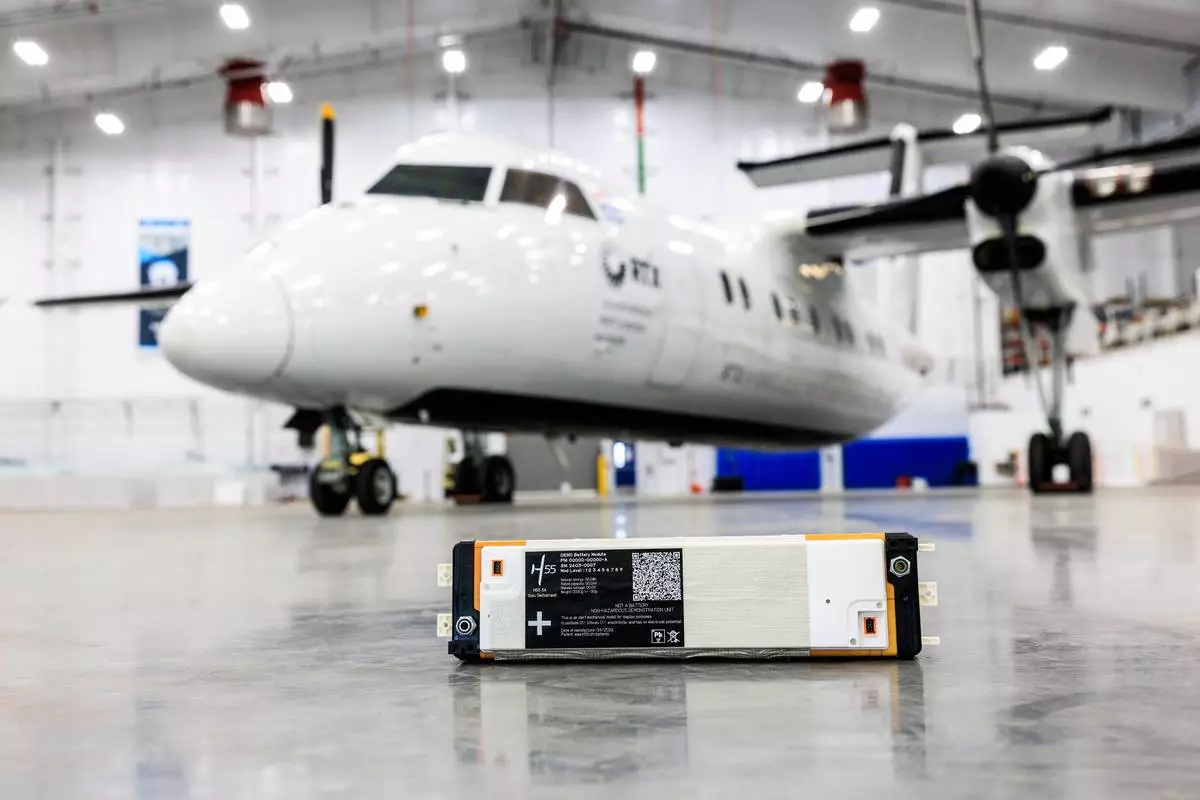
H55 Adagio Battery Modules in Pratt & Whitney Canada Hangar ©RTX