LIV Golf has 46 days between the end of a tournament in Spain and the next one in England, and it could be the most important stretch of the season for CEO Scott O'Neil.
The league is reeling from the decision by Saudi Arabia's sovereign wealth fund to stop paying for it at the end of year, having already spent some $6 billion since its June 2022 launch.
O'Neil is pushing “LIV 2.0” and seeking some $300 million from outside investors to keep the league going in 2027 and beyond. He appeared Tuesday on CNBC and said he has received a positive response from the initial push.
“I've had five meetings, formal meetings, so far,” O'Neil said. “I've got 18 more meetings this week and about the same next week. What's been really interesting is how do you slice this? Is there one partner that comes in, maybe a big private equity firm, at the full $300 (million), or do you have 10 or 12 investors at $50 and $25 million units?”
But O'Neil said there was one element as critical as the money itself.
“What we don't have is a lot of time,” he said. “So we're very urgently out there talking to those who are interested. We like the pool, but we have to get this done through the summer.”
The long break — created when a new event in New Orleans was postponed — has generated speculation whether LIV would be funded through the year. O'Neil was asked if he could guarantee the last four events would be played.
“What I can guarantee is a heck of a return if you come invest in this business,” he said.
The PGA Tour has not offered any insight into a potential return of any LIV player, perhaps the most attractive being Jon Rahm, because they are still under contract.
O'Neil made it clear that private funding would be for a league that operates much differently than it does now, referring to a “financially disciplined business model.”
“We're cutting the expense side dramatically, and the revenue momentum that we’ve had ... we're already up $100 million over last year, so we have really good business momentum. This is about getting the costs under control, reimagining what the business could, should and will look like, and then engaging our players as partners, like true equity partners in this business.”
He predicted it would take three years to reach profitability.
Adam Svensson was part of an 8-for-3 playoff in the Canada qualifier for the U.S. Open, and it was down to one spot left among three players on the third extra hole. It went to Max McGreevy, who made birdie.
Svensson, perhaps by habit, picked up his ball marker without realizing he and Matt Wallace still had to play it out to see who was first alternate. Svensson didn't have a tap-in for par, but he was out when he picked up his marker.
Whether it comes back to haunt him remains to be seen. But it was a reminder that while losing out on a U.S. Open is discouraging, the alternate spots should not be taken lightly.
The USGA held back seven spots to fill the 156-man field for those who move into the top 60 after this week — J.T. Poston is a lock, while Eric Cole, Matt Wallace, Bud Cauley and Jordan Smith have a chance — and anyone who wins a second PGA Tour title since the last U.S. Open.
The USGA does not publicize its formula for ranking alternates. But if anyone withdraws who had qualified, the alternate comes from that site.
Consider last year. Chase Johnson and Cole were the first and second alternates out of the Columbus, Ohio, qualifier. Both of them got into the field because two players who qualified from that site — Cauley and Cameron Young — got in through the world ranking.
The priority list for alternates is based on a formula that considers strength of field for each site and how many spots those sites had been awarded. First alternates include Brandt Snedeker (Springfield, Ohio).
The PGA Tour for the first time is getting involved with the Australian Open, the fifth-oldest championship in golf and a championship that years ago was looked upon as having the potential to be a fifth major.
The nature of that involvement has not been announced, though it likely would create spots for PGA Tour players who want to compete.
Golf Australia announced Tuesday a new agreement in which the European tour and PGA Tour of Australasia will co-sanction the tournament, to be played in December at revered Kingston Heath. Rory McIlroy plans to be in the field.
Golf Australia said the PGA Tour involvement in the Capital.com Australian Open was “set to ensure” a significant boost in prize money, a good spot on the global golf calendar and a chance to attract the world’s best players. More details were to be announced at the December tournament.
“Our ambition is clear. We want the men’s Capital.com Australian Open to be recognized among the top 10 most prestigious golf tournaments globally, and everything we are doing for the event flows from that ambition,” said James Sutherland, the CEO of Golf Australia.
The Australian Open was a popular destination in the 1960s and 1970s, with Jack Nicklaus and Gary Player each winning six times during that stretch, and additional winners including Arnold Palmer and Peter Thomson. It was looked upon as a global major even when the Presidents Cup was staged at Royal Melbourne in 1998.
Ryder Cup captain Jim Furyk is returning to the broadcast booth for the U.S. Open and beyond.
Furyk, whose lone major title came at the 2003 U.S. Open at Olympia Fields, will be at Shinnecock Hills as an analyst for USA Sports and will work the remainder of the year on telecasts of Golf Channel and USA Network.
He also will be the analyst for USA Network for the British Open at Royal Birkdale. Kevin Kisner is the lead analyst for those majors when they are on NBC.
Two other events on Golf Channel that will feature Furyk as the analyst are personal to him. One is the Travelers Championship, where in 2016 he set the PGA Tour record with a 58. The other is the Tour Championship, which he won in 2010 to claim the FedEx Cup.
Furyk made his television debut earlier this year for Golf Channel at the Arnold Palmer Invitational and The Players Championship.
Russell Knox took a break from the Korn Ferry Tour last week to caddie for his 16-year-old niece, Sofia Rivera, who qualified for her first U.S. Women's Open at Riviera. She had rounds of 75-74 and missed the cut. ... Bernhard Langer is the 2027 Memorial honoree, the first time the Captain's Club at Muirfield Village has selected an active player since Tom Watson in 2012. ... The PGA of America has hired Jeff Clennon as its chief commercial officer and Paul Stephens as its chief financial officer. ... The Ryder Cup is taking a page from the British Open by offering tents for spectators just outside the gates at Adare Manor for the 2027 matches. The tents can go for as little as 151 euros ($175) a night. ... Wilshire Country Club in Los Angeles has finished a course restoration project and will be back on the LPGA schedule next year as host of the JM Eagle Championship.
Nelly Korda has won $5,386,790 in eight tournaments this year. Her average earnings of $673,349 would put her 20th on the LPGA money list.
“It's the most tired I am of the four majors.” — Xander Schauffele on playing the U.S. Open.
AP golf: https://apnews.com/hub/golf

Nelly Korda holds the trophy after winning the U.S. Women's Open golf tournament Sunday, June 7, 2026, in the Pacific Palisades area of Los Angeles. (AP Photo/Jessie Alcheh)

Eric Cole waves after his putt on the fourth hole during the final round of the Memorial golf tournament, Sunday, June 7, 2026, in Dublin, Ohio. (AP Photo/Sue Ogrocki)
ATLANTA (AP) — Just a mile from Atlanta's stadium, which will welcome tens of thousands of fans to World Cup games this month, dozens of people were camped out on a downtown sidewalk waiting for a homeless shelter to open.
Some slept in sleeping bags, face masks over their eyes to block out the afternoon sun. Others sat on the sidewalk eating from cereal boxes. Shoes lay scattered alongside empty mini-liquor bottles. A boom box blasted a Jay-Z song: “This can’t be right, there’s gotta be more.”
Atlanta announced an ambitious plan last summer to end encampments and other street sleeping downtown ahead of the 39-day soccer spectacular that begins Thursday. Called Downtown Rising, the program said it has housed nearly 500 people. But the scene on a recent afternoon outside this shelter on Pryor Street was a visceral reminder that Atlanta has not reached everyone.
Atlanta is one of several of the cities in the United States, Canada and Mexico using the attention that comes with hosting the world's premier soccer tournament to address homelessness. Seattle announced a housing push and said it was using the World Cup to gauge its progress. Dallas said it was expanding a successful effort to house homeless people living downtown.
A survey by The Associated Press found, however, that most of the 16 venues, including New York, Boston, Philadelphia, Miami, Houston, Toronto, and Vancouver, British Columbia, are relying on existing programs — most without any new funding tied to the World Cup — to address homelessness.
Growing tent encampments have bedeviled urban leaders for years. Federal data showed a double-digit percentage increase in homelessness nationwide from 2023 to 2024, when 770,000 people were counted as homeless — a number acknowledged as an undercount. That was followed by a slight decrease last year to 745,652.
In the past, many cities have treated the homeless as an eyesore to be removed ahead of big sporting and political events.
During last year's Super Bowl, New Orleans spent millions of dollars clearing away tent encampments near the Superdome and moving the homeless into a temporary warehouse. Ahead of the 2024 Paris Olympics, migrants were bused out of the city until the Games ended. Chicago removed one of its biggest encampments ahead of the 2024 Democratic National Convention.
“These events provide a choice for communities,” said Ann Oliva, CEO of the National Alliance to End Homelessness. “They can do the easy thing and sweep people out of encampments and into jails or other neighborhoods, or they can do the harder work that will benefit everyone in the community — housed or unhoused.”
As host of the 1996 Olympics, Atlanta removed some 9,000 homeless people to a newly built detention center. It gave others one-way bus tickets out of town and launched “Operation Olympus,” detaining hundreds of people to reduce crime.
But this time around, the city was determined to do things differently.
It has raised $185 million in state and city funding, as well as corporate grants and other donations, toward a goal of $235 million, with the aim of housing 3,900 people citywide by next year. The latest city count last year showed there were some 2,900 homeless people citywide, about a third living in encampments or on the street.
“There will always be homeless people on our streets, more than likely, unfortunately,” said Cathryn Vassell, the CEO of Partners for HOME, the organization tasked with creating and executing Atlanta’s homelessness strategy. The goal is “to be able to identify them and quickly exit them into shelter, resources, services, and then ultimately housing.”
Downtown Rising has helped Michael Sutton turn his life around. In foster care since he was an infant, he bounced from family to family. For most of the past decade, the 31-year-old slept in train stations, parks, abandoned buildings and homeless shelters.
Since September, Sutton has had a one-bedroom apartment in an Atlanta suburb and a case worker.
“Everyone has rough days, and being able to go home or vent to yourself about it, relaxing in your own home … is priceless,” Sutton said.
But not everyone can be helped.
Some homeless people recoil at shelter rules, lack the documents to quickly move into permanent housing or have complicated drug and mental health challenges, or nomadic lifestyles that make them difficult to reach.
Tommy Elam said he's been on numerous housing lists, but nothing has happened — though he's hard to find. His phone was stolen countless times and he doesn’t currently have one.
“They don’t know where I’m at,” said Elam, who's been homeless since early 2020 and spent the last three months sleeping on the sidewalk near the Pryor Street homeless shelter, his latest spot since a crackdown on the encampment where he lived near the Georgia State Capitol building.
Standing outside the downtown supportive housing center where he now lives, Willie Jackson, who spent years on the streets, said he knows people who’ve been helped by the Downtown Rising initiative. But he's skeptical it will lead to lasting change after the World Cup — or that it’s made a significant impact on downtown’s homelessness problem.
“Just look around,” he said.
Two years ago, it was hard to miss the hundreds of tents around Dallas City Hall.
But ahead of the World Cup, there were no tent encampments downtown, where FIFA’s broadcast center is set up, or at the nearby fan zone. The matches will be played at Dallas' stadium in suburban Arlington.
Sarah Kahn, president and CEO of Housing Forward, which leads the homelessness response for Dallas and nearby Collin counties, said a $30 million campaign since 2024 reduced the number of people sleeping on downtown streets by 87% and placed some 2,000 into permanent housing.
In March, an additional $28 million was allocated to expand countywide, with a goal of providing 1,100 people housing, the agency said. Outreach workers deploy daily within a quarter-mile of transit hubs, the fan zone and the FIFA broadcast center to find anyone sleeping outside and offer services, it said.
Elisabeth Jordan, founder of The Human Impact, which helps the chronically homeless, praised the initiative as “the single greatest change ... in homeless response in Dallas.”
But she criticized Dallas police tactics that included zip-tying and removing people who remained after their encampments were cleared. Dozens of people from one encampment were housed in May, but about 20 who remained were detained, she said. In a statement, the Dallas police department called such detentions “standard practice” for people “violating the prohibited camping law” and who refuse housing.
Kacey Coker, who spent years on the streets or in jail, described a dramatic improvement in how the homeless are treated. Authorities used to “come through with a bulldozer and take our stuff and throw it away,” said the 51-year-old, who lost her birth certificate and social security card in those sweeps.
In May, she was offered a subsidized one-bedroom apartment for a few hundred dollars a month. For the first time, Coker feels safe.
“I can actually build something,” she said.
At a vacant lot several miles from Seattle's stadium, workers were putting the final touches last week on 75 tiny homes.
The 70-square-foot units with a bed, space heater and air conditioner are part of Seattle Mayor Katie Wilson's ambitious plan to open 500 units of new shelter by the start of the World Cup.
It's a goal she acknowledges she has missed — by 425 units.
“The World Cup .... provided just kind of a good goal post,” Wilson told the AP in an interview, saying the city will open an additional 228 beds by the end of the summer.
“When you put a number out there, that has the advantage of galvanizing people,” but it can also be framed as a failure if you miss it, Wilson said. “So, I really hope that the message ... is look, we are making progress.”
Homelessness advocates said they weren't surprised Wilson didn't meet such a lofty goal within six months of election. The World Cup isn't what's important; getting people housed is, they added.
“I’m just happy that anything has happened so far,” said Bruce Drager of Ballard Community Task Force on Homeless and Hunger near where the tiny homes were built.
Camped out with his wife between a sidewalk and train tracks just blocks from the stadium, Chris Moore said he hasn't heard about the city's housing plans.
A large encampment nearby has been cleared twice in the five months since he's been there, said Moore, who's been homeless for eight years. But dozens of tents were back again a week before the first game.
“I guess because the World Cup’s coming, you don’t want homeless people around,” he said.
In Inglewood, California, site of the Los Angeles area stadium, roads were squeaky clean and paved with fresh asphalt. Bright flowers filled planters downtown and near the stadium.
“There’s no homeless in Inglewood,” Mayor James Butts told the AP when asked about the city's plans for housing people living on the streets ahead of the World Cup. “Just look at the numbers.”
Indeed, Inglewood's' homeless count last year was small — just under 400, about a third of whom were living on the street in the city of 100,000 people — compared to LA, where 43,695 homeless were counted in the city of 3.8 million-plus.
But less than 2 miles (3.2 kilometers) from the stadium and just outside Inglewood city limits, the nonprofit St. Margaret’s Center was handing out dozens of sack lunches for the homeless on a recent morning.
Carter Hewgley, who oversees strategic partnerships at LA County’s Homeless Services and Housing Department, said it has secured three motel sites ahead of the World Cup — “not because there's games, but because there's homeless.” The sites, including in Inglewood, range from 54 to 104 rooms. The agency also maintains tens of thousands of shelter beds, he said.
In Canada, Toronto and Vancouver said they were relying on their already extensive services to provide thousands of shelter beds and temporary housing rooms, as well as outreach to those living on the streets. Vancouver has also set up centers where matches will be shown. Both said there were no plans to relocate homeless people ahead of the games.
Still, there were sporadic reports by advocates of crackdowns targeting homeless people.
In Toronto, where Canada's largest shelter system supports more than 8,500 people each night, advocates held a rally last month denouncing what they said were transit police tactics aggressively targeting the homeless at the city’s main train station.
Toronto Underhoused and Homeless Union said its survey of dozens of homeless people found some forcibly removed from lavatories and elsewhere, and subjected to verbal abuse by transit police. In a statement to the AP, the city did not directly address the complaints but said it doesn't “tolerate, ignore, or condone discrimination or harassment.”
In Vancouver, hundreds of activists held a protest in April over increased security ahead of the World Cup. A 2025 count showed 2,715 homeless people, some in Vancouver's Downtown East Side area near the stadium.
Last month, at a downtown park where homeless people are allowed to stay overnight, Harley Ransom was resting in his tent and said he's seen aggressive tactics.
Nearby, Francesca Crane, who said the van she lived in with her pet rabbits had been towed away, accused the city of “sweeping the homeless people under the carpet for FIFA to make it look like a clean city, no homelessness.”
“They are catering to people from other countries but stepping on the people of their own city and province,” she said. “What they’re doing is wrong.”
Casey reported from Boston. Associated Press reporters Manuel Valdes in Seattle; Claire Rush in Portland, Oregon; Jim Morris in Vancouver, British Columbia; Robert Gillies in Toronto; Heather Hollingsworth in Kansas City, Missouri; Jamie Stengle in Dallas, and Jaimie Ding in Los Angeles contributed.
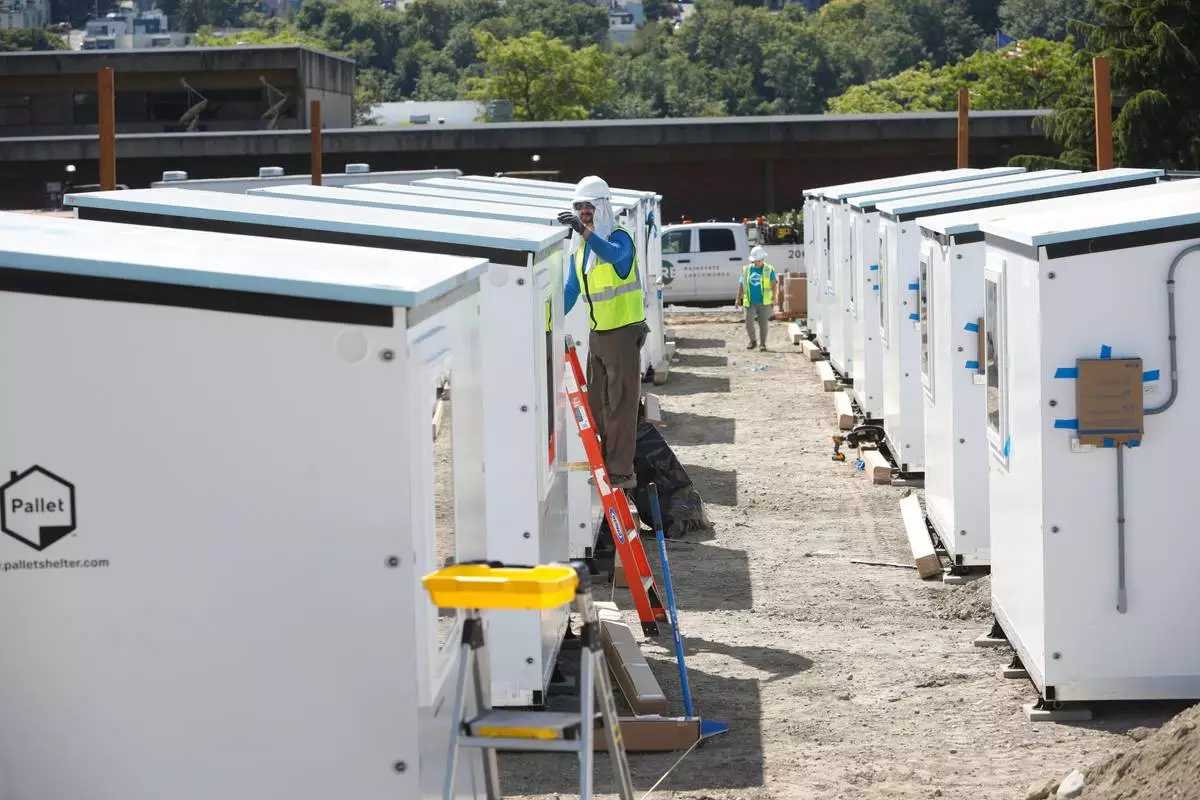
A worker inspects the top of a Pallet Shelter unit being installed in Seattle on Thursday, May 28, 2026. The single-bed units, made of composite panels, are part of Seattle Mayor Katie Wilson's plan to expand shelter for the city's homeless. (AP Photo/Manuel Valdes)
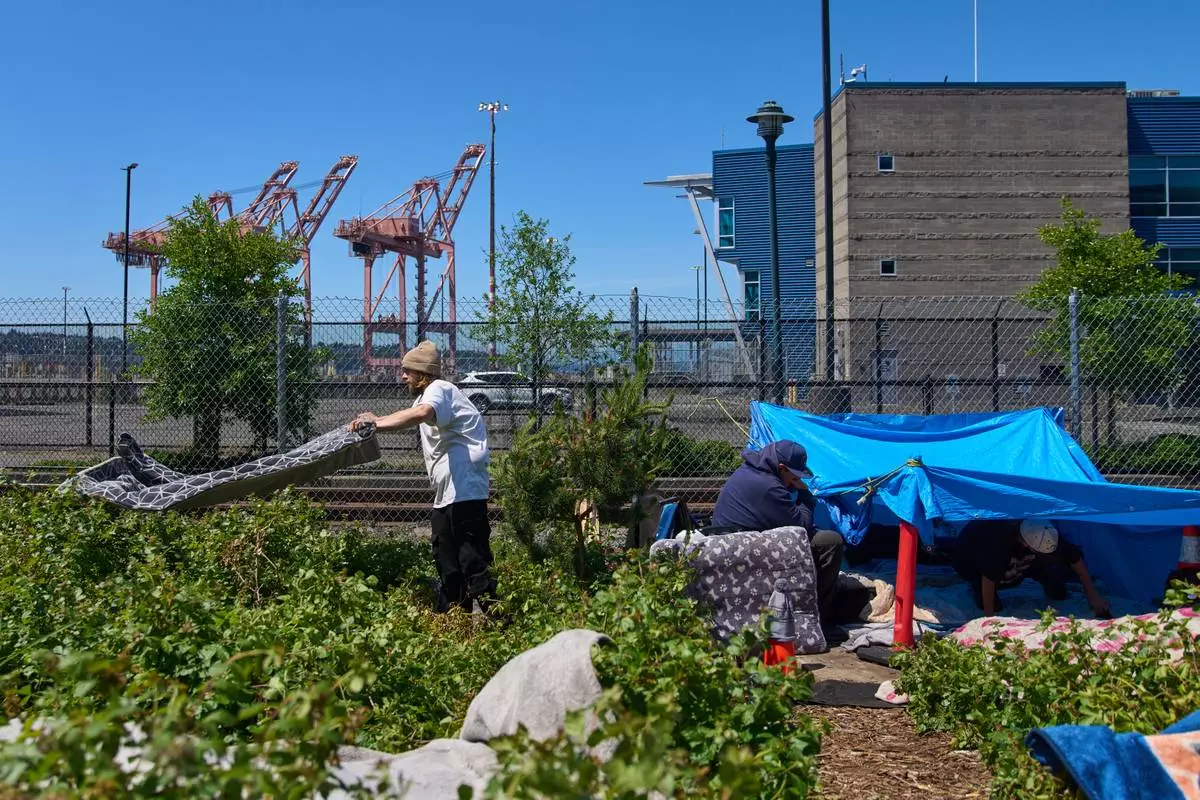
Chris Moore airs out blankets that got wet during the previous day's rain at his makeshift tent near Seattle Stadium, ahead of the 2026 FIFA World Cup soccer matches Wednesday, May 27, 2026, in Seattle. (AP Photo/Lindsey Wasson)
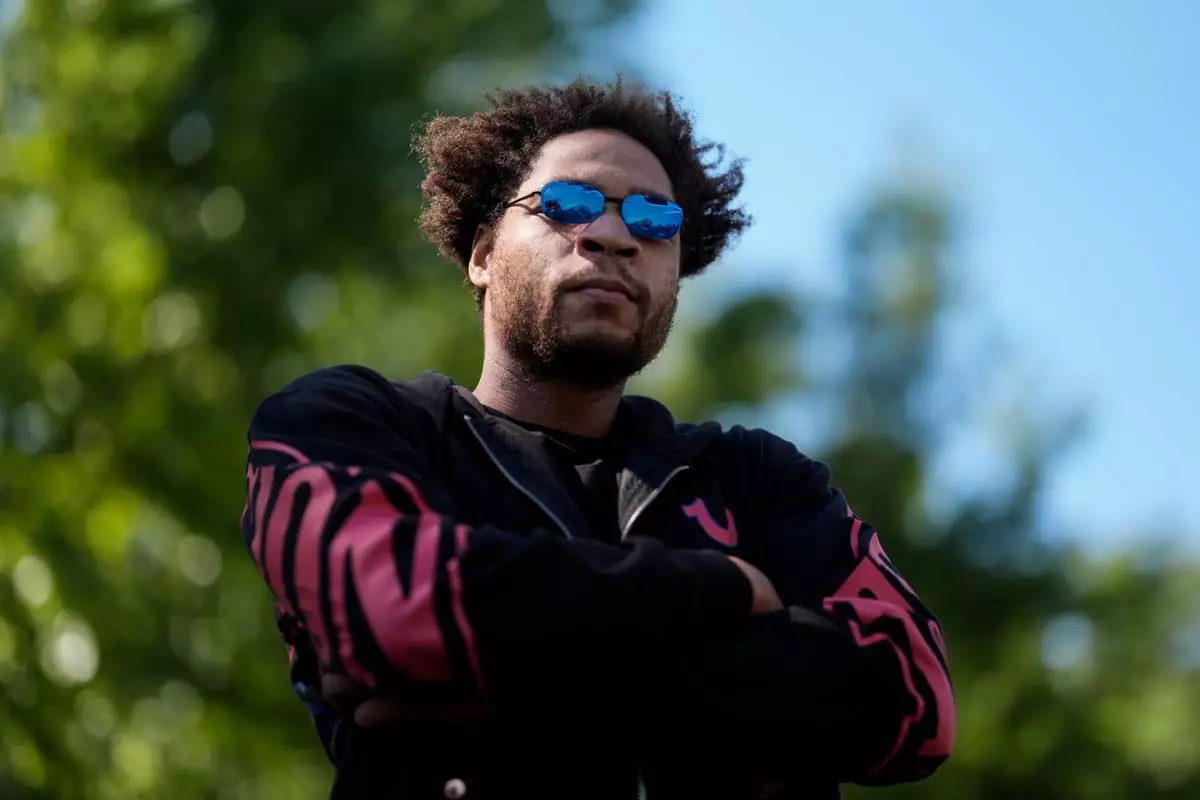
Michael G Sutton poses for a photo, Wednesday, June 3, 2026, in Decatur, Ga. (AP Photo/Mike Stewart)
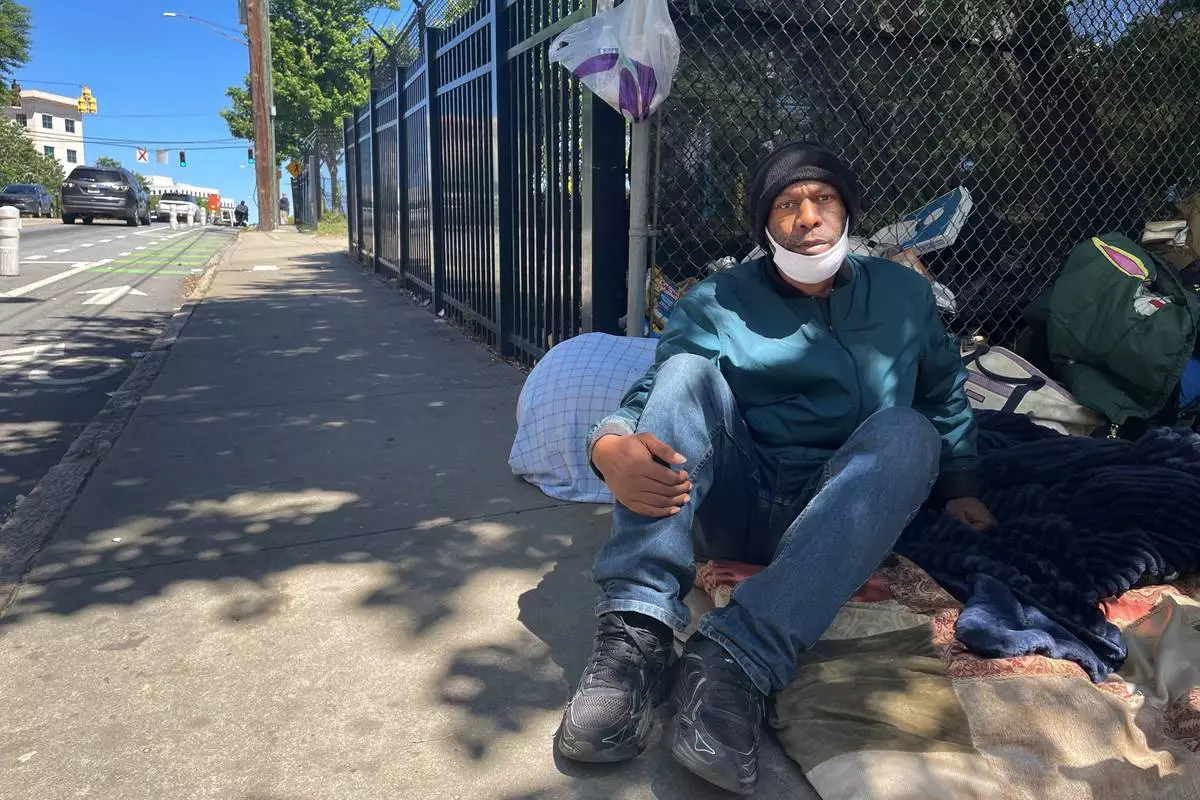
Tommy Elam sits on a sidewalk with his belongings in downtown Atlanta on Thursday, May 14, 2026. (AP Photo/R.J. Rico)
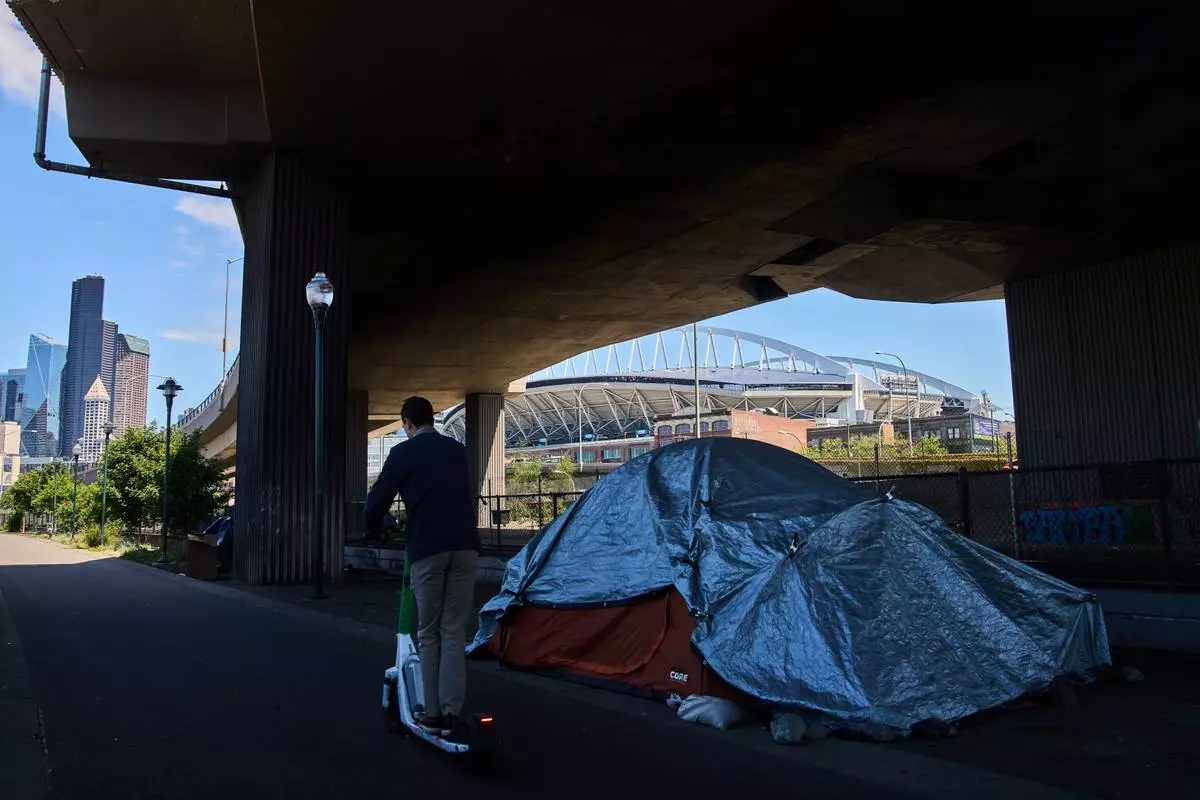
Seattle Stadium is seen in the background as a person rides a scooter past a series of tents on a trail near the stadium ahead of the 2026 FIFA World Cup soccer matches Wednesday, May 27, 2026, in downtown Seattle. (AP Photo/Lindsey Wasson)