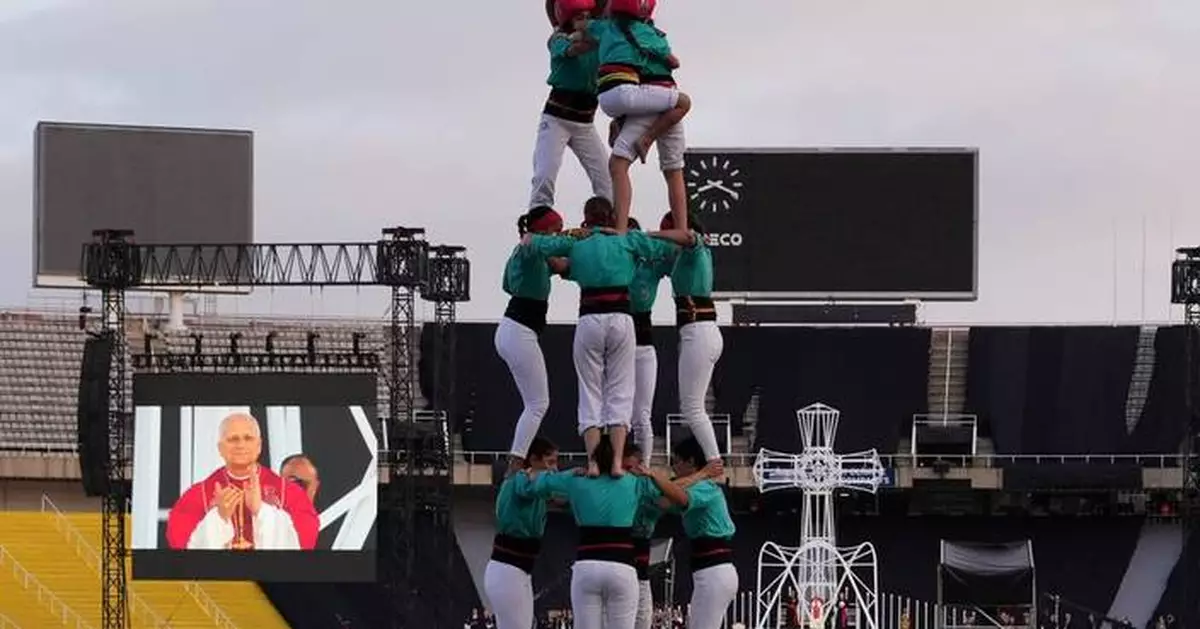
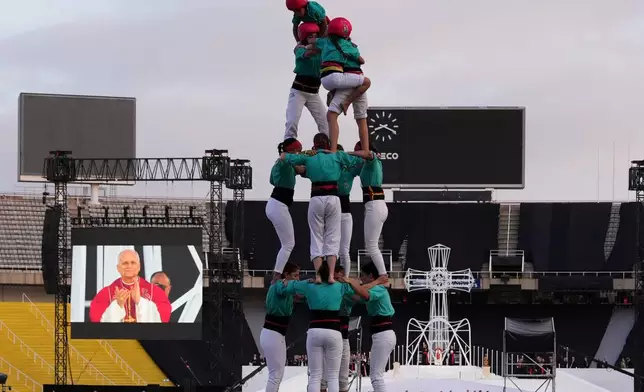
VILAFRANCA DEL PENEDES, Spain (AP) — Bruna Vall Galán, 8, gave a unique welcome to Catalonia to Pope Leo XIV Tuesday night — from the top of a nearly 10-meter (33-foot) human tower created at the start of Leo's prayer vigil in Barcelona.
Human towers, or “castells” in the Catalan language, are not only a feat of equilibrium, strength and teamwork, but a crucial part of the proud identity in this northeastern Spanish region.
Click to Gallery
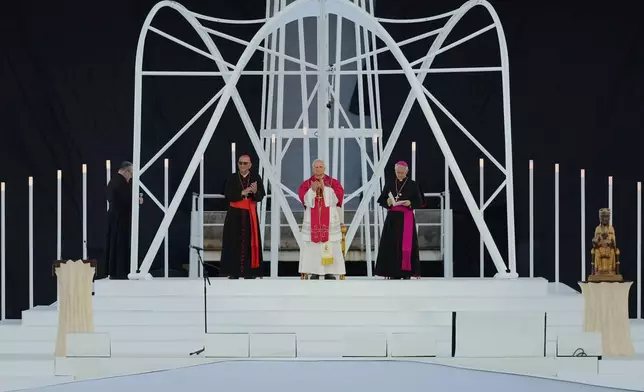
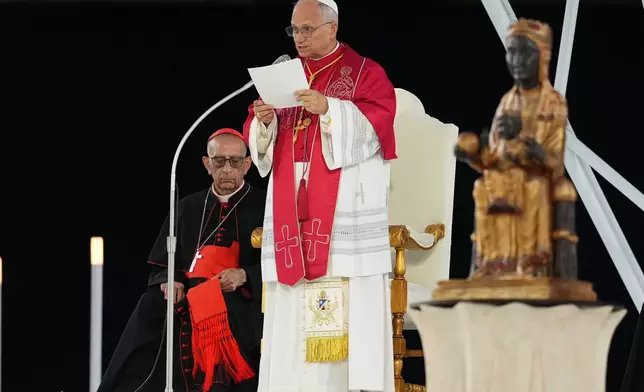
Pope Leo XIV leads a vigil of prayer at the Lluis Companys Olympic Stadium, in Barcelona, Tuesday, June 9, 2026. (AP Photo/Alessandra Tarantino)
Pope Leo XIV leads a vigil of prayer at the Lluis Companys Olympic Stadium, in Barcelona, Tuesday, June 9, 2026. (AP Photo/Alessandra Tarantino)
Pope Leo XIV arrives to attend a prayer vigil at Lluis Companys Olympic Stadium in Barcelona, Spain, Tuesday, June 9, 2026. (AP Photo/Emilio Morenatti)
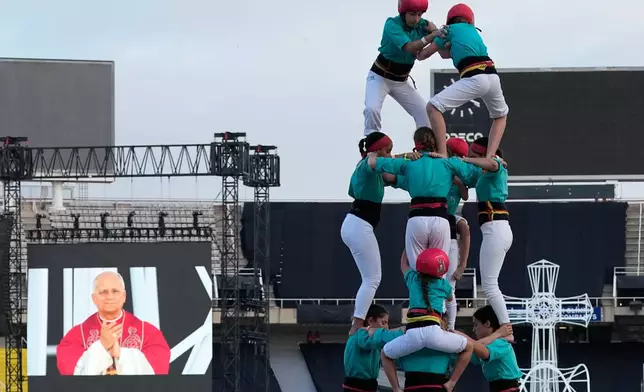
Performers make a human tower, known as Castells, for Pope Leo XIV as he leads a vigil of prayer at the Lluis Companys Olympic Stadium, in Barcelona, Tuesday, June 9, 2026. (AP Photo/Alessandra Tarantino)
Performers make a human tower, known as Castells, for Pope Leo XIV as he leads a vigil of prayer at the Lluis Companys Olympic Stadium, in Barcelona, Tuesday, June 9, 2026. (AP Photo/Alessandra Tarantino)
One of the most celebrated groups to uphold this tradition, the Castellers de Vilafranca, was tapped to perform for the pope during his seven-day trip to Spain and allowed The Associated Press to tag along on their journey, from the long bus ride to the backstage jitters to the sweaty, grinning high-fives after Leo's applause.
“A fundamental richness of castells is that anybody can take part, independently of their age, their culture, their weight or height, their beliefs or ideologies,” said Ernest Gallart Pérez, the group’s president. “Every person has their place on the structure.”
Bruna’s mom, Maria Vall Camell, joined at 18 and later met her husband in the group, where everyone dons trademark jade green shirts, white pants, tight black sashes and red bandannas with white dots. The bandannas and sashes provide crucial gripping points as members climb up — and down — each other’s bodies as the tower rises.
“The human towers are like the skyline of Catalonia,” Vall told the AP on the bus as more than 130 castellers traveled from their small town, Vilafranca del Penedes, deep in Cava wine country about 30 miles (50 kilometers) from Barcelona. “They are an identity, very important for our culture, and they represent very well our society, that we work together as a team.”
Castells are an integral part of Catalan celebrations, whether patron saint days or competitions with hundreds of participants. But at their core, they are family traditions, passed down for generations.
“It’s union, family, strength,” said Aida Ibañez Sadurní, who participated in Tuesday’s tower with her father, Xavier Ibañez Sanz. “When we get everybody down, we hug each other crying, and it’s the biggest emotion.”
It takes months to practice, and mere minutes to create the towers, starting with a large base, people pressed shoulder to shoulder in tight circles, their heads against their neighbors’ shoulders, their arms intertwined.
On Tuesday, smaller groups of four climbed up and formed a first standing circle, and more crawled up until Bruna — in her function as the “anxaneta,” a girl who serves as the pinnacle — went all the way to the top and waved, before climbing down.
When the castell successfully disbanded, Leo smiled broadly and the approximately 40,000 people in the stadium erupted in football-volume cheers.
“It’s a relief, I’m very happy, very joyful,” said Àngel Grau, the “cap de colla” or coach of the group, as the sweaty, cheerful group made their way back out to their buses and long ride home.
“There were a lot of people watching us from around the world, and whether you believe a lot or believe less, it’s such an occasion for pride for us.”
Associated Press religion coverage receives support through the AP’s collaboration with The Conversation US, with funding from Lilly Endowment Inc. The AP is solely responsible for this content.
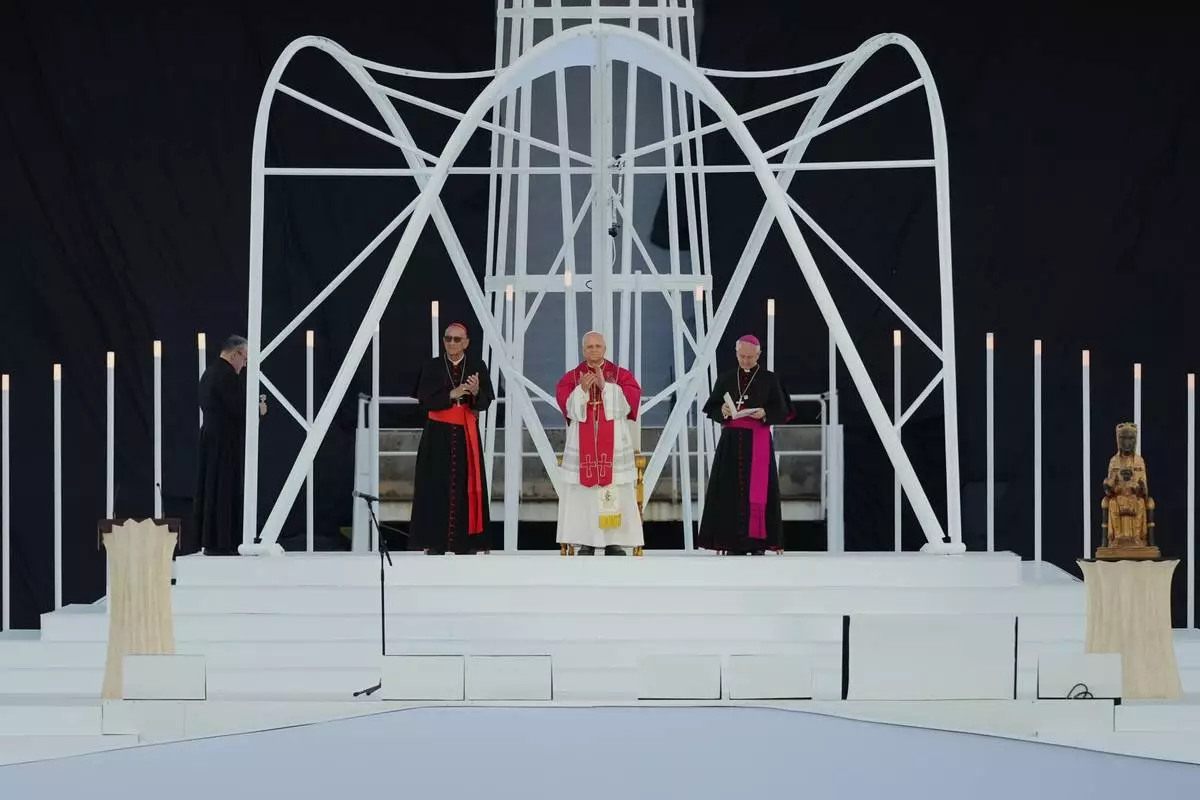
Pope Leo XIV leads a vigil of prayer at the Lluis Companys Olympic Stadium, in Barcelona, Tuesday, June 9, 2026. (AP Photo/Alessandra Tarantino)
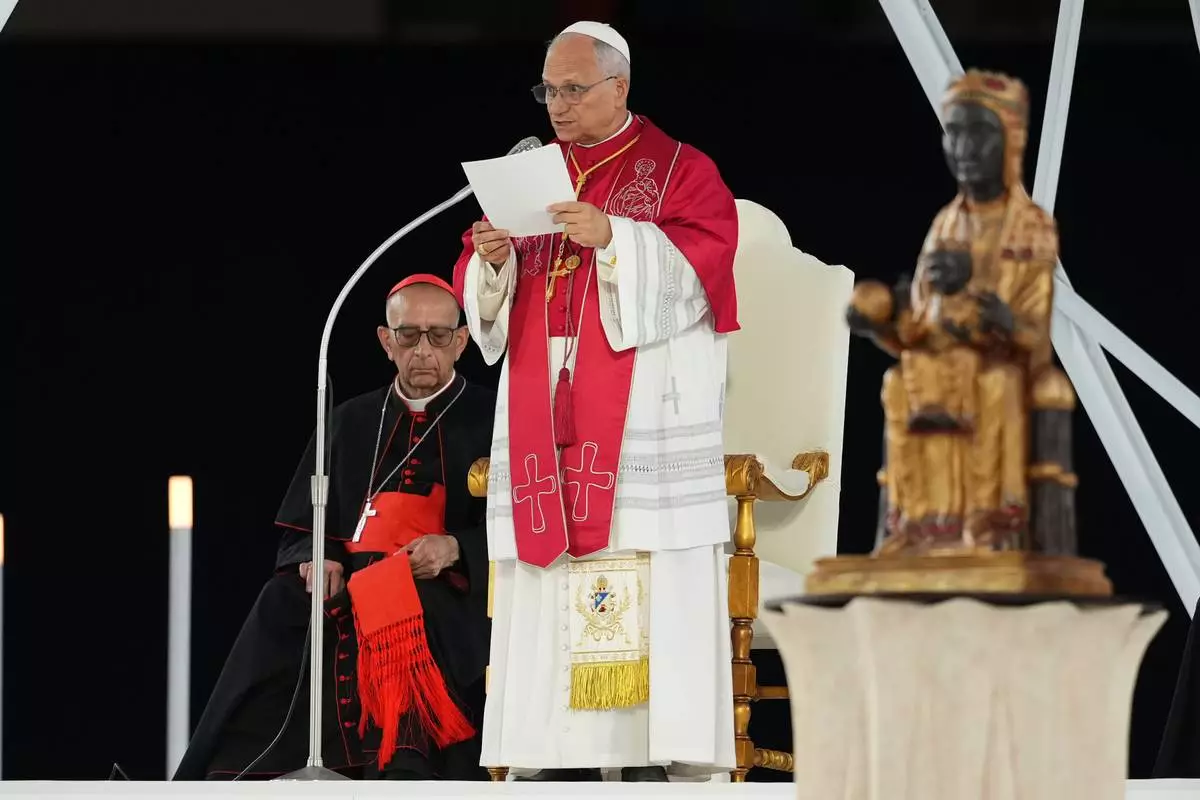
Pope Leo XIV leads a vigil of prayer at the Lluis Companys Olympic Stadium, in Barcelona, Tuesday, June 9, 2026. (AP Photo/Alessandra Tarantino)

Pope Leo XIV arrives to attend a prayer vigil at Lluis Companys Olympic Stadium in Barcelona, Spain, Tuesday, June 9, 2026. (AP Photo/Emilio Morenatti)
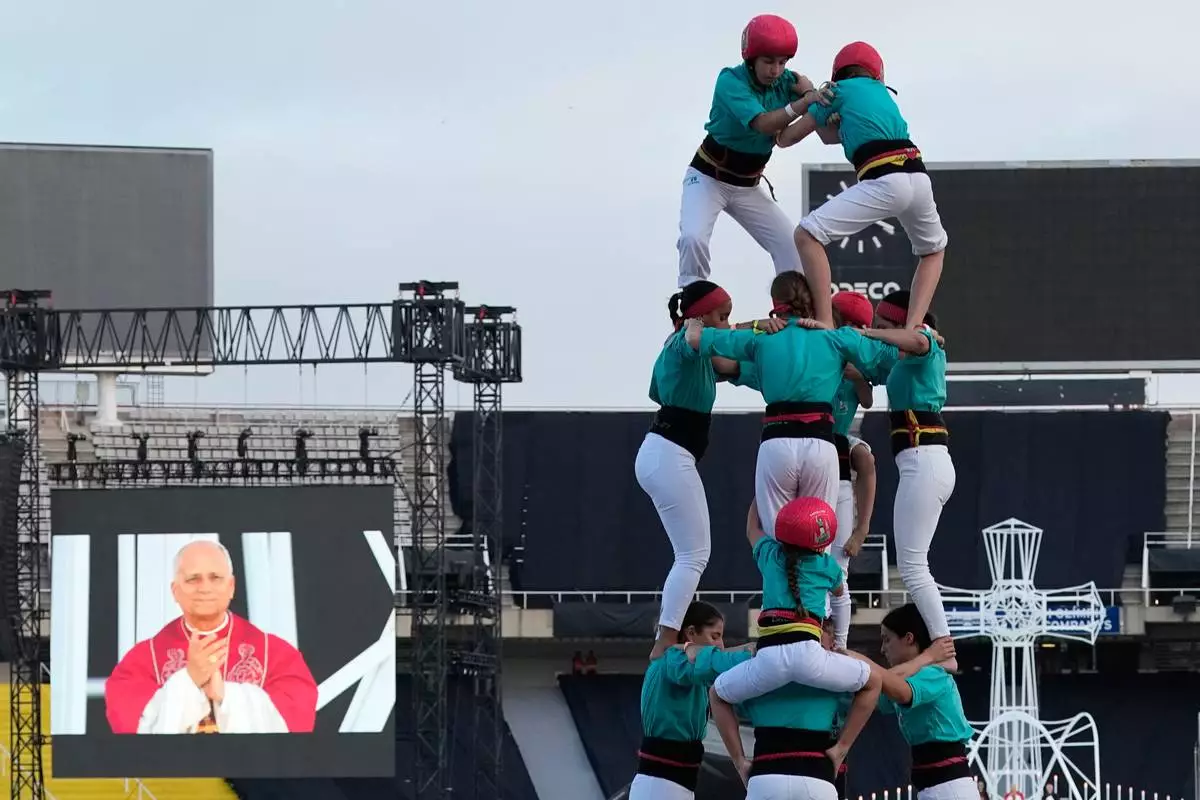
Performers make a human tower, known as Castells, for Pope Leo XIV as he leads a vigil of prayer at the Lluis Companys Olympic Stadium, in Barcelona, Tuesday, June 9, 2026. (AP Photo/Alessandra Tarantino)
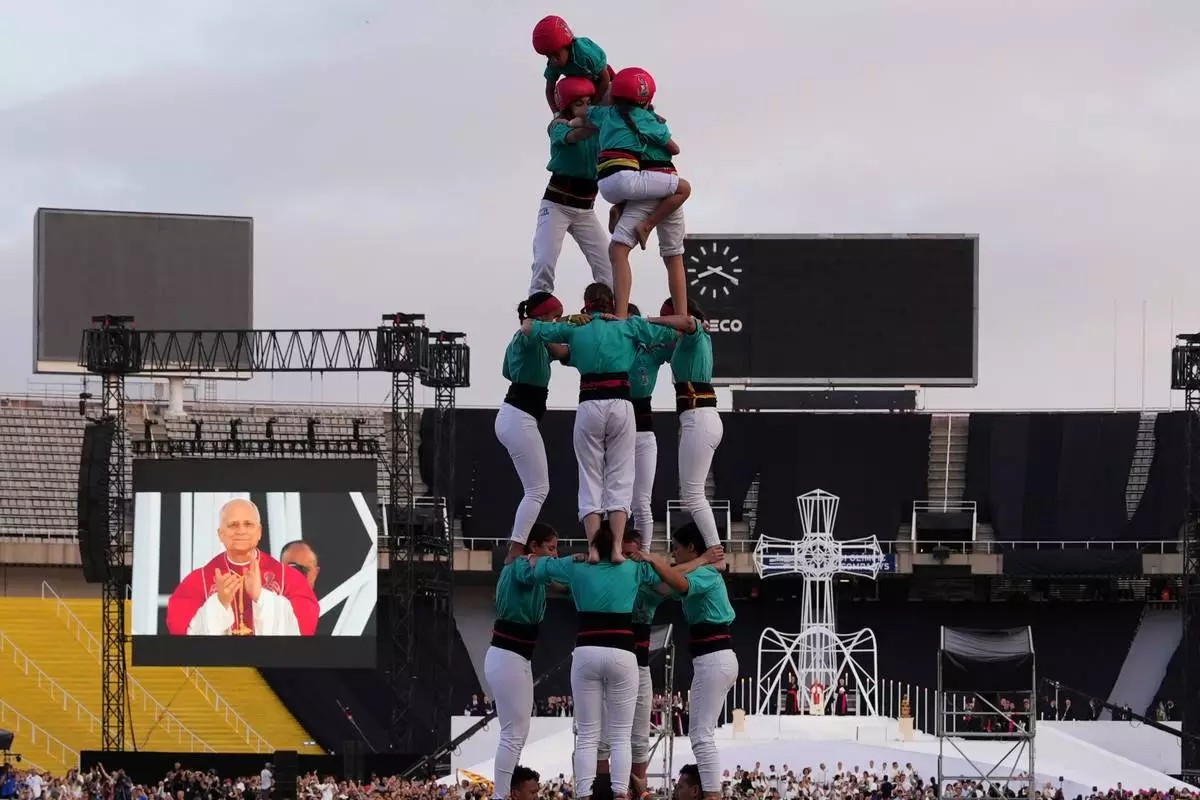
Performers make a human tower, known as Castells, for Pope Leo XIV as he leads a vigil of prayer at the Lluis Companys Olympic Stadium, in Barcelona, Tuesday, June 9, 2026. (AP Photo/Alessandra Tarantino)
WASHINGTON (AP) — A bill to provide nearly $70 billion for immigration enforcement narrowly passed the House on Tuesday and now goes to President Donald Trump for his signature, fueling the administration’s deportation agenda for the remainder of his time in the White House.
Republicans used their majority to get the bill over the finish line, funding a pair of Homeland Security agencies through the next three years. The bill passed by a vote of 214-212, over the objections of Democrats.
The White House says the bill will provide $38 billion for Immigration and Customs Enforcement, $26 billion for the Border Patrol and another $5 billion to cover unforeseen costs. It frontloads routine annual funding, ensuring a virtually uninterrupted flow of money as the Trump administration seeks to deport some 1 million people per year.
Speaker Mike Johnson needed near-perfect attendance and unity on his side to complete weeks of action. The legislation got sidetracked over $1 billion for White House security, including for Trump’s new ballroom, and a $1.8 billion fund to compensate his allies who claim they have been unjustly investigated and prosecuted. Those proposals proved politically toxic and were scrapped.
Now, the bill is focused entirely on immigration enforcement, a topic that Republicans have treated as a defining issue between the two major political parties and one they hope will carry them to victory in this year's midterm elections.
“It's long overdue,” said Johnson, R-La., of the bill. “We have to fund border security and immigration enforcement, and it's sad that Republicans have to do it on our own.”
But Democratic Rep. Lloyd Doggett of Texas called it a “slush fund for ICE.”
The funding comes on top of the nearly $140 billion that the Republican-controlled Congress gave ICE and Customs and Border Protection last year as part of Trump's tax and spending cuts bill.
Democrats objected to giving the agencies more money without significant changes in the way they operate after the deaths of Alex Pretti and Renee Good in Minneapolis. For example, Democrats insisted that agents remove masks and be required to display their ID badges during enforcement operations and that they get a judicial warrant before entering private property. Instead, the funding will come with virtually no strings attached.
Democratic leader Hakeem Jeffries of New York said Republicans weren't focused on the top priorities of the American people and have cut access to Medicaid and nutrition assistance through Trump's earlier tax and spending cut bill.
“Republicans have now come back for more, to give ICE and Donald Trump's violent mass deportation machine another $70 billion blank check, with no oversight, no accountability and no guardrails,” Jeffries said.
House Majority Leader Steve Scalise countered that Democrats were not adequately supportive of law enforcement.
“Make no mistake, if you're voting yes, you're not only voting to secure America's border, you're voting to fund law enforcement,” Scalise said. “And if you vote no, you are voting to defund the police.”
The package is the result of a monthslong standoff in Congress after Democrats refused to fund the Department of Homeland Security in the wake of the immigration enforcement actions in Minneapolis and other American cities, leading to the longest shutdown in agency history.
Negotiations had been underway with the White House to alter ICE operations as Democrats were demanding. When those negotiations failed, Republicans turned to a complicated procedural maneuver to get around the filibuster and pass the immigration funding with no Democratic votes.
Rep. Jodey Arrington, R-Texas, the chairman of the Budget Committee, said the money would provide “regular, normal funding” that ICE and the Border Patrol would get through the annual budgeting process.
“And we’re going to do it, not for one year, but for three years, so we don’t end up here again.”
The Senate completed its work on the legislation last week during an overnight session on a nearly party-line vote, with Sen. Lisa Murkowski of Alaska the only Republican to oppose it.
The money will come at a pivotal time for the Department of Homeland Security, which is under new leadership after Trump replaced Kristi Noem with new Secretary Markwayne Mullin in March.
While Mullin has vowed to keep the department out of the headlines, the administration is under pressure from anti-immigration advocates to deliver on Trump’s campaign promise of the largest deportation operation in American history.
At the same time, the administration is making it more difficult for certain legal immigrants to remain in the U.S. with Temporary Protective Status or to obtain green cards.
On the House side, Johnson had little margin for error. Rep. Kevin Kiley, I-Calif., ended up siding with Democrats on the party-line vote.
Leading up to the vote, Democrats portrayed DHS as an agency that has used its new resources to buy private jets for its leadership, warehouse immigrants in deplorable conditions and attack U.S. citizens.
“Republican leadership likes to talk a lot about common sense, but where is the common sense in giving this federal agency essentially unlimited funds without a single reform in place?” asked Rep. Pete Aguilar, chair of the House Democratic Caucus.
Republicans countered that they were fulfilling their duty to safeguard the nation and support the men and women charged with enforcing the law.
“Democrats can say whatever they want, but what it’s about is public safety. What’s it about is keeping Americans safe,” said Rep. Michelle Fischbach, R-Minn.
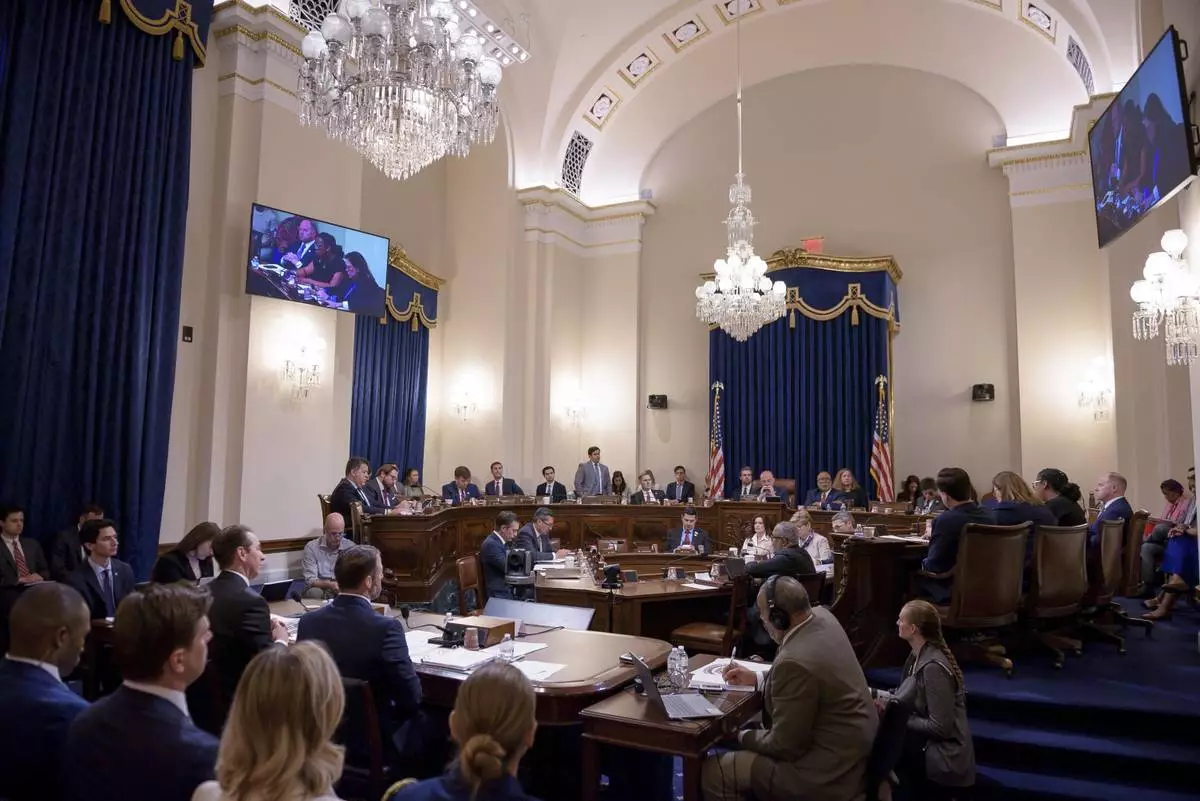
Homeland Security Secretary Markwayne Mullin, lower left, testifies before the House Committee on Homeland Security during a hearing on the Fiscal 2027 budget request for the Department of Homeland Security, in Washington, Wednesday, June 3, 2026. (AP Photo/Cliff Owen)
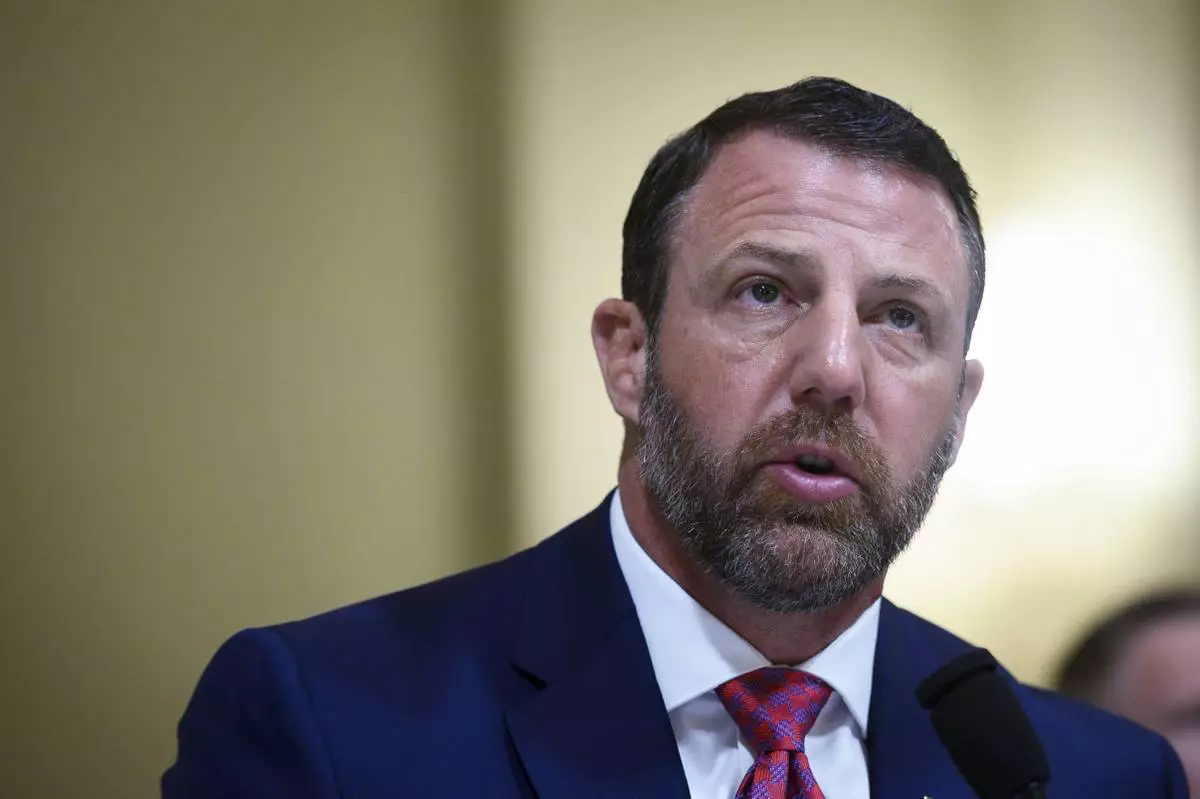
Homeland Security Secretary Markwayne Mullin testifies before the House Committee on Homeland Security during a hearing on the Fiscal 2027 budget request for the Department of Homeland Security, in Washington, Wednesday, June 3, 2026. (AP Photo/Cliff Owen)
The U.S. Capitol is seen behind a light pole, on Capitol Hill in Washington, Wednesday, June 3, 2026. (AP Photo/Cliff Owen)
FILE - The seal of U.S. Department of Homeland Security is seen before a news conference at ICE Headquarters in Washington, May 21, 2025. (AP Photo/Jose Luis Magana, File)
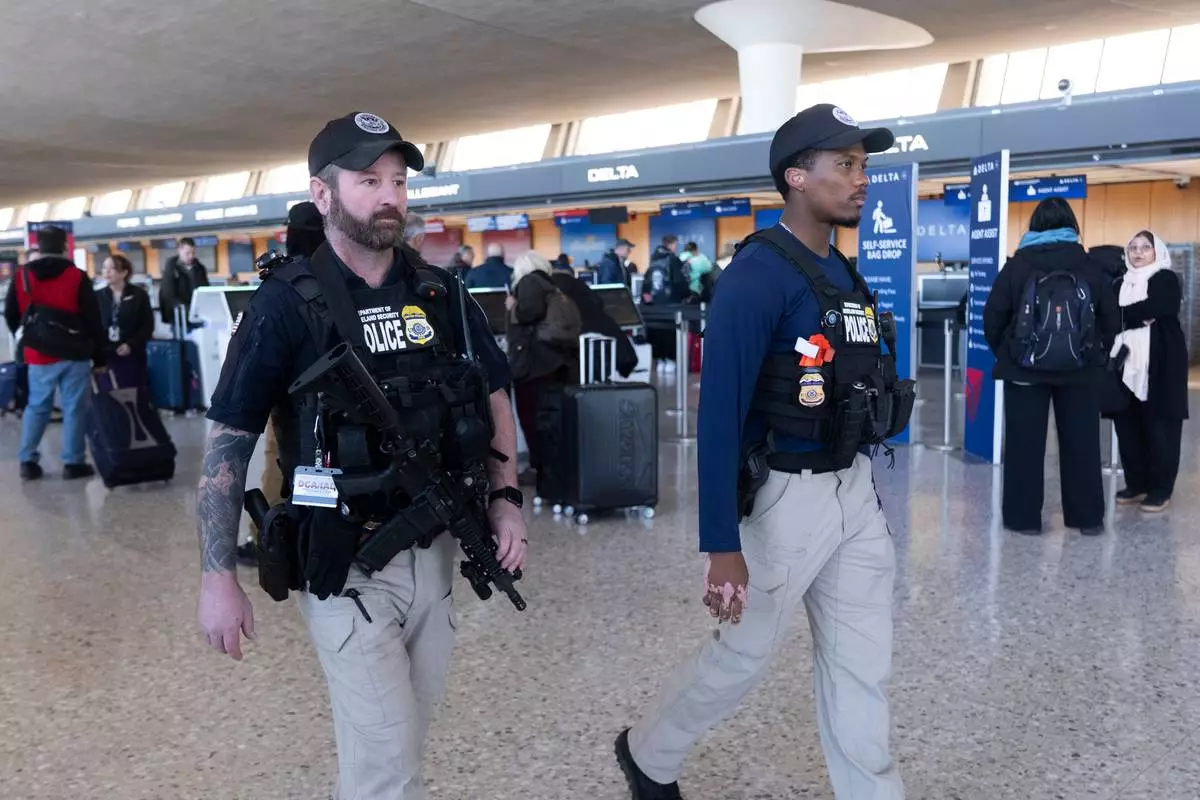
FILE - Department of Homeland Security, Transportation Security Administration, Federal Air Marshals, patrol around Washington Dulles International Airport, in Chantilly, Va., Tuesday, March 24, 2026. (AP Photo/Manuel Balce,File)