|
The practitioner-led group sets out the use cases, participants, and capabilities required to take tokenized cash management from pilots into production.
LONDON and NEW YORK, June 10, 2026 /PRNewswire/ -- The Tokenized Cash Management Advisory Group (TCMAG) today published the scope of its work program: the priority use cases, the participants required to deliver them, and the capabilities each must provide to move tokenized cash management beyond pilots and into production.
TCMAG was formed as a group of corporate treasury practitioners to guide the adoption of tokenization in cash management. In April it published twelve core principles for digital money. The work program published today is the next step, translating those principles into a concrete agenda built around the requirements of the corporate treasurer.
Darsh Johal, Chair of TCMAG, said, "The success of tokenized cash management depends on a diverse group of players weaving their capabilities into an integrated whole. By defining that scope now, we give the industry the opportunity to hit the mark as an alternative to a series of stand-alone pilots. Our twelve principles have set the standard and outlined the requirements for corporate treasurers. The work program we are publishing today turns this into a shared agenda that the whole industry can build against."
The priority use cases
The work program is organized around the everyday workflows of the corporate treasurer:
- Tokenized Money Vendor Payments. A corporate pays a vendor in tokenized money from its ERP; the payment is converted back to fiat and credited to the receiving corporate.
- Tokenized Money Receipts. A corporate receives tokenized money from different issuers and chains; each is converted to cash and credited at par value.
- Inter-Company Sweeping. A corporate HQ uses its treasury management system (TMS) to sweep excess tokenized balances from subsidiaries into a central wallet.
- Subscription and Redemption into Tokenized Money Market Funds. Excess balances are deployed 24/7 into tokenized MMFs to optimize yield on idle liquidity.
- Interoperability of Tokenized Money. Instruments from different issuers and chains are made fungible through redemption at par into cash, letting a corporate receive one instrument and pay in another.
- Agentic Payment. A corporate AI agent initiates and settles payments on-chain within pre-defined spending mandates, without human approval at execution.
The participants and capabilities required
The use cases depend on co-ordination of participants. The program defines the capabilities each must provide:
- Wallet and custody providers: multi-chain wallets and segregated custody per corporate.
- Issuers: issuance across multiple chains, with programmable token controls.
- Chains: connection to wallets and settlement venues, with privacy and performance where required.
- Instruments: tokenized deposits, stablecoins, and tokenized MMFs.
- ERP and TMS platforms: connectivity to wallets and chains, on-chain instruction and sweeps, and real-time reconciliation.
- Messaging platforms: standardized formats bridging traditional rails such as SWIFT and blockchain-native layers.
- Banks and custodians: issuance or distribution of tokenized money, and on/off-ramps between fiat and tokenized instruments.
- Identity providers: reusable digital identity, with KYC and AML credentials recognized across issuers and chains.
- Corporates: connectivity to wallets and issuers, and participation in end-to-end demonstrations.
- Clearing and settlement platforms: minting, redemption, and conversion of tokens and cash at par value, 24/7 and in near real time.
Each use case will be assessed against TCMAG's twelve principles, so that compliance, settlement finality, and operational resilience are built in from the start.
A call to action
For treasury practitioners. Corporate treasurers are invited to join, to bring their real-world requirements, and to shape the use cases so that what the industry builds reflects how treasury operates.
For the wider ecosystem. The work program calls on each of the participants set out above – chains, issuers, wallet providers and custodians, banks, identity providers, and ERP and TMS platforms – to step forward and commit the capabilities described.
TCMAG will continue to develop the work program with practitioners and solution providers, and welcomes participants across the ecosystem to help co-create the future of tokenized corporate treasury.
Notes to Editors:
About TCMAG: The Tokenized Cash Management Advisory Group is a neutral and independent group of treasury practitioners who wish to positively influence the adoption of new forms of digital money in line with corporate treasury requirements. For more information please visit tcmag.org.
The practitioner-led group sets out the use cases, participants, and capabilities required to take tokenized cash management from pilots into production.
LONDON and NEW YORK, June 10, 2026 /PRNewswire/ -- The Tokenized Cash Management Advisory Group (TCMAG) today published the scope of its work program: the priority use cases, the participants required to deliver them, and the capabilities each must provide to move tokenized cash management beyond pilots and into production.
TCMAG was formed as a group of corporate treasury practitioners to guide the adoption of tokenization in cash management. In April it published twelve core principles for digital money. The work program published today is the next step, translating those principles into a concrete agenda built around the requirements of the corporate treasurer.
Darsh Johal, Chair of TCMAG, said, "The success of tokenized cash management depends on a diverse group of players weaving their capabilities into an integrated whole. By defining that scope now, we give the industry the opportunity to hit the mark as an alternative to a series of stand-alone pilots. Our twelve principles have set the standard and outlined the requirements for corporate treasurers. The work program we are publishing today turns this into a shared agenda that the whole industry can build against."
The priority use cases
The work program is organized around the everyday workflows of the corporate treasurer:
- Tokenized Money Vendor Payments. A corporate pays a vendor in tokenized money from its ERP; the payment is converted back to fiat and credited to the receiving corporate.
- Tokenized Money Receipts. A corporate receives tokenized money from different issuers and chains; each is converted to cash and credited at par value.
- Inter-Company Sweeping. A corporate HQ uses its treasury management system (TMS) to sweep excess tokenized balances from subsidiaries into a central wallet.
- Subscription and Redemption into Tokenized Money Market Funds. Excess balances are deployed 24/7 into tokenized MMFs to optimize yield on idle liquidity.
- Interoperability of Tokenized Money. Instruments from different issuers and chains are made fungible through redemption at par into cash, letting a corporate receive one instrument and pay in another.
- Agentic Payment. A corporate AI agent initiates and settles payments on-chain within pre-defined spending mandates, without human approval at execution.
The participants and capabilities required
The use cases depend on co-ordination of participants. The program defines the capabilities each must provide:
- Wallet and custody providers: multi-chain wallets and segregated custody per corporate.
- Issuers: issuance across multiple chains, with programmable token controls.
- Chains: connection to wallets and settlement venues, with privacy and performance where required.
- Instruments: tokenized deposits, stablecoins, and tokenized MMFs.
- ERP and TMS platforms: connectivity to wallets and chains, on-chain instruction and sweeps, and real-time reconciliation.
- Messaging platforms: standardized formats bridging traditional rails such as SWIFT and blockchain-native layers.
- Banks and custodians: issuance or distribution of tokenized money, and on/off-ramps between fiat and tokenized instruments.
- Identity providers: reusable digital identity, with KYC and AML credentials recognized across issuers and chains.
- Corporates: connectivity to wallets and issuers, and participation in end-to-end demonstrations.
- Clearing and settlement platforms: minting, redemption, and conversion of tokens and cash at par value, 24/7 and in near real time.
Each use case will be assessed against TCMAG's twelve principles, so that compliance, settlement finality, and operational resilience are built in from the start.
A call to action
For treasury practitioners. Corporate treasurers are invited to join, to bring their real-world requirements, and to shape the use cases so that what the industry builds reflects how treasury operates.
For the wider ecosystem. The work program calls on each of the participants set out above – chains, issuers, wallet providers and custodians, banks, identity providers, and ERP and TMS platforms – to step forward and commit the capabilities described.
TCMAG will continue to develop the work program with practitioners and solution providers, and welcomes participants across the ecosystem to help co-create the future of tokenized corporate treasury.
Notes to Editors:
About TCMAG: The Tokenized Cash Management Advisory Group is a neutral and independent group of treasury practitioners who wish to positively influence the adoption of new forms of digital money in line with corporate treasury requirements. For more information please visit tcmag.org.
** This press release is distributed by PR Newswire through automated distribution system, for which the client assumes full responsibility. **
Tokenized Cash Management Advisory Group Publishes the Scope of Its Work Program
|
New study reveals why the Greenfield vs. Brownfield debate is the #1 planning mistake in modern data migrations.
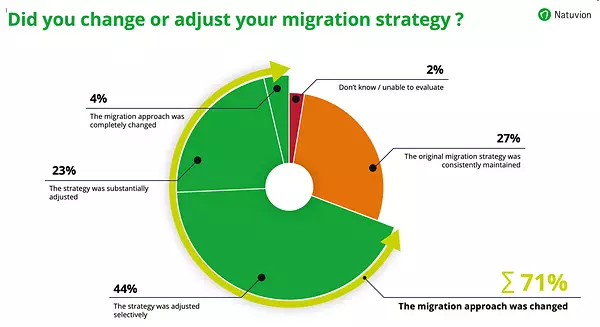
MUNICH, June 10, 2026 /PRNewswire/ -- The biggest risk in a large data transformation isn't choosing the wrong starting point: it's choosing a path which can't be changed. Deciding between a greenfield or brownfield approach feels like a strategic milestone. In reality and proved in the recent Natuvion Transformation Study 2026, conducted by the data transformation specialist Natuvion and NTT Data Business Solutions, it is often the first mistake in planning a migration. All too often, it is assumed that transformations can be planned perfectly from day one. In reality, they rarely are. The uncomfortable truth is that plans are very likely to change during the migration process. According to the 2026 Transformation Study 71 percent of companies change their migration approach mid-project.
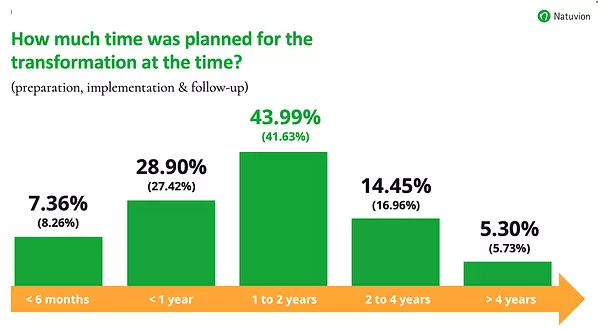
The Natuvion Transformation Study also shows that 44% of large-scale transformations in the USA take between one and two years. In that window, everything is in motion: business models shift, regulatory requirements evolve, data environments change, and internal priorities pivot.
When the original plan no longer holds, a rigid strategy becomes a liability. Nevertheless, many organizations start with a binary choice: from a US perspective Greenfield (start fresh) was chosen by 17% and Brownfield (lift and shift) by 39%, compared to the global results of 34% for Brownfield and 20% for Greenfield. While this deceptive clarity seems helpful at kickoff, it is a dangerous illusion. Neither approach is natively designed to adapt when missing data, legacy complexities, or new compliance rules appear twelve months into the roadmap.
"When a strategy is too stiff to bend, it breaks. This leads to slipped timelines, budget hemorrhaging, and stalled innovation. The failure isn't a result of poor execution; it is a result of a decision that was too rigid to account for the "moving target" of modern business", says Joanne Lang CEO of Natuvion Americas. "The defining factor of a successful transformation isn't the initial plan. It's the capability to adapt that plan without starting over. This is where Selective Data Transition changes the game. It isn't a compromise; it is a strategic capability that allows companies to change direction during the project, ensure that data remains safe, accessible, and compliant, no matter how the mission changes."
Three rules companies should keep in mind before planning a data migration:
- Prioritize partners, not just paths: Never choose tools or partners that only support one methodology. If the setup isn't capable of meeting tomorrow's demands, the transformation is at risk from the very start.
- The greenfield requirement: If starting from scratch, it must be possible to migrate existing data and processes as soon as they become relevant.
- The brownfield requirement: When migrating data using the "lift-and-shift" method, the process must be carried out with surgical precision to exclude or restructure data without breaking the core.
"Transformation is not a static concept; it is a moving target. The "best" plan isn't the one that looks good on a slide deck today. It's the one that remains viable when reality shifts tomorrow. In 2026, the winners won't be those who committed to a single approach, but those who prioritized the flexibility to keep the lights on and the data moving, regardless of the obstacles", Patric Dahse CEO of Natuvion concluded.
The full 2026 IT Transformation Study will be published in June and can be pre-ordered for free on the Natuvion website at: https://www.natuvion.com/transformation-study-2026/
About Natuvion
Natuvion is a digital moving company that moves business-critical data and processes from one technology platform to another. Natuvion experts are called in when medium-sized and large enterprises want to modernize, optimize, separate, merge, or restructure their IT systems. With its exclusive expertise in technical transformation, Natuvion enables its customers to run their data and processes on the most modern and innovative technologies available. To support data transformations, Natuvion leverages its proprietary software solution, Natuvion DCS. Natuvion is a founding member of the SAP S/4HANA Selective Data Transition Engagement Community and has been part of NTT DATA Business Solutions AG, a leading global SAP consultancy, since 2022.
More information at www.natuvion.com
New study reveals why the Greenfield vs. Brownfield debate is the #1 planning mistake in modern data migrations.
MUNICH, June 10, 2026 /PRNewswire/ -- The biggest risk in a large data transformation isn't choosing the wrong starting point: it's choosing a path which can't be changed. Deciding between a greenfield or brownfield approach feels like a strategic milestone. In reality and proved in the recent Natuvion Transformation Study 2026, conducted by the data transformation specialist Natuvion and NTT Data Business Solutions, it is often the first mistake in planning a migration. All too often, it is assumed that transformations can be planned perfectly from day one. In reality, they rarely are. The uncomfortable truth is that plans are very likely to change during the migration process. According to the 2026 Transformation Study 71 percent of companies change their migration approach mid-project.
The Natuvion Transformation Study also shows that 44% of large-scale transformations in the USA take between one and two years. In that window, everything is in motion: business models shift, regulatory requirements evolve, data environments change, and internal priorities pivot.
When the original plan no longer holds, a rigid strategy becomes a liability. Nevertheless, many organizations start with a binary choice: from a US perspective Greenfield (start fresh) was chosen by 17% and Brownfield (lift and shift) by 39%, compared to the global results of 34% for Brownfield and 20% for Greenfield. While this deceptive clarity seems helpful at kickoff, it is a dangerous illusion. Neither approach is natively designed to adapt when missing data, legacy complexities, or new compliance rules appear twelve months into the roadmap.
"When a strategy is too stiff to bend, it breaks. This leads to slipped timelines, budget hemorrhaging, and stalled innovation. The failure isn't a result of poor execution; it is a result of a decision that was too rigid to account for the "moving target" of modern business", says Joanne Lang CEO of Natuvion Americas. "The defining factor of a successful transformation isn't the initial plan. It's the capability to adapt that plan without starting over. This is where Selective Data Transition changes the game. It isn't a compromise; it is a strategic capability that allows companies to change direction during the project, ensure that data remains safe, accessible, and compliant, no matter how the mission changes."
Three rules companies should keep in mind before planning a data migration:
- Prioritize partners, not just paths: Never choose tools or partners that only support one methodology. If the setup isn't capable of meeting tomorrow's demands, the transformation is at risk from the very start.
- The greenfield requirement: If starting from scratch, it must be possible to migrate existing data and processes as soon as they become relevant.
- The brownfield requirement: When migrating data using the "lift-and-shift" method, the process must be carried out with surgical precision to exclude or restructure data without breaking the core.
"Transformation is not a static concept; it is a moving target. The "best" plan isn't the one that looks good on a slide deck today. It's the one that remains viable when reality shifts tomorrow. In 2026, the winners won't be those who committed to a single approach, but those who prioritized the flexibility to keep the lights on and the data moving, regardless of the obstacles", Patric Dahse CEO of Natuvion concluded.
The full 2026 IT Transformation Study will be published in June and can be pre-ordered for free on the Natuvion website at: https://www.natuvion.com/transformation-study-2026/
About Natuvion
Natuvion is a digital moving company that moves business-critical data and processes from one technology platform to another. Natuvion experts are called in when medium-sized and large enterprises want to modernize, optimize, separate, merge, or restructure their IT systems. With its exclusive expertise in technical transformation, Natuvion enables its customers to run their data and processes on the most modern and innovative technologies available. To support data transformations, Natuvion leverages its proprietary software solution, Natuvion DCS. Natuvion is a founding member of the SAP S/4HANA Selective Data Transition Engagement Community and has been part of NTT DATA Business Solutions AG, a leading global SAP consultancy, since 2022.
More information at www.natuvion.com
** This press release is distributed by PR Newswire through automated distribution system, for which the client assumes full responsibility. **
Natuvion study shows 71% of data transformations shift mid-project

Natuvion study shows 71% of data transformations shift mid-project
Natuvion study shows 71% of data transformations shift mid-project