Senior prosecutors and legal experts from several countries around the world gathered in Beijing on Monday for a roundtable which explored the role of prosecutors in global environmental governance, with attendees exchanging strategies on how the legal sector can help to better tackle pollution and promote conservation.
The meeting was co-hosted by China's Supreme People's Procuratorate and the environmental law NGO ClientEarth and saw prosecutors from China, Brazil, Mongolia and Vietnam, and legal experts from Europe, Oceania and beyond in attendance.
In recent years, China is increasingly turning to a powerful legal tool in its fight against pollution -- procuratorial public interest litigation. By leveraging the possibility of legal action, prosecutors are helping break down bureaucratic barriers and strengthen environmental law enforcement.
One such successful case study can be seen at China's largest freshwater lake, Nansi Lake in the eastern Shandong Province, which previously endured years of pollution.
A total of 53 rivers flow into Nansi Lake from four provinces, each with different environmental standards and enforcement authorities, which meant efforts to clean it up were stalled by jurisdictional deadlocks. That all changed in 2021, when China's top prosecutorial authority, the Supreme People's Procuratorate, launched a public interest litigation campaign that helped unify environmental standards across the watershed and address pollution at its source.
"When environmental problems cross departmental and regional boundaries, no single agency or locality can solve them alone. That's where procuratorates can play a strong coordinating role, bringing different parties together," said Xu Xiangchun, Director-General of Public Interest Litigation Procuratorial Department under the Supreme People's Procuratorate of China.
The Nansi Lake restoration has become a landmark case in China's environmental public interest litigation system, which was rolled out nationwide in 2015.
At the Beijing roundtable event, attendees shared similar cases in their own countries.
"Vietnam recently launched a pilot program allowing procuratorates to bring forward civil public interest lawsuits, including in the area of environmental protection. In just over five months, procuratorates in the six pilot areas have taken on 150 environmental cases. Many incidents of pollution were stopped before further damage could be done, and the violations have since been brought to an end," said Nguyen Duc Thai, Deputy Prosecutor General of Supreme People's Procuracy of Vietnam, on the sidelines of the event.
From Vietnam's serene Ea Sup Ha Lake to Brazil's Amazon rainforest, the environmental challenges may vary, but the objective remains the same: ensuring environmental laws are enforced effectively.
While sharing experiences and exchanging ideas, attendees at the roundtable also reached agreement that the ultimate objective is not litigation, but preventing environmental harm before it happens.
"The idea of prosecutors to come together and talk about these systems and what works using technologies, AI, satellites for their work, how do they do that, sharing experiences, challenges -- that's really important," said Dimitri De Boer, the chief representative for the Beijing office of ClientEarth.
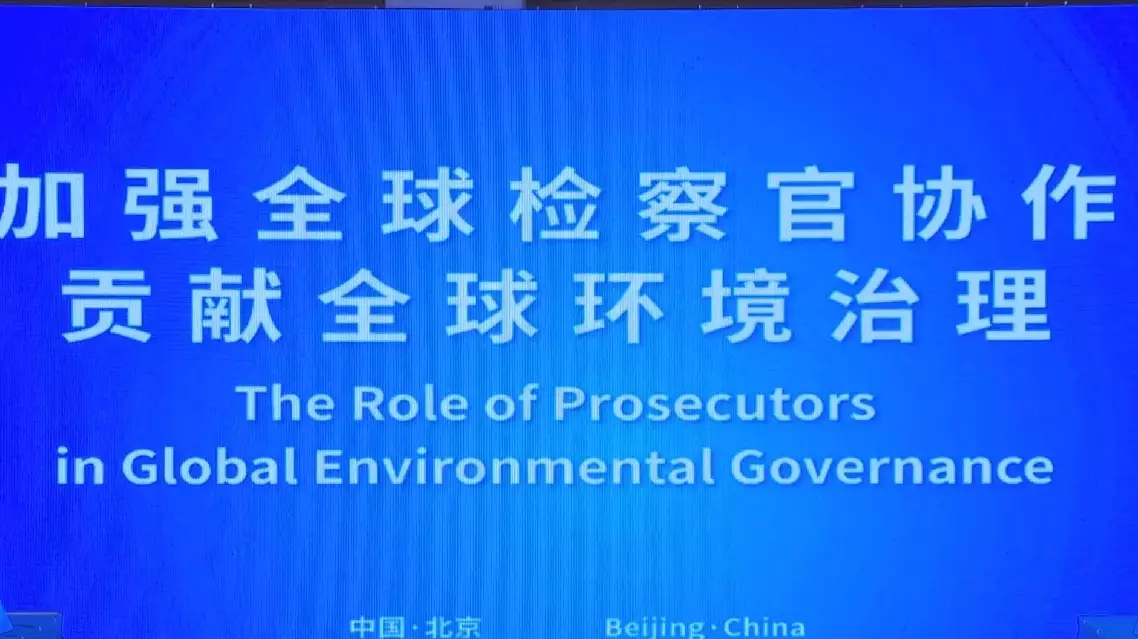
Global prosecutors gather in Beijing to exchange strategies on how to defend environment