ST. PETERSBURG, Fla. (AP) — Drew Rasmussen struck out a career-high 13 and two-hit the Boston Red Sox over seven scoreless innings, leading the Tampa Bay Rays to a 7-5 victory Wednesday.
Nick Fortes, Yandy Díaz and Taylor Walls had multiple hits for the Rays, who swept the Red Sox for the first time since 2023.
Click to Gallery
Boston Red Sox pitcher Jake Bennett goes into his delivery against the Tampa Bay Rays during the first inning of a baseball game Wednesday, June 10, 2026, in St. Petersburg, Fla. (AP Photo/Chris O'Meara)
Tampa Bay Rays' Cedric Mullins celebrates with Ben Williamson (15) and Taylor Walls (6) after the team defeated the Boston Red Sox during a baseball game Wednesday, June 10, 2026, in St. Petersburg, Fla. (AP Photo/Chris O'Meara)
Tampa Bay Rays' Yandy Díaz, front, scores ahead of the tag by Boston Red Sox catcher Mickey Gasper on a sacrifice fly by Ryan Vilade during the fifth inning of a baseball game Wednesday, June 10, 2026, in St. Petersburg, Fla. (AP Photo/Chris O'Meara)
Tampa Bay Rays pitcher Drew Rasmussen delivers to the Boston Red Sox during the first inning of a baseball game Wednesday, June 10, 2026, in St. Petersburg, Fla. (AP Photo/Chris O'Meara)
Rasmussen (6-2) fanned his first four hitters, faced the minimum through four innings and didn’t allow a runner to reach third base. Boston’s 1-4 batters were a combined 0 for 11 with 11 strikeouts against the Tampa Bay righty, who left with a 5-0 lead.
Boston then jumped on the Rays’ bullpen with a four-run eighth, including Ceddanne Rafaela’s three-run homer. Caleb Durbin also homered in the frame to put the Red Sox on the board.
But Fortes answered with his fourth hit, matching a career high, and Cedric Mullins hit a two-run homer off Boston reliever Justin Slaten. Garrett Cleavinger pitched the ninth for his second save, despite surrendering another homer to Durbin.
The small-ball Rays scored in the third when Fortes doubled off the wall, Mullins’ sacrifice bunt moved Fortes to third and Taylor Walls scored him on a sacrifice fly.
Tampa Bay used three infield hits — including an Austin Slater RBI double off the leg of Boston starter Jake Bennett (1-2) — to score three in the fifth.
Díaz, who had three hits and two RBIs, extended the longest on-base streak in the majors to 24 games.
The Rays are 12-0 against the AL East at Tropicana Field, the majors’ longest season-opening home streak against division opponents since 2009.
Boston returns home to face Texas on Friday with RHP Sonny Gray (7-1, 3.20 ERA) on the mound.
Tampa Bay begins a road trip against the Angels on Friday with LHP Shane McLanahan (6-3, 2.85) scheduled to start. Neither Texas nor Los Angeles has announced a starter.
AP MLB: https://apnews.com/hub/mlb

Boston Red Sox pitcher Jake Bennett goes into his delivery against the Tampa Bay Rays during the first inning of a baseball game Wednesday, June 10, 2026, in St. Petersburg, Fla. (AP Photo/Chris O'Meara)

Tampa Bay Rays' Cedric Mullins celebrates with Ben Williamson (15) and Taylor Walls (6) after the team defeated the Boston Red Sox during a baseball game Wednesday, June 10, 2026, in St. Petersburg, Fla. (AP Photo/Chris O'Meara)

Tampa Bay Rays' Yandy Díaz, front, scores ahead of the tag by Boston Red Sox catcher Mickey Gasper on a sacrifice fly by Ryan Vilade during the fifth inning of a baseball game Wednesday, June 10, 2026, in St. Petersburg, Fla. (AP Photo/Chris O'Meara)

Tampa Bay Rays pitcher Drew Rasmussen delivers to the Boston Red Sox during the first inning of a baseball game Wednesday, June 10, 2026, in St. Petersburg, Fla. (AP Photo/Chris O'Meara)
NEW YORK (AP) — Another sell-off for artificial-intelligence stocks helped drag the U.S. market sharply lower Wednesday, as Wall Street’s former superstars continue to face heavy scrutiny for their success.
The S&P 500 dropped 1.6% for its first back-to-back drop in three weeks and is back to where it was in early May. The Dow Jones Industrial Average tumbled 953 points, or 1.9%, and the Nasdaq composite led the market lower with a 2% slide.
Wall Street has been shaky since last week, when AI stocks went from roaring to records to suddenly turning lower. Among the worries is that their prices have simply shot too high, too fast because of AI mania. The question now is whether the break lower has cleared out excessive optimism that may have built into their stock prices, or if it’s the start of a longer downturn.
Super Micro Computer, which sells AI servers, tumbled 28% after saying late Tuesday that it plans to raise $7 billion in cash by selling shares of stock and convertible preferred stock. Such moves raise the most money for companies when their stock prices are high, and they can dilute the ownership stakes of existing shareholders.
Micron Technology swung from an early loss of nearly 4% to a modest gain and back to a loss of 4.7%. It’s coming off a wild stretch where it sank 7.7% last Thursday, then plunged another 13.3% Friday and rallied 9.9% Monday. Despite all the swings, the computer memory maker’s stock is still up 212.5% for the year so far.
Nvidia, the chip company that’s grown into a nearly $4.9 trillion behemoth because of the AI boom, was the heaviest weight on the S&P 500 after falling 3.7%. The second-heaviest was another AI winner, Broadcom, which fell 5.1%.
Some of the pressure on AI stocks could also be coming from investors pulling cash out to prepare for high-profile debuts on the U.S. stock market for several AI giants. SpaceX’s initial public offering could come later this week, for example.
Weakening stocks for companies with big fuel bills also pulled the market lower. United Airlines sank 6.2%, and cruise-operator Carnival fell 6.3% after oil prices rose due to the latest fighting in the war with Iran.
The price for a barrel of Brent crude oil rose 1.8% to $93.10 after President Donald Trump warned Iran would “pay the price” for stalled negotiations between the two on their war. The war has been keeping the Strait of Hormuz effectively shut to oil tankers, which has prevented the delivery of crude from the Persian Gulf to customers worldwide.
High oil prices have sent inflation higher, and a report on Wednesday showed that prices for U.S. consumers jumped in May at the highest speed in three years.
But Treasury yields nonetheless held relatively steady in the bond market because the figures were pretty much exactly what economists had forecast. The rise in an important underlying measure of inflation, meanwhile, was not as bad from April through May as economists expected.
The yield on the 10-year Treasury edged up to 4.54% from 4.53% late Tuesday. The two-year Treasury yield, which more closely tracks expectations for what the Federal Reserve will do with its overnight interest rates, held at 4.13%.
Traders have been building bets recently that the Fed will have to hike its main interest rate at least once this year, given how high inflation is and how strong the U.S. job market remains. Wednesday’s inflation update didn’t sway them much, according to data from CME Group.
High yields can slow entire economies and undercut prices for all kinds of investments, including stocks and cryptocurrencies. They hit investments seen as the most expensive in particular, and some critics are calling AI a bubble where investment inflated too far.
All told, the S&P 500 fell 119.66 points to 7,266.99. The Dow Jones Industrial Average dropped 953.33 to 49,918.78, and the Nasdaq composite sank 509.32 to 25,169.50.
In stock markets abroad, indexes in Europe were mixed following sharper drops in Asia.
South Korea’s Kospi tumbled 4.5%, hurt by losses for tech giants Samsung Electronics and SK Hynix.
Tokyo’s Nikkei 225 sank 1.9% after data showed Japan’s producer price index, a measure for prices at the wholesale level, rose in May at the fastest pace in more than three years. Shares of technology and telecommunications giant SoftBank Group, which has a strong AI focus, lost 8.3%.
AP Business Writers Chan Ho-him and Matt Ott contributed to this report.
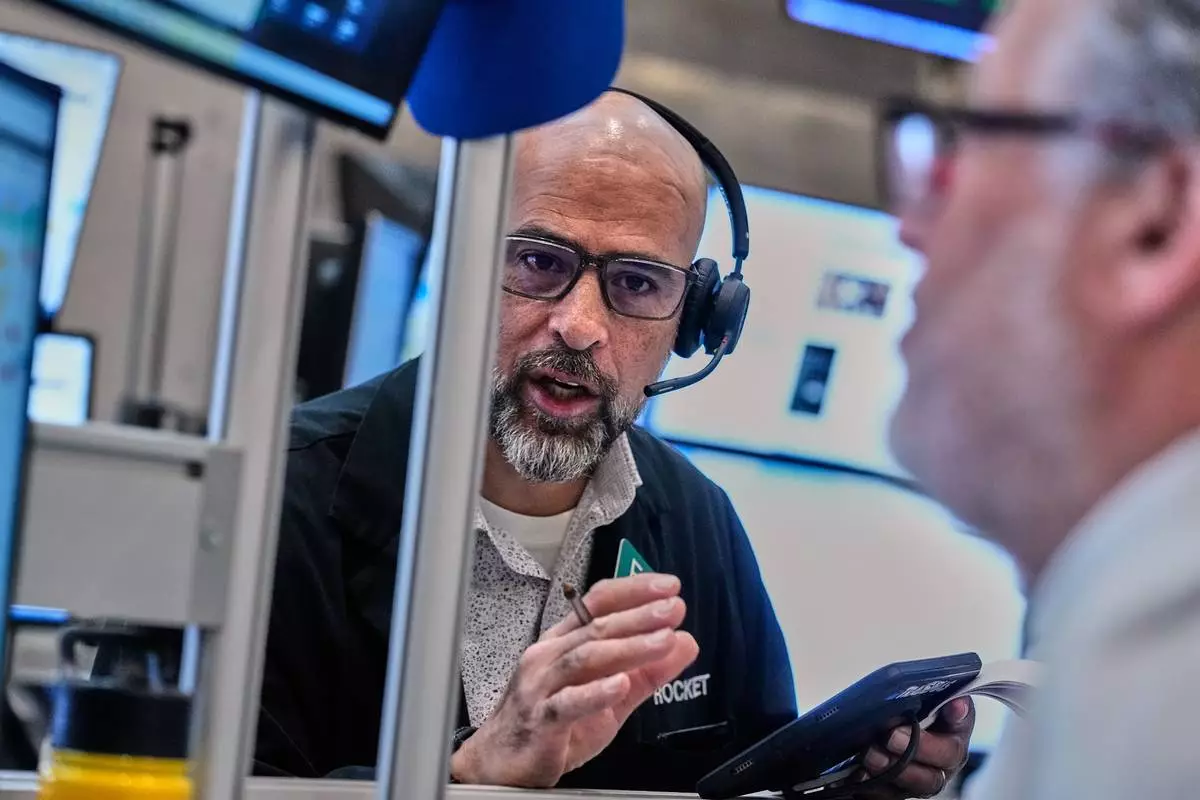
Options traders Steven Rodriguez, left, and Marty Handler work on the floor of the New York Stock Exchange, Wednesday, June 3, 2026. (AP Photo/Richard Drew)
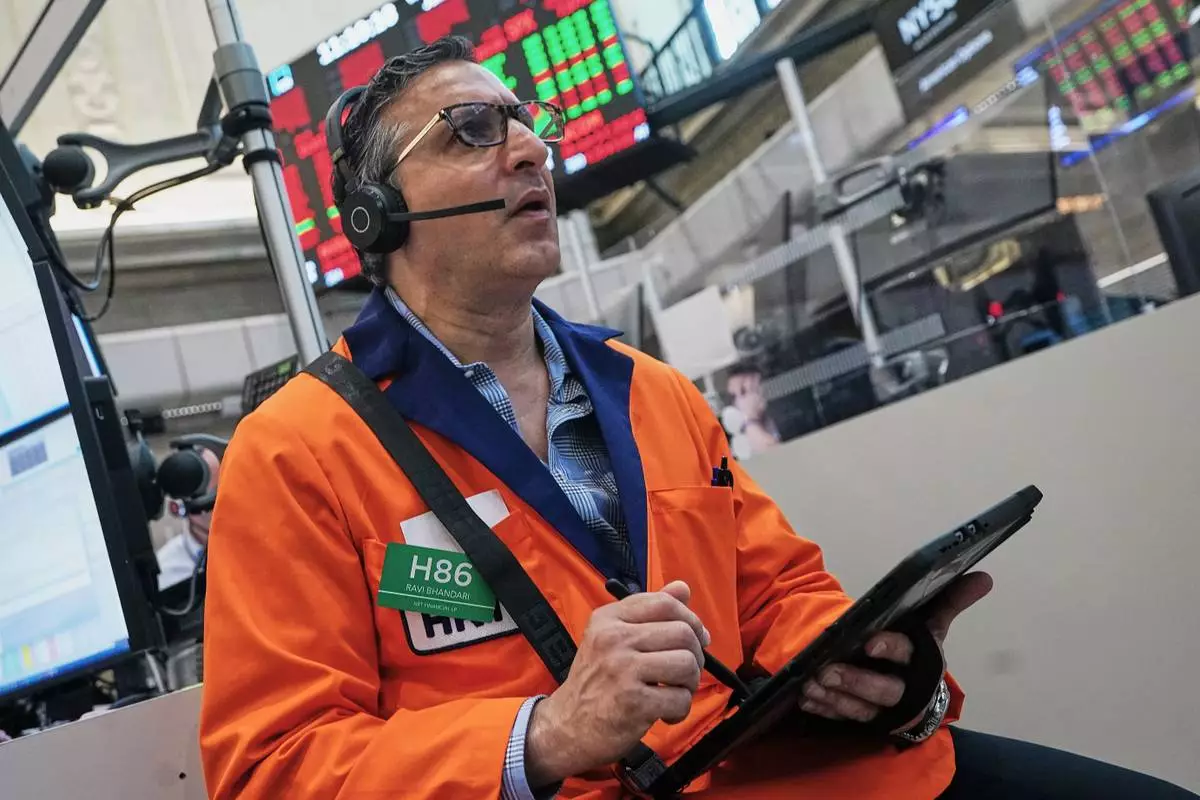
Options trader Ravi Bhandari works on the floor of the New York Stock Exchange, Wednesday, June 3, 2026. (AP Photo/Richard Drew)
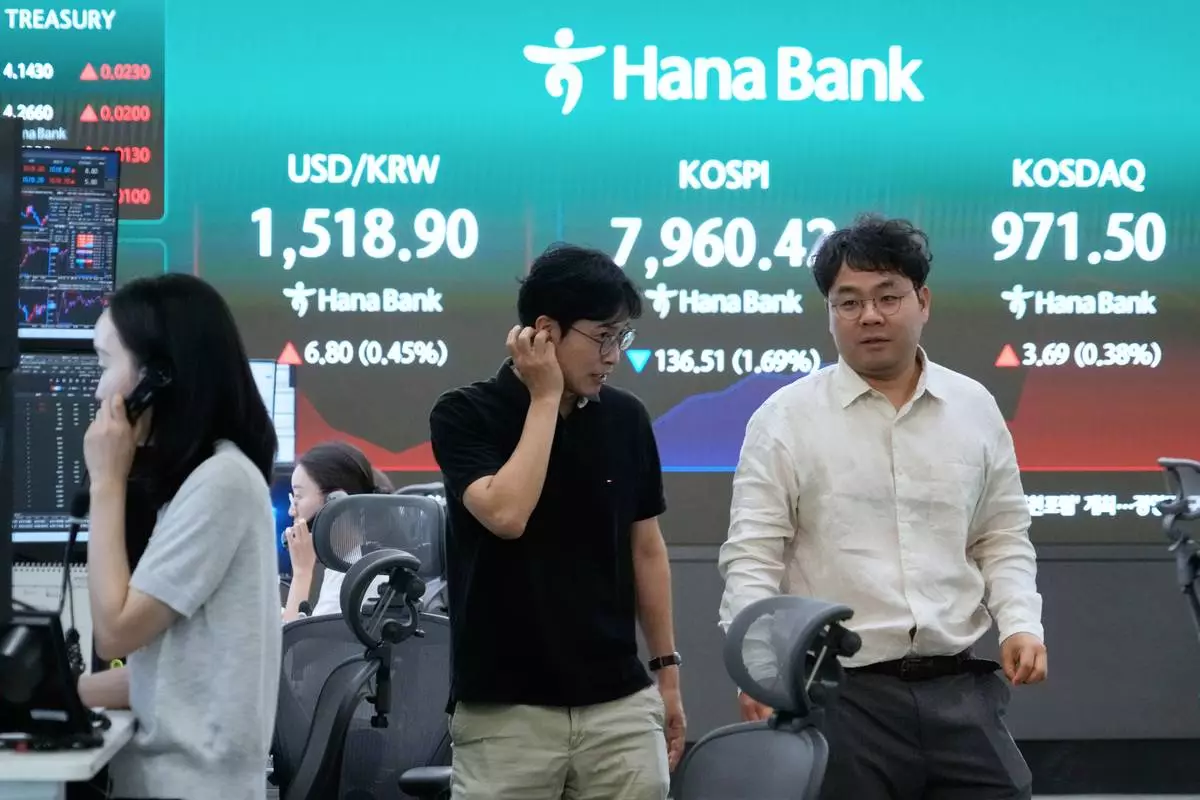
Currency traders pass by a screen showing the Korea Composite Stock Price Index (KOSPI) and the foreign exchange rate between U.S. dollar and South Korean won at the foreign exchange dealing room of the Hana Bank headquarters in Seoul, South Korea, Wednesday, June 10, 2026. (AP Photo/Ahn Young-joon)
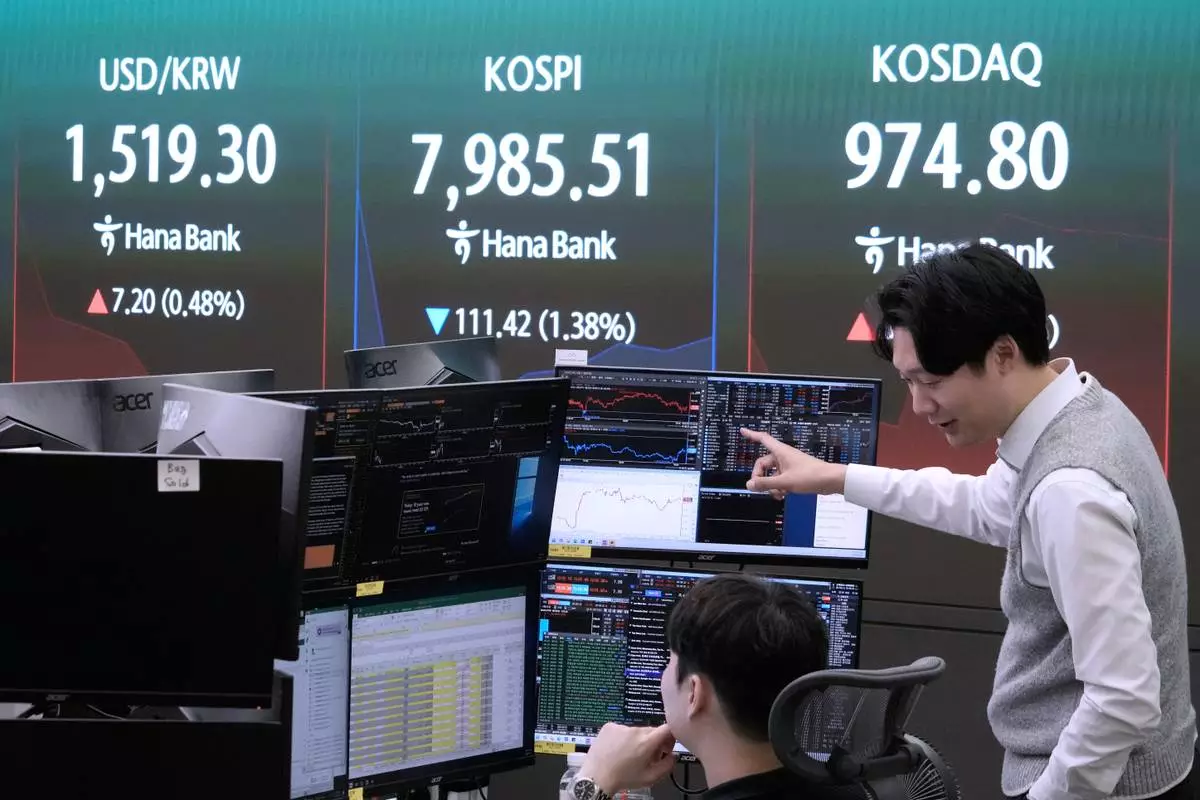
Currency traders work near a screen showing the Korea Composite Stock Price Index (KOSPI) and the foreign exchange rate between U.S. dollar and South Korean won at the foreign exchange dealing room of the Hana Bank headquarters in Seoul, South Korea, Wednesday, June 10, 2026. (AP Photo/Ahn Young-joon)
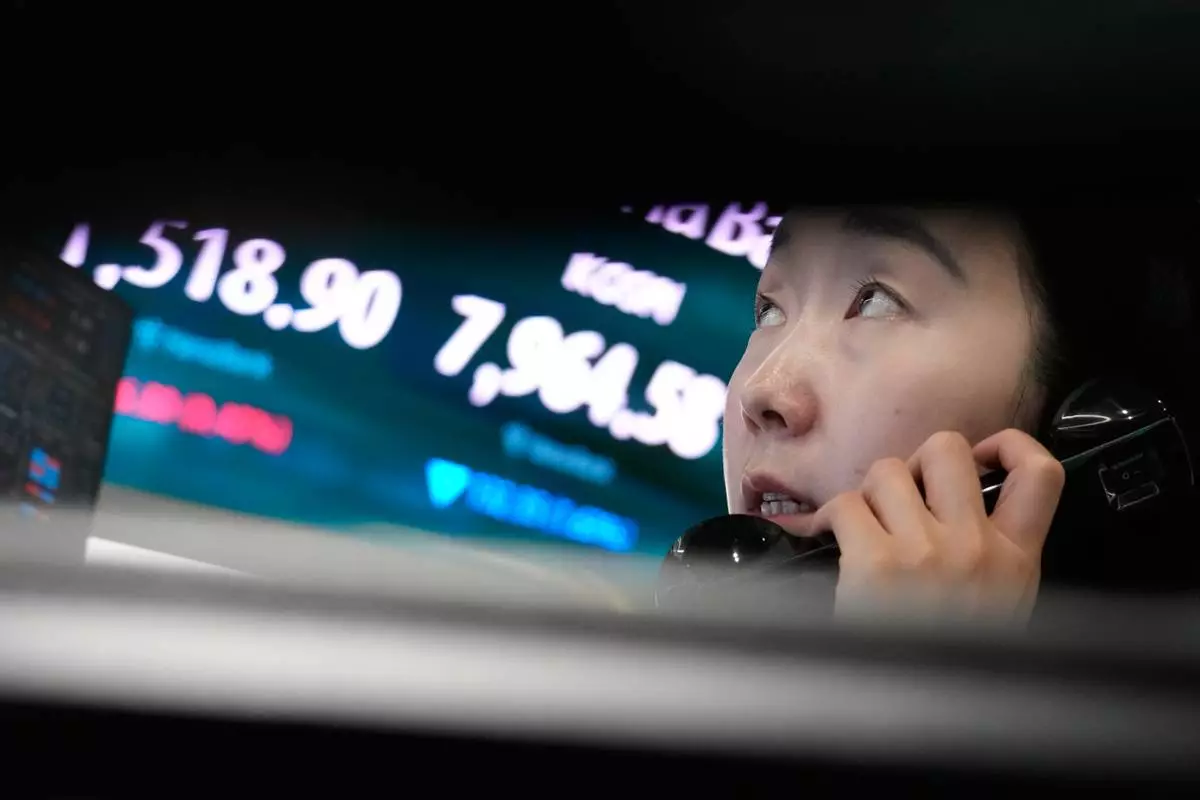
A currency trader talks on the phone near a screen showing the Korea Composite Stock Price Index (KOSPI) and the foreign exchange rate between U.S. dollar and South Korean won at the foreign exchange dealing room of the Hana Bank headquarters in Seoul, South Korea, Wednesday, June 10, 2026. (AP Photo/Ahn Young-joon)