Speech by CE at Alatau City Investment Round Table
Following is the speech by the Chief Executive, Mr John Lee, at the Alatau City Investment Round Table today (June 11):
Your Excellency Deputy Prime Minister Kanat Bozumbayev (Deputy Prime Minister of the Republic of Kazakhstan), members of the Alatau City Development Council, friends from Kazakhstan, distinguished guests, ladies and gentlemen,
I am pleased to join you today for the Alatau City Round Table meeting.
Delighted to have this welcome opportunity to return the warm hospitality my delegation and I received throughout our visit, last week, in Kazakhstan.
My thanks to the Deputy Prime Minister, here in Hong Kong leading a delegation of Kazakhstan government officials and business leaders. They cover a wide variety of sectors, from transport and infrastructure, to finance and digital development.
And I'm pleased you're with us to know more about Hong Kong, and to share with us the vast opportunities of Kazakhstan and the innovative, high-tech Alatau City, fast rising at the crossroads of Europe, Central Asia and China.
The emerging smart city, with its preferential taxation and customs regulations, and administrative support for high-tech industries, is destined to become a new economic hub - for Kazakhstan, Central Asia and the wide world beyond.
Kazakhstan's impressive economy - contributing some 60 per cent of Central Asia's collective GDP - will see to that. Last year, Kazakhstan's economy rose 6.5 per cent, supported by strong domestic demand and abundant natural resources. Then there's your ambitious target - to double the size of Kazakhstan's economy by 2030, from 2023 levels.
I know that Kazakhstan has long been a bridge of culture and commerce on the ancient Silk Road, and that today it's a business and logistics hub with the promise of long-term, sustainable growth.
I know because I've seen Kazakhstan's dynamism for myself. The high-level business delegation I led to Kazakhstan - 75 business and institutional leaders from Hong Kong and the Chinese Mainland - represented industries spanning finance, logistics, energy, professional services and innovation and technology.
It was an honour to meet His Excellency President Tokayev (President of Kazakhstan, Mr Kassym-Jomart Tokayev) and His Excellency Prime Minister Bektenov (Prime Minister of Kazakhstan, Mr Olzhas Bektenov) during our visit, to learn from them of your country's determination to rise as the economic powerhouse of Central Asia and the wider region beyond.
My delegation held substantive talks with Kazakhstan's business leaders. And I'm pleased to say that the visit resulted in eight MOUs and co-operation agreements between the governments of Kazakhstan and Hong Kong.
As for our respective companies, organisations and institutions, they reached 53 accords, covering investment, green finance, logistics, innovation and more. So the total number of MOUs and agreements reached in Kazakhstan was 61 altogether; that's an outstanding result for a three-day visit.
Kazakhstan's ambitious reforms and its open, welcoming attitude towards international partners were both welcome and impressive. And Hong Kong is eager to build on this momentum, to explore wide-ranging business and investment co-operation with Kazakhstan - Alatau City very much included.
I can tell you Hong Kong shares your commitment to openness and connectivity. Under the unique "one country, two systems" principle, we are the only world city to combine the China advantage and the global advantage.
Hong Kong is built on the rule of law and a common law system similar to most global financial centres. We maintain a low and simple tax regime, with no sales or capital gains tax and no estate duty. We enjoy the free flow of information, capital, goods and talent. Our workforce is multitalented, multilingual and well versed in the business practices of Asia and the wider world.
Hong Kong is ranked No.1, globally, in economic freedom. The Global Financial Centres Index ranks Hong Kong third in the world and first in Asia, while last year's World Competitiveness Yearbook placed us third, globally - up two places over the previous year.
Let me give you a recent example of what that means in practice. Last September, the Development Bank of Kazakhstan raised 2 billion Renminbi on Hong Kong's offshore market through a "dim sum" bond issuance - the first issuance of its kind by a Central Asian entity.
Today, some 500 Kazakhstani students are studying in our publicly funded universities, making them one of the largest groups in our Belt and Road student community. And I'm pleased to add that many of them are here on the HKSAR Government's Belt and Road Scholarship, which covers tuition fees for outstanding students from Belt and Road countries studying in our institutions.
Ladies and gentlemen, Hong Kong and Kazakhstan can develop a hub-to-hub working relationship, with Hong Kong as a hub to East Asia, South Asia and the ASEAN region, and Kazakhstan as a hub to Central Asia. And Hong Kong can contribute to the future success of Alatau City in three concrete ways.
First, Hong Kong can become your gateway to global capital. Our stock exchange is one of the world's largest, and our asset management sector is underpinned by deep liquidity. Earlier this year, we were recognised as the world's largest cross-boundary wealth-management centre.
Kazakhstani companies and funds can confidently issue bonds, raise equity or launch IPOs in Hong Kong. And, thanks to our world-class professional services, you will find it easy to do so. We are well positioned to help Kazakhstan fund high-potential infrastructure and innovation projects. We speak the language of global finance - and we look forward to doing so with Kazakhstan - with you.
Second, Hong Kong is your gateway to China, our country. I know your delegation visited our neighbouring city of Shenzhen and have seen, firsthand, the city's remarkable rise in innovation and technology.
Hong Kong and Shenzhen are two of the 11 cities in the Guangdong-Hong Kong-Macao Greater Bay Area, a cluster-city development counting more than 88 million people and a combined GDP similar to the world's 10th-largest economy.
Hong Kong has unparalleled access to the Mainland market. Last year, we set up the dedicated GoGlobal Task Force to help Mainland enterprises build overseas markets, Kazakhstan included.
Through our professional services, in law, accounting, finance and much more, Kazakhstani enterprises can partner with Hong Kong, accessing supply chains throughout the Mainland, the rest of Asia and the world beyond.
Third, Hong Kong is your partner in talent and technology. Hong Kong is the only city in the world with five universities in the global top 100. The innovation cluster formed by Hong Kong, Shenzhen and Guangzhou, which brings together Hong Kong's research strengths and the Mainland cities' innovation and manufacturing capabilities, was ranked No.1, globally, last year by the World Intellectual Property Organization.
And I'm delighted to add that Hong Kong has its own Alatau - the Northern Metropolis. Spanning one-third of our city's geographic area, and close to the Mainland boundary, the Northern Metropolis is designed to become Hong Kong's fast-beating I&T heart, as well as an urban centre and university town.
We are now streamlining procedures and drawing up preferential policy packages to help businesses, and a world of investors, settle smoothly into the Northern Metropolis. And we will formulate dedicated legislation to fast-track the Northern Metropolis' development.
Ladies and gentlemen, Hong Kong builds connectivity. We share a development vision with Alatau City and Kazakhstan. Today, right here, right now, is a golden opportunity to bring our two economies closer together.
I wish you all a rewarding round table session, and the best of business today and a memorable stay in Hong Kong, Asia's world city. Thank you.
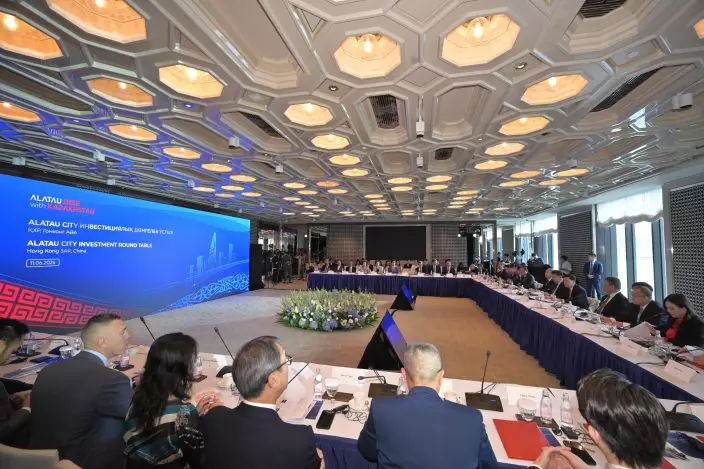
The Chief Executive, Mr John Lee, today (June 11) attends the Alatau City Investment Round Table. Source: HKSAR Government Press Releases
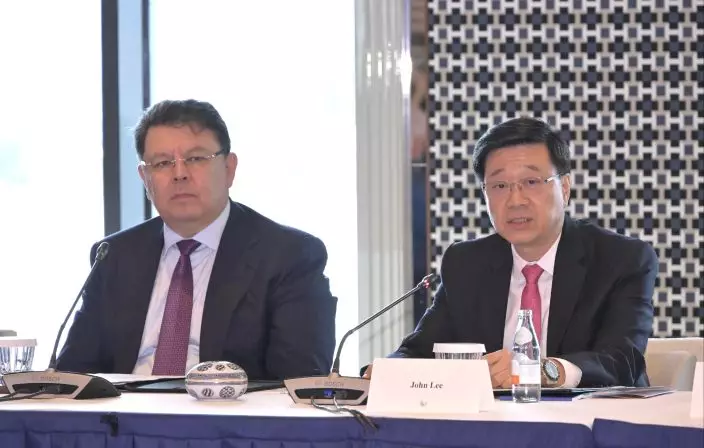
The Chief Executive, Mr John Lee (right), today (June 11) attends the Alatau City Investment Round Table. On his left is Deputy Prime Minister of Kazakhstan Mr Kanat Bozumbayev. Source: HKSAR Government Press Releases