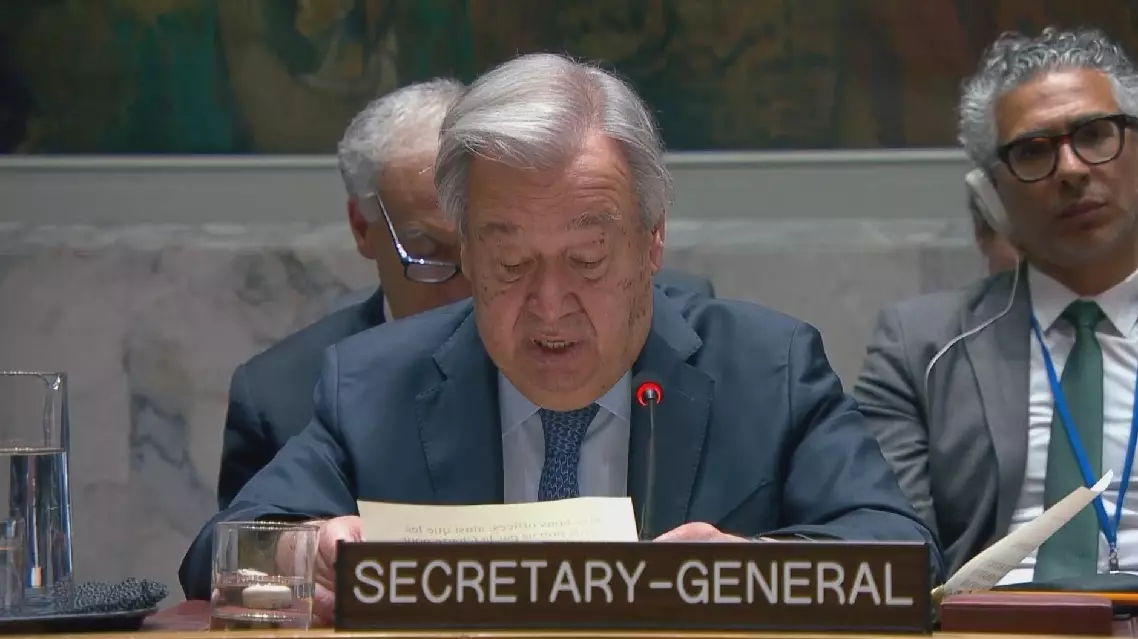
United Nations Secretary-General Antonio Guterres on Wednesday warned of the dangers of a "full resumption of conflict" across the Middle East amid escalating hostilities in the region.
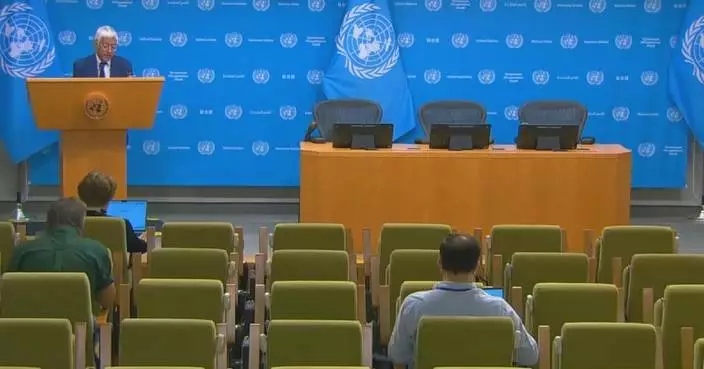
Speaking at an open debate of the UN Security Council on the Middle East situation, Guterres said the Middle East is being pulled deeper into crisis and that the consequences will reach far beyond the region.
A brutal price is being paid by people across the region, particularly in the most vulnerable countries and communities, he said.
The UN chief said he is alarmed by the deterioration of the situation this week and was "profoundly concerned it could trigger a full resumption of conflict."
Guterres noted the escalation in Lebanon since March, as Israel has intensified its operations in Lebanese territory while Hezbollah has fired deeper into Israel.
The conflict has resulted in extensive demolition of homes and civilian infrastructure in southern Lebanon, as well as the forced displacement of over a million civilians, he said.
In addition, seven UN peacekeepers have been killed to date, the secretary-general added.
Guterres urged all parties to work towards a diplomatic settlement that fully respects the territorial integrity, sovereignty, and political independence of Lebanon within its internationally recognized borders, in line with Security Council Resolution 170, which calls for a full cessation of hostilities between Israel and Hezbollah.
On the Palestinian question, Guterres noted the "alarming reports coming from the occupied West Bank", including settler violence, the demolition of homes, the confiscation of land, and the relentless expansion of illegal Israeli settlements, as well as the "profound uncertainty and immense human suffering" in the Gaza Strip.
"The provision of humanitarian aid must never be used as a bargaining chip," he stressed, adding that "Gaza is and must remain an integral part of a Palestinian State."
"Dialogue is our best and only hope for peace. As for the Middle East, I urge this Council to put its full weight behind the two-state solution, which is the key to a just and lasting peace in the region. There is no alternative, and there is no time to waste," Guterres said at the meeting.
At the same time, restrictions on navigational rights and freedoms in and around the Strait of Hormuz are driving up global energy prices, disrupting supply chains, making fertilizers more costly and hunger more prevalent, and pushing up inflation and piling on debt, the UN chief cautioned.
He called on all parties to honor the ceasefire, work to restore navigational rights and freedoms in and around the Strait of Hormuz, and advance serious negotiations on the nuclear issues while ensuring that Iran's nuclear program is exclusively peaceful.
On Yemen, Guterres said that last month the United Nations supported a group of mediators between the parties to reach an agreement on the release of 1,600 conflict-related detainees.
However, he warned that "tensions persist" in the country.
Guterres said threats by the Houthis to curtail navigational rights and freedoms in the Bab al-Mandeb Strait must stop, and strongly urged the group to immediately and unconditionally release all arbitrarily detained personnel.
UN chief warns of dangers of 'full resumption of conflict' in Middle East