KIRKLAND, Wash.--(BUSINESS WIRE)--Jun 11, 2026--
Verasonics, Inc., the world’s leading provider of advanced ultrasound platforms for research and development, announced today the celebration of its 25 th anniversary. Marking a quarter century of innovation, collaboration, and impact, this milestone highlights Verasonics’ longstanding commitment to empowering researchers, engineers, and commercial partners around the world with flexible, high-performance ultrasound technologies.
This press release features multimedia. View the full release here: https://www.businesswire.com/news/home/20260611489822/en/
“From the beginning, our goal has been to give innovators the freedom to explore what’s possible with ultrasound,” said Jon K. Daigle, CEO of Verasonics. “Our 25 th anniversary is a celebration of the researchers, engineers, and partners who have pushed and expanded the boundaries of ultrasound innovation.”
Founded in 2001, Verasonics introduced a new paradigm in ultrasound by replacing hardware-based beamforming with a highly programmable software-based ultrasound platform. This approach provided researchers with direct control over system parameters, access to real-time raw channel data, and the ability to leverage rapid advances in computing power, unlocking new possibilities for experimentation, rapid prototyping, and commercialization. This vision has helped redefine ultrasound innovation worldwide.
Today, Verasonics systems are trusted by research and development teams in academia, commercial and government institutions around the world and have supported thousands of scientific publications across biomedical imaging, focused ultrasound therapy, photoacoustics, and nondestructive testing (NDT). Through its advanced, programmable ultrasound platforms and close collaboration with the global ultrasound community, Verasonics continues to help drive innovation across a wide range of applications.
As Verasonics celebrates 25 years of empowering ultrasound innovation, the company remains focused on the opportunities ahead. With advancements accelerating across imaging, therapy, and interdisciplinary applications, Verasonics will continue to equip customers with the powerful, flexible tools they need to shape what comes next. Verasonics thanks its customers and partners for being an essential part of this journey and looks forward to empowering the next generation of ultrasound discoveries and innovations.
About Verasonics, Inc.
Headquartered in Kirkland, Washington, USA, Verasonics is a privately held company founded in 2001. Verasonics, the leader in research ultrasound, empowers ultrasound innovation worldwide by providing flexible ultrasound platforms for research, development, and commercialization. Verasonics solutions are used across biomedical ultrasound, materials science, earth sciences, and acoustics to help accelerate innovation from concept to market. Verasonics also licenses its technology to companies for use in their commercial products.
Learn more by visiting the Verasonics website or following us on LinkedIn and X.

Verasonics celebrates 25 years of empowering ultrasound innovation. Since 2001, the company has provided flexible, programmable ultrasound platforms that enable researchers, engineers, and commercial partners to explore new ideas, accelerate development, and advance applications across biomedical imaging, focused ultrasound, photoacoustics, nondestructive testing, and more. As Verasonics marks this milestone, the company recognizes the global community of customers, collaborators, and partners whose work continues to drive innovation and shape the future of ultrasound technology.
MINNEAPOLIS (AP) — Blake Cashman led an onslaught of pressure all afternoon. Harrison Smith had the game-sealing interception.
The Minnesota Vikings aren't scoring much, but a near-impenetrable defense has so far had all the support it's needed to fuel the NFC's last undefeated team.
Kyler Murray and the Vikings overcame another sluggish start and remained unbeaten with a 16-10 victory over the spiraling Indianapolis Colts on Sunday.
“We feel really comfortable and confident to win football games when we don’t turn it over and we win the field position and boring stuff like that, because we know over the course of 60 minutes what that side can do,” Vikings coach Kevin O'Connell said.
Cashman, the eighth-year linebacker who is thriving as the primary communicator for defensive coordinator Brian Flores, had 12 tackles, two sacks, four passes defensed and three hits on quarterback Daniel Jones for the Vikings (6-0), who have allowed a league-low 74 points.
Smith picked off Jones around midfield with about a minute left to kill the last-ditch drive by the Colts (2-5) before it ever got going. It was his 40th career interception. Smith planted the ball on the 40-yard line to mark the occasion as the crowd at U.S. Bank Stadium chanted: “Harry! Harry! Harry!”
“There’s a lot of fight in this group,” said Smith, a six-time Pro Bowl safety who decided right before the regular season to return for his 15th year with the Vikings.
Will Reichard made three field goals for the Vikings, including a 52-yarder with 1:39 left after his 59-yard try was blocked by Grover Stewart earlier in the fourth quarter.
Jonathan Taylor gave the Colts the lead they kept for more than three quarters of the game with a 38-yard touchdown run on their opening drive, but Spencer Shrader missed two field goals in the second half.
The miss from 56 yards that coach Shane Steichen called for on fourth-and-2 set the Vikings up for their only touchdown, when Murray used a 35-yard run to get in range for a short scoring pass to T.J. Hockenson. That was just the 10th touchdown for the offense in six games.
“We’ll continue to get better. I know we will. I know we keep saying that, but I felt like we moved the ball well today,” said Murray, who was 14 for 24 for 150 yards. “We’ve just got to put the ball in the end zone.”
Jones went 13 for 22 for 108 yards and lost 44 yards on four sacks, with Flores relentlessly sending blitzers into the backfield.
“I think we expected it to be this kind of game, kind of an ugly game, and credit to them on defense,” said Jones, who spent the last half of the 2024 season as a backup with the Vikings. “They have a good system and do good stuff.”
Jones has just four touchdown passes and seven interceptions in seven games, but Steichen said afterward he's not considering a switch.
“I've got a ton of faith in Daniel,” Steichen said.
Reichard hit from 28 and 47 yards in the second quarter to set the franchise record with 35 consecutive made field goals, which was the longest active streak in the league — until the block.
Shrader, who leads the NFL in scoring this season with 70 points, had his streak of 22 straight made field goals end with his wide-left miss that had heavy pressure off the edge by former Colts cornerback Isaiah Rodgers. That also stopped Shrader's run of seven makes in a row from 50-plus yards.
Colts: With standout Sauce Gardner (calf) inactive, the CB depth chart was chewed up in the second half when Justin Walley (knee) and Cam Taylor-Britt (groin) left with injuries. ... TE Tyler Warren (groin) missed his second straight game. LB Jaylon Carlies (ribs) returned to the starting lineup after missing two games.
Vikings: RB Aaron Jones aggravated a nagging knee injury in the fourth quarter when he took a low hit at the end of a 17-yard run. He didn't return.
Colts: at Jacksonville next Sunday.
Vikings: at Detroit next Sunday.
See AP’s full NFL coverage here
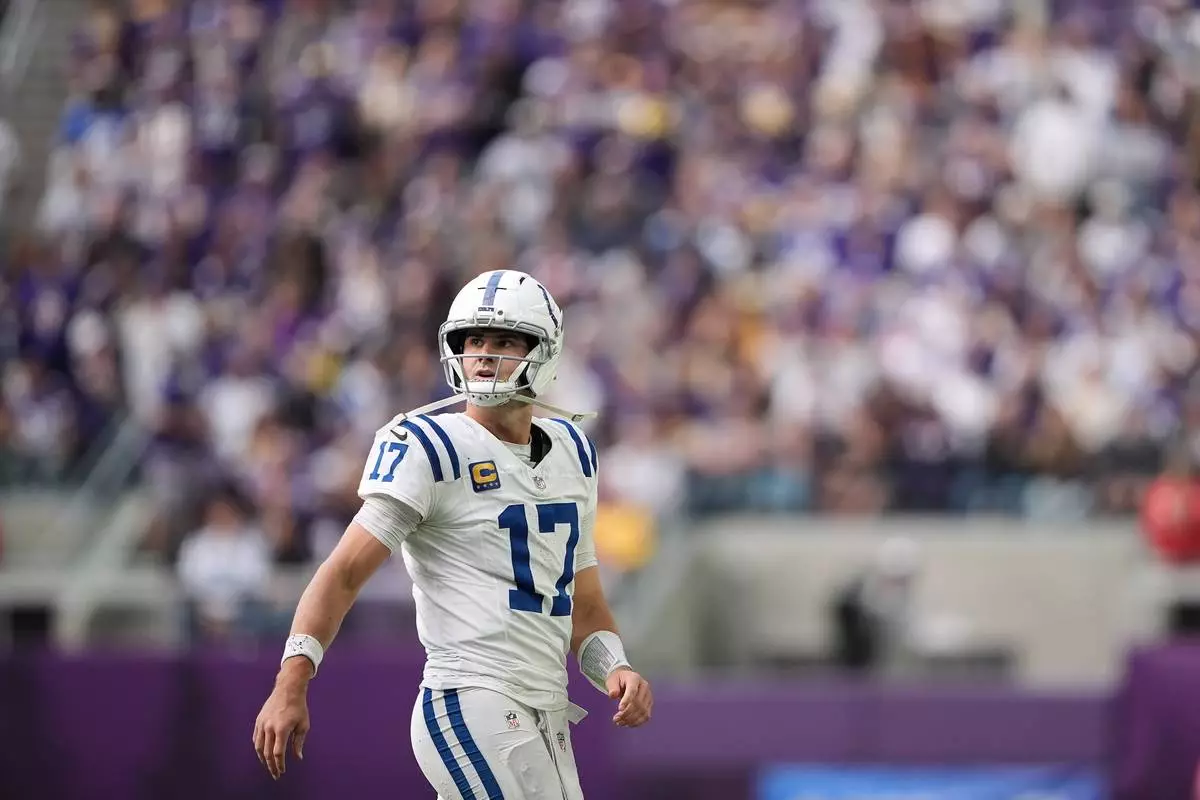
Indianapolis Colts quarterback Daniel Jones (17) walks on the field during the first half of an NFL football game against the Minnesota Vikings in Minneapolis, Sunday, Oct. 25, 2026. (AP Photo/Ellen Schmidt)
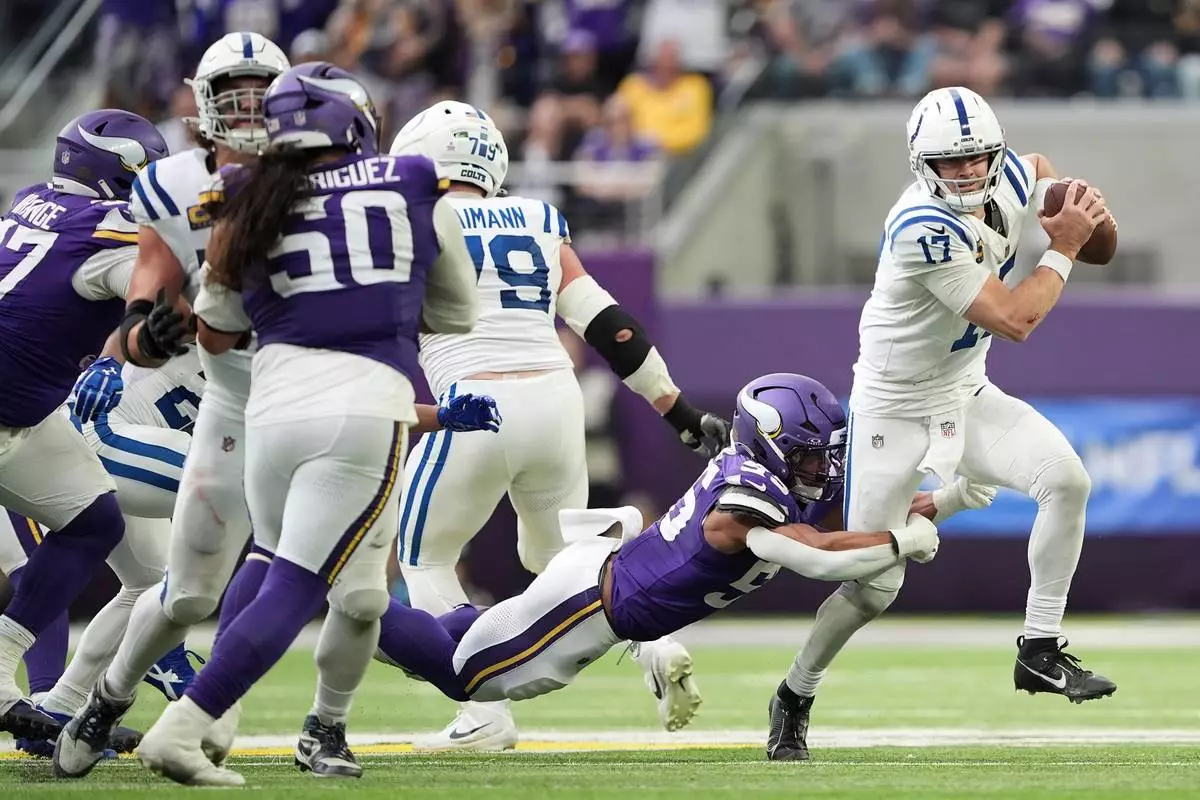
Indianapolis Colts quarterback Daniel Jones (17) tries to scramble away from Minnesota Vikings linebacker Eric Wilson, bottom, during the second half of an NFL football game in Minneapolis, Sunday, Oct. 25, 2026. (AP Photo/Ellen Schmidt)
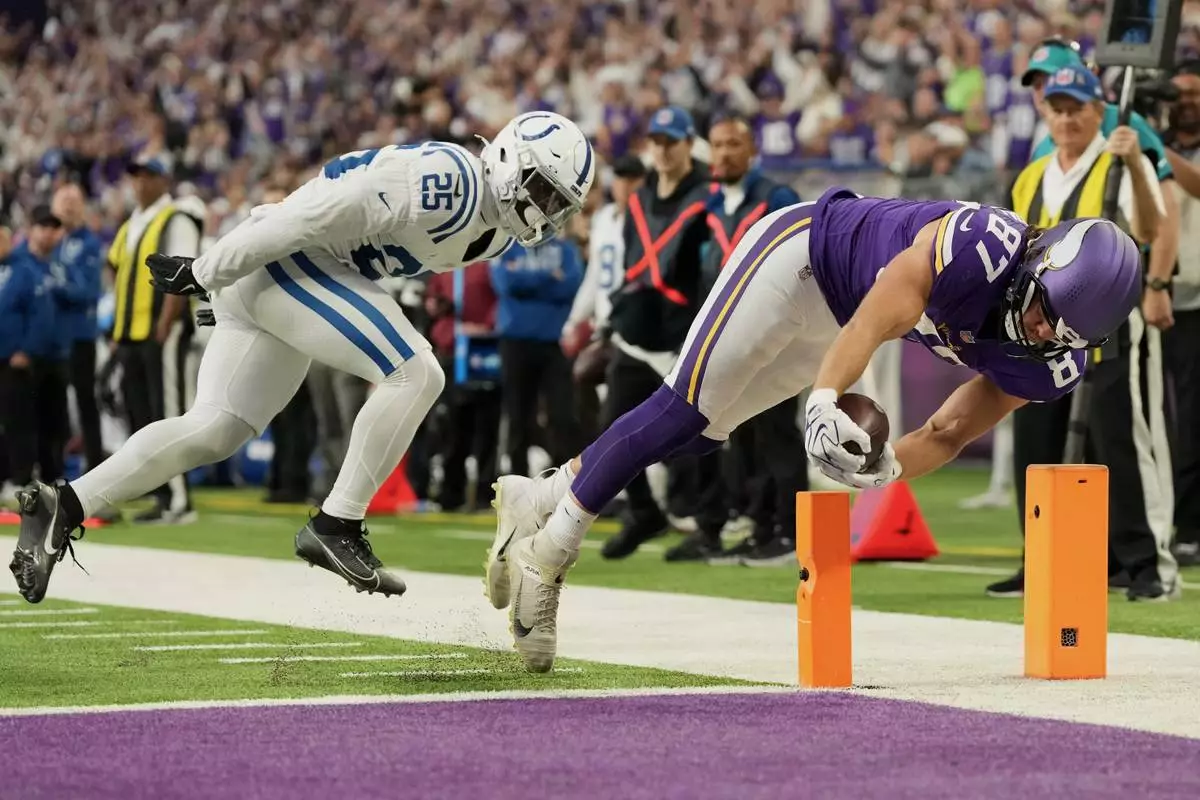
Minnesota Vikings tight end T.J. Hockenson (87) scores past Indianapolis Colts safety A.J. Haulcy (25) during the second half of an NFL football game in Minneapolis, Sunday, Oct. 25, 2026. (AP Photo/Ellen Schmidt)
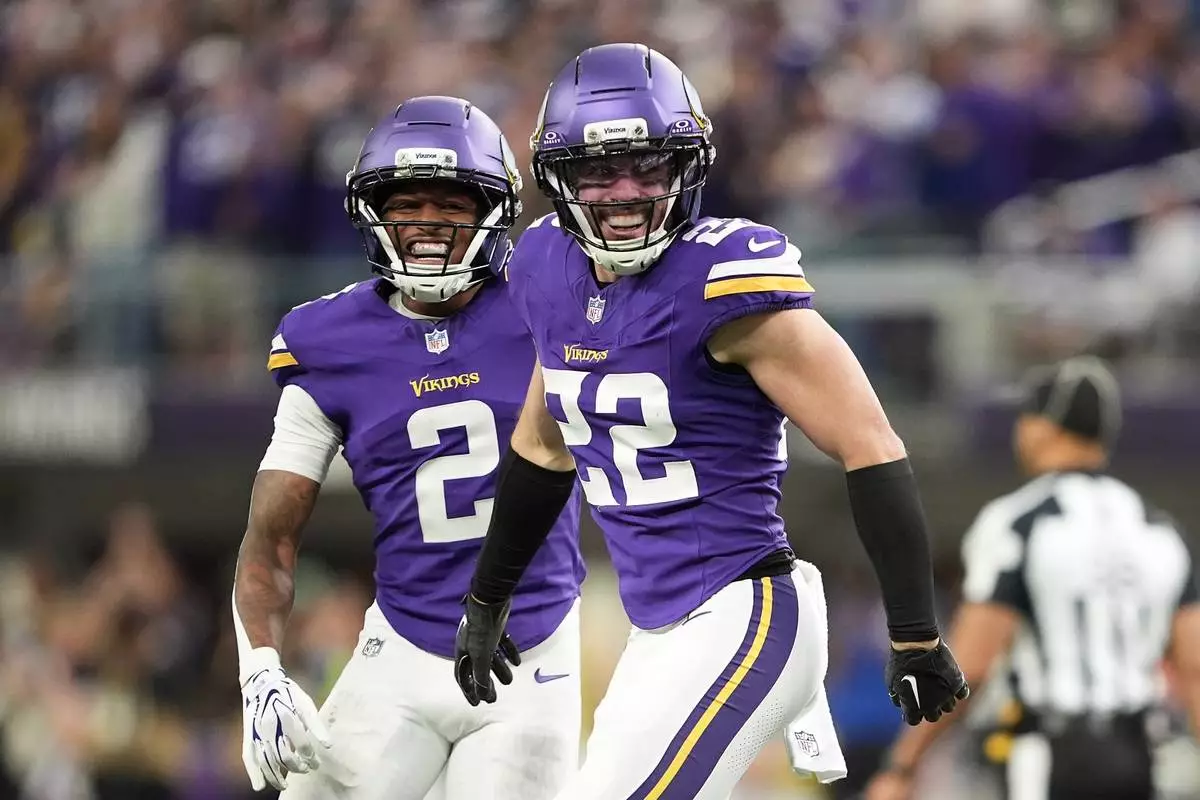
Minnesota Vikings safety Harrison Smith (22) celebrates with cornerback Isaiah Rodgers (2) after intercepting a pass against the Indianapolis Colts during the second half of an NFL football game in Minneapolis, Sunday, Oct. 25, 2026. (AP Photo/Ellen Schmidt)