LOS ANGELES (AP) — In “Disclosure Day,” out Friday, Steven Spielberg is once again inviting audiences to ponder the existence of extraterrestrial life — and the implications it would have for religion on Earth.
But Spielberg is hardly the only one making headlines of late about UFOs and the possibility of life on other planets.
What was once considered fringe or conspiratorial has in recent months popped up everywhere from the White House to the Catholic Church, as public fascination with unidentified anomalous phenomena — or UAPs, as the government calls them — becomes more mainstream.
The Pentagon in May made public large swaths of UFO files with very little context, leaving curious sleuths to piece together their own interpretations. The dump came just weeks after former President Barack Obama set off a media frenzy for stating unambiguously in an interview that aliens are real, though he later tempered that take.
“Statistically, the universe is so vast that the odds are good there’s life out there,” the former president, who made a surprise visit to the “Disclosure Day” set, posted on social media. “I saw no evidence during my presidency that extraterrestrials have made contact with us. Really!”
Some religious adherents, as well as some nonbelievers, maintain that the existence of life on other planets might undermine many faiths because it would complicate assertions that humans are unique. But others argue the opposite.
“Belief in UFOs is really one of the best things that’s happened to religion in a long time,” said Diana Walsh Pasulka, a religion scholar at the University of North Carolina Wilmington. “It’s a blow to the secular, materialist worldview.”
Even if broad interest in UAPs bolsters the case for an enchanted universe, some believers in religions such as Christianity think they are something to be wary of.
“I don’t think they’re aliens. I think they’re demons,” Vice President JD Vance, a Catholic convert, said in a recent podcast interview.
That sentiment was echoed by Monsignor Stephen Rossetti, formerly an exorcist with the Archdiocese of Washington. He was removed last week by the archbishop, who said statements by Rossetti “gravely undermine” Catholic teaching on demons and the devil.
“It’s my personal belief that probably many, if not most, of these UFO sightings are in fact demons,” Rossetti said in a May 29 video posted on his Facebook page. “Aliens, if there are aliens, don’t possess people.”
Christopher Baglow, who heads a science and religion initiative at the University of Notre Dame, was surprised by the firing given that Rosetti made clear in the video he was expressing his own opinion. Baglow speculated that there may be other factors behind the decision.
“I ask forgiveness for any ways that I have not been faithful to the teachings of the Church’s Magisterium,” Rosetti said in a statement online.
Despite the assertions by Vance and Rossetti about demons, Baglow maintains the Catholic Church has long been open to the possibility of extraterrestrial life. “Theologians have been speculating about this for centuries and the church has never ever taught one way or the other,” he said.
While meeting with astronomy students last year at the Vatican, Pope Leo XIV spoke about the “ancient light of distant galaxies” and the “mysterious joy” provoked by the study of outer space. Some interpreted these remarks as tacit speculation about the possibility of life on other planets.
In one sense, the idea of otherworldly beings coming to Earth can be traced back millennia.
“People would call it the plurality of worlds. So even back in the time of Socrates and Aristotle, there were Greek philosophers who talked about beings on other planets and other stars,” Walsh Pasulka said.
But it wasn’t until after 1945 that modern conceptions of UFOs began to develop, according to Jeffrey Kripal, a historian of religions at Rice University. “The flying saucer and the alien and the UFO — it’s definitely a Cold War invasion narrative,” he said.
That narrative explains why UAPs are often perceived as hostile to humans. But it’s also evolved over time and led to the formation of some religions — like Scientology, which counts many a Hollywood celebrity among its adherents — that see extraterrestrials as good or even part of a divine plan. Some adherents to the Nation of Islam, for example, believe that its founder will inaugurate an apocalyptic return to Earth on a spaceship.
The International Raëlian Movement, also know as Raëlism, is a UFO religion that was founded in France in the 1970s. It is still practiced today, with its strongest followings in parts of Asia, Africa and Canada, according to Susan Palmer, a sociologist who studies new religious movements at Concordia University in Montreal.
Its founder, Raël, claims he is a direct descendant of Yahweh, whom Raël visited on the planet of Elohim in 1975. Raëlism claims the Buddha, Jesus and Muhammad are all hybrids of humans and extraterrestrials, as well as Raël’s half brothers.
Of the groups she has studied, Palmer argued Raëlism is the most sympathetic toward UFOs. “They’re not interested in extraterrestrial wars,” she said.
But some think that sentiment might be growing.
Kripal, who heads Rice’s archival collection of reported paranormal experiences called the Center for the Impossible, perceives an increasing openness to these kinds of conversations about the existence of UFOs — and the possibility that they are not hostile.
“People are reporting these experiences or these encounters with entities and they’re religious through and through,” he said. “My colleagues in the academy, they’re really starting to listen in a different way.”
Associated Press religion coverage receives support through the AP’s collaboration with The Conversation US, with funding from Lilly Endowment Inc. The AP is solely responsible for this content.
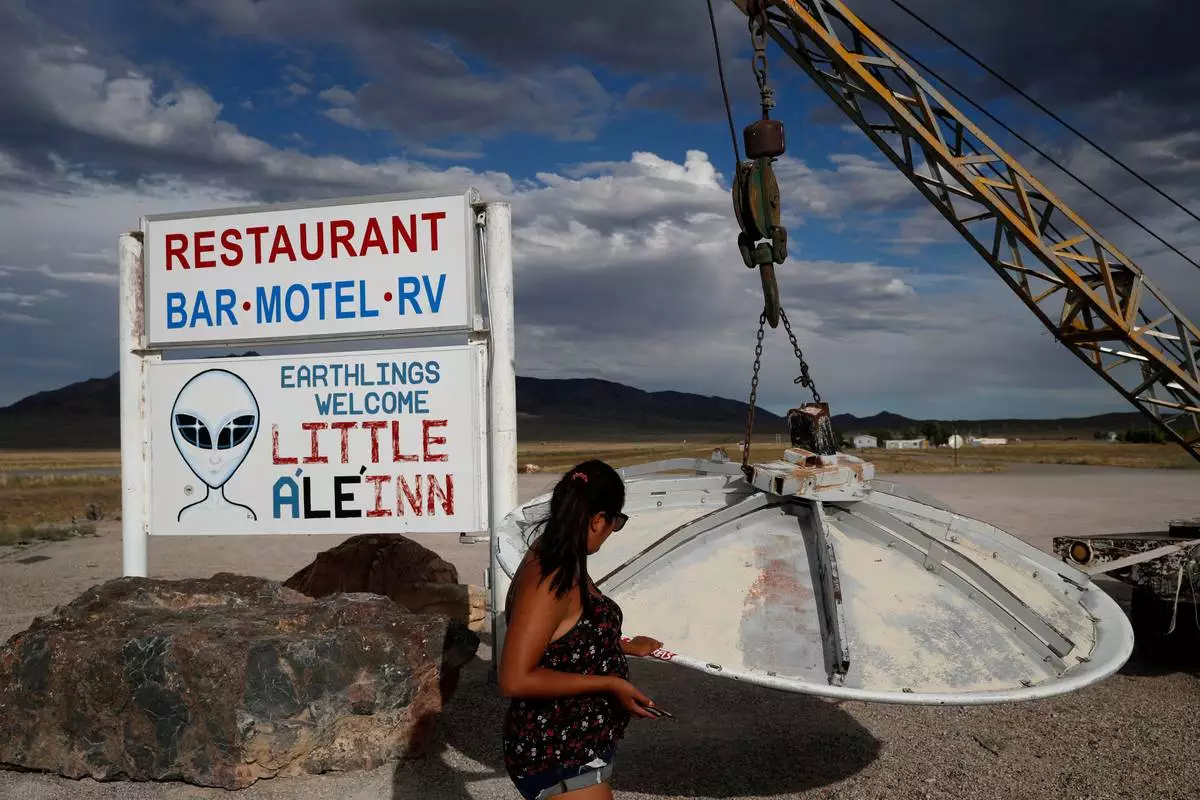
FILE - A woman looks at a UFO display outside of the Little A'Le'Inn, in Rachel, Nev., the closest town to Area 51, July 22, 2019. (AP Photo/John Locher, File)
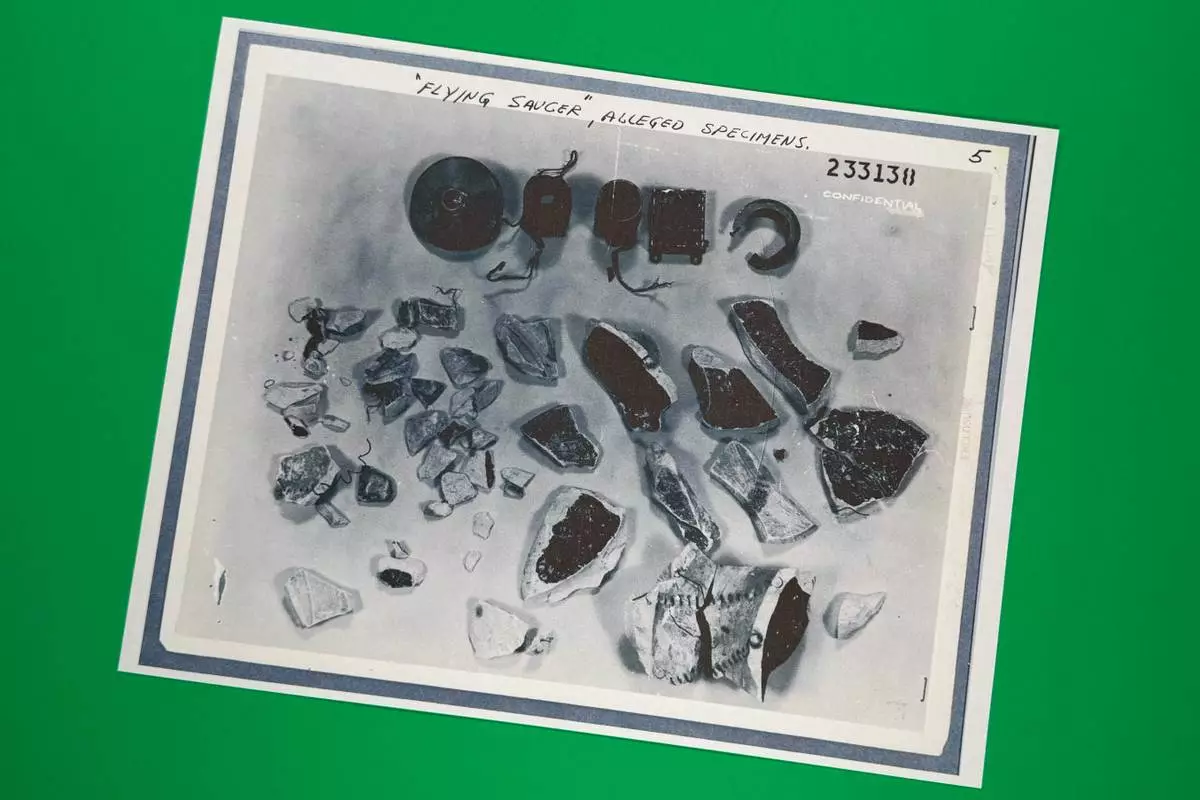
FILE - A photo of "flying saucer alleged specimens" in files on UFOs, released May 8, 2026, by the Pentagon, is photographed in Washington. (AP Photo/Jon Elswick, File)
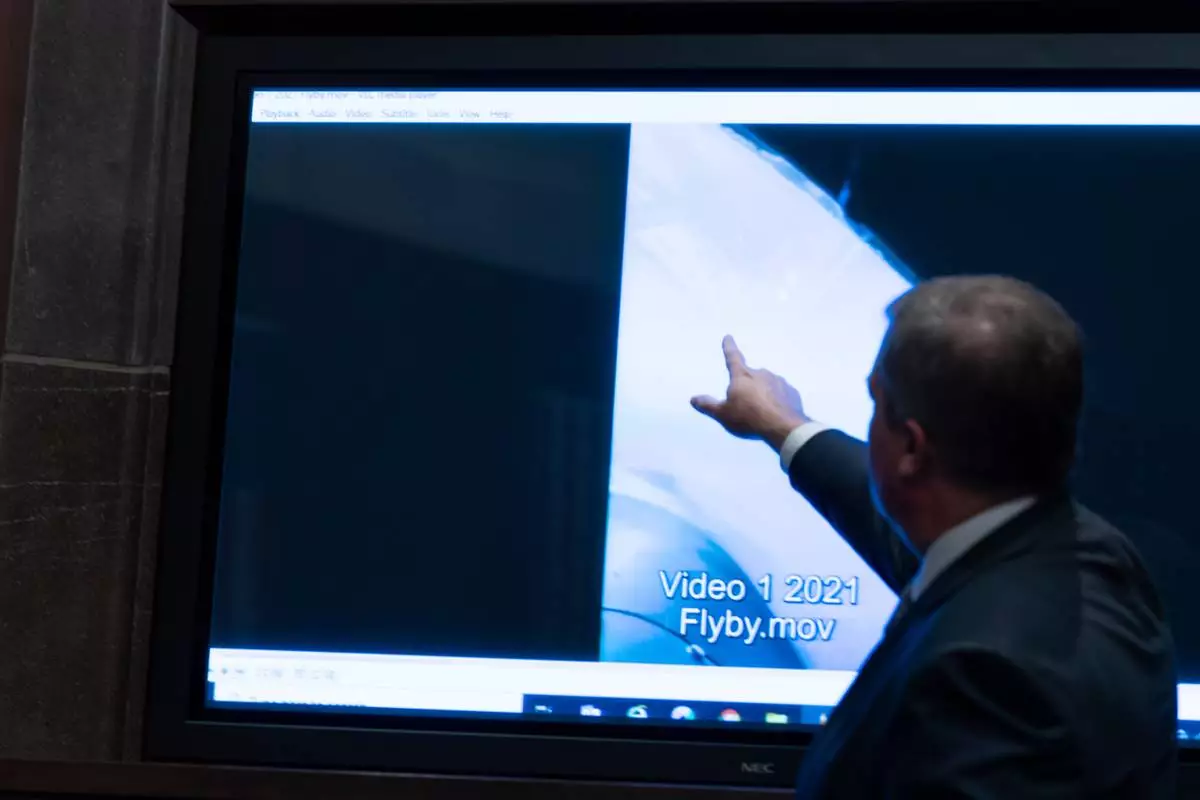
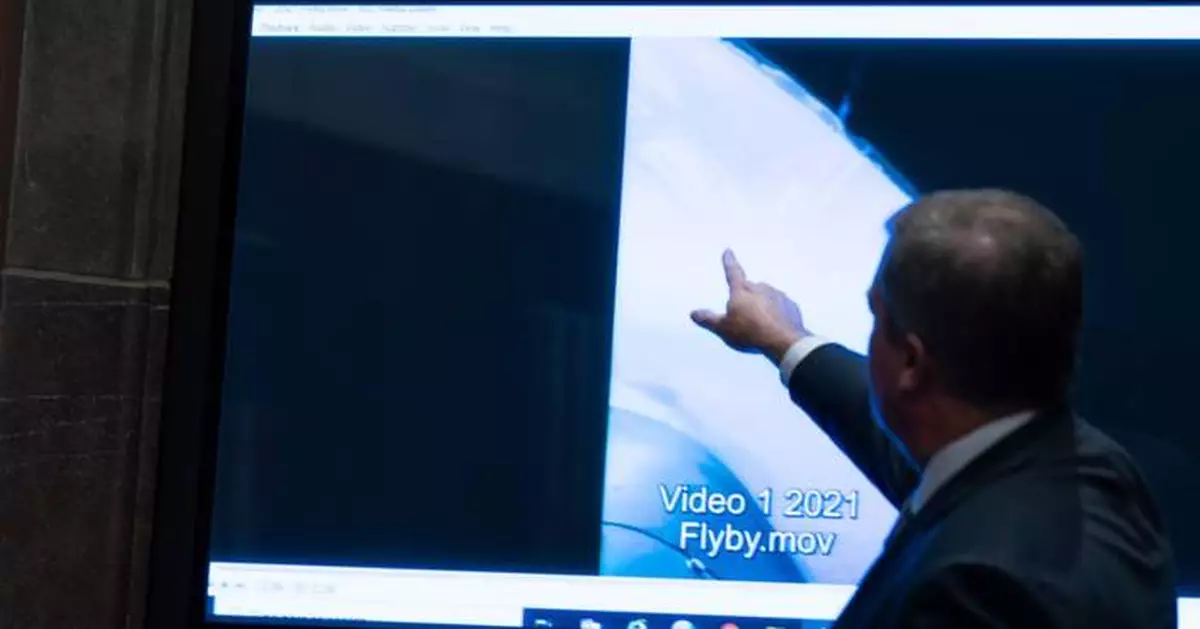
FILE - Deputy Director of Naval Intelligence Scott Bray points to a video display of a UAP during a hearing of the House Intelligence, Counterterrorism, Counterintelligence, and Counterproliferation Subcommittee hearing on "Unidentified Aerial Phenomena," on Capitol Hill, May 17, 2022, in Washington. (AP Photo/Alex Brandon, File)
LONDON (AP) — Artist David Hockney, whose paintings of pools shimmering in the Los Angeles sunshine became icons of 20th-century art, has died, his publicist said Friday. He was 88.
One of the most popular and critically lauded British artists of the last century, Hockney was born in the north of England but lived much of his life in Southern California, making its sun-drenched suburban views a major motif.
Later in life he returned to Europe, finding renewed inspiration in the wooded hills of his native county of Yorkshire and the fields and trees of France’s Normandy region. He became one of the U.K.’s most treasured artists, his works selling for record prices at auction.
Historian Simon Schama said it's no mystery why his work is so enduring.
“His work is admired — loved is not too strong a word — by the millions who, worldwide, flock to see it because it presupposes an expectation of pleasure,” Schama wrote in an essay accompanying a 2025 Hockney exhibition in Paris.
Hockney’s publicist, Erica Bolton, said he died at his home in London on Thursday, less than a month short of his 89th birthday. She did not give a cause of death.
He is survived by his longtime partner Jean-Pierre Gonçalves de Lima, his great-nephew and studio assistant Richard Hockney, his brothers Philip and John, and numerous nieces, nephews, great-nieces and great-nephews.
With his trademark round glasses and bleached-blond hair, Hockney was a well-known figure in the swinging British and American art scenes of the 1960s, even before he reached the age of 30. His paintings were just as distinctive, many of them creating a dreamlike world of patterned light bouncing off water and windows, and human forms rendered in flattened, simplified shapes in matte acrylic paint.
“I’m excited every day,” he told the Los Angeles Times in 1979. “London has lots of dreary parts but I never find anything dreary in Los Angeles.”
Hockney was born July 9, 1937, in Bradford, a large industrial city whose chief export was woolen textiles. He spent his first two decades there before going to London’s Royal College of Art. He made an impact even before his graduation, and art dealer John Kasmin took him into his stable of artists in 1961.
His artistic influences ranged widely, from Renaissance portraitists to 19th-century English landscape painter J.M.W. Turner, Pablo Picasso’s experiments in Cubism and 20th-century American pop art.
He shared with other pop artists an interest in the polished surface of modern life. And, like Andy Warhol with his Brillo boxes and Campbell’s soup cans, Hockney occasionally incorporated advertising labels, such as a British Typhoo Tea box used in his 1961 “Tea Painting in an Illusionistic Style.”
He told The New York Times in 1964 he enjoyed the burgeoning pop art scene in New York but wasn’t sure he was part of it.
“I’m just an ordinary artist,” he said. “I do admire American pop — in fact it seems that everything fresh-looking and vital in England these days has been coming from the U.S.” Nonetheless, he still considered himself “very much an artist in the English tradition,” he said in 1995.
Even his move to California in 1964 had a historic precedent, he noted, since earlier generations of English artists had sought out the brilliant light of Italy.
Hockney, who was out as a gay man long before it was common, explored erotic themes, giving youthful male bodies the same tender scrutiny that artists had been giving the female nude for centuries. Friends and lovers frequently posed as models, and some images were based on photos in men’s bodybuilding magazines.
Early works like “We Two Boys Together Clinging” and “Two Men in a Shower” celebrated gay relationships when homosexuality was still illegal in Britain.
Early in his career, two of his drawings were bought for the Museum of Modern Art in New York.
“The moment I first sold pictures to earn a living, I felt rich. I’ve been rich ever since,” he told The Associated Press in 1995. “I didn’t have much money but I did what I wanted. ... You are a rich man if you do the things you want to do.”
That freedom brought Hockney acclaim and wealth, with his works fetching record-breaking sums. In 2018, his 1972 painting “Portrait of an Artist (Pool with Two Figures)” sold at a Christie’s auction for $90.3 million, at the time a record for a living artist. In February 2020 another pool painting, “The Splash,” from 1966, sold at Sotheby’s for 23.1 million pounds ($30 million).
While paintings of pools were a Hockney trademark, he also literally painted a pool when he decorated the bottom of the swimming pool at the historic Hollywood Roosevelt Hotel in Los Angeles.
While many of his best-known paintings had American scenes, he also tackled British subjects. He immortalized his parents in several portraits. “Mr. and Mrs. Clark and Percy,” a 1971 dual portrait of two of his English friends and their cat, was ranked No. 5 in a 2005 BBC Radio-National Gallery (London) online poll of the greatest paintings in Britain. It was the only work by a living painter in the top 10.
Like many traditional artists, he considering drawing a fundamental skill and lamented that it wasn’t taught as rigorously as it used to be.
“Human beings are the most interesting things we see, so they’re the hardest to draw,” he said in a 1996 AP interview.
He didn’t limit himself to drawing and painting, though. He contributed costume and set designs for theater and the opera, including a celebrated production of “Tristan und Isolde” first staged in 1987 at the Los Angeles Opera.
Always an innovator, Hockney also embraced printmaking, photo collage and video in a seven-decade career.
When he took up photography, he fused genres, assembling individual photos into elaborate collages like “Pearblossom Highway, 11-18th April, 1986,” built up of individual views of a desert highway intersection.
“My photographer friends said it was a painting,” Hockney told the AP in 2001. “I said it’s a photograph; I used a camera.”
The insight he gained from his photo work led him to research and write a 2001 book, “Secret Knowledge: Rediscovering the Lost Techniques of the Old Masters.” He argued that through the centuries, artists used lenses and other optical devices to aid them in drawing much more often than most historians believe.
Later he began to draw on iPads, which became his favorite tool.
In the early 2000s he looked afresh at the fields and forests of Yorkshire in a series of landscape paintings that combined bold color with minute attention to the texture of snow on a hillside or a blossom on a hawthorn hedge. They featured in a 2017 exhibition at Tate Britain in London that was visited by half a million people and moved to the Pompidou Center in Paris and the Metropolitan Museum in New York.
Hockney used the English landscape for inspiration in his design for a stained-glass window at Westminster Abbey to celebrate the long reign of Queen Elizabeth II. Completed in 2018, the Queen’s Window depicts a landscape of blossoming hawthorn trees in hues of blue, green, yellow, orange, pink and red.
By this time, Hockney was widely considered Britain’s greatest living artist, and a national treasure. In 1997, the queen named him a Companion of Honour, an award limited to 65 people “of distinction.”
In 2019, he moved to Normandy, where during the 2020 coronavirus lockdown he produced joyous iPad drawings of springtime for his friends. His message — “Do remember they can’t cancel the spring” — was emblazoned in neon across the Fondation Louis Vuitton in Paris when it hosted a huge Hockney exhibition that opened in April 2025.
Art curator Norman Rosenthal, who helped put together the Paris exhibition, called Hockney “the Picasso of our times.”
“When I say that, people laugh at me, as Picasso was the archetypal artist of the 20th century,” Rosenthal told the Independent newspaper. “But David Hockney is also an incredibly popular artist whose work changes how we see things.”
An unrepentant cigarette smoker who railed against government anti-smoking rules, Hockney complained when a poster for the 2025 exhibition was banned from the Paris Metro because it showed him holding a cigarette.
The announcement of his death from his publicist noted that Hockney was “a committed life-long and defiant smoker, expressing the pleasure in life it brought him. ... He smoked up to the end.”
Hockney had a minor stroke in 2012 and was increasingly deaf in later years — something he said had improved his visual perception.
“If you lose one sense, you gain other senses, and I feel I could see space clearer,” he told the AP in 2017.
He never stopped working.
“It’s my work that keeps me young,” Hockney told the Sun newspaper in 2017. “I’ve been a professional painter for 60 years. Sixty years of getting up every day and doing exactly what I want to do.”
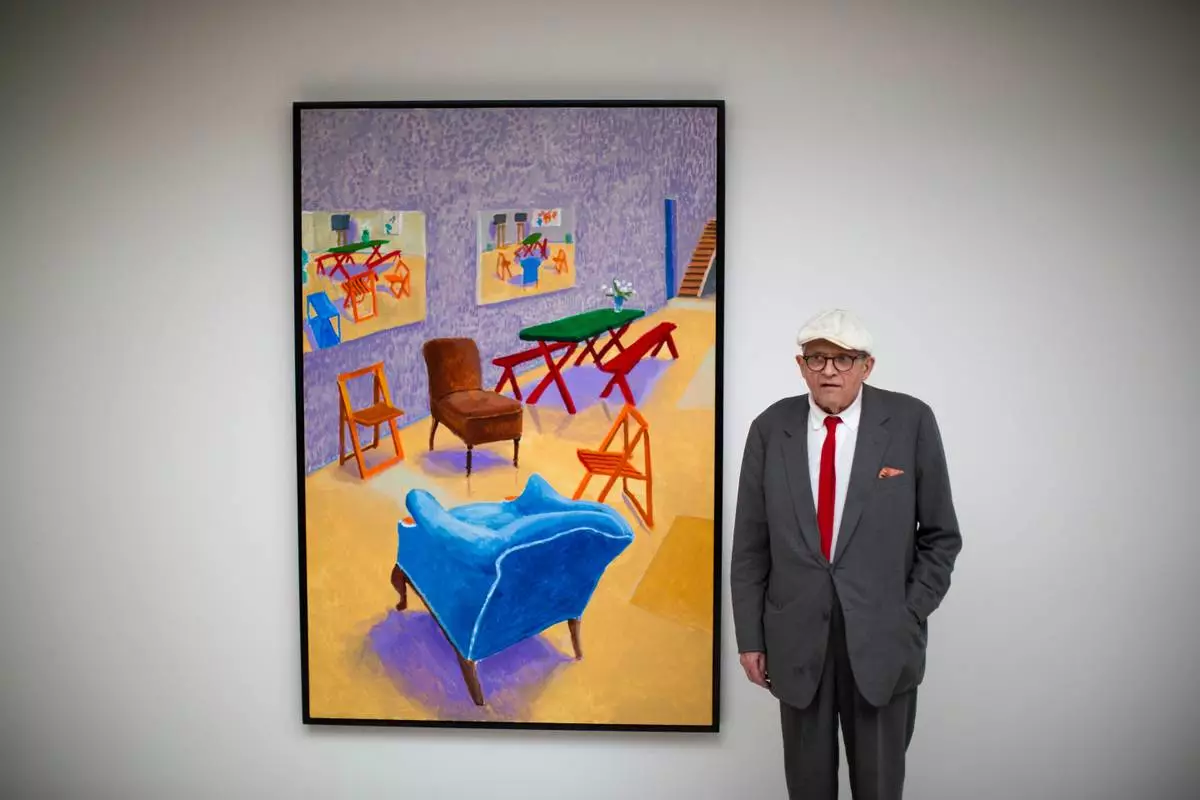
FILE - British artist David Hockney poses for photographers in front of his acrylic on canvas "Studio Interior #4" which features as part of the "David Hockney Painting and Photography" exhibition at the Annely Juda Fine Art gallery in London, Thursday, May 14, 2015. (AP Photo/Matt Dunham, File)
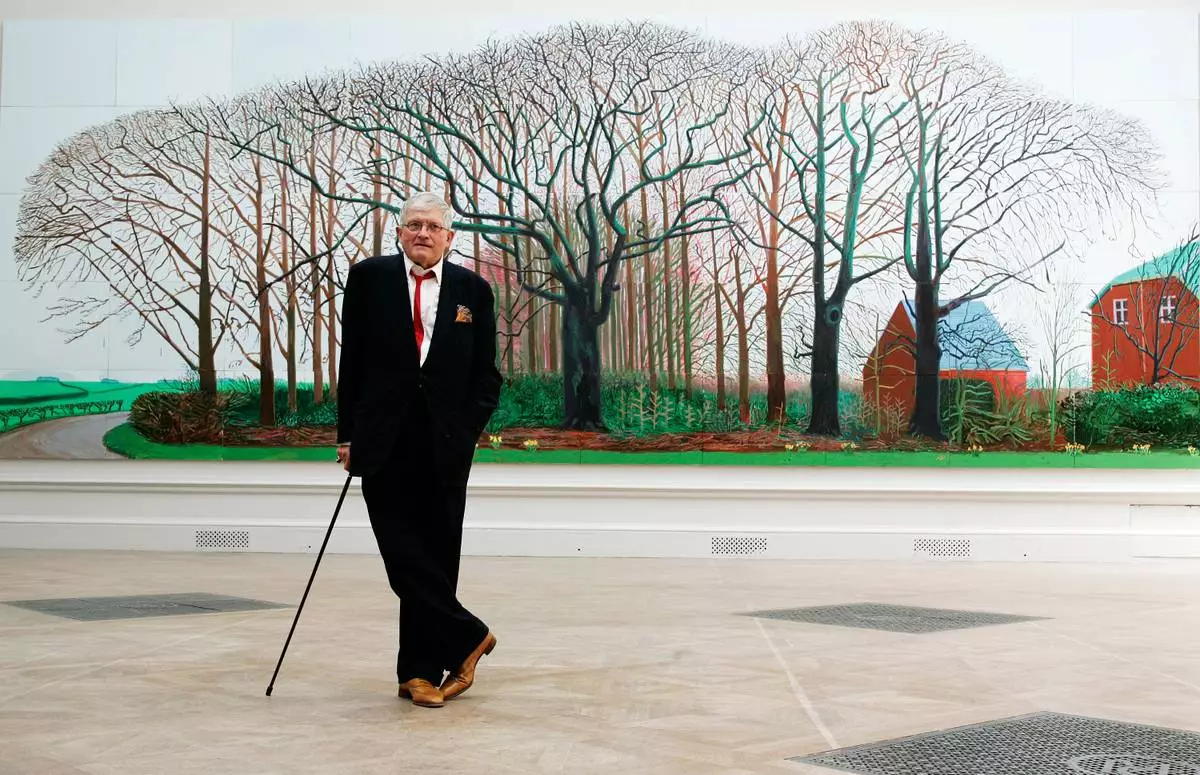
FILE - British artist David Hockney poses as he unveils his painting 'Bigger Trees Near Water', the largest painting ever shown at the Royal Academy's Summer Exhibition, London, Friday, May 25, 2007. (AP Photo/Sang Tan, File)
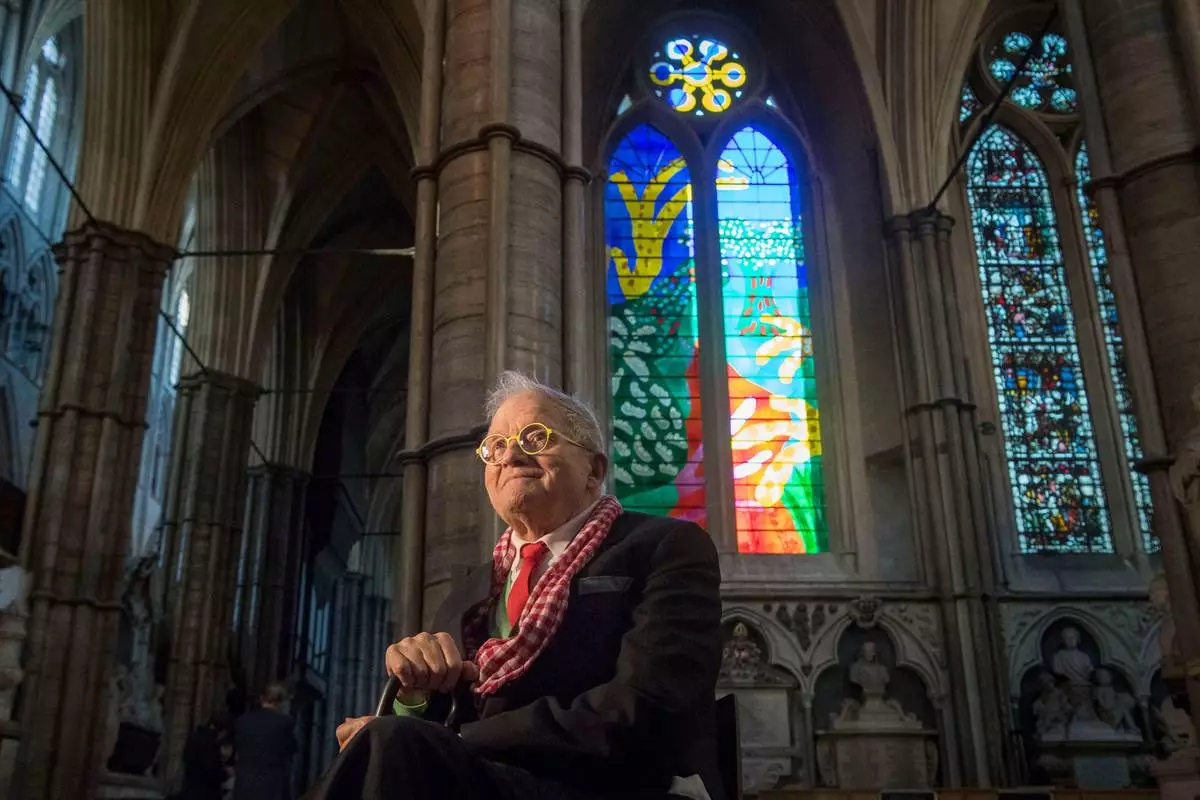
FILE - British artist David Hockney sits in front of The Queen's Window, a new stained glass window at Westminster Abbey, London, designed by David Hockney and revealed for the first time on Wednesday Sept. 26, 2018. (Victoria Jones/Pool via AP, File)
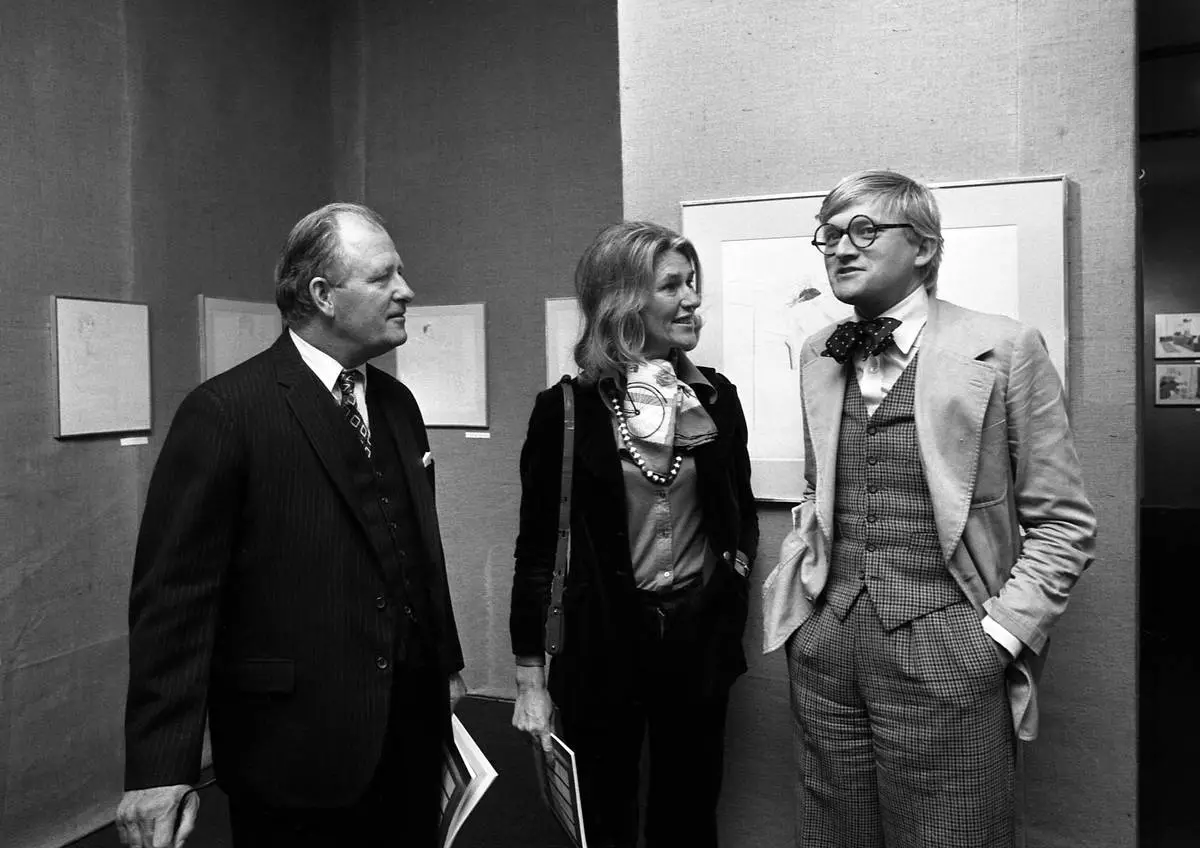
FILE - Painter David Hockney, right, with British Ambassador Edward Tomkins, left, at the opening of his exhibition at Musee des Arts Decoratifs on Oct. 10, 1974 in Paris. (AP Photo/Michel Lipchitz, File)
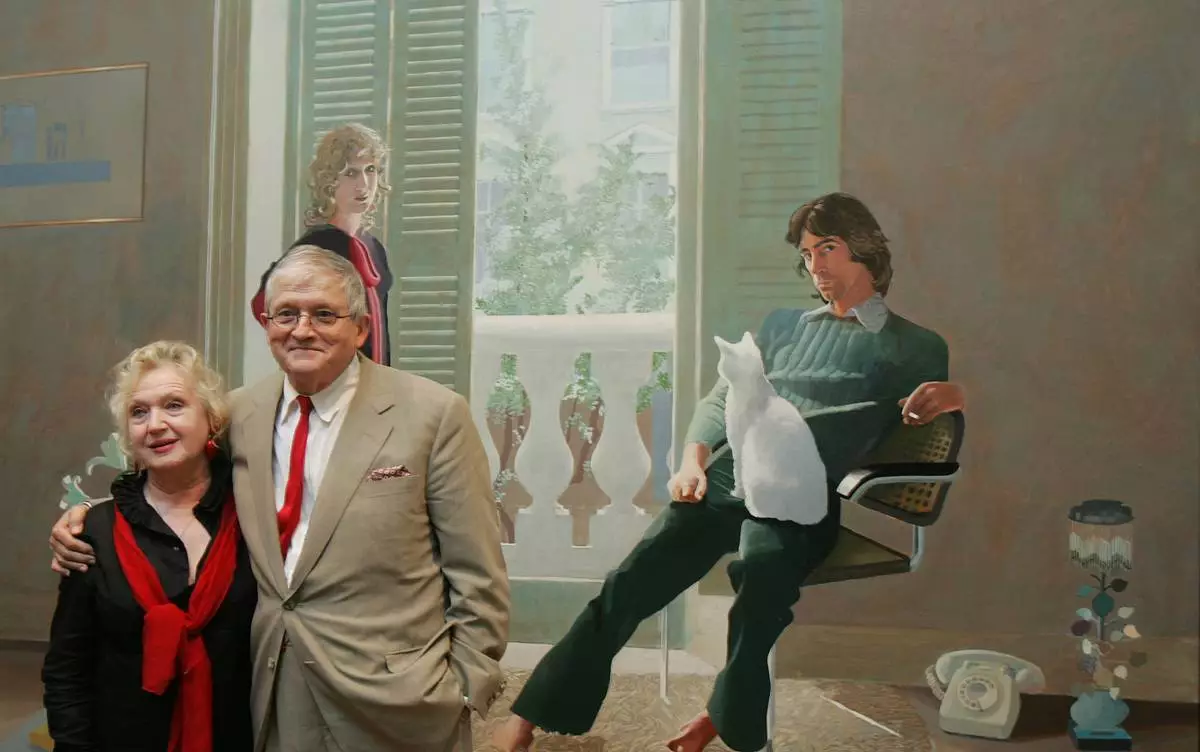
FILE - British artist David Hockney, stands next to his friend and model Celia Birtwell, in front of one of his most famous works ' Mr and Mrs Clark and Percy' at the National Portrait Gallery in London, Wednesday Oct. 11, 2006. (AP Photo/Alastair Grant, File)
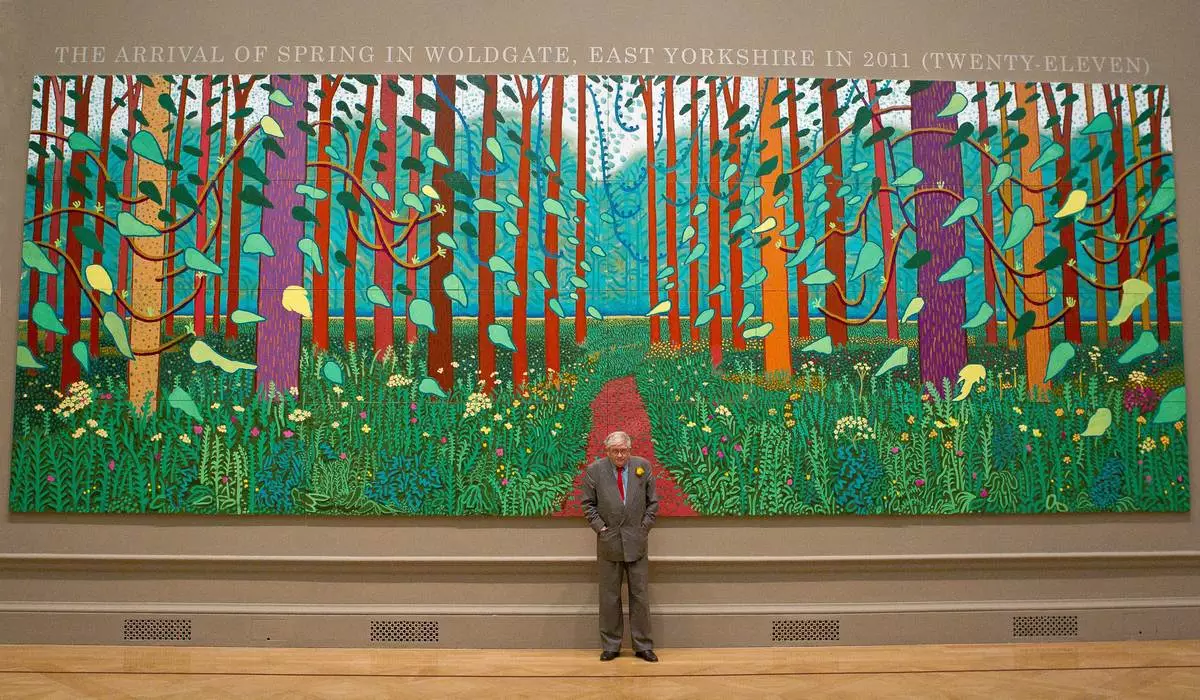
FILE - British artist David Hockney stands before one of his paintings of the East Yorkshire landscape at The Royal Academy of Arts in Piccadilly, London, Monday, Jan. 16, 2012, ahead of his exhibition called 'A Bigger Picture'. (AP Photo/Joel Ryan)
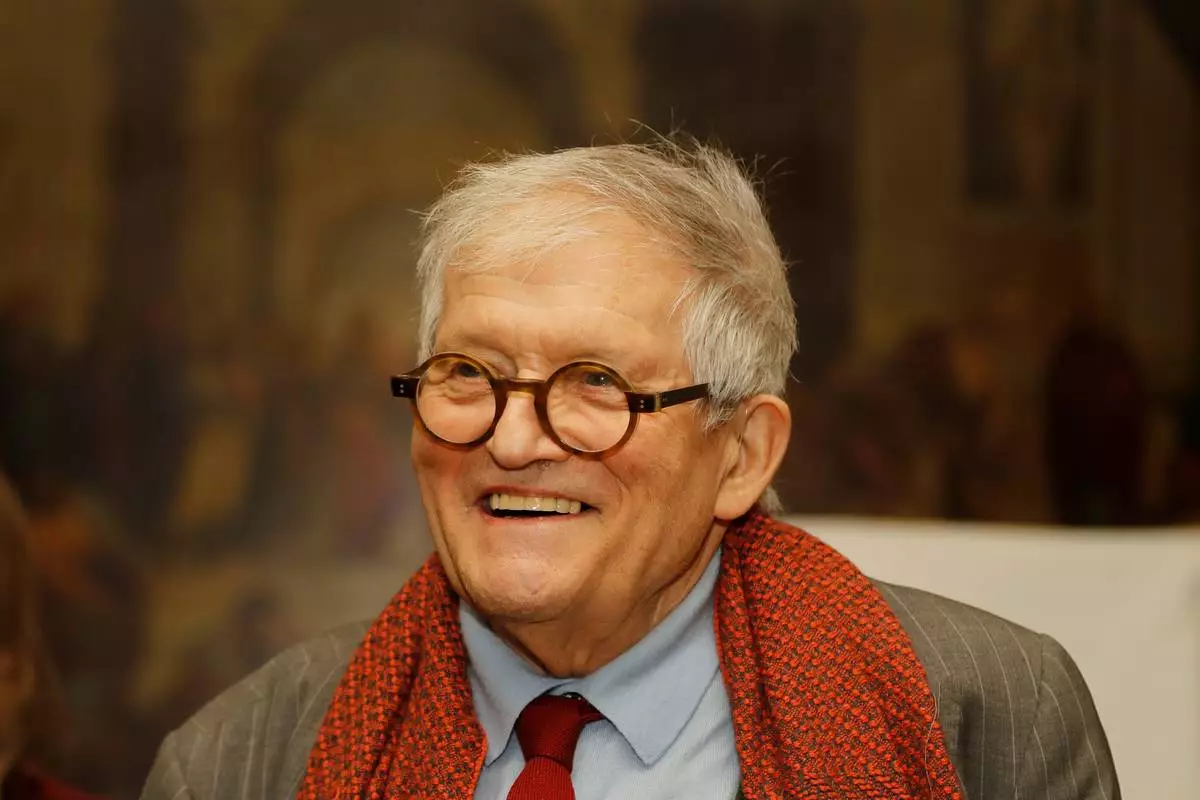
FILE - Artist David Hockney after unveiling the bottle design for the 2014 vintage wine of Château Mouton Rothschild in London, Friday, Feb. 3, 2017. (AP Photo/Frank Augstein, File)