Hospital Authority statement on dismissal of intern doctor
The following is issued on behalf of the Hospital Authority:
The Hospital Authority (HA) today (June 12) issued the following statement regarding the dismissal of an intern doctor:
The HA holds doctors to the highest standards of professional conduct, behaviour, and discipline. The HA insists that all doctors serving patients in public hospitals must possess both medical competence and conduct themselves in a professional manner. In addition to having professional knowledge to treat patients, they must uphold the strictest professional conduct and place patient well-being, privacy, safety, and care as their foremost priority at all times. The HA has absolutely zero tolerance for any form of behaviour that undermines the professional conduct of doctors. The HA will not permit any doctors concerned to practise in public hospitals to safeguard patient safety.
Upon becoming aware of recent discussions on social media posts regarding a series of improper acts by an intern doctor, the HA has taken action to establish an investigation panel to follow up on the event seriously. The panel has completed its investigation and determined that the intern doctor was involved in a series of improper act. The HA has taken action today to dismiss the intern doctor immediately.
During its investigation, the panel conducted interviews with the intern doctor and relevant healthcare staff, and carried out a detailed review of various evidence, including clinical and computer system records. The panel concluded that the intern doctor was involved in several serious improper act, including:
- Breach of the professional conduct and integrity expected of doctors;
- Infringement of patient privacy and professional confidentiality; and
- Failure to faithfully follow instructions in performing medical procedures.
The HA has notified the intern doctor of the dismissal decision, and has also informed the medical school of the relevant university for appropriate follow-up. The HA will continue to investigate the event. If it is determined that any other doctors were involved in improper act, the HA will deal with the issue with the utmost seriousness and without leniency, in order to uphold doctors' professional conduct and safeguard patient safety.
The HA spokesperson reiterates that the HA will not tolerate any conduct that undermines patient safety or doctors' professional conduct, and strongly condemns such conduct.
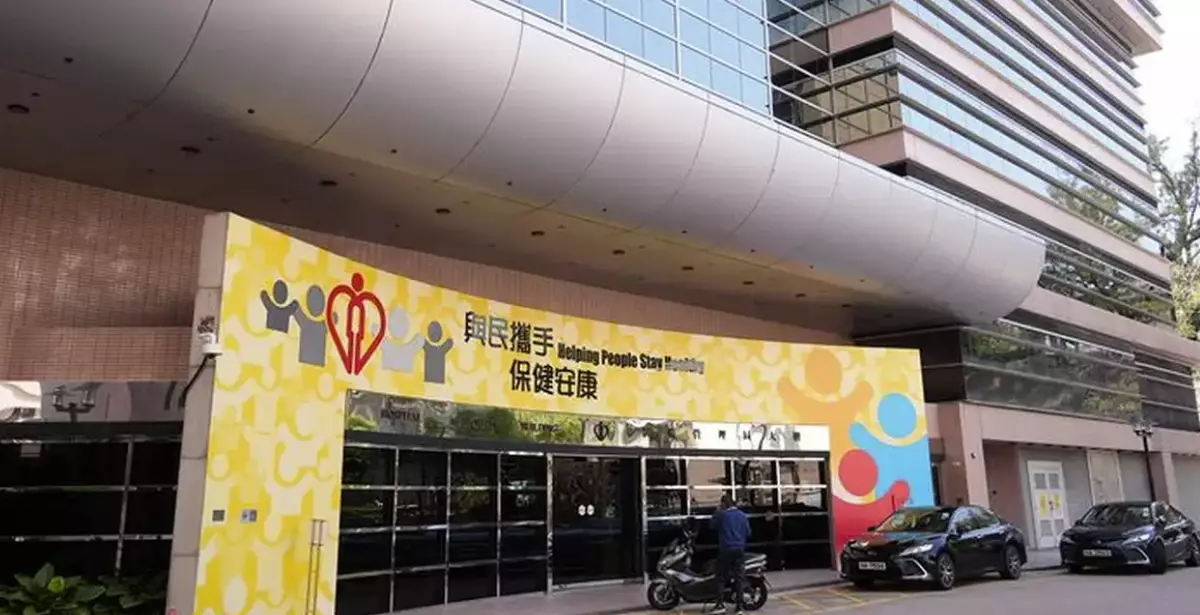
The Hospital Authority, Photo source: reference image
CHP continues to actively follow up on a case of low-pathogenic avian influenza A (H9) infection and reminds the public of the possibility of "twin-peaks" for seasonal influenza and COVID-19 during summer
The Centre for Health Protection (CHP) of the Department of Health (DH) today (June 15) continued to actively follow up on a case of human infection with influenza A (H9) in collaboration with the relevant government departments. Following whole genome sequencing and analysis of the patient's clinical specimens, the virus strain was confirmed to be a low-pathogenic avian influenza A (H9N2) virus. All of the virus genes were avian in origin and no significant genetic variations were detected. The patient is currently in stable condition and all six of his household contacts have remained asymptomatic. As the H9N2 avian influenza virus has long been present in local poultry with low mortality rate for birds, and that the H9N2 avian influenza virus involved in this case has not shown evidence of human-to-human transmission or significant genetic variation, the CHP currently assessed the risk of a local avian influenza pandemic as low. Nevertheless, the CHP once again strongly urged the public to maintain good personal and environmental hygiene at all times, avoid contact with live poultry, birds or their droppings, thoroughly cook poultry meat and eggs before consumption, and wash hands thoroughly after visiting places where live poultry is sold, so as to reduce the risk of avian influenza infection.
In addition, with the recent rise in the activity of seasonal influenza and COVID-19, the CHP does not rule out the possibility that the activity of these two respiratory diseases will continue to rise in the coming months, leading to a "twin-peaks" phenomenon. Members of the public, particularly high-risk individuals, are advised to receive vaccination in a timely manner to reduce the risk of severe disease and death.
Human infection with influenza A (H9) virus
------------------------------------------------------
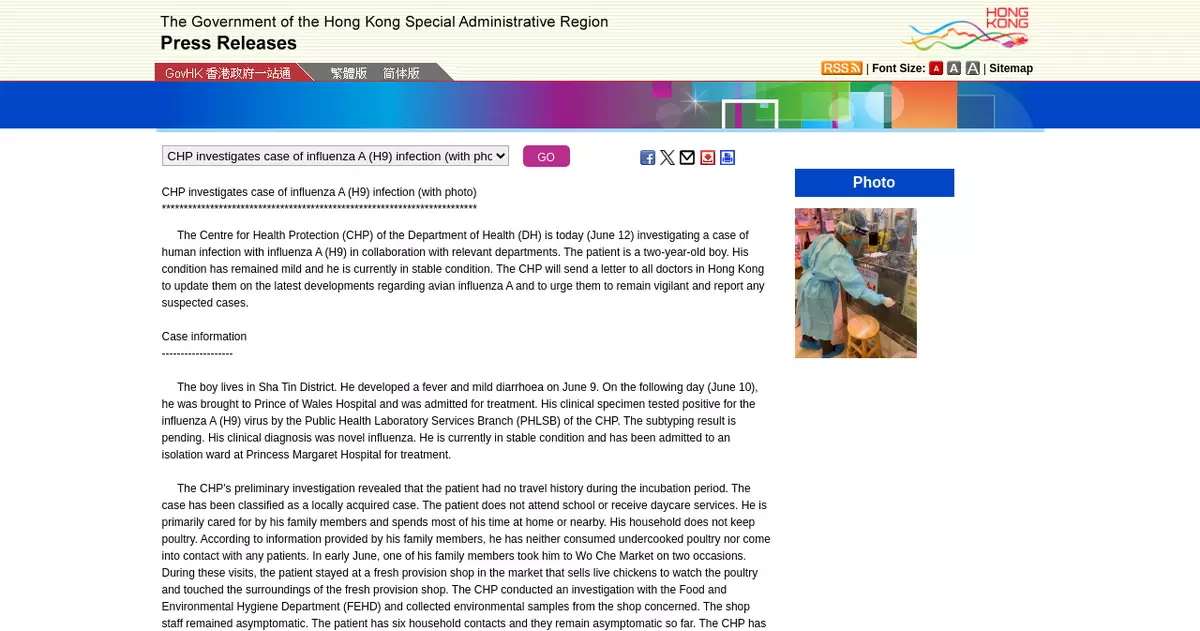
In relation to the recent influenza A (H9) infection in a two-year-old boy, the Public Health Laboratory Services Branch of the CHP conducted whole genome sequencing and analysis of the virus, confirming that the virus strain is a low-pathogenic H9N2 avian influenza virus and that no significant genetic variations were detected. The CHP has collected 17 environmental samples from the residence of the patient, the fresh provision shop at Wo Che Market he had visited, as well as a park in Fung Wo Estate. One sample collected from a metal tray placed at the bottom of a live chicken cage inside the shop that was used to collect chicken droppings was tested positive for the H9 avian influenza virus. The remaining 16 samples tested negative. The CHP will conduct further analysis on the positive environmental sample. The CHP believed that it is more likely for the boy to have contracted H9 avian influenza by touching a contaminated surface at the fresh food shop selling live poultry in Wo Che Market. Thorough disinfection and cleaning will be conducted at the fresh food shop in question.
The patient remains hospitalised in stable condition. His symptoms remain mild. Neither his family members nor the staff at the fresh provision shop concerned have developed any symptoms. The CHP has provided them with preventive medication and will continue to put them under medical surveillance.
Based on the above epidemiological and virological evidence, the CHP assessed that the recent local case of infection has not changed the current risk level. The risk of an influenza pandemic due to local avian influenza remains low. The Government's response level under the "Preparedness Plan for Influenza Pandemic" remains at "Alert" level.
Avian influenza viruses are generally classified as highly pathogenic or low pathogenic, and they mainly affect birds and poultry. Birds are also natural hosts for avian influenza viruses. In occasional circumstances, cross-species transmission may occur when human come into close contact with infected poultry or contaminated environments. However, there is currently no scientific evidence to suggest that the existing avian influenza viruses are capable of sustained and efficient human-to-human transmission. No novel influenza virus arising from genetic reassortment between human seasonal influenza viruses and animal influenza viruses has been found either.
Since 1999, a total of 11 cases of human influenza A (H9N2) have been recorded in Hong Kong, including five local cases and six imported cases. No fatal case has been recorded so far.
According to data published by the World Health Organization (WHO), more than 160 cases of human infection with influenza A (H9) have been recorded globally in the past decade. The vast majority of patients presented with mild symptoms. As poultry is a natural host of the virus in many regions, sporadic human infections caused by contact with infected poultry or contaminated environments are expected to continue occurring worldwide.
The CHP will continue to strengthen public education and publicity efforts to reduce the risk of avian influenza infection among the general public. A letter has been issued to all doctors in Hong Kong to update them on the latest situation regarding influenza A (H9), urging them to heighten vigilance and report any suspected cases.
Seasonal influenza and COVID-19
-------------------------------------------------
Influenza activity in Hong Kong has increased in recent weeks but remains below the baseline level. Based on past experience, Hong Kong may experience two influenza seasons each year. The onset of summer influenza season began at a later time than usual last year, and sustained a longer period, extending from early September last year to early January this year, resulting in the absence of the winter influenza season that traditionally occurs in the first quarter of each year. Since the summer influenza season typically occurs between July and August, it cannot be ruled out that it may begin earlier than usual this year.
Regarding COVID-19, while overall local activity remains at a relatively low level, a slight increase has been recorded continually since early May. The COVID-19 activity levels fluctuate, with an upsurge period seen approximately every six to nine months in recent years. Each upsurge is associated with changes in predominant circulating variants and a decline in community herd immunity. It has been nearly a year since the end of the last periodic upsurge of COVID-19 activity in Hong Kong, and it cannot be ruled out that the overall COVID-19 activity will rise further in the coming one to two months.
Government's vaccination programmes
---------------------------------------------------
Vaccination remains the most effective way to prevent seasonal influenza, COVID-19 and its complications. It also reduces the risk of hospitalisation and death.
The WHO has earlier announced its recommendations for the composition for seasonal influenza and COVID-19 vaccines in the upcoming season. Vaccine manufacturers are currently producing vaccines in accordance with the recommendations. A new batch of seasonal influenza vaccines will arrive in Hong Kong in this September, while COVID-19 vaccines will arrive in the fourth quarter.
The COVID-19 vaccine provided under the Government's COVID-19 Vaccination Programme (the Programme) for children and adults will expire in mid-July and early September this year respectively. As the production and delivery of COVID-19 vaccines to Hong Kong with the new composition take time, eligible persons will not be able to receive free COVID-19 vaccines through the Programme for a short period during the transition period before a new batch of vaccines arrive in Hong Kong. Therefore, those in need are advised to make appointments as early as possible. Existing vaccination services will continue until the following dates:
 Individuals aged six months to 11 years: COVID-19 vaccination services will be available until July 10, 2026.
Individuals aged 12 or above: COVID-19 vaccination services will be available until September 5, 2026.
Individuals aged six months to 11 years: COVID-19 vaccination services will be available until July 10, 2026.
Individuals aged 12 or above: COVID-19 vaccination services will be available until September 5, 2026.
In addition, the shelf life of vaccines under the Government's Seasonal Influenza Vaccination (SIV) Programmes will expire at the end of July. The DH launched the 2025/26 SIV Programmes in September last year. With the government's active promotion and the cooperation of various stakeholders, over 2.03 million doses of vaccines have been administered. Members of the public who have not received vaccinations, particularly children, the elderly and chronic disease patients, should receive influenza vaccination as soon as possible.
To prevent respiratory diseases, members of the public should maintain good personal, hand and environmental hygiene at all times. Members of the public with respiratory symptoms, even if the symptoms are mild, should wear a surgical mask, avoid crowded places and seek medical advice promptly. They should maintain hand hygiene before putting on and after removing a mask. When there is a rise in activity levels of respiratory diseases, high-risk persons should wear surgical masks when visiting public places. The general public should also wear a surgical mask when taking public transport or staying in crowded places.
The public may visit the CHP's webpages for more information:Avian Influenza Webpage,Avian Influenza Report, COVID-19 Vaccination Programme, Seasonal Influenza Vaccination Programmes,Facebook pageandYoutube channel.
Source: AI-found images