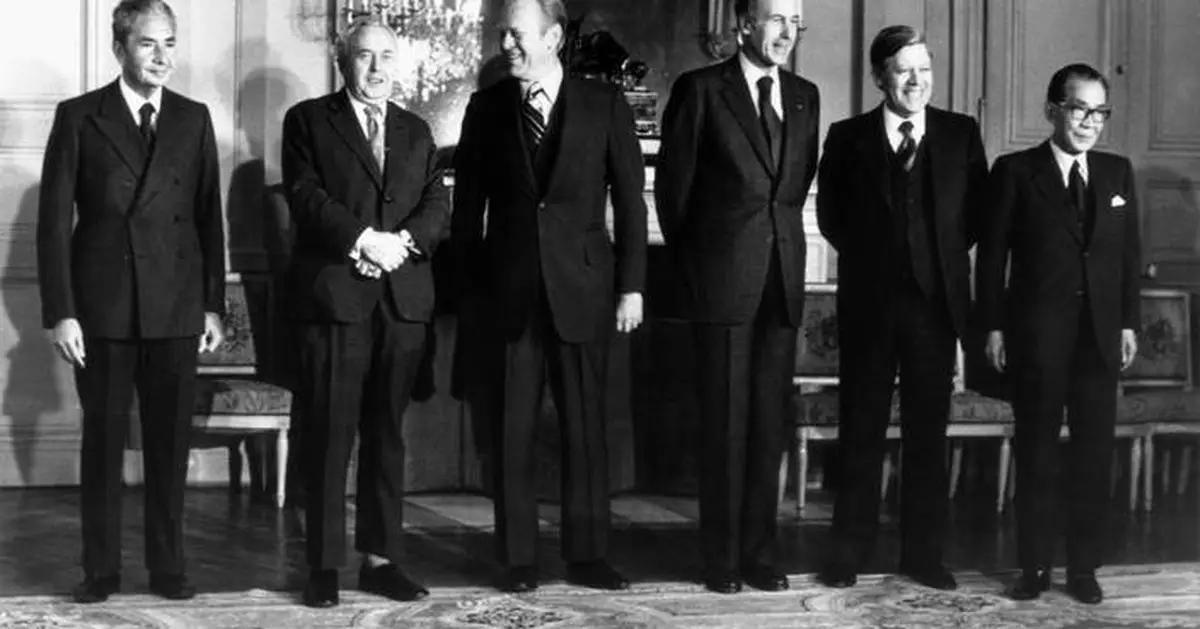
EDITOR’S NOTE: When U.S. President Gerald Ford and leaders of five other leading democracies gathered for talks at a castle outside Paris on Nov. 15, 1975, they planted the seed for what subsequently became the Group of Seven nations.
The initial six industrial powers that huddled at the Château de Rambouillet for three days of brainstorming about fixes for the global economy became the G7 the following year when Canada joined the elite club.
During and after the Cold War, the G7 became a powerful tool of influence, enabling Western allies and Japan to hammer out common positions not only on economic issues but also their foreign policy and security priorities.
The combined economic, industrial, military, and diplomatic strength of G7 nations ensures the summits they hold annually, rotating hosting duties, are always major news events.
The next G7 summit is in France next week.
As part of its coverage, The Associated Press is republishing extracts of the story that AP correspondent Arthur L. Gavshon wrote on the first day of the inaugural summit in 1975, hosted by French President Valéry Giscard d’Estaing and also including the leaders of West Germany, the U.K., Italy and Japan, as well as Ford.
By ARTHUR L. GAVSHON
RAMBOUILLET (AP) — President Ford called on leaders of five other major industrial nations Saturday to set themselves the task of transforming the world’s economic slump into prosperity by 1977.
Addressing the opening session of an economic summit meeting amid the splendor of the 14th-century Chateau de Rambouillet, Ford “categorically rejected the view” that expansion in the industrial world is impossible at pre-recession rates, an aide told newsmen.
He added that Ford said America’s economic recovery has been stronger than anticipated and forecast a growth rate of between 6 and 7 percent through 1976.
The first meeting with leaders of France, Britain, West Germany, Japan, and Italy began shortly after the President arrived at the historic chateau, 30 miles south of Paris.
The free-flowing talks broke nearly three hours later for dinner, and the host, French President Valéry Giscard d’Estaing, told newsmen: “I am optimistic. I think we can arrive at something concrete.”
A French spokesman said the leaders were reaching “a remarkable convergence of views.” British officials indicated a consensus was emerging that the worst of the economic downturn might already be over.
Secretary of State Henry A. Kissinger struck the same positive note, saying the meeting “went very well.”
The dinner was remarkably simple in comparison with the usual fare for a state occasion in France and was in line with the low-key approach favored by the French.
Stuffed chicken was the main course, with wines that were good but not spectacular.
In other developments at the six-nation talks:
— Japanese Prime Minister Takeo Miki who reported his country has been hurt by a decline in world trade, began pressing immediately for a freer flow of international commerce.
— British Prime Minister Harold Wilson disclosed through aides he wants his fellow leaders to back up a plan for a new and strengthened world code to check the spread of nuclear know-how, equipment, and weapons.
— Ford will join Giscard d’Estaing and Italian Prime Minister Aldo Moro Sunday morning for services at the Roman Catholic church in Poigny la Forêt, a 10-minute drive from the chateau.
The setting was priceless furniture and statuary trucked from the Louvre for the occasion, but the mood at the start of the summit was that of a relayed businessmen’s weekend seminar.
“It’s just a beautiful place here,” said Ford as President Valery Giscard d’Estaing of France led the participants from six nations into the pink and gray hall of marble at the chateau where Louis XVI passed idle hours and Napoleon his last night in France before banishment to St. Helena.
“The facilities are really gorgeous,” Ford said to Giscard d’Estaing. “It’s very comfortable.”
“I hope you feel as positive about all this afterwards,” Giscard d’Estaing shot back with a laugh. Then he called out “Helmut, oh Helmut,” as West German Chancellor Helmut Schmidt entered the room.
The relayed mood also was apparent in the dress of the leaders. Giscard d’Estaing wore a greenish tweed weekend suit, and Schmidt had on a light gray one. Ford was the most formally dressed of the leaders in a dark blue suit with a vest and white shirt.
The group, 18 in all including the finance and foreign ministers of participating nations, was spread out nine on each side of a 30‑foot long table. Giscard d’Estaing and Ford faced each other across the chestnut-colored upholstery covering the table, as did Harold Wilson of Britain and Aldo Moro of Italy, and Takeo Miki of Japan and Schmidt.
Each of the participants had earphones on which to follow proceedings. There were five closed-in interpreters’ booths at one end of the smallish room, and a bust of King Francois I of France, who died at the chateau, at the other end.
The leaders do not expect to reach firm decisions at the three-day seminar but to define directions their individual governments can take in fighting inflation, unemployment and declining world trade.
Presidential press spokesman Ron Nessen said during Ford’s flight across the Atlantic that the summit may result in an improved performance in the American economy.
“The President has always thought of it in practical terms – what it means to the American consumer,” Nessen said.
Each of the visiting leaders was assigned an apartment in the chateau, home of French kings and rulers from the 14th century. Moving men had worked until the early hours Saturday uncrating furniture and paintings brought from the Louvre to spruce up the rooms.
More than 3,000 armed French police were deployed around the wooded grounds and gardens of the palace.
Ford was given the top room of the Francois I tower, which a French spokesman described as “the most comfortable apartment in the chateau.” It has a Spanish-made bed with a working fireplace at the foot and a direct telephone linking Ford to the White House.
Prime Minister Harold Wilson of Britain was given an apartment done in mahogany and satin overlooking the garden ponds; Japanese Prime Minister Takeo Miki was down the hall in an apartment with heavy beams and Louis XVI furniture; Chancellor Helmut Schmidt of West Germany was in an apartment furnished in Directoire style, and Premier Aldo Moro of Italy had rooms furnished in Empire style.
With the idea of achieving general economic growth – and a cutback of the 15 million jobless in Western countries – the six nations intend to try to align their policies on such big issues as:
— The old French-American dispute over reform of the world monetary system. The French dislike the present floating exchange rates and want to return to a more rigid system while the United States and Britain would as soon leave the system flexible.
— The formulation of a common energy policy. Ford can count on majority backing for his view that the economic and political future of the industrial democracies cannot be left to the mercy of the oil producers. New sources of supply and new conservation programs should be jointly and quickly developed.
— The general world economic outlook and ways of tackling the inflation which is undermining political stability many places.
— Relationships between the older industrialized nations of the West, the newly rich producers of oil and other scarce raw materials, and the poorest developing lands.
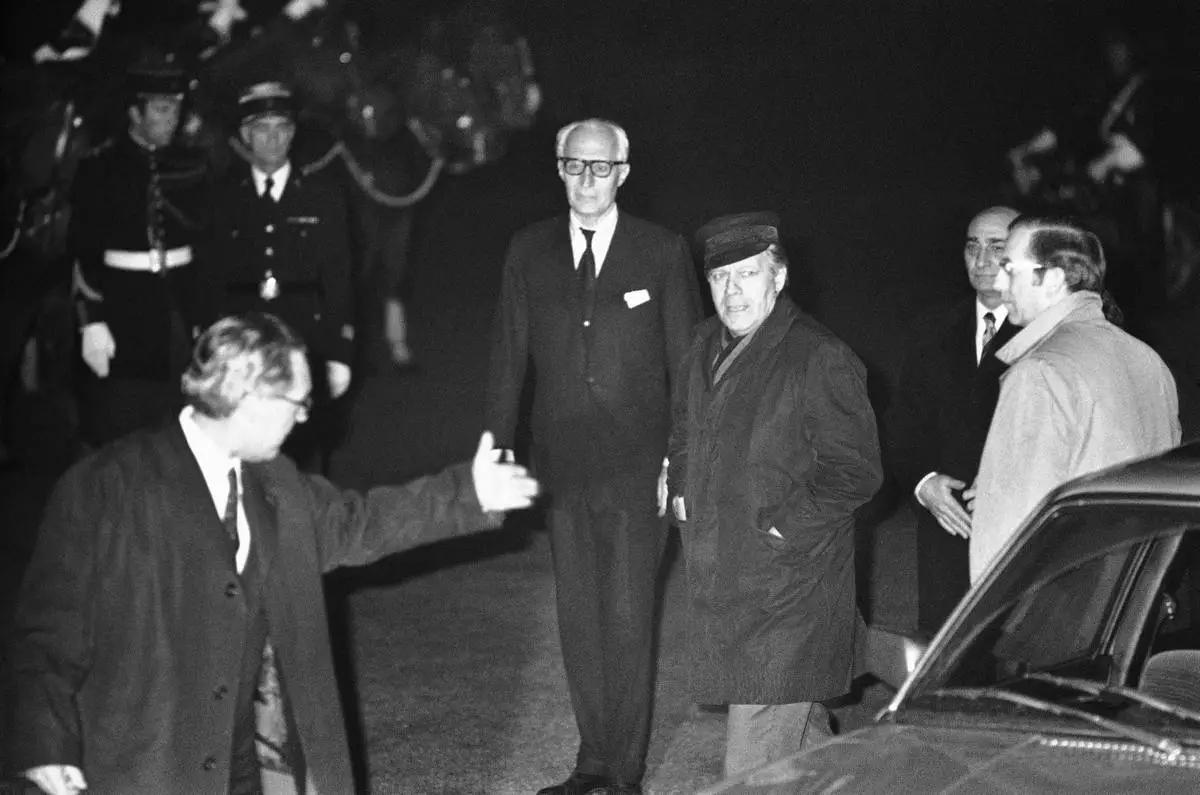
FILE - West German Chancellor Helmut Schmidt is met by French protocol chief Mr. Angles, left, as he arrives at the Chateau de Rambouillet, west of Paris on Nov. 15, 1975 for the Economic and Monetary summit meeting. (AP Photo/Michel Lipchitz, file)
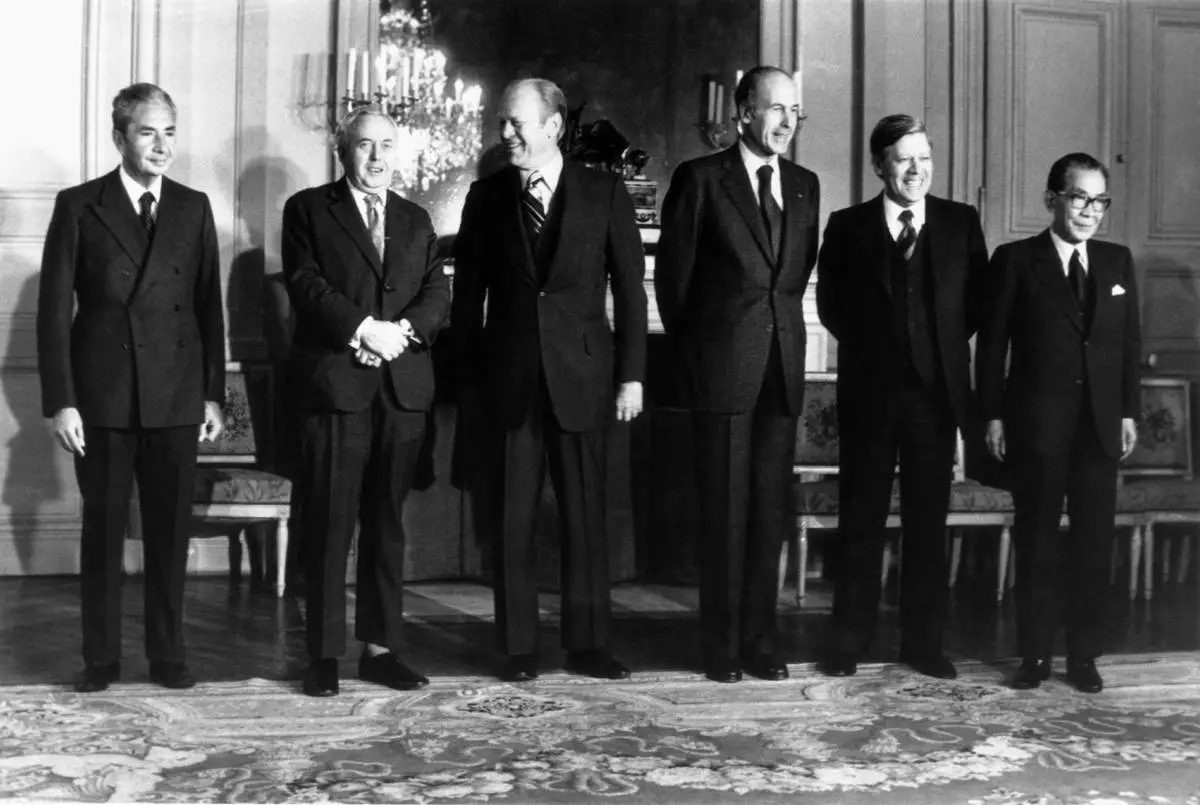
FILE - From left: Premier Aldo Moro of Italy, Premier Harold Wilson of the Great Britain, President Gerald Ford of the United States, President Valery Giscard d'Estaing of France, Chacellor Helmut Schmidt of West Germany and Premier Takeo Miki of Japan, the six heads of state and government, pose for a group portrait during the Economic and Monetary summit meeting at the Chateau de Rambouillet, West of Paris, Nov. 17, 1975. (AP Photo, File)