FIFA has been cooperating with Lenovo, a Chinese multinational technology company, to harness artificial intelligence (AI) and other emergent technologies to enhance teams' performances and fan experiences during the ongoing 2026 World Cup.
Santiago Manso, director of sports vertical at Lenovo, explained how the company is helping to aggregate wide-ranging data related to the tournament, from the locations of teams and officials to social media feeds and weather forecasts.
"AI is bringing in a way to get quicker, rapid value from the information, [make] strategic decisions, specific insights, but also in another way, especially through computer vision and through all the treatment of the video," said Santiago Manso, director of sports vertical at Lenovo.
Technicians use AI to stabilize referee body camera shots, so fans can clearly see what the referees are seeing, while also avoiding motion sickness.
AI is also expected to assist the Video Assistant Referee (VAR) in making more accurate decisions. Instead of using traditional photographs, Lenovo has built an AI model to create 3D avatars of the players.
"These avatars are digital twins of the football players. We are scanning 1,200 players at the level of millimeters. So, you really see the hair of the players, you really see all kinds of shapes of the players. Scanning the players, having the real digital twins of the players is making this very realistic. So, everybody will see that the reality matches with the generated pictures," said Manso.
These details may make a huge difference as FIFA introduces a new semi-automated offside alert sent directly to the VAR.
In the past, featureless humanoid avatars represented all players. Thanks to digital twin technology, the precise limb lengths and body dimensions of every player can now be tracked, leading to more accurate calls and a better viewing experience for fans.
"Certain countries are able to bring a much larger staff force with data analysts, whereas some countries with smaller budgets, they can't do that. So, this is about giving people access to the same data and being able to make informed decision making," said Myles Spittle, FIFA delivery lead at Lenovo.
The 2026 FIFA World Cup officially began on Thursday with an opening ceremony held at the Azteca Stadium in Mexico.
The expanded 2026 tournament is set to be the biggest ever World Cup, featuring a record number of 48 teams and seeing the competition hosted by three nations for the first time, with matches taking place in Mexico, Canada and the United States from June 11 to July 19.

Lenovo's AI technology enhances team performances, fan experiences in FIFA World Cup

Lenovo's AI technology enhances team performances, fan experiences in FIFA World Cup

Lenovo's AI technology enhances team performances, fan experiences in FIFA World Cup
Chinese President Xi Jinping, also general secretary of the Communist Party of China (CPC) Central Committee and chairman of the Central Military Commission, has charted the strategic course for advancing high-quality economic and social development during the 15th Five-Year Plan period (2026-2030).
The year 2026 marks both the 105th anniversary of the founding of the CPC and the start of the country's new five-year plan through 2030. Since the beginning of the year, Xi has issued a series of important instructions and directives about ensuring a solid start to the new plan and fully accomplishing the major strategic tasks of economic and social development in the years ahead. On Jan 20, Xi attended a special study session for principal officials at the provincial and ministerial level on studying and implementing the guiding principles of the fourth plenary session of the 20th CPC Central Committee. In his speech, he said the plenary session had made strategic arrangements for economic and social development during the 15th Five-Year Plan period, stressing the need to continuously deepen the study and implementation of the guiding principles of the session.
On March 12, Chinese lawmakers approved the outline of the 15th Five-Year Plan for national economic and social development at the closing meeting of the fourth session of the 14th National People's Congress, China's national legislature, providing robust legal safeguards to better ensure that the national development plan fully plays its strategic guiding role.
Since the beginning of 2026, Xi has made a series of major decisions and deployment for driving high-quality development.
In January, Xi presided over this year's first group study session of the Political Bureau of the CPC Central Committee, which focused on forward-looking planning and the development of future industries. When making his first domestic inspection tour of the year in February, he visited an information technology (IT) innovation park in Beijing to learn about IT application and innovation.
These two major events have brought to the fore the urgent imperative of modernizing the country's industrial system and fast-tracking technological self-sufficiency at a high level.
During the annual "two sessions" in March, Xi took part in a deliberation with his fellow deputies from the delegation of Jiangsu Province at the national legislative session. During the meeting, he emphasized the need to strengthen the real economy to support high-quality development.
Fostering a new pattern of development is a strategic priority for China. Since the beginning of this year, Xi has made strategic deployment to accelerate the creation of a new development pattern.
Coordinated regional development is a key pillar for achieving high-quality development. During this year's "two sessions", Xi instructed China's major economic provinces to lead in studying new situations, solving new problems, and sharing their experiences in this regard.
In late March, Xi inspected the Xiong'an New Area in north China's Hebei Province, where he also chaired a symposium on further advancing the high-quality construction and development of the new area, setting the direction for the coordinated development of the Beijing-Tianjin-Hebei region. At a national work conference in June, he made important instructions about steadily advancing cooperation between China's eastern and western regions.
The modernization of agriculture and rural areas bears on the overall development and quality of Chinese modernization, and it has always been a matter of great concern to Xi. In June, the general secretary visited Dongyujia Village in Dezhou, a city in east China's Shandong Province and a major grain-producing hub on the North China Plain, where he learned about the local wheat harvest, corn planting, and agricultural supplies.
On July 30, Xi presided over a meeting of the Political Bureau of the CPC Central Committee. The meeting noted that since the beginning of this year, China's economy has shown a trend characterized by new growth drivers and improving economic structure, laying a solid foundation for achieving the annual economic and social development targets.
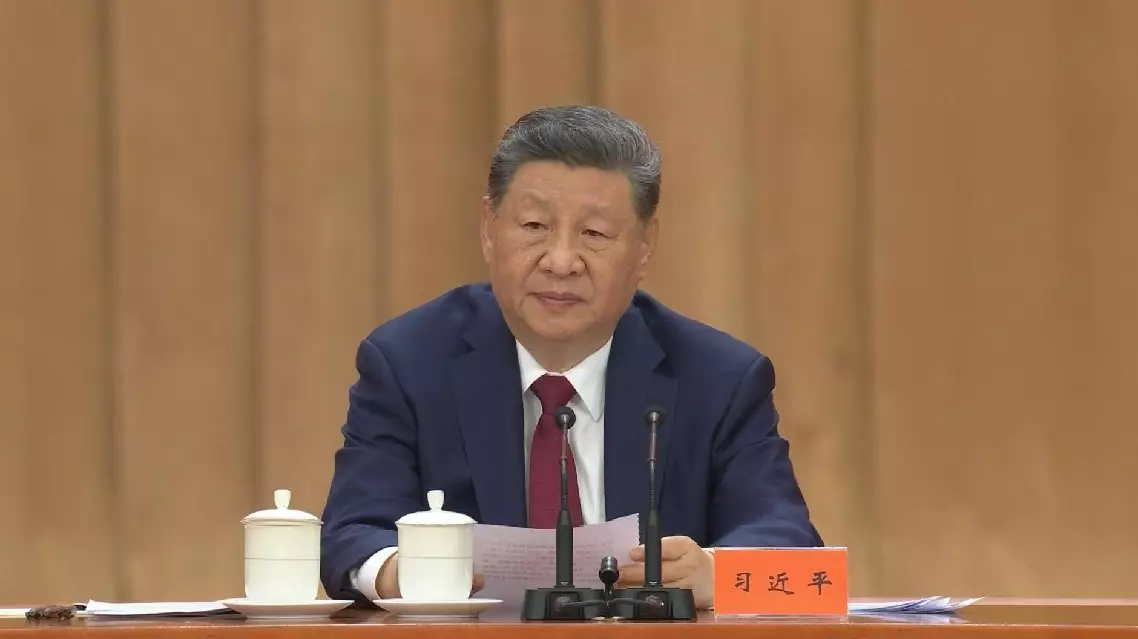
When addressing a gathering in celebration of the 105th founding anniversary of the CPC on July 1, Xi called on all Party members to stay firm in convictions and forge ahead with continuous efforts, to fulfill the Party's mission and tasks in the new era and on the new journey.
Xi charts course for advancing high-quality development during 15th Five-Year Plan period