Skip to Content Facebook Feature Image

Mass shootings in South Africa’s poorest areas are a symptom of organized crime and police failures

News

Mass shootings in South Africa’s poorest areas are a symptom of organized crime and police failures
News

News

Mass shootings in South Africa’s poorest areas are a symptom of organized crime and police failures

2026-06-14 00:10 Last Updated At:00:20

JOHANNESBURG (AP) — A mass shooting in South Africa this week was the latest in a trend of killings in some of the country's poorest areas that experts say is a symptom of organized crime gangs taking advantage of the failures and sometimes absence of police.

The shooting carried out by multiple suspects in an informal settlement of shacks in Johannesburg left 12 people dead and at least 15 wounded, according to authorities.

More Images
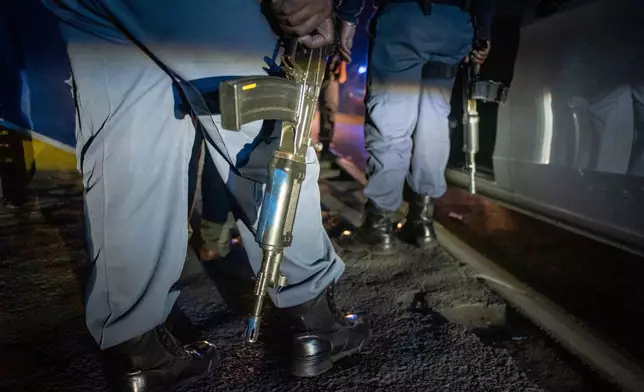
FILE - Police patrol an area in Soweto, South Africa, July 12, 2022 in search of illegal firearms following a deadly bar shooting. (AP Photo, File)
FILE - Police patrol an area in Soweto, South Africa, July 12, 2022 in search of illegal firearms following a deadly bar shooting. (AP Photo, File)

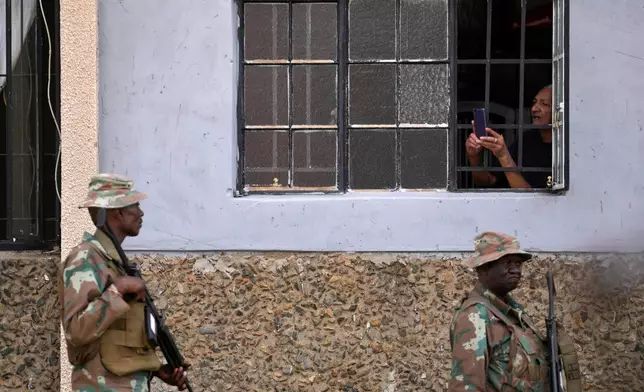
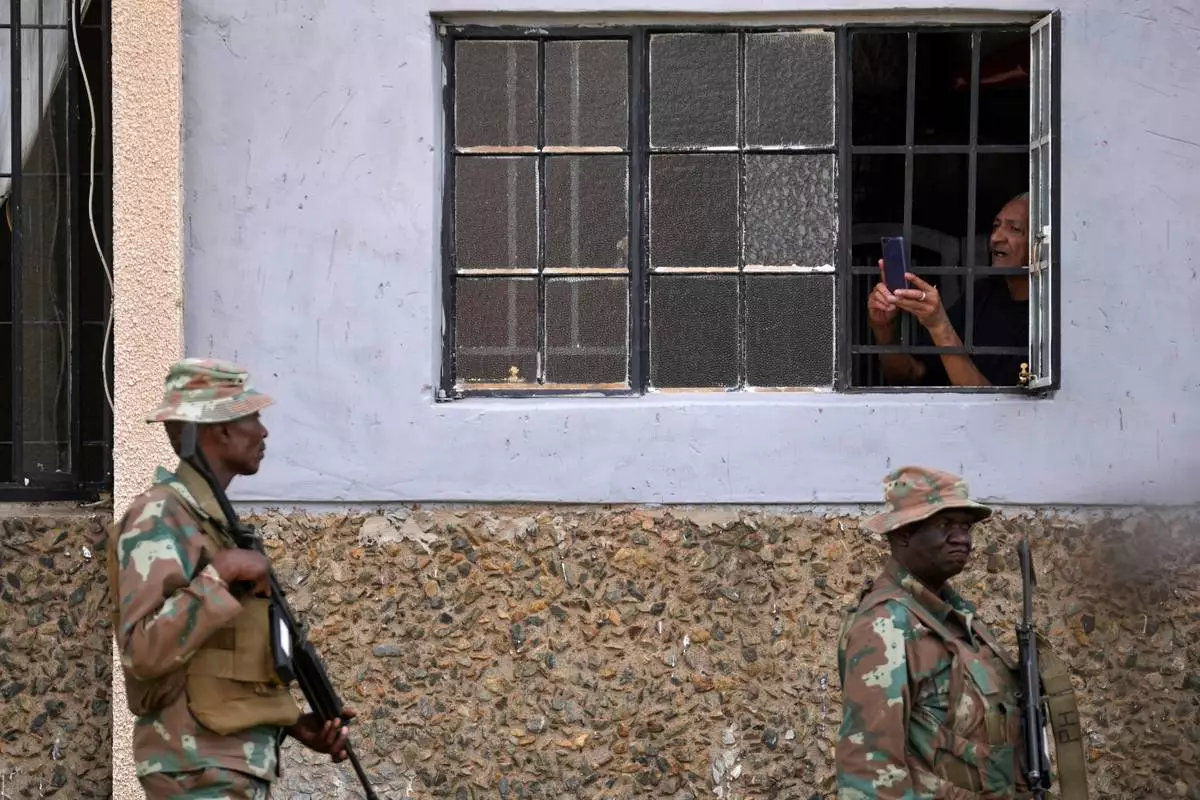
FILE - A resident uses a mobile phone to take a photograph of the South African National Defense Force officers deployed in the area, in the Riverlea township of Johannesburg, South Africa, March 11, 2026. (AP Photo/Themba Hadebe, File)
FILE - A resident uses a mobile phone to take a photograph of the South African National Defense Force officers deployed in the area, in the Riverlea township of Johannesburg, South Africa, March 11, 2026. (AP Photo/Themba Hadebe, File)

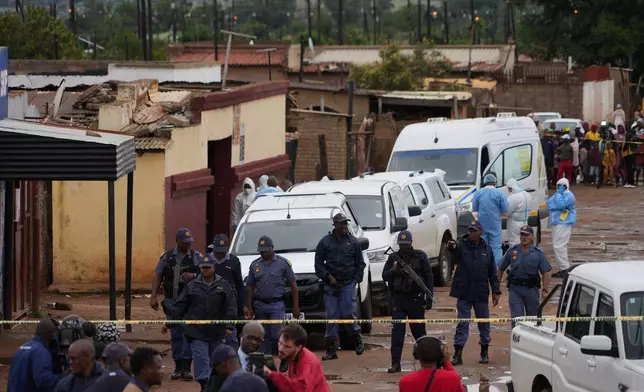
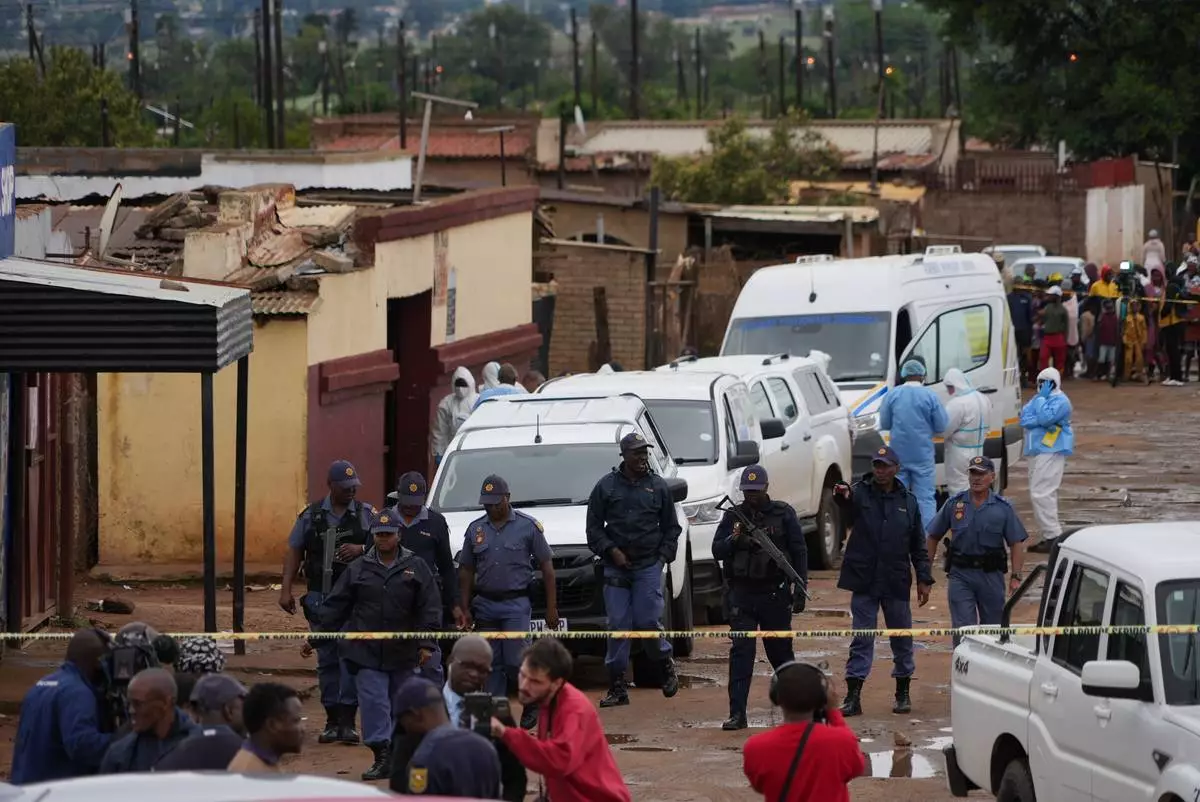
FILE - South African police gather at the scene of a mass shooting where gunmen killed and injured several people in a pub in Bekkersdal, South Africa, Dec. 21, 2025. (AP Photo/Alfonso Nqunjana, File)
FILE - South African police gather at the scene of a mass shooting where gunmen killed and injured several people in a pub in Bekkersdal, South Africa, Dec. 21, 2025. (AP Photo/Alfonso Nqunjana, File)

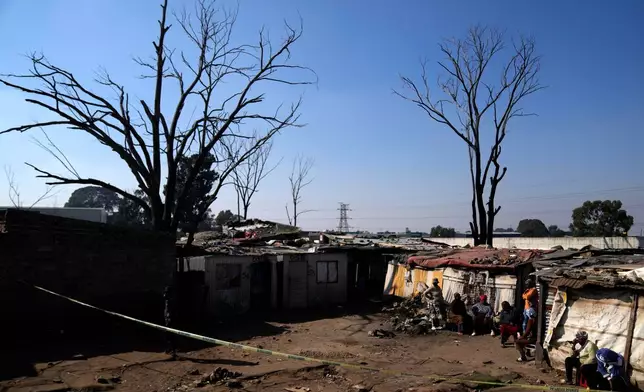
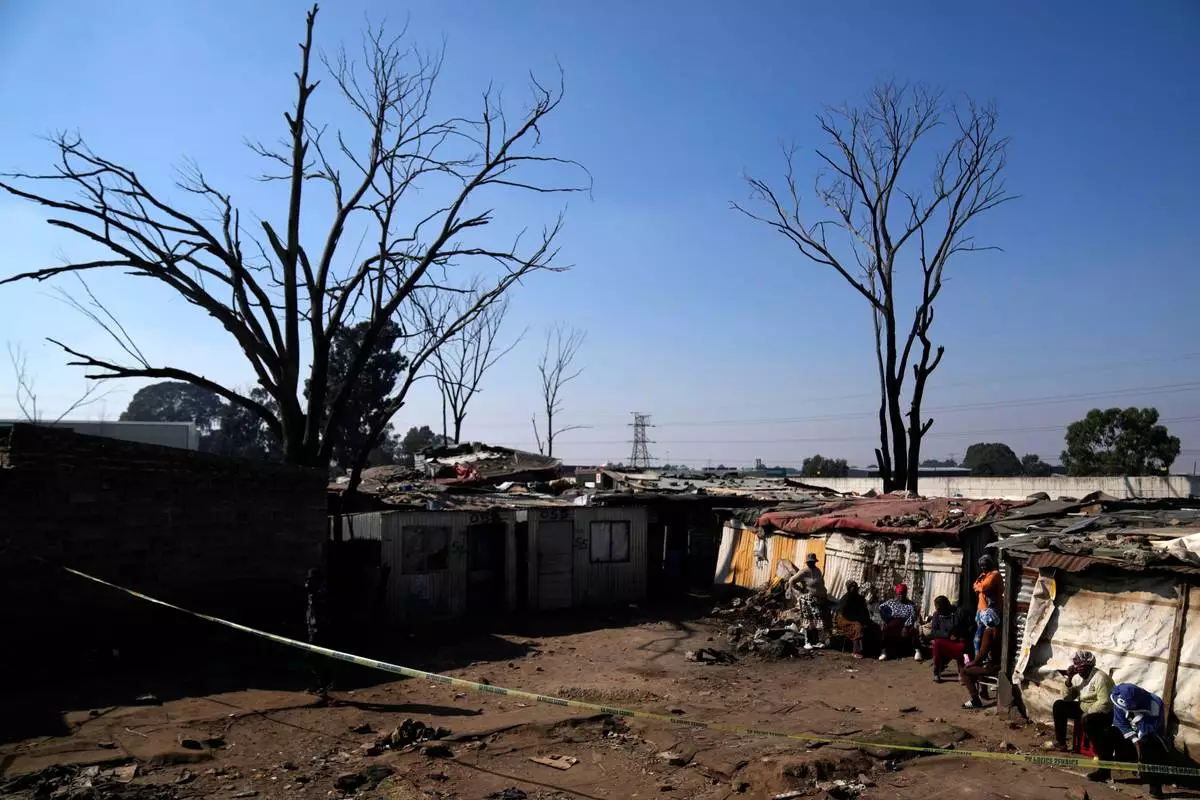
People sit outside a cordon, at the scene of a mass shooting at an informal settlement in the Cleveland suburb of Johannesburg, South Africa, Wednesday, June 10, 2026. (AP Photo/Themba Hadebe)
People sit outside a cordon, at the scene of a mass shooting at an informal settlement in the Cleveland suburb of Johannesburg, South Africa, Wednesday, June 10, 2026. (AP Photo/Themba Hadebe)

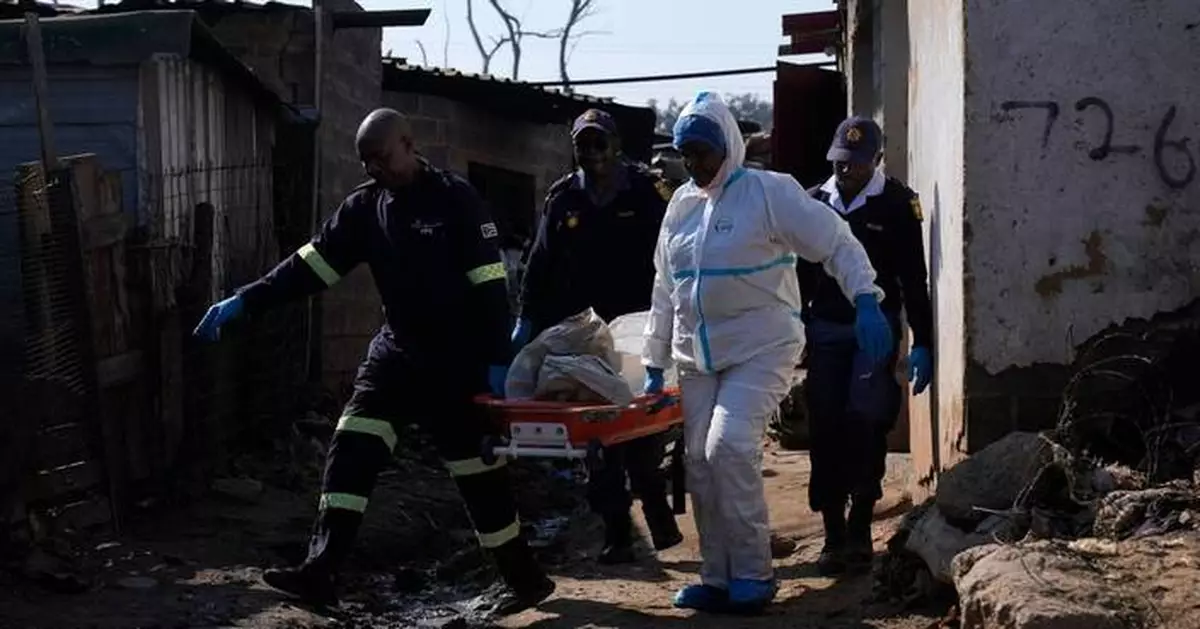
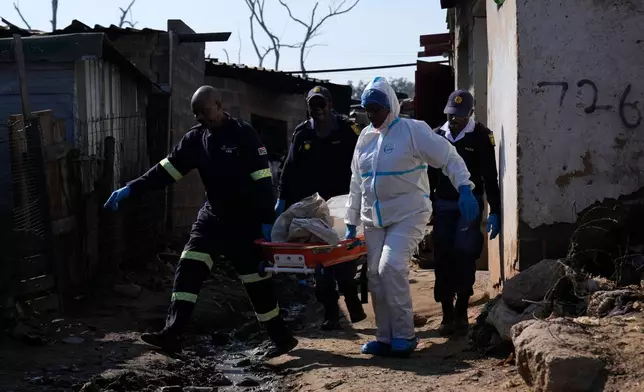
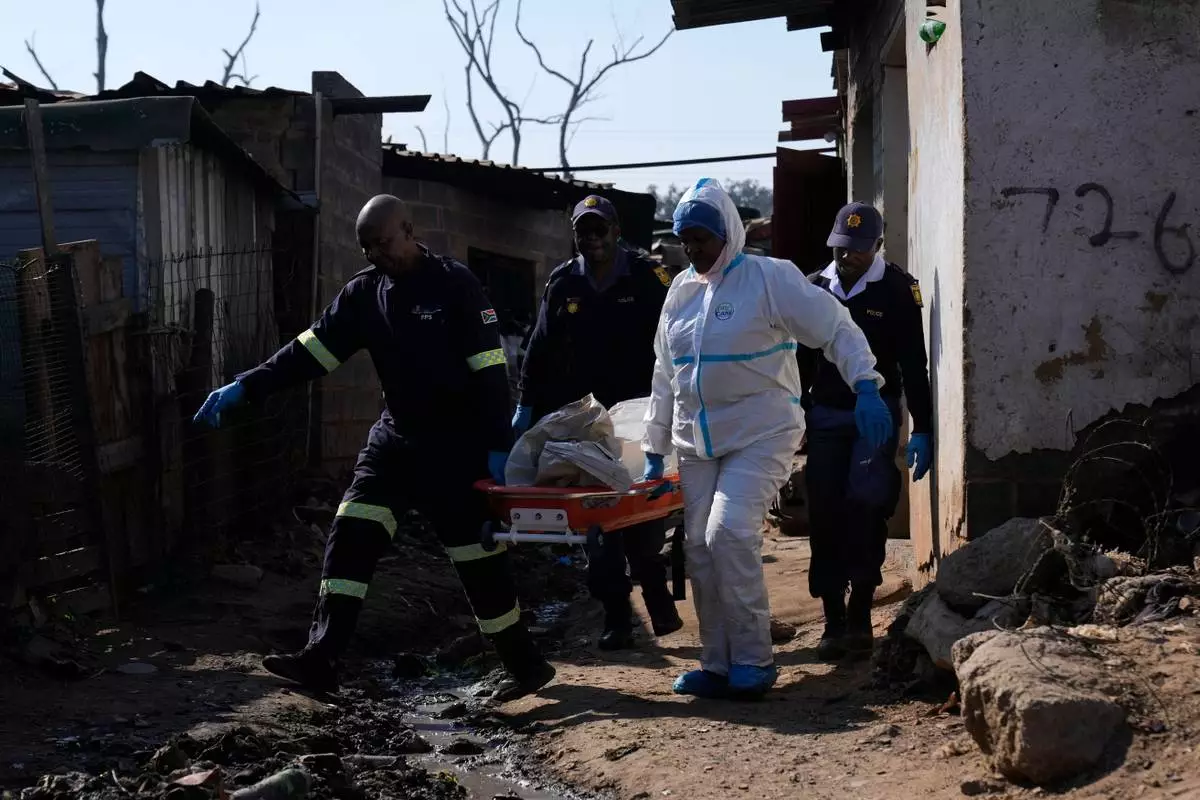
Police officers carry the body of a person on a stretcher after a mass shooting at an informal settlement in the Cleveland suburb of Johannesburg, South Africa, Wednesday, June 10, 2026. (AP Photo/Themba Hadebe)

Police officers carry the body of a person on a stretcher after a mass shooting at an informal settlement in the Cleveland suburb of Johannesburg, South Africa, Wednesday, June 10, 2026. (AP Photo/Themba Hadebe)

There have not been any arrests.

South Africa's president deployed the army to the streets in several hotspots earlier this year in an attempt to combat organized crime — an unusual move seen by critics as an admission that police in Africa's most developed country were losing the battle in those areas.

Alongside that, South Africa's police force has been embroiled in allegations of corruption and collusion with criminal syndicates. That has resulted in more than a dozen senior officers being arrested and top officials, including the police minister and the national police commissioner, being suspended.

Recent mass shootings — including two in December that left more than 20 people dead — have occurred in poor areas away from city centers where organized crime gangs take advantage of conditions like a lack of security, poor lighting and slow police responses, experts say.

“Criminal syndicates explicitly capitalize on this to hide weapons, execute hits, and vanish into the shadows,” Jacob Mofokeng, a professor of criminology at the University of South Africa, told The Associated Press.

South Africa has very high levels of violent crime, with the most recent annual statistics showing an average of more than 60 homicides a day.

But the vast majority of killings occur in poor townships or informal settlements. South Africa has a long history of deep inequality that is reflected in its crime: rich neighborhoods have much lower violent crime rates.

Illegal mining gangs have long been a problem in and around South Africa's largest city of Johannesburg, which has some of the biggest gold reserves in the world.

The gangs are notorious and known as zama zamas — which translates roughly as “hustlers” or “chance-takers” in the Zulu language. They establish bases in impoverished and poorly policed areas and fight turf battles with other gangs or use violence to hold control in those areas.

Mining gangs often include migrants from neighboring countries who are in South Africa illegally, according to authorities.

That makes it hard for police to track down suspects as they have “no legal identification, no registered address, and no fingerprints or DNA profile,” said Mofokeng. “They are effectively a ghost.”

South Africa's government has said it loses more than $3 billion a year to illicit mining. Zama zamas have been a problem for decades and were one of the reasons South African President Cyril Ramaphosa authorized a yearlong deployment of troops on the streets to fight organized crime in specific areas across the country.

Residents in the Johannesburg neighborhood hit by this week's mass shooting said illegal mining gangs were known to operate there. Police said the motive for the shooting was not known, but mining gangs were a focus of the investigation.

South Africa has strict regulations controlling the legal ownership of firearms, but there are around 2 million to 3 million illegal guns circulating in a country of 62 million people, according to independent studies and civil society organizations.

Guns are by far the most common cause of homicides.

Willem Els, an analyst at South Africa's Institute for Security Studies, said the flow of illegal guns and police failures led to an ideal environment for criminality.

“In South Africa, we actually managed to create conditions that are very conducive for violent crime and also for organized crime syndicates to operate with impunity,” he told the AP. “We’ve got a lot of unregistered firearms that are not being controlled by the police.”

Analysts say police in South Africa are underresourced, but allegations of corruption in the force have also seriously undermined its credibility.

South Africa has had police corruption problems before. A new allegation last year by a provincial police commander that top officers and officials were colluding with organized criminals led President Ramaphosa to announce a national investigation into police corruption. That has resulted in a wave of arrests of senior police officers.

Private investigator and security specialist Mike Bolhuis said police corruption has implications for on-ground policing in those areas impacted by violent crime as citizens are sometimes hesitant to give out information or help authorities.

“The public doesn’t trust the police, they don’t trust the authorities, and they don’t trust each other,” Bolhuis said.

AP Africa news: https://apnews.com/hub/africa
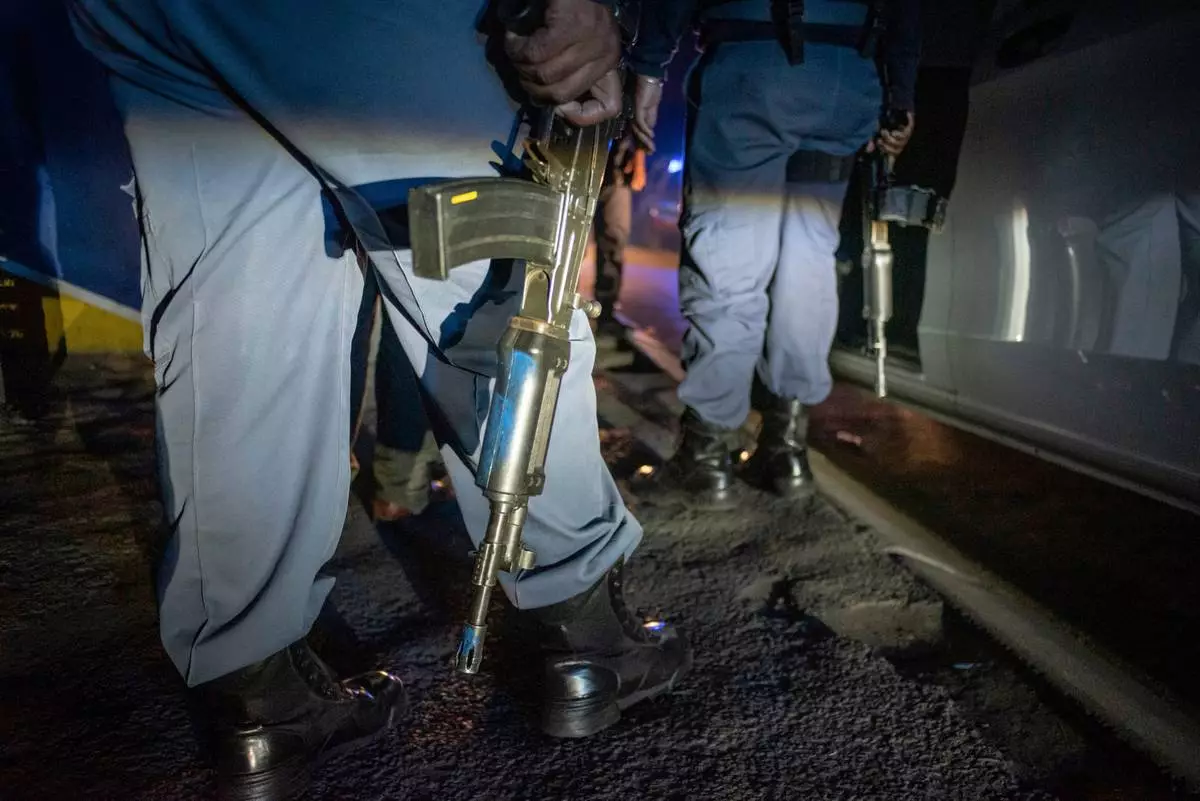
FILE - Police patrol an area in Soweto, South Africa, July 12, 2022 in search of illegal firearms following a deadly bar shooting. (AP Photo, File)
FILE - Police patrol an area in Soweto, South Africa, July 12, 2022 in search of illegal firearms following a deadly bar shooting. (AP Photo, File)

FILE - A resident uses a mobile phone to take a photograph of the South African National Defense Force officers deployed in the area, in the Riverlea township of Johannesburg, South Africa, March 11, 2026. (AP Photo/Themba Hadebe, File)
FILE - A resident uses a mobile phone to take a photograph of the South African National Defense Force officers deployed in the area, in the Riverlea township of Johannesburg, South Africa, March 11, 2026. (AP Photo/Themba Hadebe, File)

FILE - South African police gather at the scene of a mass shooting where gunmen killed and injured several people in a pub in Bekkersdal, South Africa, Dec. 21, 2025. (AP Photo/Alfonso Nqunjana, File)
FILE - South African police gather at the scene of a mass shooting where gunmen killed and injured several people in a pub in Bekkersdal, South Africa, Dec. 21, 2025. (AP Photo/Alfonso Nqunjana, File)

People sit outside a cordon, at the scene of a mass shooting at an informal settlement in the Cleveland suburb of Johannesburg, South Africa, Wednesday, June 10, 2026. (AP Photo/Themba Hadebe)
People sit outside a cordon, at the scene of a mass shooting at an informal settlement in the Cleveland suburb of Johannesburg, South Africa, Wednesday, June 10, 2026. (AP Photo/Themba Hadebe)

Police officers carry the body of a person on a stretcher after a mass shooting at an informal settlement in the Cleveland suburb of Johannesburg, South Africa, Wednesday, June 10, 2026. (AP Photo/Themba Hadebe)
Police officers carry the body of a person on a stretcher after a mass shooting at an informal settlement in the Cleveland suburb of Johannesburg, South Africa, Wednesday, June 10, 2026. (AP Photo/Themba Hadebe)
DUBLIN (AP) — Canada's Prime Minister Mark Carney continued his efforts to pivot away from the United States and allign with Europe, meeting with the leader of Ireland on Saturday ahead of the upcoming G7 summit and saying middle power countries shouldn’t compete for favor with America.

Carney said that Canada and the European Union have a combined population that is more than twice that of the United States, with a similarly sized economy and a collective defense budget that is twice that of China’s.

He said smaller nations can multiply their strength by partnering with like-minded allies.

“In a world of great power rivalry, middle powers have a choice — to compete for favor or to combine to create a third path with impact,” Carney said at Trinity College in Dublin.

He made similar comments at the World Economic Forum in Davos, Switzerland, which became a symbol of middle-power resistance in January, when he declared the global rules-based order over and condemned coercion by great powers on smaller countries

Carney's latest comments received a standing ovation and was commended by Trinity’s president for his Davos speech.

Carney visited Ireland's Taoiseach Micheál Martin earlier on Saturday and French President Emmanuel Macron on Friday ahead of the Group of Seven summit of industrialized democracies that begins on Monday in France.

U.S. President Donald Trump leaves for the G7 summit right after he hosts UFC fights at the White House on Sunday for his 80th birthday.

Carney described Canada and Europe as a ”force for good — because we safeguard the values of human rights, dignity, and pluralism that our people hold dear.”

The prime minister said together, the EU and Canada are one of the largest economic, cultural, technological, financial, and military blocs in the world.

“The new world order will be built starting with Europe,” Carney said at an earlier joint news conference with Martin. “Canada is the most European of non-European countries. We are transforming our cooperation with Europe.”

In February, Canada became the first non-European member of the SAFE mechanism, the European Union’s defense procurement initiative. Carney, on this ninth trip to Europe since become prime minister 15 months ago, noted Canada 56 partnerships in the critical minerals sector across more than 10 countries, primarily in Europe.

Carney made his comments despite saying that the U.S. isn’t interested in big changes to free trade agreement with the Canada and Mexico.

“The U.S. has been clear. They don’t want to go to change the fundamental architecture,” Carney said.

There is a scheduled July 1 review of the U.S.-Mexico-Canada Agreement (USMCA) the latest iteration of the North American free-trade pact that has intertwined the economies of the three countries since the early 1990s. Trump said this week that he may not renew the deal.

But Carney emphasized that the Trump administration has allowed about 85% of Canadian trade to the U.S. to be tariff free because it is covered under USMCA.

Carney said that to fundamentally change the agreement the White House would have to go to Congress, adding that the White House doesn’t want to do that.

Trump said again this week that the U.S. doesn’t need anything that Canada has. Carney has set a goal for Canada to double its non-U. S. exports in the next decade, saying Trump’s trade war is causing a chill in investment.

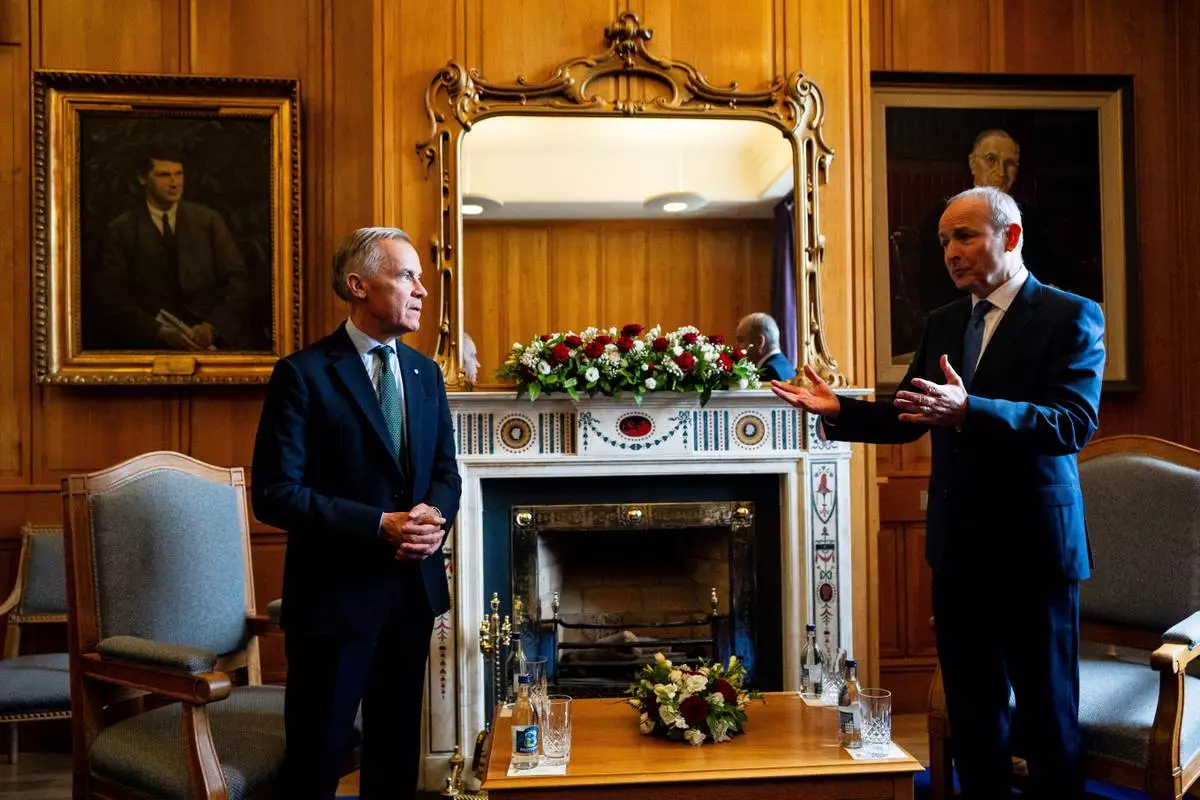
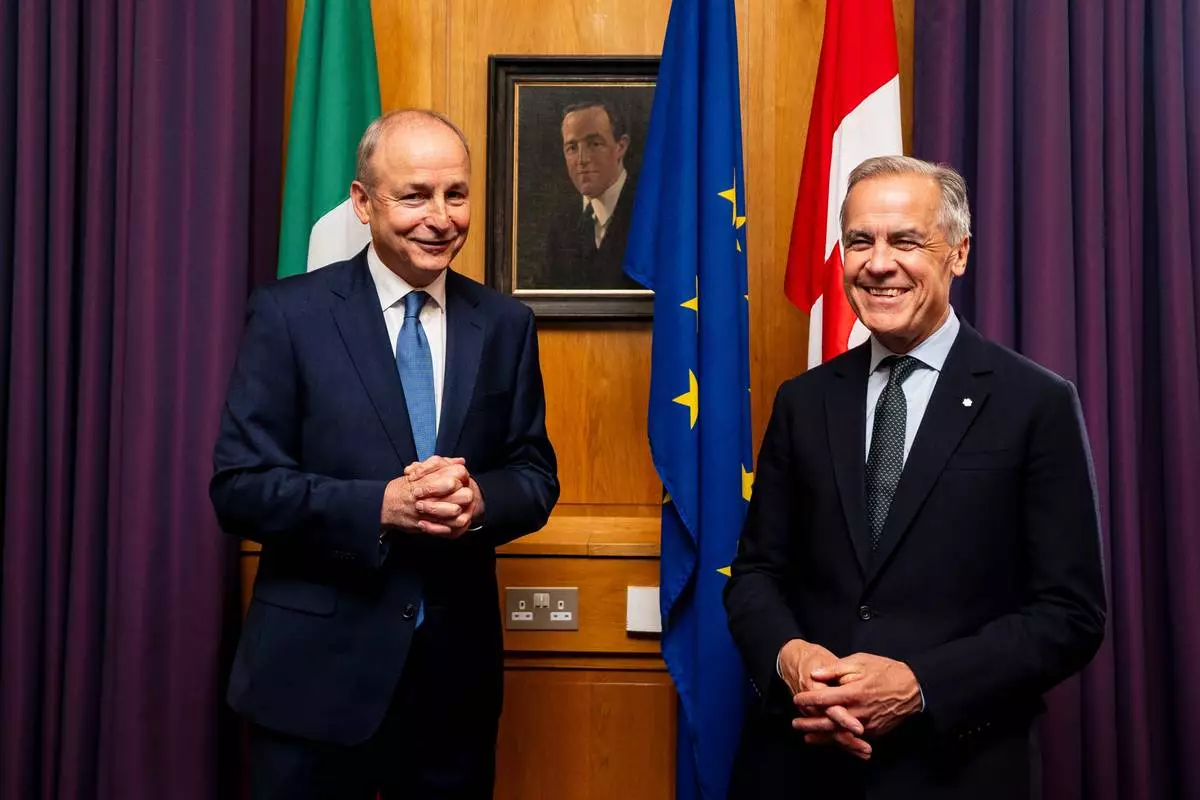
Prime Minister Mark Carney, right, poses for a photograph with Micheal Martin, Ireland's head of government, in front of a portrait of Harry Boland, at the Government Buildings in Dublin, on Saturday, June 13, 2026. (Christopher Katsarov /The Canadian Press via AP)

Prime Minister Mark Carney, right, poses for a photograph with Micheal Martin, Ireland's head of government, in front of a portrait of Harry Boland, at the Government Buildings in Dublin, on Saturday, June 13, 2026. (Christopher Katsarov /The Canadian Press via AP)

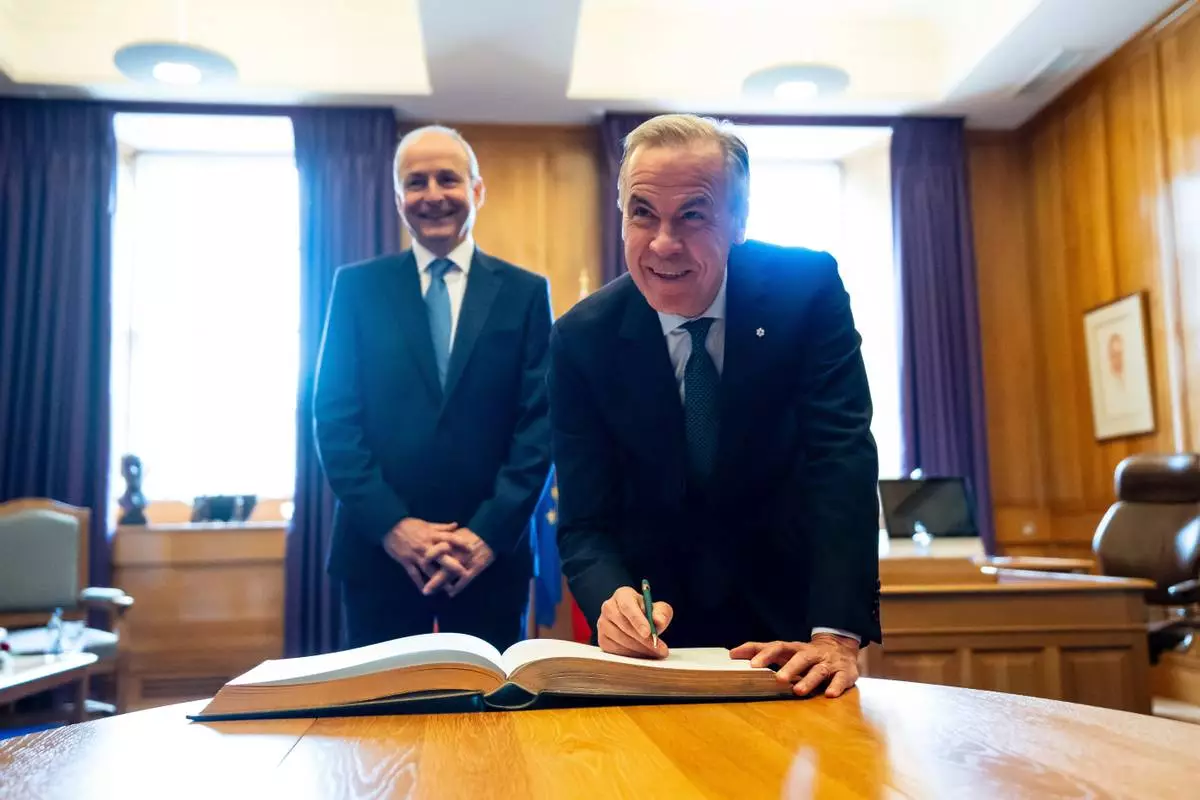
Prime Minister Mark Carney signs the Guest Book as Micheal Martin, Ireland's head of government looks on, at the Government Buildings in Dublin, on Saturday, June 13, 2026. (Christopher Katsarov /The Canadian Press via AP)

Prime Minister Mark Carney signs the Guest Book as Micheal Martin, Ireland's head of government looks on, at the Government Buildings in Dublin, on Saturday, June 13, 2026. (Christopher Katsarov /The Canadian Press via AP)

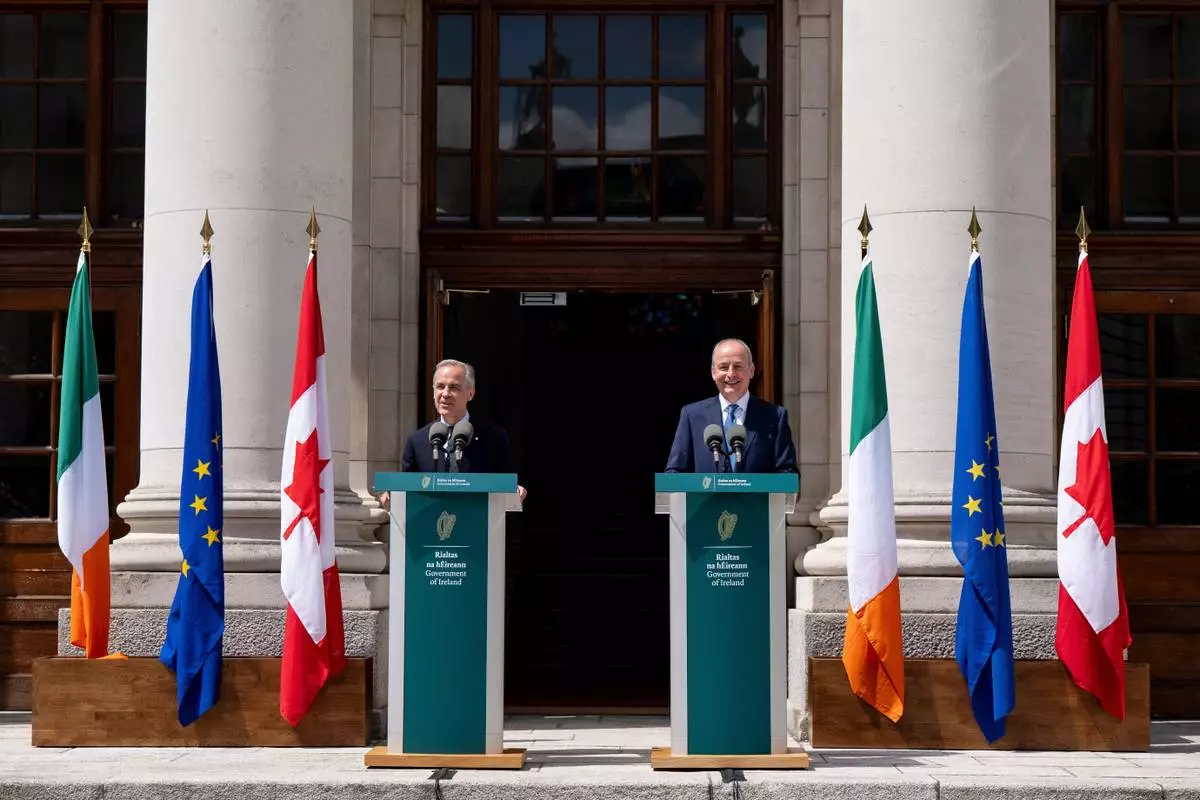
Prime Minister Mark Carney, left, gives remarks alongside Micheal Martin, Ireland's head of government, at the Government Buildings in Dublin, on Saturday, June 13, 2026. (Christopher Katsarov /The Canadian Press via AP)

Prime Minister Mark Carney, left, gives remarks alongside Micheal Martin, Ireland's head of government, at the Government Buildings in Dublin, on Saturday, June 13, 2026. (Christopher Katsarov /The Canadian Press via AP)

Prime Minister Mark Carney, left, speaks with Micheal Martin, Ireland's head of government, at the Government Buildings in Dublin, on Saturday, June 13, 2026. (Christopher Katsarov /The Canadian Press via AP)

Prime Minister Mark Carney, left, speaks with Micheal Martin, Ireland's head of government, at the Government Buildings in Dublin, on Saturday, June 13, 2026. (Christopher Katsarov /The Canadian Press via AP)

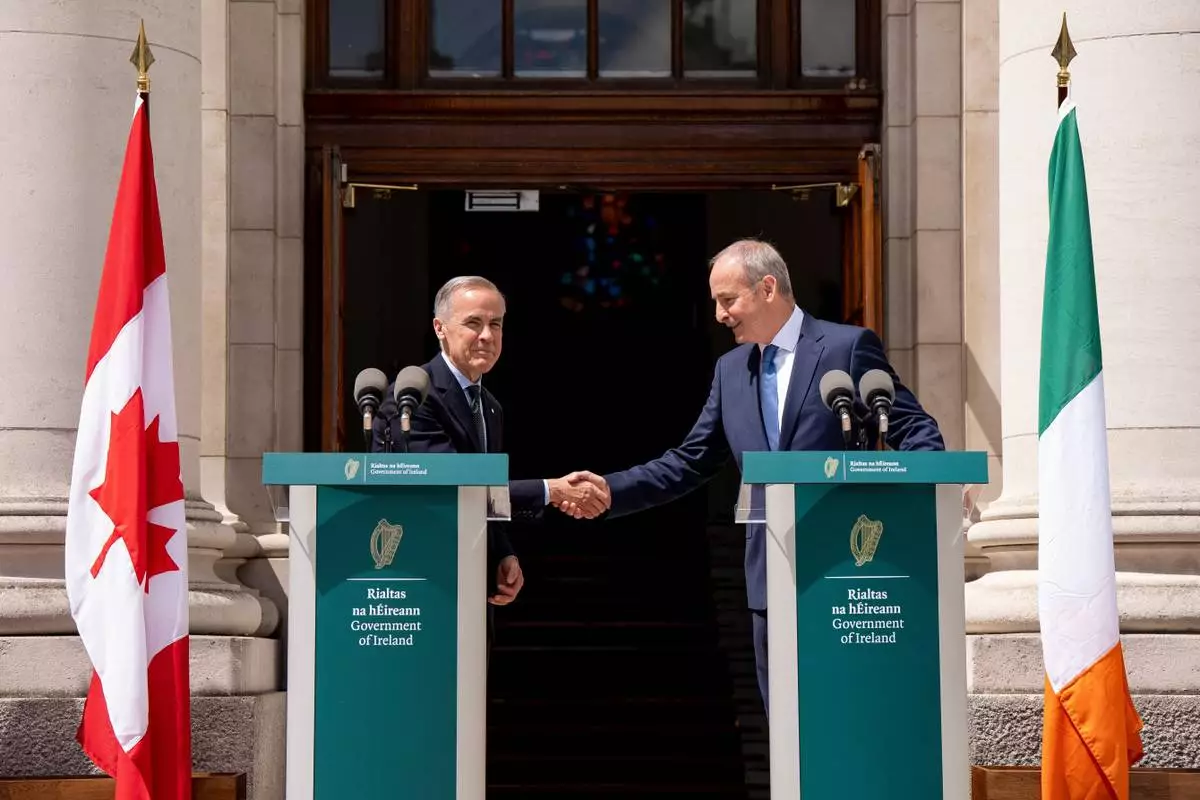
Prime Minister Mark Carney, left, shakes hands with Micheal Martin, Ireland's head of government, after giving remarks at the Government Buildings in Dublin, Ireland, on Saturday, June 13, 2026. (Christopher Katsarov /The Canadian Press via AP)

Prime Minister Mark Carney, left, shakes hands with Micheal Martin, Ireland's head of government, after giving remarks at the Government Buildings in Dublin, Ireland, on Saturday, June 13, 2026. (Christopher Katsarov /The Canadian Press via AP)

Recommended Articles