In Jiangsu, a key shipbuilding hub in eastern China, robust demand from shipbuilders is driving the expansion of high-end specialty steel and accelerating its localization, steadily strengthening domestic supply capabilities in the process.
At a major shipbuilder in Nantong City, several ship construction projects are proceeding at full speed.
"Our shipyard's orders are booked through 2030. We are shifting from building traditional bulk carriers to very large crude carriers (VLCCs) and 22,000-TEU container ships," said Wei Jun, deputy general manager of the shipbuilder.
Running at full capacity and approaching production limits, the company has seen a sharp rise in steel consumption. Orders at nearby supporting steel mills are fully booked, and certain high-grade steel plates are now in short supply.
"The group consumes about 800,000 tons of steel per year. As for the surrounding steel mills, their orders are already maxed out. The normal delivery period is about three months, but it has now been extended. It used to be around 75 days, but now it may reach about 90 days," Wei said.
According to Wei, as the shipyard has shifted toward high-tech vessels, ships are getting larger and more complex. Steel requirements now go beyond thickness and weight, driving a surge in demand for high-end specialty steel.
For large container ships, the torsion box, which is a key structural component, requires high-strength crack-arresting steel. On a 22,000-TEU container ship, such specialty steel accounts for approximately 5 percent of the total steel used, costing 800 to 1,000 yuan more per ton than ordinary marine steel.
Five years ago, this specialty steel was largely imported. Today, it is 100 percent domestically produced and 15 to 20 percent cheaper than foreign equivalents.
Li Yong, deputy general manager of another large container shipbuilder in Nantong, said their orders have been booked through 2030. In its digital stacking yard, various specialty steel plates are neatly arranged, each with a unique ID. These customized plates are precisely cut and welded in an intelligent workshop before being assembled into large vessels.
"A ship like this consumes more than 50,000 tons of steel. With the block construction method, steel plates are first cut into blocks, each about 20 meters long, and the final error is only a few millimeters," Li said.
Li gave the example of a newly completed large container ship nearly 400 meters in length. The vessel consumed 1,303 tons of crack-arresting steel, a material that had long relied on imports.
The shipyard has been partnering with domestic steel mills on joint research and development since 2005, gradually increasing the localization rate of marine steel plates. By the end of last year, cumulative domestic steel supplies had exceeded 2.5 million tons.
"After 20 years of joint research and development, the localization rate of high-strength marine steel plates has increased from 10 percent to 70 percent, and our production capacity is expected to grow by more than 20 percent over the next [five] years," Lu Ting, another deputy general manager of the large container shipbuilder.
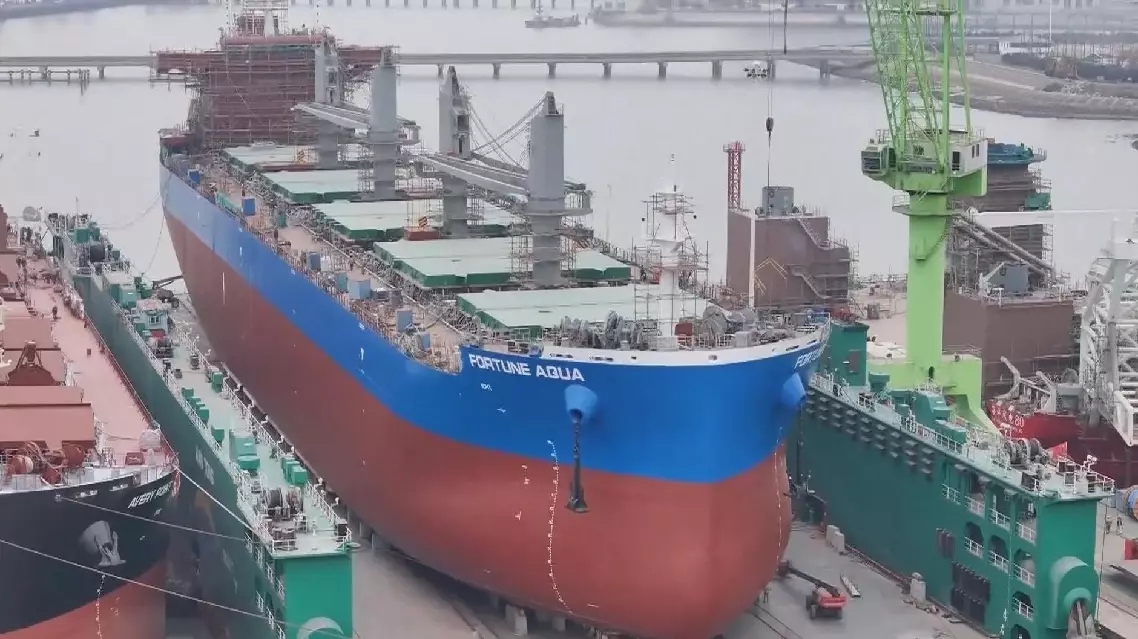
Robust ship demand in China's Jiangsu fuels domestic high-end steel growth