Skip to Content Facebook Feature Image

Implementation of Regulatory Enhancements for Mediation Profession to Solidify HK's Status as Capital of Mediation

HK

Implementation of Regulatory Enhancements for Mediation Profession to Solidify HK's Status as Capital of Mediation
HK

HK

Implementation of Regulatory Enhancements for Mediation Profession to Solidify HK's Status as Capital of Mediation

2026-06-16 11:00 Last Updated At:12:28

Implementation of regulatory enhancements for mediation profession to solidify HK's status as capital of mediation

The Department of Justice (DoJ) announced today (June 16) that its Working Group on Mediation Regulatory System has completed its review of Hong Kong's mediation regulatory system and made seven recommendations to enhance the relevant regulatory system, strengthening the professionalism and competitiveness of Hong Kong's mediation services. The DoJ welcomed and accepted the recommendations made by the Working Group. It will actively take forward the implementation of the recommendations to solidify Hong Kong's status as the capital of mediation.

Established by the DoJ in October 2024 in line with the Chief Executive's Policy Address initiative to strengthen the regulatory system governing the accreditation and disciplinary matters of the mediation profession, the Working Group was tasked with reviewing and making recommendations to enhance the existing framework.

The Working Group completed a comprehensive review in late 2024 and, following a stakeholder consultation conducted in 2025, finalised seven recommendations, which are summarised as follows:

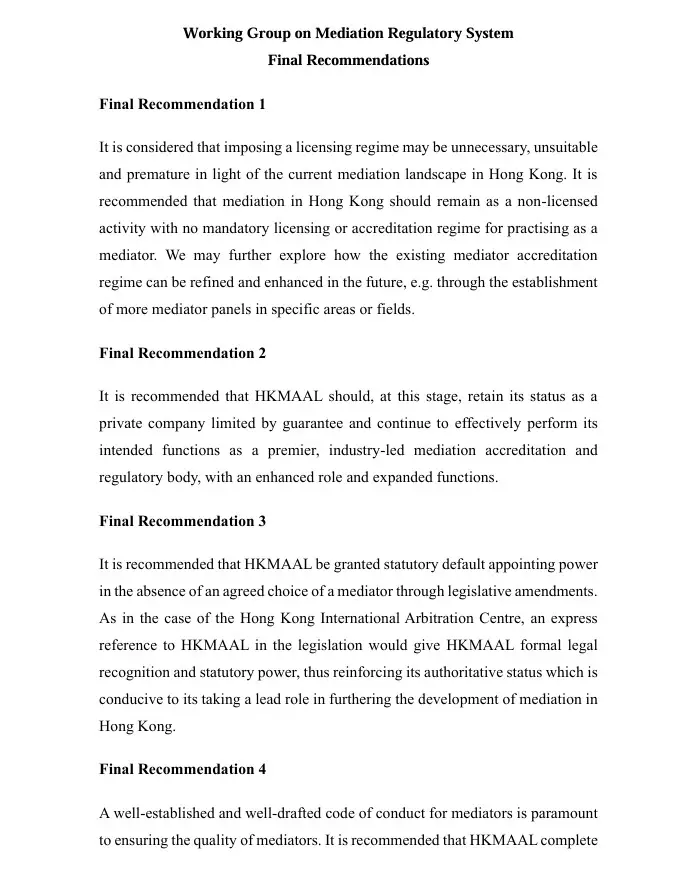
(1) Mediation in Hong Kong should remain as a non-licensed activity with no mandatory licensing or accreditation regime for practising as a mediator.

(2) The Hong Kong Mediation Accreditation Association Limited (HKMAAL) should remain as a private company limited by guarantee to perform its role as an industry-led mediation accreditation and regulatory body, with an enhanced role and expanded functions.

(3) The HKMAAL should be granted statutory mediator-appointing power in the absence of an agreed choice by the parties through legislative amendments.

(4) The HKMAAL should complete the review of the Hong Kong Mediation Code (Mediation Code) and going forward, take ownership and responsibility of reviewing, managing and administering the Mediation Code to provide a consistent professional standard.

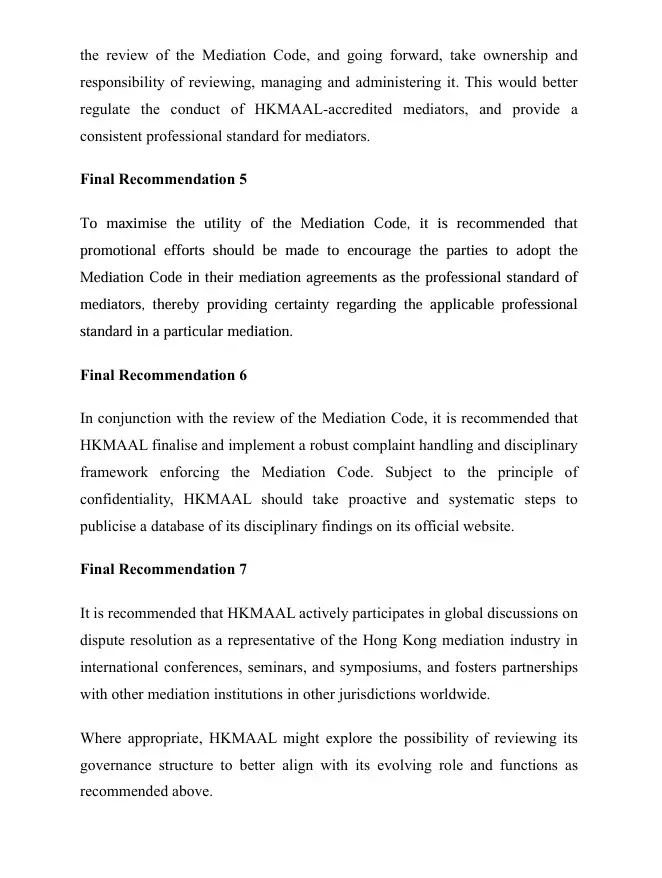
(5) Promotional efforts should be made to encourage parties to adopt the Mediation Code.

(6) The HKMAAL should finalise and implement a robust complaint-handling and disciplinary framework to enforce the Mediation Code, and should take steps to publicise a database of its disciplinary findings on its website.

(7) The HKMAAL should actively participate in global discussions on dispute resolution as a representative of the Hong Kong mediation industry and foster partnerships with mediation institutions worldwide.

The full version of the final recommendations is attached in the Annex.
Source: HKSAR Government Press Releases
Source: HKSAR Government Press Releases

Source: HKSAR Government Press Releases

Source: HKSAR Government Press Releases

The DoJ puts forth that the recommendation by the Working Group of maintaining mediation in Hong Kong as a non-licensed activity will preserve the process as a voluntary and flexible dispute resolution mechanism and promote the use of mediation skills in the public's daily lives. At the same time, strengthening the HKMAAL's role as a premier, industry-led mediation accreditation and regulatory body will ensure that Hong Kong's mediation regulatory system remains robust, credible, and well-positioned for the future development of the sector.

The DoJ and the HKMAAL have been taking active steps to deepen the mediation culture in Hong Kong. Significant progress has been made for some of the Working Group's recommendations.

Pursuant to Recommendation 3 of the Working Group, the DoJ is taking forward the necessary legislative amendment work to confer statutory mediator-appointing power upon the HKMAAL to promote the advancement of mediation. The DoJ will commence a stakeholder consultation on the key provisions of the draft amendment bill today. After considering the views of stakeholders, the DoJ aims to introduce the amendment bill into the Legislative Council in the second half of 2026.

Regarding Recommendations 4 and 5, the HKMAAL has completed its review of the Mediation Code and published an updated version of the Mediation Code in April 2026. The updated version addresses recent developments in mediation practices and technological advancements, while enhancing the professional standards for mediators. In parallel, the HKMAAL has updated its sample agreement to mediate for voluntary adoption by parties and mediators, further maximising the utility of the Mediation Code.

Looking ahead, the HKMAAL will review its complaint-handling and disciplinary framework to strengthen the enforcement of the Mediation Code. With due regard to the principle of confidentiality, it will also explore publishing disciplinary findings on its website to enhance transparency and public confidence in mediation. Furthermore, the HKMAAL will actively engage in global discussions on dispute resolution to promote Hong Kong mediation industry internationally.

On the policy front, the Government has, as a matter of general policy, incorporated a mediation clause in all applicable government contracts since February 6, 2025. The DoJ has been tracking the implementation of the policy across all government departments since it took effect. As reflected in the latest statistics, over 95 per cent of government contracts falling within the scope of the policy have incorporated mediation clauses in line with the policy, demonstrating that the Government is committed to promoting "mediate first" in dispute resolution by taking the lead.

The DoJ remains committed to developing a world-class mediation framework in Hong Kong.

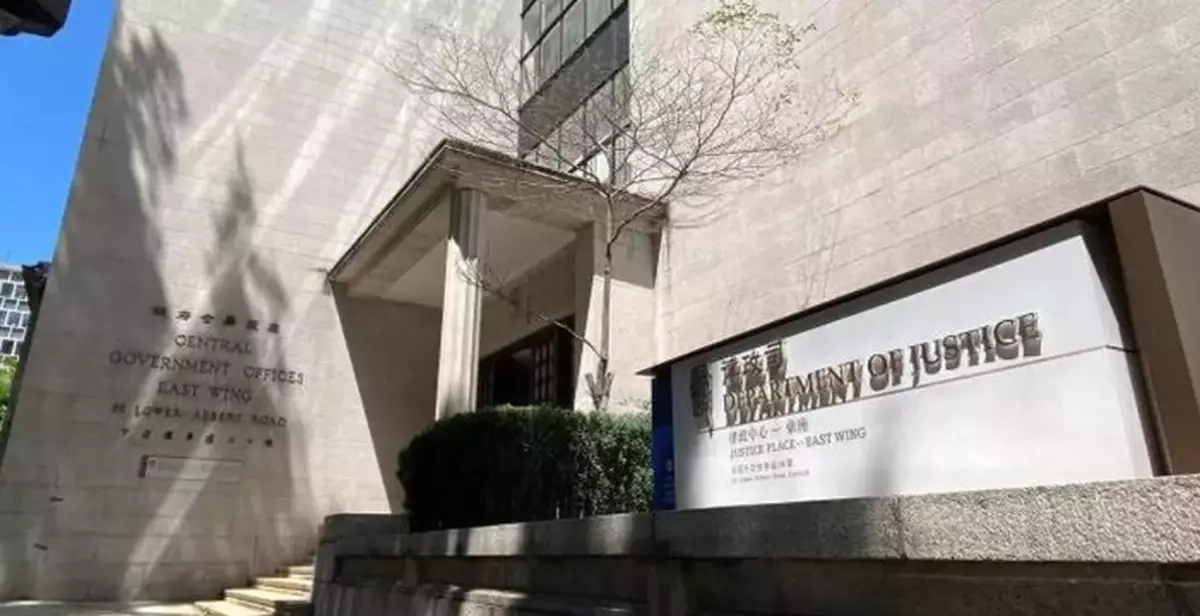
The Department of Justice, Photo source: reference image


The Department of Justice, Photo source: reference image

Speech by SJ at PCPD 30th Anniversary Privacy Protection Summit

Following is the speech by the Secretary for Justice, Mr Paul Lam, SC, at the PCPD 30th Anniversary Privacy Protection Summit today (June 16):

Commissioner Chung (Privacy Commissioner for Personal Data, Ms Ada Chung), Deputy Commissioner Li of the OCMFA (Deputy Commissioner of the Office of the Commissioner of the Ministry of Foreign Affairs of the People's Republic of China in the Hong Kong Special Administrative Region (HKSAR) Mr Li Yongsheng), Director Liu of the LOCPG (Director-General of the Department of Law of the Liaison Office of the Central People's Government in the HKSAR, Mr Liu Chunhua), distinguished guests, ladies and gentlemen,

A very good morning. It is my great pleasure to join you today for the Office of the Privacy Commissioner for Personal Data(PCPD)'s 30th Anniversary Privacy Protection Summit.

The Summit, an open session of the 65th Asia Pacific Privacy Authorities Forum, brings together some 400 privacy regulators, data-protection experts, industry leaders and academics from Hong Kong, the Chinese Mainland and the Asia-Pacific region. You're here to share perspectives on privacy protection, at a time when digital transformation and artificial intelligence are reshaping societies and economies around the world.

Hong Kong, a key regional hub for the free and orderly flow of information, data, and technology, has a long tradition of rigorously upholding privacy standards.

The Office of the Privacy Commissioner for Personal Data was established in 1996 as an independent privacy authority - the earliest of its kind in Asia. Over the past three decades, it has served as a steadfast guardian of personal data privacy. Through concerted enforcement and practical compliance guidance, it has created a privacy-conscious culture in Hong Kong.

Today, in the dawning of the age of artificial intelligence, we continue to ensure that AI is, as mentioned in the Chief Executive's latest Policy Address, "steered by safety and driven by application."

The Hong Kong Artificial Intelligence Research and Development Institute, which comes into full operation later this year, will drive our innovative AI research and development, as well as its industrial applications.

No less important, it will establish AI standards, building cross-sector and inter-regional AI collaboration platforms to promote AI's standardisation and safe application. The HKSAR Government is, in short, determined to promote the safe and ethical use of AI.

And, as Ada just mentioned, the Hong Kong International Data Privacy Academy officially opens today. The Academy will provide data protection training programmes for organisations, privacy-protection practitioners and others in Hong Kong, the Chinese Mainland and around the world.

The National 15th Five-Year Plan puts a central priority on accelerating innovation. Its Digital China Initiative is designed to empower economic and social progress through digital and intelligent technologies and the expansion of AI+ applications.

But the Plan is also committed to combating data misuse, deep fakes and privacy leaks. It emphasises the importance of privacy protection and cross-border law enforcement co-operation.

As announced by the Chief Executive recently, Hong Kong will unveil its First Five-Year Plan later this year. It will align with the National 15th Five-Year Plan, driving Hong Kong's deeper integration into the overall national development.

The theme of this Summit, "Protecting Privacy, Embracing Innovation", smartly captures the vision and goals of the HKSAR Government and our country. Hong Kong is fast emerging as a smart city, powered by emerging technologies, AI very much included.

Over the years, the Office of the Privacy Commissioner for Personal Data has performed not only as a regulator, but also as an enabler of responsible innovation.

Public confidence in the privacy and security of new technologies is crucial to their adoption. And the work of the Office is pivotal in instilling public confidence that technology can - and must - be used in an ethical and meaningful way.

The HKSAR Government is committed to supporting the Office as Hong Kong's trusted privacy regulator, and to ensuring it has all the necessary means to rise above the globalised reality of privacy threats.

Of course, no jurisdiction can tackle these challenges alone. Collaboration is essential. It's through events such as this Summit, and the Asia Pacific Privacy Authorities Forum which it is part of, that partnerships are created, best practices exchanged, and emerging trends in privacy regulation addressed.

Ladies and gentlemen, I wish you all a very rewarding Summit and a productive Forum.

And my congratulations, once again, to the Office of the Privacy Commissioner for Personal Data, on its landmark 30th anniversary.

Thank you very much.

Source: AI-found images

Source: AI-found images

Recommended Articles