The 2026 European International Defence and Security Exhibition kicked off in Paris on Monday, showcasing the latest advancements in smart armored vehicles and systematic drone solutions amid rising global security threats.
As a biennial international arms trade fair held at the Paris-Nord Villepinte Exhibition Center, this year's event runs through June 19 and has attracted more than 2,600 exhibitors from 68 countries and regions, bringing together leading defense industry players worldwide.
At the armored vehicle zone, the new-generation main battle tank developed by European defense firm KNDS took center stage. The platform integrates drones and artificial intelligence systems to enable rapid target identification and locking.
Christophe Hesse, director of the Main Battle Tanks Turrets Division at KNDS, noted that for defense manufacturers, this continuous technological upgrade is not just an option, but a necessity driven by the ever-changing nature of modern combat.
"Currently every day there are changes and more threats on the battlefield and therefore also the tank development will not end here and will go on in the future," he said.
Beyond traditional armor, the exhibition also highlighted a major shift in unmanned aerial technology. As drones become increasingly ubiquitous on modern battlefields, defense contractors are no longer just competing on manufacturing individual units. Instead, the focus has shifted to providing comprehensive system solutions, ranging from combat-capable strike and defense drones to training platforms designed to boost operational readiness.

2026 Eurosatory opens in Paris
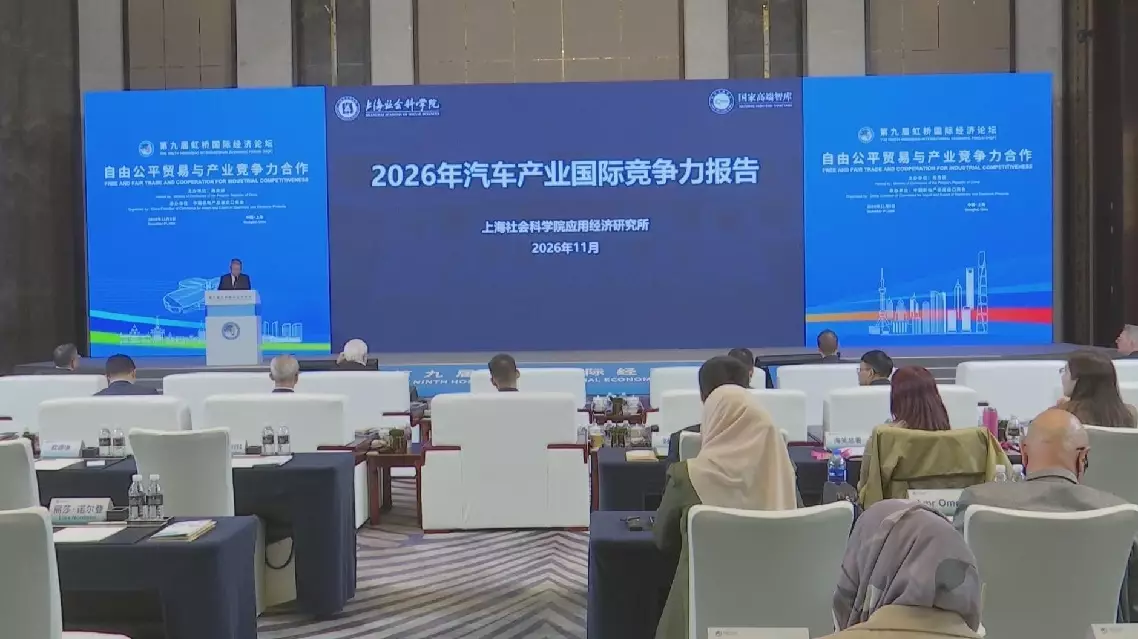
Competition in the global automotive industry has shifted from a contest of scale to a multi-dimensional coordination of capabilities, a new report released at the ninth Hongqiao International Economic Forum said on Thursday, which called for a more collaborative global industry ecosystem. Titled "Global Automotive Competitiveness Report 2026," the study was unveiled at the parallel session "Free and Fair Trade and Industrial Competitiveness Cooperation" of the Hongqiao Forum, held as part of the ninth China International Import Expo (CIIE).
The report constructs an evaluation framework for the international competitiveness of the automotive industry consisting of five dimensions -- industrial foundation, technological innovation, market competitiveness, global resource allocation, and environmental support -- and 29 indicators. Based on calculations and comparisons across 41 major countries worldwide, the report concludes that global automotive competition has evolved from a scale-based competition to a multi-dimensional coordination of capabilities. It calls for efforts to foster a new global automotive industry ecosystem featuring more coordinated supply chains, more inclusive technology, more open trade, more mutually beneficial investment, and more synergistic governance.
"The automotive industry has evolved from traditional fuel vehicles to new energy vehicles and now to intelligent connected vehicles, and its entire competitive logic is undergoing fundamental changes. The previous set of evaluation and analysis indicators, characterized by scale and output value, can hardly adapt to or explain the new competitiveness. The iteration and upgrading of the automotive industry, including the opening of new market space, require better coordination and cooperation," said Tang Yunyi, deputy director of the Institute of Applied Economics of the Shanghai Academy of Social Sciences.
The idea that global auto competition is now a contest of coordinated capabilities rather than sheer scale is finding an echo among the automakers that have built their China businesses on competition and cooperation alike.
For companies like Mercedes-Benz, which has spent decades manufacturing and selling in the world's largest car market, the report's core argument that lasting advantage lies in coordination mirrors a conviction already embedded in its own approach to the country.
"I believe, as a German company, in this true collaboration driving long-term value creation. And it is based on rules, fair competition, and therefore, we are very much looking forward to the next chapter here in China," said Oliver Thone, a board member of Mercedes-Benz Group AG.
The ninth Hongqiao International Economic Forum, running at the National Exhibition and Convention Center under the theme "Stability and Cooperation: Building an Open World Economy Together," brings together business leaders and representatives from around the world to explore paths to a more open global economy, alongside a series of parallel sessions and report releases.
The forum is running alongside the ninth China International Import Expo (CIIE), which opened in Shanghai the same day, drawing more than 4,100 overseas exhibitors from 148 countries and regions. First held in 2018 as the world's first national-level expo dedicated to imports, the CIIE has since evolved into a vital gateway for foreign businesses seeking access to China's vast consumer and industrial markets.
Shanghai forum unveils new framework for global auto industry competitiveness