WHO holds expert meeting on International Herbal Pharmacopoeia in Hong Kong, China
The World Health Organization (WHO) today (June 16) convened the fifth WHO Expert Meeting on the Development of the International Herbal Pharmacopoeia (IHP) in Hong Kong, China, for three days. The meeting brings together experts from six WHO regions to discuss and advance internationally harmonised quality standards for selected herbal medicines.
The Chinese Medicine Regulatory Office of the Department of Health (DH), as the WHO Collaborating Centre for Traditional Medicine (WHOCC), is supporting the WHO in organising the meeting, taking part in drafting selected herbal medicine monographs and contributing to related technical work.
The WHO recognises the important role of traditional medicine in healthcare systems worldwide and the need for its evidence-based integration. The development of the IHP aims to support harmonised quality standards for herbal medicines, strengthen regulatory capacity and help ensure the quality and safety of traditional medicine products. This work aligns with Strategic Objective 2 of the WHO Global Traditional Medicine Strategy 2025-2034, which was endorsed by the World Health Assembly in 2025.
The Unit Head, Traditional Medicine Norms, Standards and Systems Integration Unit, Global Traditional Medicine Centre of the WHO, Dr Kim Sungchol, delivered opening remarks. He expressed the WHO's appreciation to the Hong Kong Special Administrative Region (HKSAR) Government for its support for the meeting, and to the WHOCC for its close collaboration. He also acknowledged the important contributions of collaborating technical teams to the development of the IHP.
The Director of Health, Dr Ronald Lam, said, "The HKSAR was honoured to support the WHO's important work in developing the IHP. To align with the National 15th Five-Year Plan to advance the inheritance, innovation and high-quality development of Chinese medicine, expand and strengthen the Chinese medicine industry and promote Chinese medicine culture, the DH will continue to steadfastly promote the development of Chinese medicine and better integrate into and serve the overall national development. The DH will fully leverage the HKSAR's expertise in developing herbal medicine standards, testing and quality control. We will work closely with the WHO and international experts to contribute to the standardisation, safety and quality of traditional herbal medicines, thereby safeguarding the health and well-being of humanity."
Dr Lam also briefed participants on Hong Kong's work in developing safety and quality standards for Chinese medicines, telling good stories of Hong Kong.
Dr Lam said, "The DH has developed the Hong Kong Chinese Materia Medica Standards since 2002, with 12 volumes published covering standards for 357 Chinese Materia Medica. The project has gained international recognition, with its scientific findings cited by overseas authorities and international journals. The Government Chinese Medicines Testing Institute under the DH, which is equipped with advanced technology and equipment, will continue to develop Chinese Medicine testing methods and standard development capabilities and promote high-quality development of Chinese medicine in the HKSAR. Leveraging the HKSAR's unique advantages under 'one country, two systems', with strong support of the motherland and close connections with the world, Hong Kong will continue to contribute to the wider global dissemination of Chinese medicine and establish the HKSAR as a bridgehead for Chinese Medicine to go global."
The HKSAR has continued to support the WHO's work on the development of the IHP. Following the WHO meeting organised with the support of the DH in Hong Kong, China, in November 2024 to discuss the roadmap and working mechanism for the development of the IHP, this meeting marks another important occasion on which the HKSAR supports the WHO in advancing this important international initiative.
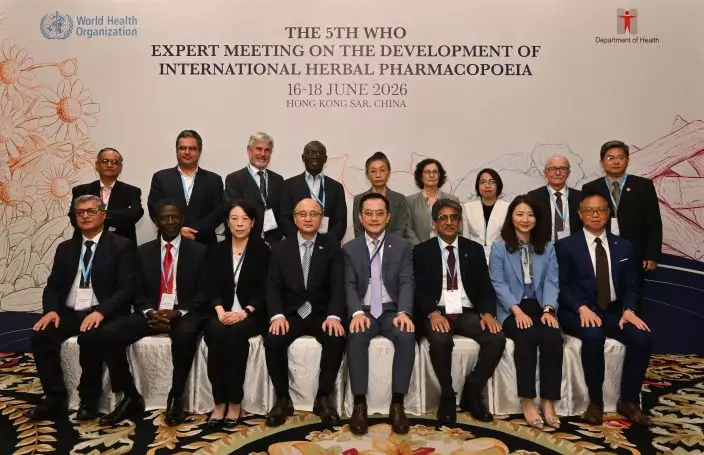
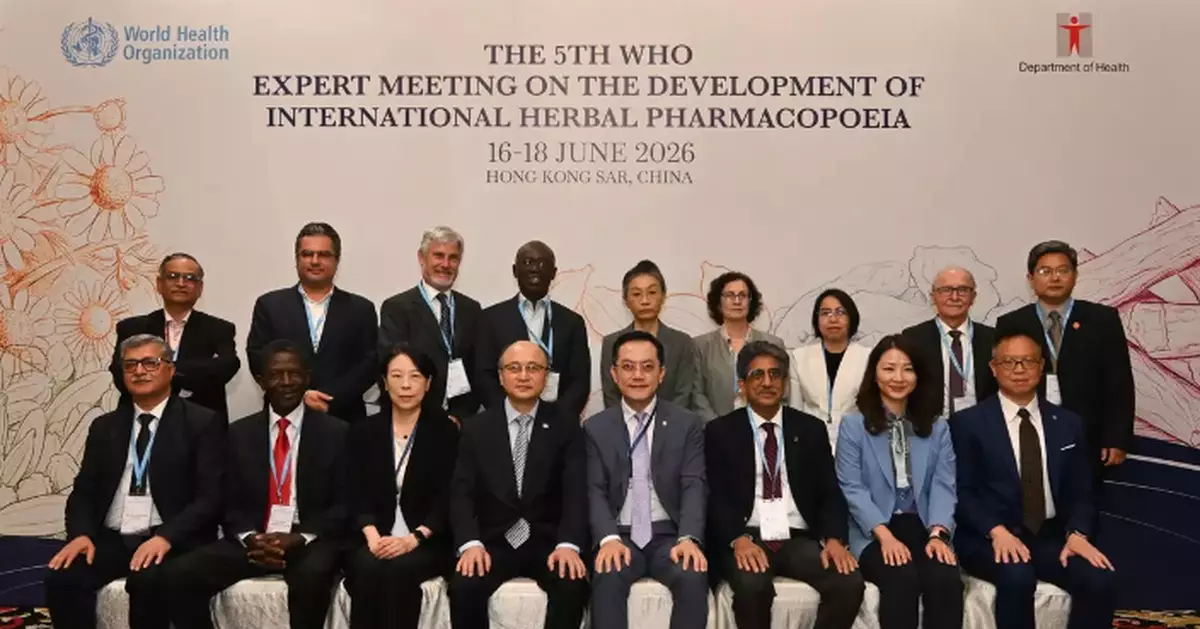
The World Health Organization (WHO) today (June 16) convened the fifth WHO Expert Meeting on the Development of the International Herbal Pharmacopoeia in Hong Kong, China, for three days. The meeting brings together experts from six WHO regions to discuss and advance internationally harmonised quality standards for selected herbal medicines. Photo shows the Director of Health, Dr Ronald Lam (front row, fourth right); the Unit Head, Traditional Medicine Norms, Standards and Systems Integration Unit, Global Traditional Medicine Centre of the WHO, Dr Kim Sungchol (front row, fourth left); the Controller of Regulatory Affairs of the Department of Health, Dr Fung Ying (front row, third left), and other participants. Source: HKSAR Government Press Releases
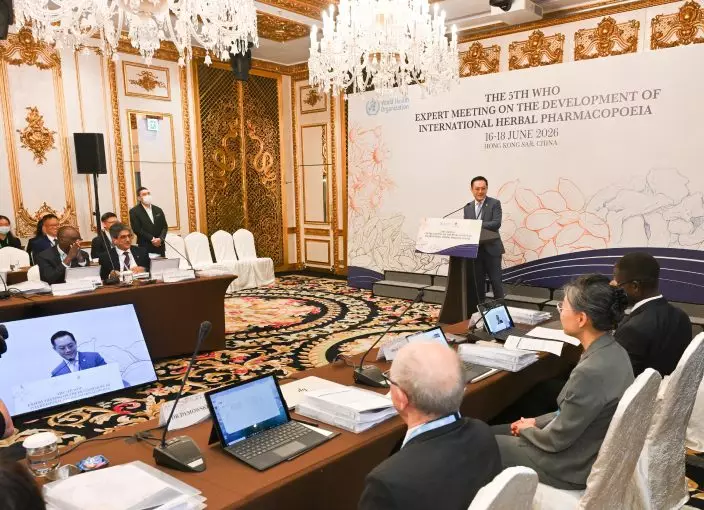
The World Health Organization (WHO) today (June 16) convened the fifth WHO Expert Meeting on the Development of the International Herbal Pharmacopoeia in Hong Kong, China, for three days. The meeting brings together experts from six WHO regions to discuss and advance internationally harmonised quality standards for selected herbal medicines. Photo shows the Director of Health, Dr Ronald Lam, addressing the meeting. Source: HKSAR Government Press Releases
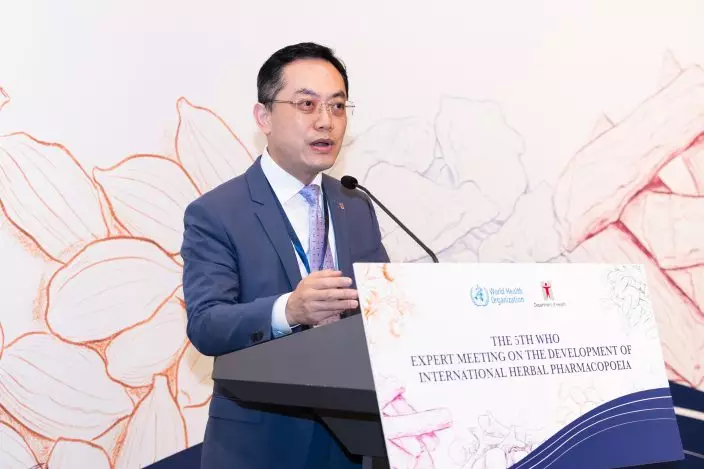
The World Health Organization (WHO) today (June 16) convened the fifth WHO Expert Meeting on the Development of the International Herbal Pharmacopoeia in Hong Kong, China, for three days. The meeting brings together experts from six WHO regions to discuss and advance internationally harmonised quality standards for selected herbal medicines. Photo shows the Director of Health, Dr Ronald Lam, addressing the meeting. Source: HKSAR Government Press Releases
Speech by PSITI at Second Global Innovation Show and Global Innovation Summit - Hong Kong
Following is the speech by the Permanent Secretary for Innovation, Technology and Industry, Mr Kevin Choi, at the Second Global Innovation Show and Global Innovation Summit - Hong Kong today (August 25):
Distinguished guests, ladies and gentlemen,
Good morning. It is my great pleasure to join you today at the 2nd Global Innovation Show and Global Innovation Summit (GIS) - Hong Kong. I would like to thank the organisers for bringing together innovation leaders, industry experts and entrepreneurs from the Chinese Mainland, Hong Kong and around the world to exchange insights and explore new opportunities for collaboration.
Based in Hong Kong, drawing upon the strengths of our country and engaging with the world, GIS brings together innovation resources from different places and strengthens connections among the cities of the Guangdong-Hong Kong-Macao Greater Bay Area (GBA). By bringing together the respective strengths of different places in technology, capital and markets, GIS provides a valuable platform for technological innovation and industry collaboration. This aligns well with Hong Kong's role as a bridge connecting the Chinese Mainland and the world, and our development into an international innovation and technology (I&T) centre.
This year marks the beginning of the National 15th Five-Year Plan period. The Plan reaffirms support for Hong Kong's development into an international I&T centre, while placing strong emphasis on technological innovation, industrial innovation and the development of new quality productive forces. Against this backdrop, the Hong Kong Special Administrative Region (HKSAR) Government is pressing ahead with new industrialisation, fostering strategic emerging and future industries while supporting the transformation and upgrading of traditional industries. Our strategic focus includes life and health technologies, artificial intelligence (AI) and robotics, as well as advanced manufacturing and new energy. By promoting the integration of technological and industrial innovation, we seek to accelerate the commercialisation of research and development (R&D) outcomes and develop new engines for Hong Kong's high-quality economic growth.
Our efforts are bearing fruit. Manufacturing and new industrialisation-related industries accounted for 3.8 per cent of Hong Kong's Gross Domestic Product in 2024. This reflects that the Government's new industrialisation initiatives are playing an increasingly important and positive role in promoting economic diversification and enhancing Hong Kong's overall competitiveness. We are also formulating Hong Kong's medium to long-term development plan of new industrialisation, taking into account the National 15th Five-Year Plan, opportunities for industrial synergy in the GBA, as well as Hong Kong's own industrial foundation and advantages.
To provide fertile soil for our I&T development, we are building a comprehensive I&T ecosystem anchored by three major I&T Parks and five key R&D institutions. In particular, the Loop Hong Kong Park is an important platform for I&T collaboration in the GBA and is envisioned to develop into a world-class innovation platform connecting international companies with the Chinese Mainland. As at July 2026, the Loop Hong Kong Park has already attracted over 100 technology enterprises and institutions to sign tenancy agreements, with its first two completed wet laboratory buildings leasing all available floor area. The adjacent San Tin Technopole will serve as a natural extension of the Loop Hong Kong Park, providing a large piece of land that can help accelerate the commercialisation of R&D results by providing industrial space for prototyping, pilot and mass production.
We are also providing targeted support to accelerate technology commercialisation and industrial development. The $10 billion New Industrialisation Acceleration Scheme provides matching funds for enterprises in designated industries to set up new smart production facilities in Hong Kong, while the $10 billion Innovation and Technology Industry-Oriented Fund channels market capital to invest in emerging and future industries of strategic importance. Earlier this year, we also launched the New Industrialisation Elite Enterprises Nurturing Scheme, focusing on supporting high-growth enterprises that contribute to the development of new industrialisation in Hong Kong, with the goal of nurturing emerging and future industry enterprises.
At the same time, we are deepening I&T and industrial collaboration within the GBA. Under "one country, two systems", Hong Kong is proactively integrating into and serving the overall national development, while giving full play to our unique strengths as an international city. By leveraging Hong Kong's strengths in R&D and international connectivity, we can foster deeper integration of technological and industrial innovation and create greater opportunities for enterprises across the region. The Shenzhen-Hong Kong-Guangzhou innovation cluster ranked first globally in the Global Innovation Index 2025, demonstrating the strong innovation capabilities of the GBA.
We are continuing to deepen this collaboration. In September 2024, the HKSAR Government and the Ministry of Industry and Information Technology (MIIT) signed the Co-operation Agreement on the Development of New Quality Productive Forces and the Promotion of New Industrialisation, supporting Hong Kong in developing new quality productive forces and promoting new industrialisation according to local conditions, while strengthening exchanges and promoting co-operation in industries where both sides have clear advantages.
Building on this foundation, our co-operation took another important step forward last month, when the HKSAR Government and MIIT signed the Co-operation Agreement on Advancing the Joint Establishment of Manufacturing Innovation Centre by the Ministry and Hong Kong. As announced in this year's Budget, it has been proposed to reserve funding to establish in Hong Kong the first national manufacturing innovation centre. Focusing on next-generation power semiconductor technologies, the Hong Kong Microelectronics Research and Development Institute will undertake the important task of taking the lead to operate the innovation centre.
For enterprises, these developments open up new opportunities to leverage the complementary strengths of Hong Kong and the GBA. Hong Kong can serve as a "super connector" and "super value-adder", helping Chinese Mainland enterprises connect with international innovation resources while providing overseas enterprises with a gateway to the GBA and the broader Chinese Mainland market. In this way, we can better leverage Hong Kong's strengths to serve our country's needs, while creating new room for development for enterprises in Hong Kong and beyond.
Looking ahead, the HKSAR Government will continue to strengthen our I&T ecosystem, advance new industrialisation and deepen synergy with our partners in the GBA. We welcome I&T enterprises and innovation partners from the Chinese Mainland and around the world to leverage Hong Kong's unique advantages, tap into the opportunities of the GBA and grow with our expanding I&T ecosystem.
By working together and leveraging our complementary strengths, we can contribute to developing the GBA into an international I&T hub with global influence and create new momentum for high-quality development. I wish GIS every success and all of you a rewarding and fruitful exchange. Thank you very much.

Source: AI-found images
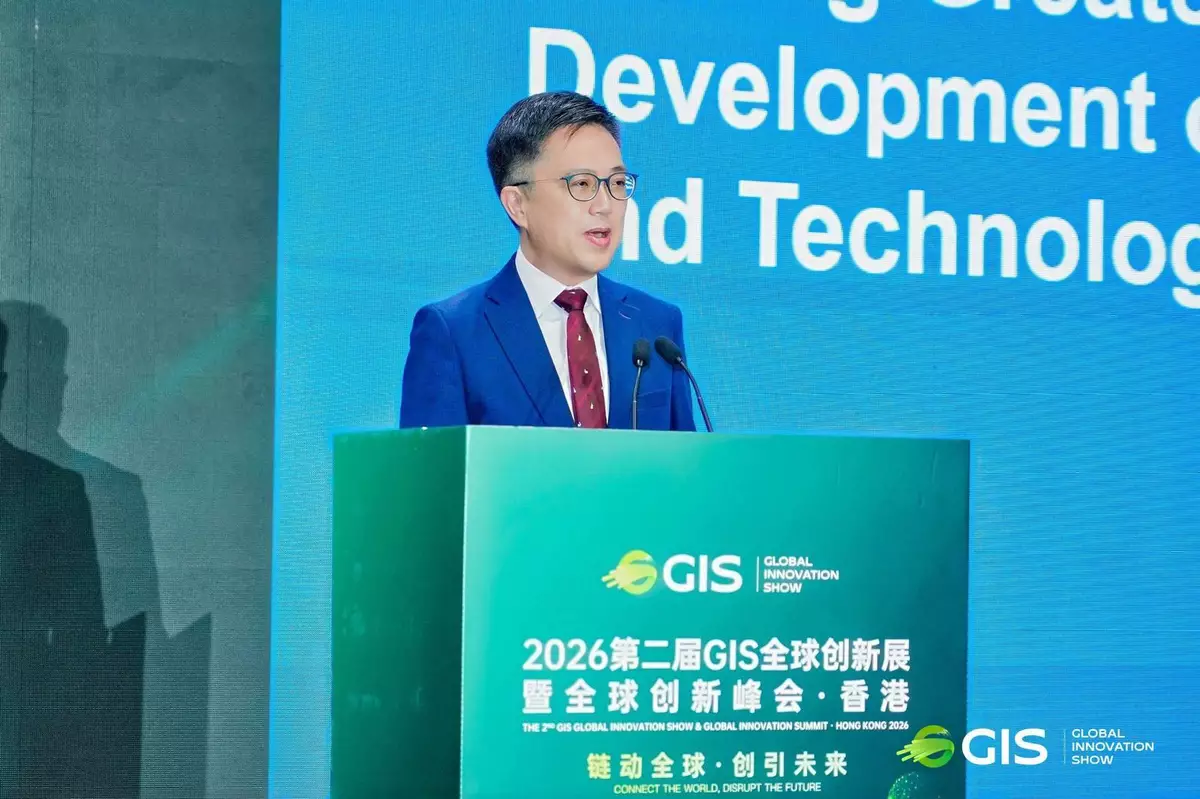
Speech by PSITI at Second Global Innovation Show and Global Innovation Summit - Hong Kong Source: HKSAR Government Press Releases
Source: AI-found images