Hong Kong's Gross National Income and external primary income flows for the first quarter of 2026
The Census and Statistics Department (C&SD) released today (June 16) the preliminary statistics on Hong Kong's Gross National Income (GNI) and related figures for the first quarter of 2026.
Hong Kong's GNI, which denotes the total income earned by Hong Kong residents from engaging in various economic activities, increased by 5.1% in the first quarter of 2026 over a year earlier to $925.7 billion at current market prices. The Gross Domestic Product (GDP), estimated at $843.9 billion at current market prices in the same quarter, recorded a 5.3% increase over a year earlier. The value of GNI was larger than GDP by $81.8 billion in the first quarter of 2026, which was equivalent to 9.7% of GDP in that quarter, mainly attributable to a net inflow of investment income.
After netting out the effect of price changes over the same period, Hong Kong's GNI increased by 3.9% in real terms in the first quarter of 2026 over a year earlier. The corresponding GDP in the same quarter increased by 5.9% in real terms.
Hong Kong's total inflow of primary income, which mainly comprises investment income, estimated at $529.6 billion in the first quarter of 2026 and equivalent to 62.8% of GDP in that quarter, recorded an increase of 1.6% over a year earlier. Meanwhile, total primary income outflow, estimated at $447.8 billion in the first quarter of 2026 and equivalent to 53.1% of GDP in that quarter, also increased by 1.4% over a year earlier.
As for the major components of investment income inflow, direct investment income (DII) increased by 2.8% over a year earlier, mainly due to the increase in earnings of some prominent local enterprises from their direct investment abroad. Portfolio investment income (PII) recorded an increase of 7.4% over a year earlier, mainly attributable to the increase in interest income received by resident investors from their holdings of non-resident debt securities.
Regarding the major components of investment income outflow, DII increased by 2.5% over a year earlier, mainly due to the increase in earnings of some prominent multinational enterprises from their direct investment in Hong Kong. PII increased significantly by 29.4%, mainly attributable to the increase in interest payout to non-resident investors from their holdings of resident debt securities.
Analysed by country/territory, Chinese Mainland continued to be the largest source of Hong Kong's total primary income inflow in the first quarter of 2026, accounting for 38.8%. This was followed by the British Virgin Islands (BVI), with a share of 16.0%. Regarding total primary income outflow, Chinese Mainland and the BVI remained the most important destinations in the first quarter of 2026, accounting for 30.1% and 20.6% respectively.
Further Information
GDP and GNI are closely related indicators for measuring economic performance. GDP is a measure of the total value of production of all resident producing units of an economy. GNI denotes the total income earned by residents of an economy from engaging in various economic activities, irrespective of whether the economic activities are carried out within the economic territory of the economy or outside.
Figures of GNI and primary income flows analysed by income component from the second quarter of 2024 to the first quarter of 2026 are presented in Table A, while selected major country/territory breakdowns of primary income inflow and outflow for the same quarters are presented in Tables B(1) and B(2) respectively.
Statistics on GDP and GNI from 2024 onwards and primary income flows from 2025 onwards are subject to revision when more data are incorporated.
More detailed statistics are given in the report "Gross National Income and External Primary Income Flows, First Quarter 2026". Users can browse and download this publication at the website of the C&SD (www.censtatd.gov.hk/en/EIndexbySubject.html?pcode=B1040005&scode=250).
For enquiries about GNI and related statistics, please contact the Balance of Payments Branch (2) of the C&SD (Tel: 3863 2291 or email: gni@censtatd.gov.hk).
Source: AI-found images
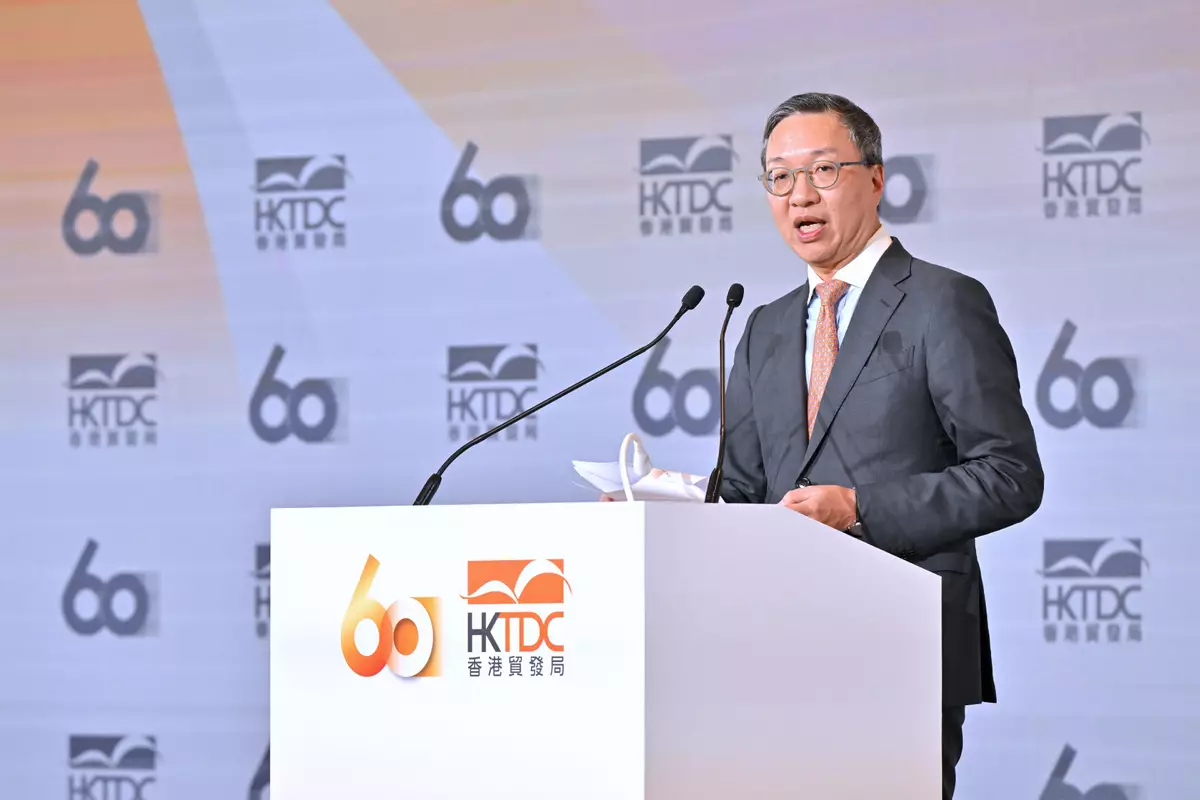
Speech by SJ at Hong Kong Trade Development Council's 60th Anniversary Cocktail Reception
Following is the speech by the Secretary for Justice, Mr Paul Lam, SC, at the Hong Kong Trade Development Council (HKTDC)'s 60th Anniversary Cocktail Reception today (June 16):
Professor Fred Ma (Chairman of the HKTDC, Professor Frederick Ma), Deputy Commissioner Li (Deputy Commissioner of the Office of the Commissioner of the Ministry of Foreign Affairs of the People's Republic of China in the Hong Kong Special Administrative Region (HKSAR) Mr Li Yongsheng), Director Xu (Director-General of the Economic Affairs Department of the Liaison Office of the Central People's Government in the HKSAR, Mr Xu Weigang), Ms Sophia Chong (Executive Director of the HKTDC), Consuls-General, friends of the HKTDC, distinguished guests, ladies and gentlemen,
A very good evening. It is a great pleasure to join you tonight in celebration of the HKTDC's 60th anniversary.
It is indeed a milestone not just for the TDC, but also Hong Kong. Last year, Hong Kong rose to become the world's fifth-largest merchandise trading economy – I think that's what just Fred Ma reminded us. That, ladies and gentlemen, reaffirms Hong Kong's remarkable rise to become an international trade centre - one that champions free and multilateral trade, and one that has never stopped evolving, adapting, and thriving.
That achievement is in no small part attributed to the tremendous contribution of the TDC. My thanks, and congratulations, to the TDC and to each and every one of its hard-working, and smart-working past and present staff over the past six decades of stellar achievement.
The TDC was founded in Hong Kong in 1966, and quickly expanded overseas, setting up offices in London, Nairobi, New York and Sydney.
That was at a time when products manufactured in Hong Kong such as textiles, electronic goods, plastics and toys were taking on the world. To buyers around the world, the "Made in Hong Kong" mark signified quality, value and reliability. The TDC was then promoting the brand of Hong Kong, beginning with the International Samples Fair in Barcelona, in June 1966. That autumn, it ran major product promotions in London and Stuttgart in the then West Germany, as well as department stores in nine major US cities.
And yes, the TDC has always been at the forefront of promoting Hong Kong's external trade. From organising trade fairs and business missions, to building global networks and digital platforms, the TDC today continues to play a pivotal role in connecting Hong Kong companies with markets around the world.
And at every crossroad along the way, the TDC has worked tirelessly to shape and reinforce Hong Kong's status in global trade, while at the same time helping to transform the city from a manufacturing hub into an international financial, trade, logistics and services centre.
From garments, rattan furniture and plastic flowers, to watches, transistor radios and toys in the old days, and to fintech, intellectual property and many high-value added industries at present - the diversity of products and services offered by Hong Kong demonstrates how our economy has evolved to meet changing circumstances. This is a story based on the spirit of resilience and innovation of the Hong Kong people.
Throughout Hong Kong's many transformations, the TDC has always been there, promoting and developing our small-and-medium enterprises, and telling our good stories to the world, through its extensive network of more than 50 global offices covering over 100 countries.
The theme of the TDC's 60th anniversary, namely "Connect the World, Shape the Future", perfectly captures both its legacy and its vision. Hong Kong has long been a connector between East and West. The principle of "one country, two systems" ensures that Hong Kong shall maintain unparalleled connectivity with the Chinese Mainland and the world.
In today's fragmented global landscape, amid continuing challenges in international trade, connectivity has become much more important than ever. But we are not simply connecting people together in a literal sense. The TDC, as an excellent example of Hong Kong's role, has been converting connections into collaborations, and collaborations into mutually beneficial opportunities. By doing so, it has enabled the formation of partnerships that are enduring and forward-looking, which in turn help to shape tomorrow's economy collectively. I suppose that's why Hong Kong is not only a "super connector", but also a "super value-adder".
For 60 years, we have worked side by side - the Government's policy priorities coupled with steadfast support combined with the TDC's global network and on-the-ground expertise. Together, we have advanced Hong Kong's trade and economic development. And together, we are building Hong Kong's flourishing future.
Just two weeks ago, the Chief Executive led a high-level business delegation to Kazakhstan and Uzbekistan. It was the largest delegation that he has led to date, both in terms of the number of delegates - 75 business and institutional leaders from Hong Kong and the Mainland - and of the variety of participating sectors and industries.
The Central Asia mission yielded promising results, with 15 MOUs (Memorandum of Understanding) and agreements signed at the government level, and 81 MOUs and agreements reached by our businesses and institutions with their Central Asian counterparts. The Government is confident they will create long-term economic and trade co-operations for all concerned.
As the Chief Executive has said, the visit's great success was due, in large part, to the TDC's painstaking assistance in the organisation of the mission. From high-level business matching to on-the-ground logistics, the TDC's support was indispensable.
Bringing people, businesses, governments and opportunities together is something the TDC has been doing, and doing well, for 60 years.
In Chinese culture, 60 years represents the completion of a full cycle: . It does not mark an end, but the beginning of a new cycle. It reminds us that after six decades of growth, wisdom and achievements, the time has come to welcome a new, and even more successful chapter. And hence, we are looking forward to another 60 years of success and beyond for the TDC.
May I conclude by saying, once again, happy birthday, the TDC. And I hope you all have a very enjoyable evening. Thank you very much.
Speech by SJ at Hong Kong Trade Development Council's 60th Anniversary Cocktail Reception Source: HKSAR Government Press Releases