MADRID (AP) — Antonio Rüdiger is “not done” at Real Madrid as the German defender stays for another season, signing a one-year contract extension while at the World Cup and pledging his support for the team's rebuild under Jose Mourinho.
Rüdiger was at the end of the four-year contract he signed when he joined Madrid from Chelsea in 2022 and reportedly had rival offers from Saudi Arabia.
“I am not done here,” he wrote on social media. “Renewing my journey with Real Madrid is a proud moment, but more than anything, it’s a commitment to turning things around together with my teammates.”
The 33-year-old German won the Spanish league and Champions League at Madrid in 2024. Back-to-back seasons without a trophy mean Madrid is under pressure to improve next season as Mourinho returns as coach.
Rüdiger played 26 games in all competitions for Madrid last season as injuries limited his availability.
"We are going through a demanding phase. The setbacks have tested us, but this is exactly where I want to be," he said. “Some people may have written me off after my injuries but that only motivated me even more. So, thank you for that."
The announcement of Rüdiger's new deal came a day after Madrid signed left back Marc Cucurella from Chelsea.
Rüdiger is with Germany at the World Cup and came off the bench in the opening 7-1 win over Curaçao as Jonathan Tah and Nico Schlotterbeck started in the center of the German defense.
AP soccer: https://apnews.com/hub/soccer

FILE - Real Madrid's Antonio Rudiger, right, congratulates Federico Valverde after scoring during a Spanish La Liga soccer match between Real Madrid and Elche CF, in Madrid, March 14, 2026. (AP Photo/Manu Fernandez, File)
LOS ANGELES (AP) — The B-52 that crashed during a test flight at an Air Force base in California was airborne for just over three minutes before plunging to the ground at a rate nearly 10 times faster than a plane normally descends for landing, limited tracking data shows.
All eight people aboard were killed in Monday's fiery crash of the Boeing B-52 Stratofortress, which was taking part in a routine test mission as part of an overall program to keep the long-running aircraft flying for decades to come. It was not yet clear Tuesday what caused the plane to crash, and officials at Edwards Air Force Base said it could take up to six months to complete the investigation.
The B-52 was airborne for 3 minutes and 15 seconds, according to AirNav Systems, a flight tracking website.
Flight tracking that was available Tuesday shows the bomber turning to the northeast right after taking off and nearly completing a 180 degree turn before crashing on another runway, according to AirNav Systems. The data that comes from a system called “multilateration” doesn’t show precise altitude and speed information, but it does show the plane fell to earth at a rate of descent of 5,056 feet (1,541 meters) per minute.
The airfield remained closed Tuesday. Crews were making the crash site safe for search and recovery teams to enter, after fires flared up overnight, said Mike Paoli, a spokesperson for the 412 Test Wing at Edwards.
The aircraft was supporting a “radar modernization program,” Col. James Hayes, the deputy commander for the 412 Test Wing, said Monday. In 2025, Boeing sent a B-52 to Edwards with a modernized radar system that is key to keeping the bomber in the air through at least 2050, nearly a century after it first entered service.
A test team planned to conduct ground and flight test activities on the aircraft throughout 2026 to feed a production decision, the Air Force said in a 2025 news release. The modern Active Electronically Scanned Array (AESA) radar system replaced the aircraft’s antiquated radar. It was unclear if that was the same aircraft involved in Monday’s crash.
AESA replaced 1960s radar technology and offers improved navigation and targeting capabilities, according to a 2023 news release from Raytheon, which designed the new system for the Air Force's entire B-52 fleet.
The B-52, a long-range bomber that entered service in 1955, is designed to carry both conventional and nuclear weapons. It has been used in conflicts involving the U.S. military from Vietnam to Iran.
Along with a new radar, the fleet of 76 B-52s are scheduled to receive additional upgrades, including new engines, crew compartments, conventional and nuclear communication systems, avionics and weapons. The military said the goal is to make the B-52 a complement to the Air Force’s newest strategic bomber, the B-21 Raider.
Aerial footage showed virtually nothing left of the aircraft that went down at the base in the Mojave Desert about 100 miles (161 km) northeast of Los Angeles. Officials determined no one could have survived after reviewing footage of the crash, Hayes said at a news conference.
Those on the B-52 included government contractors, Boeing employees and uniformed military.
Edwards is home to the 412th Test Wing, which conducts regular developmental testing of all Air Force aircraft, weapons systems, software and components before purchase by the service as well as throughout their life span. Test missions take place at Edwards daily, Hayes said.
The base is where Air Force test pilot Chuck Yeager reached a speed of Mach 1.05 and broke the sound barrier in 1947.
Aviation safety experts have said their first thoughts about what might have caused the crash were about a malfunction in the flight controls or engines, but it is way too early to know. And investigators will consider a myriad of factors, including the age and maintenance of the plane.
J. Joseph, a retired Marine Corps colonel and airline pilot. said that even in a B-52 with eight engines, a malfunction can make the plane difficult to control if the pilot loses the outboard engines, and the forces pushing the plane get out of balance in a condition Joseph called asymmetric thrust. Although if there is time, the pilots can adjust the other throttles to rebalance the forces.
Heather Penney, a former F-16 combat pilot and aviation expert, said she knew one of the people who died aboard the B-52 personally -- reinforcing how tragic this crash is for the close-knit community of military aviators. She declined to name the person before officials do.
She said it is unlikely that pilot error caused this crash given the expert training and experience of the test pilots on this flight. The age of the B-52 also opens up the possibility of problems with the structure of the plane.
“The youngest B- 52 was delivered to the Air Force in 1962. That was before the Cuban missile crisis, before the first man walked on the moon, before we had personal computers,” said Penney, who is director of Studies and Research at The Mitchell Institute for Aerospace Studies. “These are old airplanes. They’re structurally robust, but they are old aircraft. So structural failure can’t be ruled out.”
All the modernization efforts and upgrades that have been made to the B-52s over the decades have extended the life of these planes. At some point, these bombers will have to be replaced, but for now they continue to play a crucial role for the Air Force.
“The B-52 fleet that we have today, is the backbone of America’s bomber force. It’s over 50% of our bomber force, and it can go further, have larger payload, and stay airborne longer without refueling than any of our other bombers,” Penney said. “There’s no other bomber in our force has the attributes of the B-52. It’s been a workhorse. It’s going to continue to be a workhorse.”
Funk reported from Omaha, Nebraska. Associated Press journalist Konstantin Toropin contributed from Washington, D.C.
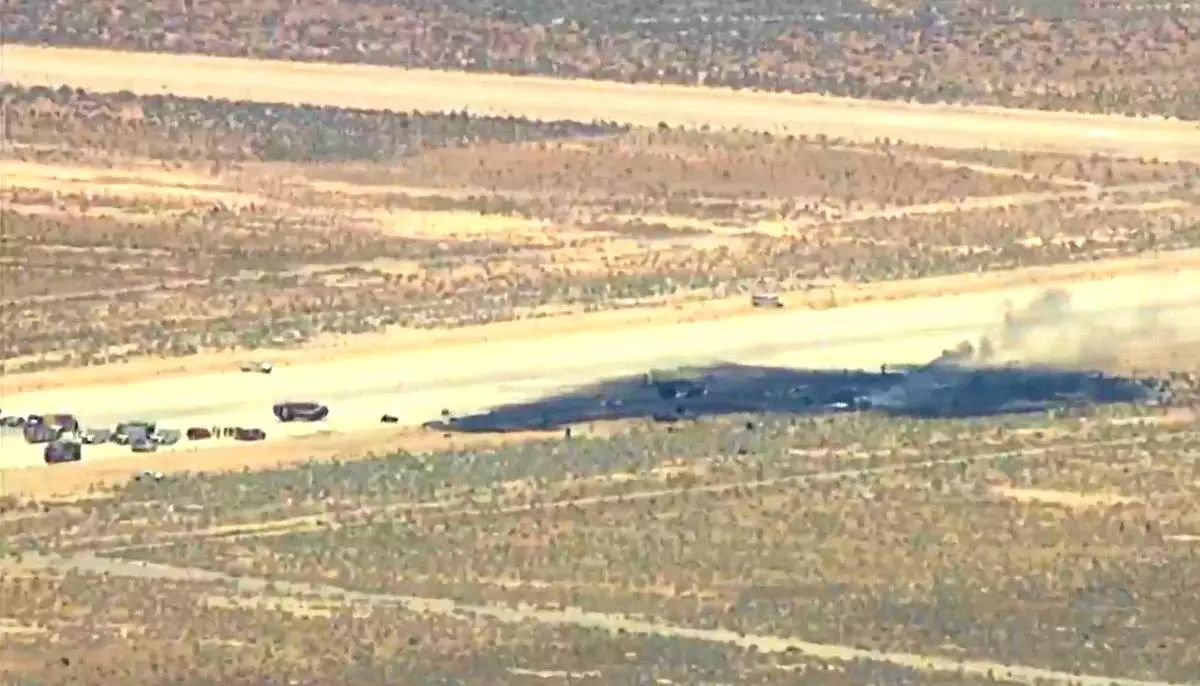
This image taken from video provided by KABC shows law enforcement responding to the scene of an aircraft crash, Monday, June 15, 2026, near Edwards Air Force Base, Calif. (KABC via AP)