LILLE, France--(BUSINESS WIRE)--Jun 17, 2026--
Xsolla, a global video game commerce company that helps developers launch, grow, and monetize their games, today announced its sponsorship of Game Camp France this 18-19 June 2026.
This press release features multimedia. View the full release here: https://www.businesswire.com/news/home/20260617351463/en/
The French video game industry is widely recognized as one of the most vibrant in Europe, with revenue reaching approximately €5.8 billion in 2025. Rather than a centralized market, it is a patchwork of regional scenes, each with its own communities, creative identity, and business dynamics. Game Camp France plays a key role in bringing these diverse voices together, creating a centralized space for collaboration, exchange, and growth.
By sponsoring Game Camp France, Xsolla is investing directly in the local ecosystem and the developers who power it. Xsolla will be on-site to engage with studios, share insights, showcase its product offerings, and better understand the priorities shaping the French market today.
“Game Camp France is a unique reflection of the diversity and strength of the French games ecosystem,” said Berkley Egenes, Chief Marketing & Growth Officer at Xsolla. “We’re proud to support an event bringing together so many regional communities and to connect directly with the developers shaping the future of gaming in France.”
"Game Camp France makes one thing unmistakable: this isn't a scene waiting for opportunity, it's one building its own," said Eddy Celestine, Business Development Manager, France & EU, at Xsolla. "Across Paris, Lyon, Lille, Bordeaux, and Nantes, studios already have the talent and creativity; what they're forging now is the ecosystem to match. Events like Game Camp France aren't peripheral, they're where the industry connects, aligns, and moves forward together."
At Game Camp France, Xsolla will highlight its global payments infrastructure, supporting more than 1,000+ payment methods across 200+ geographies. Designed to optimize conversion and deliver localized checkout experiences, Xsolla Payments enables developers to reach players worldwide while adapting to regional preferences and regulatory environments. Additionally, Xsolla will showcase how they are connecting developers with premium entertainment-based intellectual property (IP). By simplifying licensing and partnership opportunities, Xsolla Agency helps studios enhance player acquisition, drive engagement through LiveOps, and unlock new monetization pathways.
For more information about Xsolla’s presence in France, please visit: https://xsolla.pro/GCF26
About Xsolla
Xsolla is a global commerce company that builds and provides all the things developers need to launch, grow, and monetize video games. Headquartered in Los Angeles, California, the company supports studios of every size, from indie to AAA, with solutions across direct-to-consumer commerce, intelligent payments, entertainment-based IP, and player engagement products. Xsolla helps developers fund, distribute, market, and monetize their games at scale. Trusted by more than 60% of the top 100 highest-grossing games, Xsolla operates as the merchant of record across 200+ geographies with access to over 1,000+ local payment methods worldwide. Grounded in a deep belief in the future of gaming, Xsolla is resolute in bringing opportunities together and unlocking growth for creators everywhere.
For more information, visit xsolla.com

Berkley Egenes, Chief Marketing & Growth Officer at Xsolla

Eddy Celestine, Business Development Manager, France & EU, at Xsolla

Graphic: Xsolla
BOSTON (AP) — Generations of Boston families played and picnicked on the grassy, sloping lawns of the Bunker Hill Monument.
Musket balls and other artifacts from one of the American Revolution’s most consequential battles were buried just below their feet the whole time.
Inspired by a centuries-old map, archaeologists have been digging in the park that sits on the site where American patriots hastily constructed an earthen fort to slow advancing British forces at what became known as the Battle of Bunker Hill.
Ground-penetrating radar identified potential locations for the fort in Boston's Charlestown section. Soon after digging the first trench, the team led by Joe Bagley, the city of Boston's archaeologist, found definitive signs of a ditch constructed hours before the battle on June 17, 1775, one of the first of the American Revolution.
“The part that’s really crazy to me is that we get to stand in the same ditch,” said Bagley, standing over one of the two dig sites, where soil is removed about 4 inches (10 centimeters) at a time, put in buckets and filtered through screens. Any items found are bagged up and identified.
So far, the dig has uncovered musket balls and parts of a musket from the battle. They also found objects likely left behind by British troops who occupied the area after the battle — including tea cups, tobacco pipes, sleeve buttons and a wig curler. There were nearly 150 combatants who died there but no human remains have been found, though a forensic archaeologist is on site to identify any bones.
“Everything about the ditch is from 1775. You’ve got musket balls, gun flints. It’s what you would expect to see,” Bagley said. “It’s pretty powerful because these things are being dropped in the middle of the battle.”
The start of the American Revolution is often associated with the Battle of Lexington and Concord, skirmishes fought on April 19, 1775. But many scholars cite Bunker Hill and June 17 as the war's first significant battle.
Rebels intended to hold off a possible British attack by fortifying Bunker Hill, a 110-foot-high (34-meter-high) slope in Charlestown across the Charles River from British-occupied Boston. But for reasons still unclear, they instead took a position on a smaller and more vulnerable ridge known as Breed’s Hill, where most of the fighting took place.
The battle ended with the rebels in retreat, but not before the British had sustained more than 1,000 casualties. Bunker Hill is often portrayed as an American victory, since the British failed to win decisively and it served to galvanize the colonies against the British.
Today, a 221-foot (67-meter) white obelisk atop Breed's Hill memorializes the battle.
On Wednesday, a church service in Charlestown will be followed by a procession that makes its way to the Bunker Hill Monument. A remembrance ceremony will be held there that includes a wreath-laying, moment of silence and musket firing demonstration. The dig also ends Wednesday.
At the dig site, Joel Bohy, a battlefield archaeologist who specializes in identifying American Revolution weaponry, marveled at what had been pulled from the dirt. One volunteer held in her hand two jagged stones — the gray one was an English gun flint while a beige one was a French gun flint. When the trigger on the musket was pulled, flint struck the steel, producing sparks that ignited the gunpowder.
They also found eight marble-sized musket balls from both sides in the battle. The markings and shape of some bullets showed they had been fired from a distance but didn't hit anyone. If they had, the balls would have been deformed.
“You can see the ramrod mark from when the soldier rammed it down. You can the little ring on the top where it was pushed down,” Bohy said, adding that “marks on the edge of the ball” show that it had been fired.
Using pick axes and shovels, more than 1,000 provincials and residents dug through the night to construct a ditch that was 3 feet (1 meter) deep and over 6 feet (2 meters) wide. They shoveled the soil in front of the ditch to make a 6-foot-high wall or parapet that reached 150 feet (46 meters) long on each of the four sides.
A map drawn by Henry Pelham two months after the battle showed a square redoubt on Breed's Hill. But it wasn't until the dig that anyone had confirmed the shape in the map was accurate. Previous digs in the 1990s had found items related to the battle and some evidence of the ditches.
“If you come to the site, we have the monument, we have a lot of maps on display, and the landscape is beautiful. But you can’t really see the fort, the fortifications that were built,” Bagley said. “Very little of what’s here visibly is from 1775. So, this trench is the reason why all of this is here.”
Beyond locating the fort, the dig also provides visitors a chance to hold “a piece of the battle in their hand,” Bohy said. “In a way, it makes the history more dimensional when you look at these objects from the battle itself.”
Several tourists from Colorado stopped by to watch the dig. One visitor, Greg Nockleby, who had spent a week in Boston learning about American history, said watching the archaeologists at work was a “wonderful surprise.”
“A live dig happening right now to uncover our nation’s history is amazing,” he said. “To see that there has been people here who have died for our freedom and our nation is very immersive.”
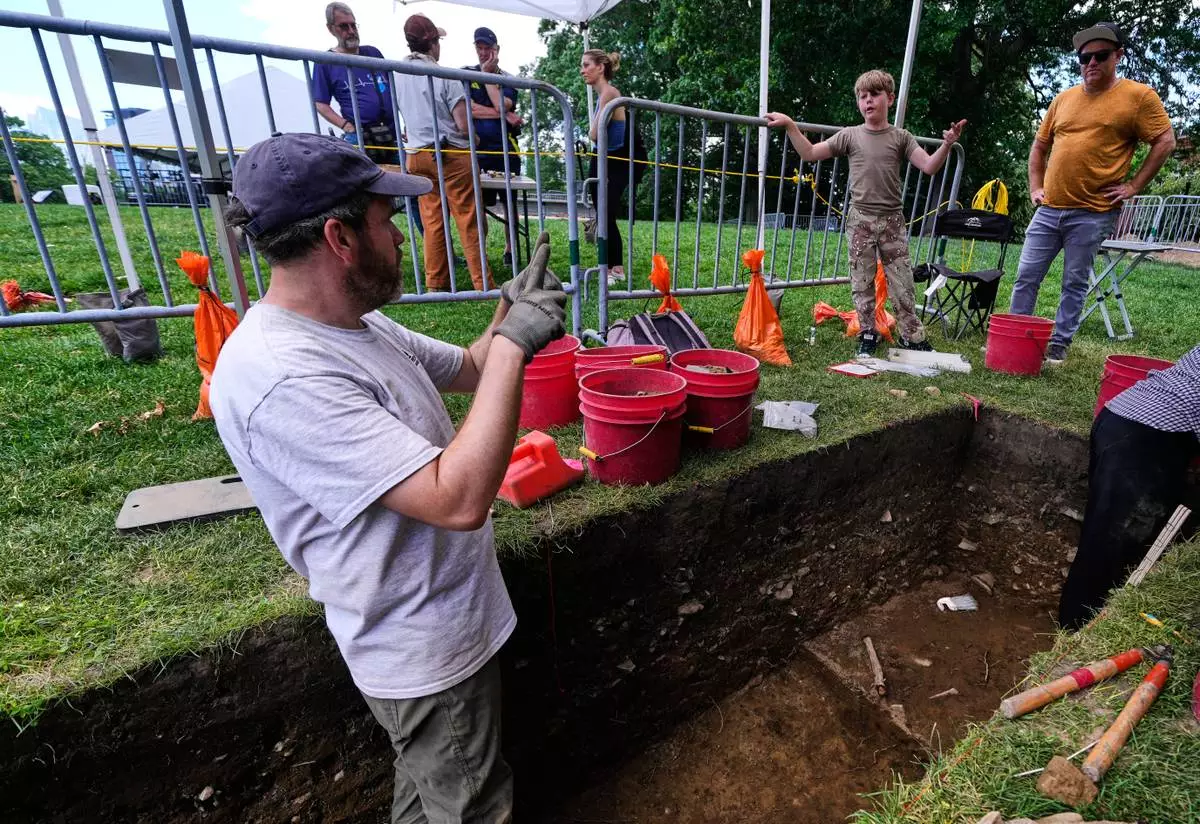
Joe Bagley, the City of Boston Archeologist, left, chats with visitor Owen MacDonald, of Los Angeles, who was visiting Boston with his father John, during an archaeological dig at the site of the Battle of Bunker Hill, Monday, June 15, 2026, in Boston. (AP Photo/Charles Krupa)
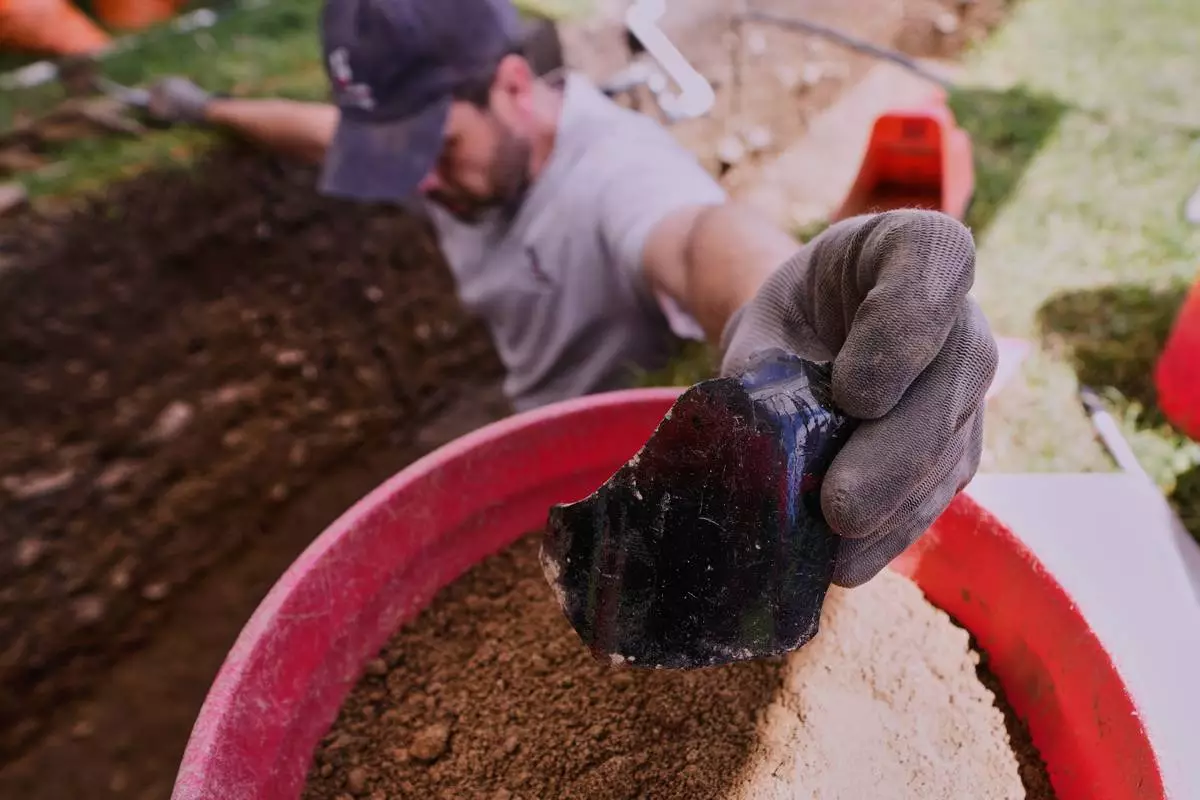
Joe Bagley, the City of Boston Archeologist, holds a portion of a bottle that was unearthed during an archaeological dig at the site of the Battle of Bunker Hill, Monday, June 15, 2026, in Boston. (AP Photo/Charles Krupa)
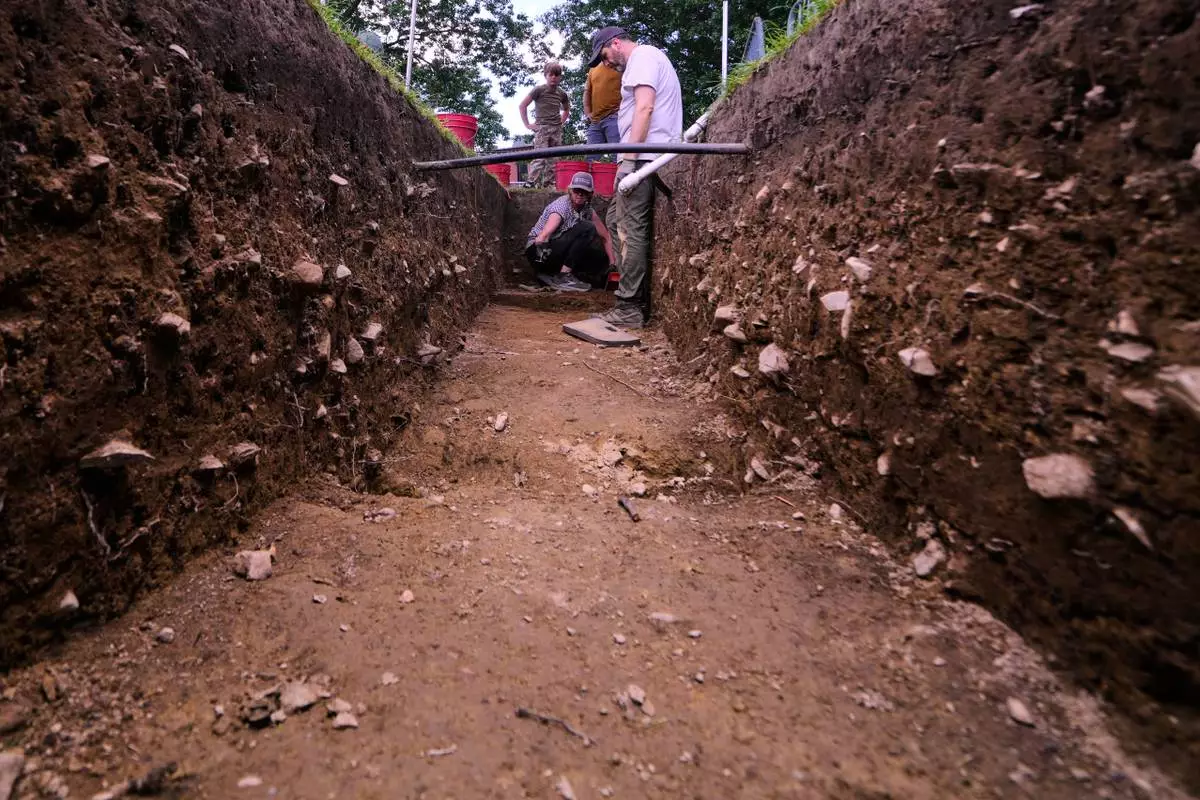
Joe Bagley, right, the City of Boston Archeologist, talks with with Sarah Kiley Schoff, a forensic anthropologist, during an archaeological dig at the site of the Battle of Bunker Hill, Monday, June 15, 2026, in Boston. (AP Photo/Charles Krupa)

Calla Ruff, an intern from Carleton College, sifts dirt removed from an archaeological dig at the site of the Battle of Bunker Hill, Monday, June 15, 2026, in Boston. (AP Photo/Charles Krupa)

Calla Ruff, an intern from Carleton College, holds a musket ball that was removed from an archaeological dig at the site of the Battle of Bunker Hill, Monday, June 15, 2026, in Boston. (AP Photo/Charles Krupa)