PARIS (AP) — Donald Trump explained the appeal in one sentence: “Versailles is not gold leaf — Versailles is the real deal.”
For Emmanuel Macron, that was precisely the point.
On Wednesday night, the French president throws open Louis XIV’s palace to his U.S. counterpart for a private reception, show and dinner marking America’s 250th birthday. At a turbulent moment for the trans-Atlantic alliance, it could help Macron keep a personal channel open as the two navigate differences over Iran, Ukraine and tariffs.
It has already kept Trump from leaving a Group of Seven summit early, as he did last year in Canada.
“I’m a fan of beautiful places,” he told reporters, saying he had planned to leave earlier until “a very nice man” invited him to dinner.
The welcome also served a practical purpose. In an interview earlier this week with France’s TF1 television, Macron said Trump “needs to stay until the end” to help complete the summit’s agreements.
It is perhaps the biggest soft-power flex available to a French president: Versailles, the Hall of Mirrors, the gardens of the Sun King and several centuries of carefully polished national grandeur.
“Versailles is a diplomatic tool and an instrument of influence,” Macron said Wednesday, likening diplomacy to soccer. “Whether I’m playing at home or away, my goal is to score goals. And when I host other teams, I try to give them a nice welcome.”
France holds little economic or military sway over Washington, so pageantry is one of its few levers — even as its use elsewhere has brought mixed results at best.
Macron and Trump have often clashed over policy.
Their relationship has endured partly because Macron understands the power of personal attention, dramatic settings and a well-timed invitation.
Their first meeting in 2017 produced a white-knuckled handshake that instantly became a symbol of their competitive rapport.
Months later came dinner inside the Eiffel Tower and a place of honor at France’s Bastille Day parade.
Versailles raises the stakes, allowing a French president to wrap a modern political encounter in the scale and authority of national history.
“It is soft-power flex based on hard buildings,” said Denis Lacorne, professor of American studies at Sciences Po.
Macron has used the palace before, receiving Russian President Vladimir Putin there in 2017 and later hosting King Charles III and Queen Camilla for a state dinner.
Versailles has been a favored setting for French leaders to honor foreign guests for over three centuries, the palace told The Associated Press. It remains “a place in the service of French diplomacy.”
With Trump, the setting carries added resonance.
The former real estate developer has long treated architecture as a statement of status, success and power. In his second term, he has sought to erect a legacy in stone — with plans for a new White House ballroom and a 250-foot (76-meter) triumphal arch resembling Paris’ Arc de Triomphe.
French media reported the evening could include a Hall of Mirrors visit and fountain display with fireworks. The full program was not released.
The Hall of Mirrors was once a feat of technology: 357 mirrors set in 17 arches along a 73-meter (240-foot) gallery, showing French manufacturers could rival Venice’s celebrated glassmakers.
They were also built to multiply a king. Every royal entrance ricocheted across the glass, and a modern guest gets the same treatment.
“You will be reflected many, many times, from one mirror to another,” Lacorne said.
For a president who has spent his second term turning the Oval Office gold, the appeal is clear, he added.
Trump arrives, in a sense, at a building he has quoted for years: he has said he modeled Mar-a-Lago’s ballroom after Versailles.
Trump remembers spectacle, and often brings it home.
The 2017 Bastille Day parade saw tanks, horses and marching bands fill the Champs-Élysées as fighter jets trailing red, white and blue smoke soared overhead.
Trump called it “one of the greatest parades I’ve ever seen.”
“We’re going to have to try and top it,” he said back in Washington, where he began pressing for a military parade. In 2025, he finally presided over a large Army anniversary parade through the capital.
China employed dazzle diplomacy when it hosted Trump for a “state visit plus” in 2017, including a rare tour of its Forbidden City, an experience once reserved for emperors.
Britain offered its own version last September, greeting Trump’s second state visit with mounted troops, a carriage procession and a Windsor Castle banquet.
The diplomatic pomp has clearly flattered Trump, who called the Windsor banquet one of the highest honors of his life.
But it seems to have won few concessions.
The early Macron-Trump “bromance” has hardened into something rougher and more transactional.
Trump has threatened tariffs of up to 100% on French wine and Champagne amid a broader trade fight. France opposed the U.S. war against Iran, even as Macron pressed Washington to keep backing Ukraine.
At home, the dinner has drawn criticism.
“We must learn once and for all to live without Trump,” said Jean-Luc Mélenchon, the veteran far-left leader.
Versailles hands Macron some advantages, experts say: centuries of diplomatic history, a setting built for Trump’s taste for ceremony, and a palace already familiar to the hundreds of thousands of Americans who visit each year.
History counsels caution. Ronald Reagan dined beneath the same mirrors on the sidelines of the 1982 G7, and central disagreements outlasted the splendor.
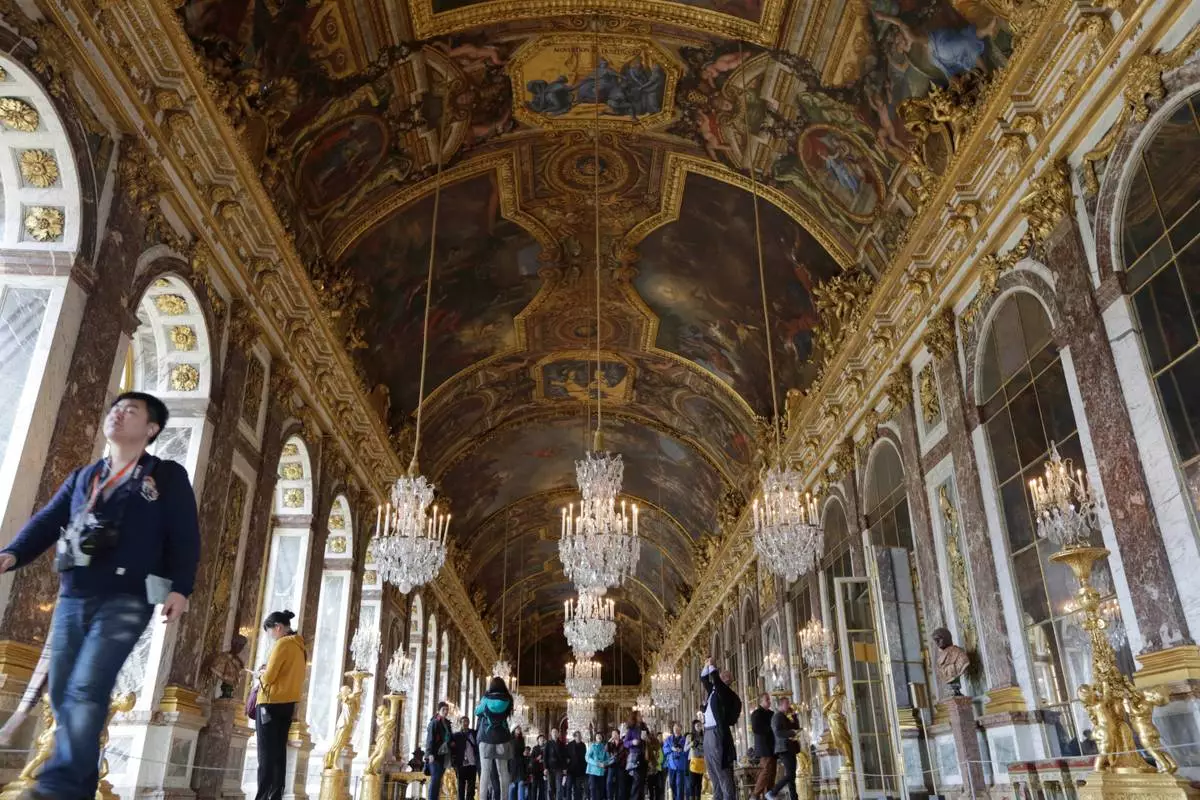
FILE - Visitors walk inside the Hall of Mirrors in the Versailles castle, on Nov. 17, 2015 in Versailles, west of Paris. (AP Photo/Amr Nabil, File)
ATLANTA (AP) — Georgia is the next Southern state where Republicans are convening to redraw voting districts in ways that could diminish the political power of Black and other nonwhite voters after the U.S. Supreme Court gutted Voting Rights Act provisions that helped shape existing boundaries in racially diverse states.
The General Assembly convenes Wednesday in a special session called by outgoing Gov. Brian Kemp in response to the court's Louisiana v. Callais decision, which struck down Louisiana’s congressional map as an illegal racial gerrymander.
Kemp, who is in the final months of his second term, deviated from other governors who fast-tracked new congressional maps for the November midterms partly in response to President Donald Trump's pleas to shore up the party's chances at maintaining control of Congress. Kemp instead wants Georgia lawmakers to draw districts for the 2028 elections. Yet the governor moved ahead of his Southern counterparts by asking the Republican-controlled Assembly to redraw its own boundaries, as well.
That would make Georgia the first state to apply Callais to its legislature and demonstrate the cascading effect of the high court's decision across Southern states with the nation’s highest proportions of Black voters and Black lawmakers.
The issue is especially salient in Georgia, where the Capitol complex includes a statue of the Rev. Martin Luther King Jr. and sits blocks from where the slain civil rights icon lived, preached and led the movement that yielded the Voting Rights Act in 1965.
Still, neither Kemp nor Republican legislative leaders had unveiled proposed changes as of Wednesday morning, frustrating Democrats and activists who plan daily demonstrations throughout the session.
“They have not been transparent,” said state Rep. Tanya Miller, a Black legislator from Atlanta who is the Democratic nominee for attorney general. “Something as fundamental as voters getting to choose their leaders ought not to be done in the dark, ought not happen in back rooms.”
Several Republican lawmakers said Wednesday morning they still had not seen proposed districts, and Kemp’s office had not scheduled any public remarks from the governor.
House Speaker Pro Tem Jan Jones, a veteran of earlier redistricting efforts, said the outcome “will be a legislative prerogative” — a notion Kemp aides confirmed. But Jones said that even as a top-ranking Republican on the committee that would consider new maps, she hasn't “been in any room creating maps.”
Asked directly who is drawing new districts, she replied: “I don't know.”
Before Callais, Section 2 of the Voting Rights Act was understood to require maps — for Congress, state legislatures and local legislative bodies — that gave historically marginalized minorities a reasonable chance to select candidates of their choice. Nationally and in Georgia, those so-called “opportunity districts” have disproportionately elected Black and other nonwhite representatives.
For example, about a third of Georgia's 180 state representatives are Black. Latino, Asian and other minorities bring the total nonwhite share to about 40% — roughly reflecting the state's overall population. Georgia's U.S. House delegation has five districts out of 14 total where the electorate is majority or plurality nonwhite. All elected Black Democrats in 2024.
With the Callais ruling, issued earlier this spring, a conservative majority of justices concluded that jurisdictions drawn with racial makeup in mind are discriminatory and violate the U.S. Constitution's equal protection clause. The justices declared that apportionment should be “race neutral.”
Their stated reasoning did not hinge on party interests, and federal courts have said partisan gerrymandering is constitutionally permissible. But in Southern states, especially, party loyalty dovetails considerably with race and ethnicity. So the decision has allowed Republicans — a party dominated by white people — to redraw maps to goose likely GOP districts by redistributing nonwhite voters who tend to support Democrats.
That, many civil rights activists and experts argue, makes it impossible for Southern legislatures to be genuinely “race neutral” when drawing boundaries.
Emory University professor Carol Anderson compared Callais and the resulting redistricting push to poll taxes and literacy tests imposed by white Southern conservatives — and blessed by the Supreme Court — during the Jim Crow era.
“They used racially neutral language for policies that were clearly racially targeted,” said Anderson, who is also a board member of Fair Fight Action, a group organizing against the Georgia redistricting.
It's not guaranteed that Georgia Republicans can get what they want from new maps.
Partisan gerrymandering involves redistributing voters — packing certain citizens into fewer districts or dividing them across more districts. Around metro Atlanta, spreading nonwhite, Democratic-leaning voters across more districts could make more seats seem to lean Republican. The risk, however, is that more battleground districts emerge because white metropolitan voters are trending less conservative, which could give Democratic candidates of any race or ethnicity more chances to win.
That's perhaps not a major factor in the Georgia state Senate, which already is considered gerrymandered for Republicans. But it could be a consideration when drawing state House and U.S. House maps.
Kemp is effectively asking Republicans, especially in metro Atlanta, to redraw their own boundaries and take on new, unfamiliar territory.
Nationally, a partisan redistricting battle started last year when Trump urged Republican-controlled states to redraw congressional boundaries to shore up the GOP's narrow House majority in Washington this November. Texas answered the call first.
California Gov. Gavin Newsom and Democrats in Sacramento answered with their own gerrymander that voters later approved. A succession of states followed. The outcome would have been close to even had the Virginia Supreme Court, controlled by conservatives, not struck down new Democratic-drawn maps approved by the state’s voters. All told, Republicans think they could gain as many as 16 seats from their redistricting efforts while Democrats think they could gain six seats from new districts in California and Utah.
That still may not be enough for the GOP to hold a congressional majority, given Trump's lagging approval ratings. But it could mitigate Democratic gains and set Republicans up well for 2028 and beyond.
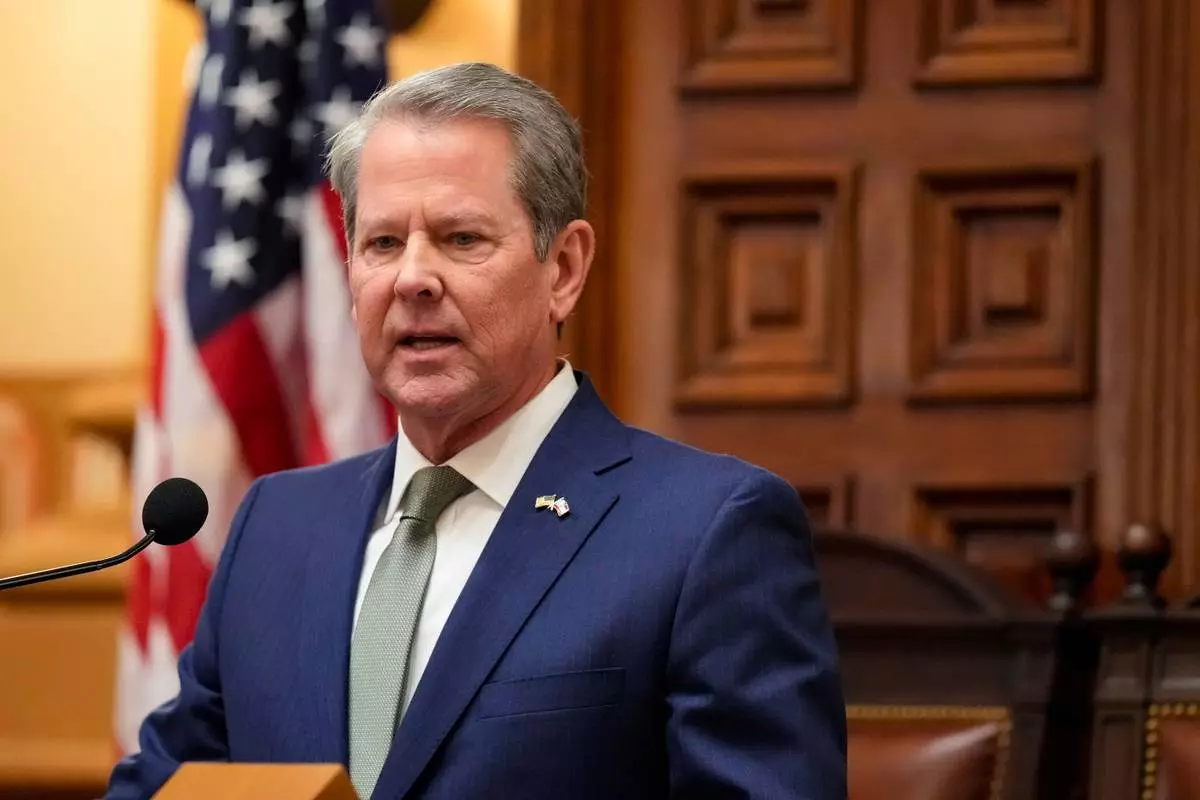
FILE - Gov. Brian Kemp speaks during the State of the State, Jan. 15, 2026, in Atlanta. (AP Photo/Brynn Anderson, File)