

Skip to Content Facebook Feature Image

Hong Kong Officials Discuss Poverty Alleviation Strategies and Their Impact at Press Conference

HK

Hong Kong Officials Discuss Poverty Alleviation Strategies and Their Impact at Press Conference
HK

HK

Hong Kong Officials Discuss Poverty Alleviation Strategies and Their Impact at Press Conference

2026-06-18 20:20 Last Updated At:20:28

Remarks by CS at press conference on Report on Impact of Targeted Poverty Alleviation Strategy in Hong Kong (with photos/video)

The Chief Secretary for Administration, Mr Chan Kwok-ki, hosted a press conference on press conference on Report on Impact of Targeted Poverty Alleviation Strategy in Hong Kong today (June 18). Also present were the Secretary for Labour and Welfare, Mr Chris Sun, and the Permanent Secretary for Labour and Welfare, Ms Alice Lau, with members of Commission on Poverty, namely Honorary President of the Federation of Hong Kong Industries Mr Jimmy Kwok; the Chief Executive Officer of St James' Settlement, Ms Josephine Lee; and the Chief Executive of the Tencent Charity Foundation, Dr James Li. Following are their remarks at the press conference:

Reporter: First, does the Government have the number of how many people have been lifted out of poverty thanks to the poverty alleviation measures? If no, how can the Government assess the effectiveness of these measures when we are talking about poverty alleviation, and does that mean Hong Kong will no longer have a poverty line? Second, the Government has for the first time adopted the concept of social transfer values in poverty alleviation measurement, which shows the benefits received by households. How does this actually tell the effectiveness of the poverty alleviation efforts? How does the Government assess whether the amounts are enough to help those in need. Does that justify not providing more financial support? Thank you.

Secretary for Labour and Welfare: Thank you for your question. As the Chief Secretary has said very clearly, when we talk about targeted alleviation of poverty, it is based on a very comprehensive basic services provided in the fields of social service, medical, education, and also public housing. So all these four areas, you can imagine, provide a very comprehensive basic support for a wide spectrum of people in Hong Kong who are in need of different forms of Government support for them. But on top of that, we are also conscious about the needs of some special groups. They include those living in sub-divided flats, those who are single parent families, and what we call, all-elderly families. They have needs other than what is usually provided through social welfare, medical, education and public housing. Then we designed targeted services. This includes visits by the Care Teams and Community Living Rooms. All these are designed to help different groups. I think the key is to look at the for each individual project, we are more focused on KPIs and whether we have been able to achieve all those pre-set KPIs. It is clearly shown in the report. I think we are more than meeting the KPI requirements. So this all shows that these targeted alleviation projects achieved the stated objectives, by helping all those groups and targeted groups of people whom we believe they need our help.

And a part of that, we have provided with new tools, as you have mentioned, the social transfer values. This is an internationally recognised way to monetise, and to give you a value about the services provided by the Government. I think the best way is to visualise the fact, if you turn to page 168 and 169 of the Report, we have given you some very typical examples, including the elderly and families living in a public housing estates, and those receiving elderly services or receiving cash subsidies from the Government, so they show you in a very easily understandable way. So if all the services provided by the Government had to be obtained from the market, of course assuming all these services are available in the market, what would be the value in monetary terms of all these services? To give you an idea about the support provided to all those people who are in need of help, this is the way to look at what we are doing right now about targeted alleviation of poverty. Thank you.

Chief Secretary for Administration: I want to supplement that in terms of beneficiaries, and according to our records for the Sham Shui Po Community Living Room as an example, so far there are about 520 000 number of attendance, and for the Strive and Rise programme, we all together have more than 14 000 students, and for the after-school care service, the quota is 10 500. These are the beneficiaries.

(Please also refer to the Chinese portion of the remarks.)
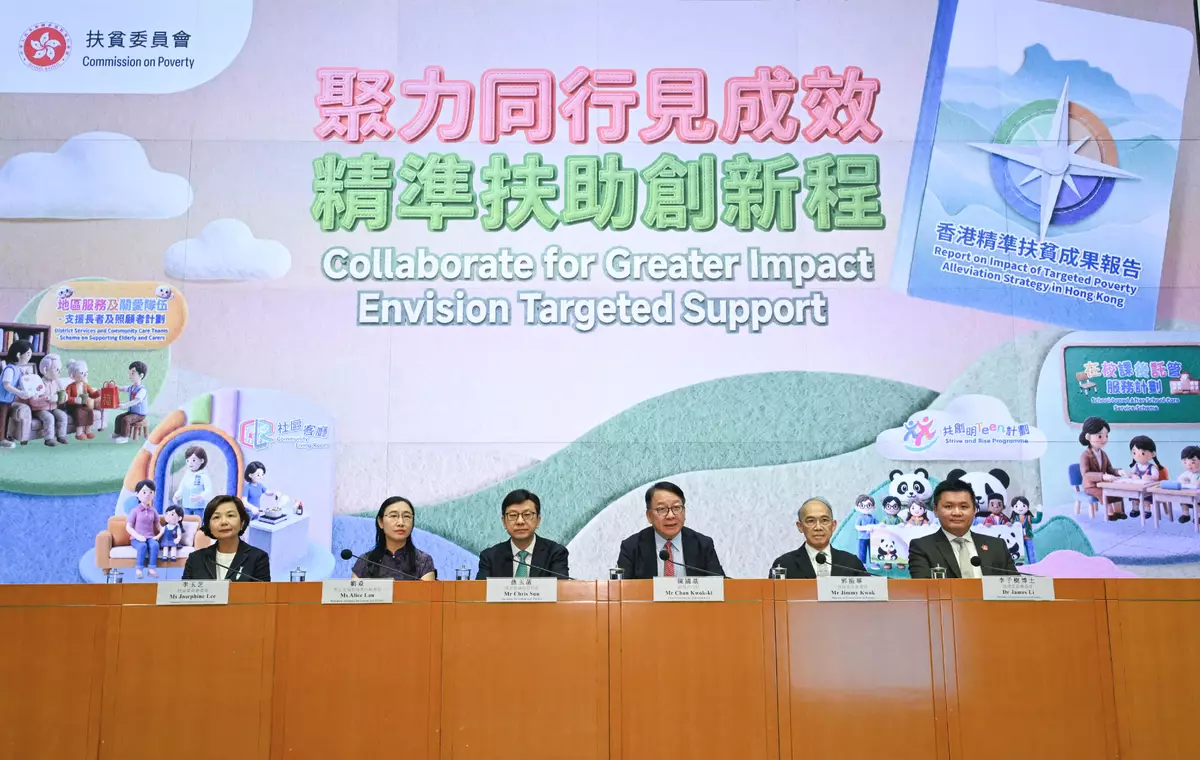
Remarks by CS at press conference on Report on Impact of Targeted Poverty Alleviation Strategy in Hong Kong (with photos/video) Source: HKSAR Government Press Releases
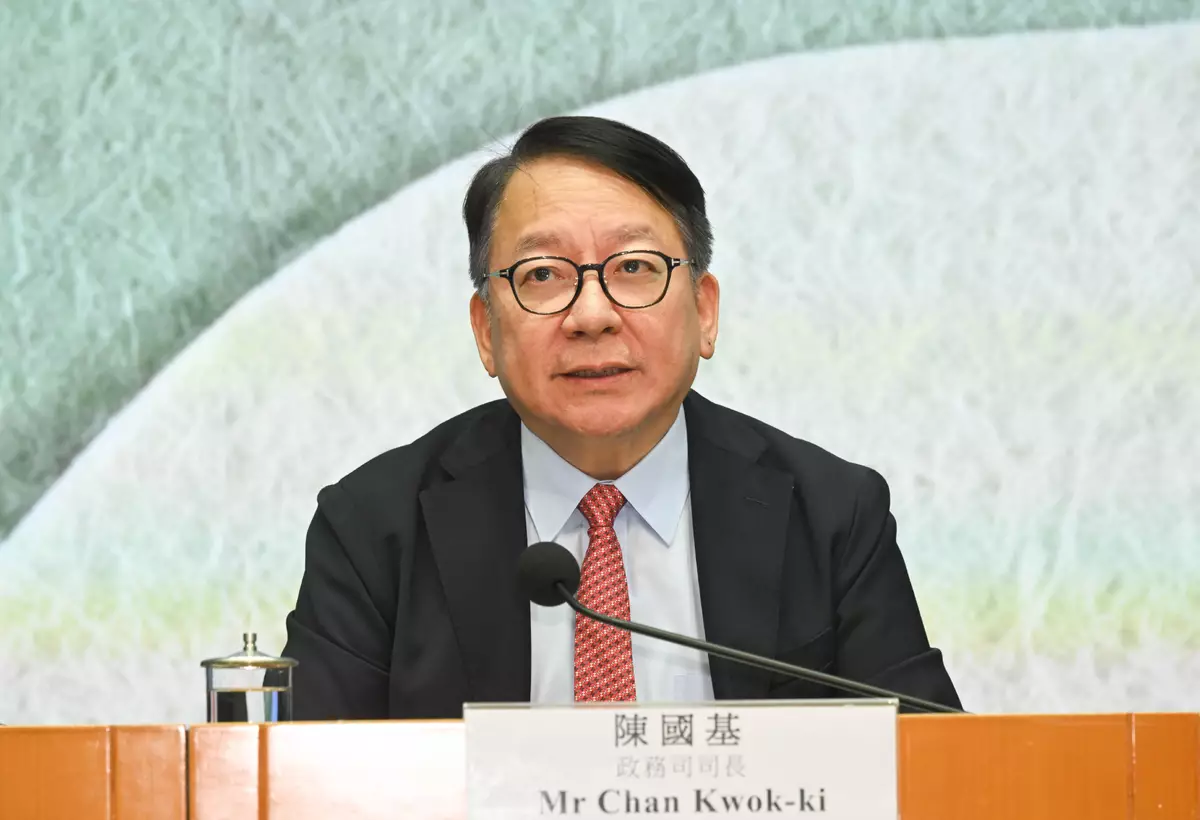
Remarks by CS at press conference on Report on Impact of Targeted Poverty Alleviation Strategy in Hong Kong (with photos/video) Source: HKSAR Government Press Releases

Remarks by CS at press conference on Report on Impact of Targeted Poverty Alleviation Strategy in Hong Kong (with photos/video) Source: HKSAR Government Press Releases

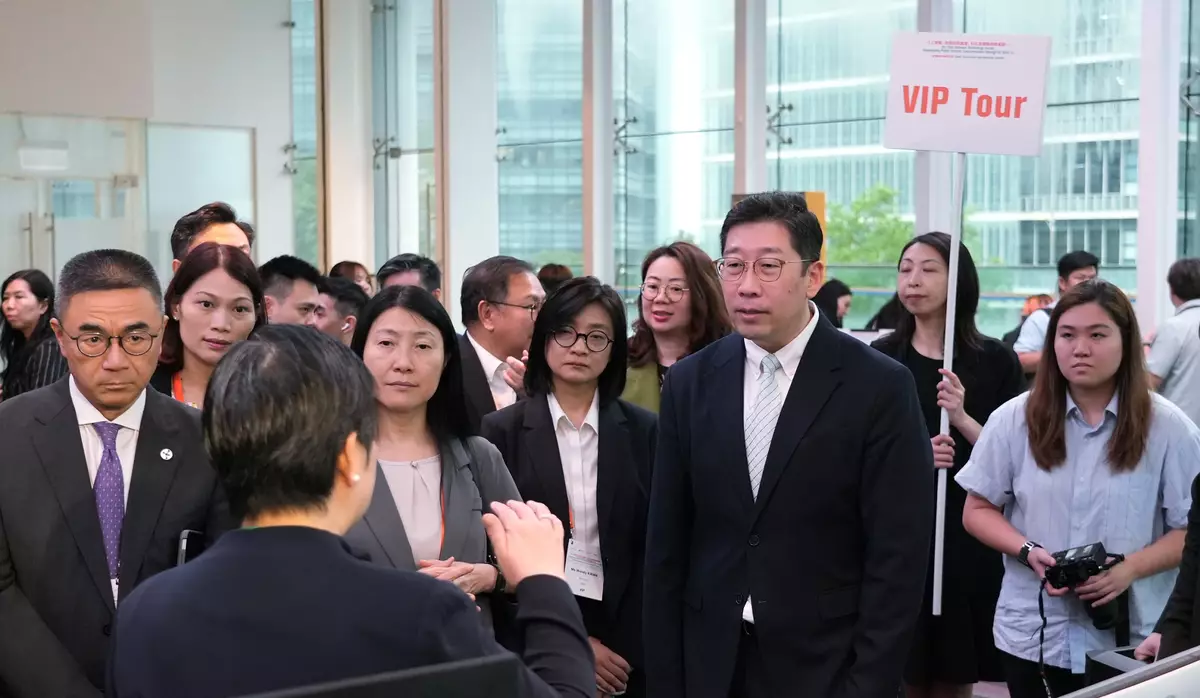
Remarks by CS at press conference on Report on Impact of Targeted Poverty Alleviation Strategy in Hong Kong (with photos/video) Source: HKSAR Government Press Releases
Remarks by CS at press conference on Report on Impact of Targeted Poverty Alleviation Strategy in Hong Kong (with photos/video) Source: HKSAR Government Press Releases
Remarks by CS at press conference on Report on Impact of Targeted Poverty Alleviation Strategy in Hong Kong (with photos/video) Source: HKSAR Government Press Releases

Digital Policy Office holds "AI+ Civil Services: Empowering Public Services Transformation through AI Tools" Series technology forum

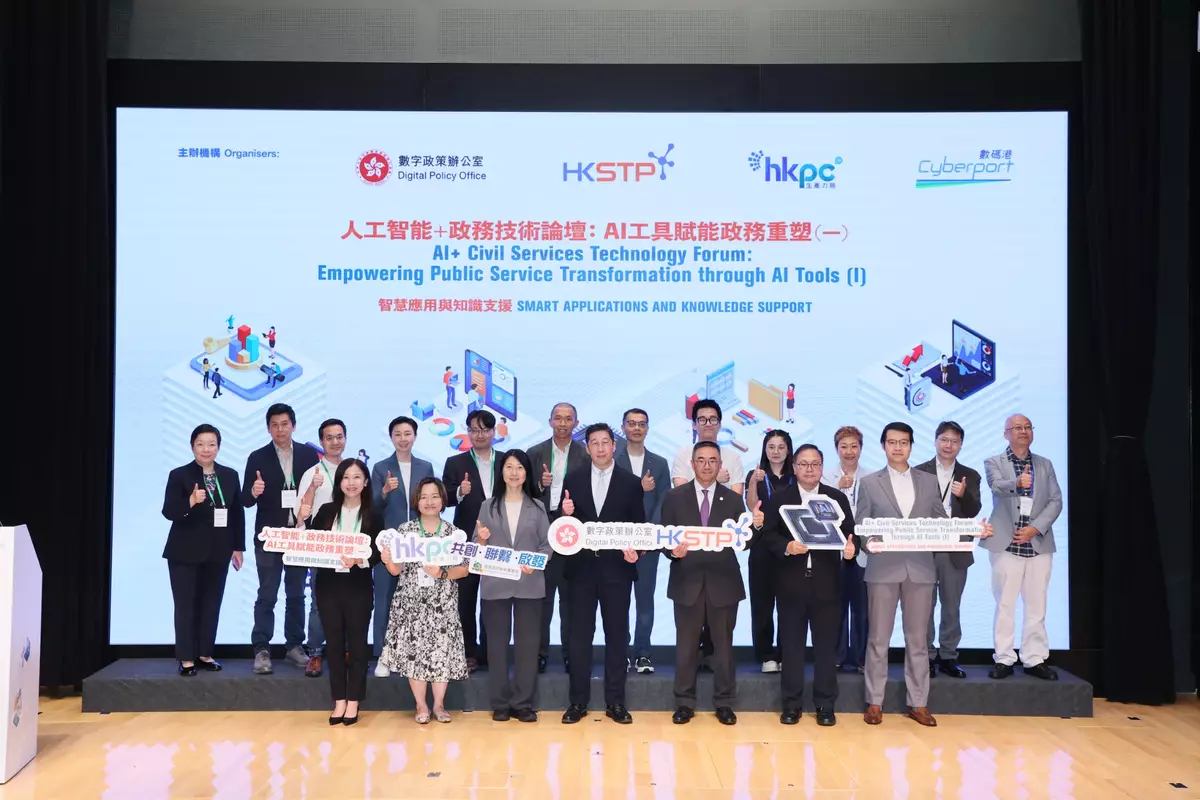
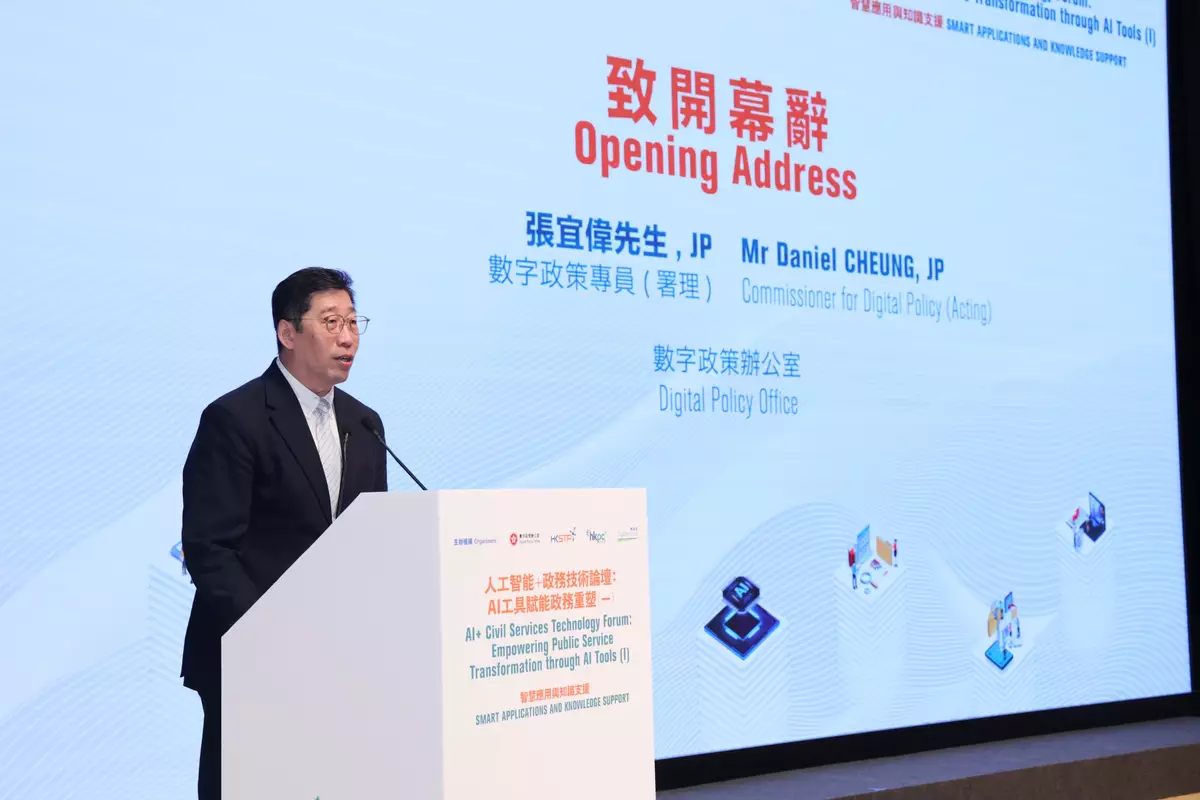
The Digital Policy Office (DPO) held the first technology forum under the "AI+ Civil Services: Empowering Public Services Transformation through AI Tools" Series today (June 18) at the Hong Kong Science Park, officially starting a series of activities focused on exploring how AI tools can reshape public services. Themed "Smart Applications and Knowledge Support", the forum was held in a hybrid format and attracted over 1 000 professionals from nearly 100 government departments, as well as public and private organisations, to jointly explore the practical application of AI in transforming public services.

The Acting Commissioner for Digital Policy, Mr Daniel Cheung, said in his opening address that AI is reshaping the global technology and economic landscape at an unprecedented pace. The Hong Kong Special Administrative Region Government is proactively aligning with the strategic deployment under the National 15th Five-Year Plan and the national "AI+" initiative, continuously promoting AI adoption in public services to drive economic and social transformation and upgrading. He also appealed to government departments and the industry to continue working together to promote the practical applications of AI for the benefit of the public.

The forum invited multiple government departments, public organisations and technology companies to share specific applications and practical experiences on how they leverage AI tools to enhance the effectiveness of public services, engaging in in-depth exchanges and discussions. Among them, the Hong Kong Customs and Excise Department and the Water Supplies Department shared their successful experiences in applying AI tools. The Hong Kong Science and Technology Parks Corporation (HKSTP) and the Hong Kong Productivity Council (HKPC) also introduced the latest developments in AI technology and related solutions. The forum also featured a number of exhibition booths showcasing the industry's latest real-world applications of AI, enabling government colleagues to gain a deeper understanding of how to innovate public services through AI.

The forum was organised by the Smart Government Innovation Lab (Smart Lab) under the DPO in collaboration with the HKSTP, the HKPC and Hong Kong Cyberport Management Company Limited. The Smart Lab has been committed to connecting the Government with the innovation and technology sector, actively fostering close partnerships between local start-ups, small and medium-sized enterprises, and government departments. Through regularly organising promotional activities and technology exchange workshops, the Smart Lab supports and assists government departments in accelerating the introduction of local advanced innovative technology products and solutions to facilitate business matching and achieve mutually beneficial outcomes.

To promote the wider adoption of AI across government departments, the DPO will continue to launch various promotional activities and technology forums. Interested parties are encouraged to stay engaged and participate in the upcoming events. For more details, please visit the Smart Lab website (www.smartlab.gov.hk/en/).

Digital Policy Office holds "AI+ Civil Services: Empowering Public Services Transformation through AI Tools" Series technology forum Source: HKSAR Government Press Releases

Digital Policy Office holds "AI+ Civil Services: Empowering Public Services Transformation through AI Tools" Series technology forum Source: HKSAR Government Press Releases

Digital Policy Office holds "AI+ Civil Services: Empowering Public Services Transformation through AI Tools" Series technology forum Source: HKSAR Government Press Releases
Digital Policy Office holds "AI+ Civil Services: Empowering Public Services Transformation through AI Tools" Series technology forum Source: HKSAR Government Press Releases
Digital Policy Office holds "AI+ Civil Services: Empowering Public Services Transformation through AI Tools" Series technology forum Source: HKSAR Government Press Releases
Digital Policy Office holds "AI+ Civil Services: Empowering Public Services Transformation through AI Tools" Series technology forum Source: HKSAR Government Press Releases

Recommended Articles