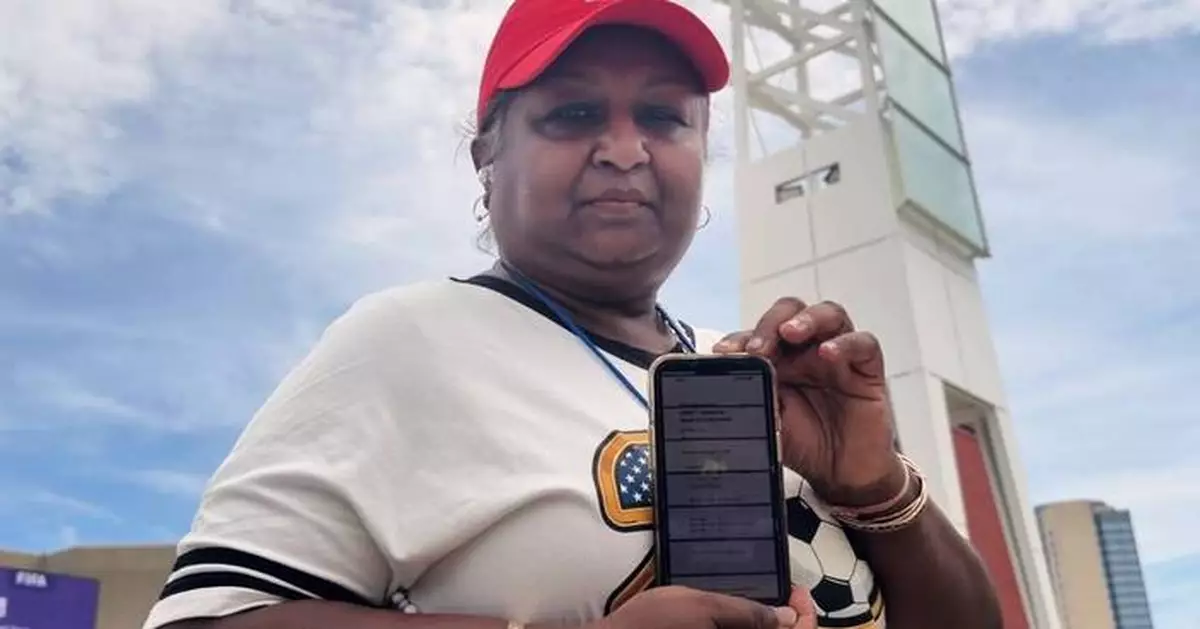
ATLANTA (AP) — Bina Ramroop broke down in tears when she realized she wasn't going to get the World Cup tickets she had bought for her grandson's 13th birthday.
As thousands poured into Atlanta's Mercedes-Benz Stadium on Monday to see Spain face Cape Verde in what turned out to be a remarkable scoreless draw, Ramroop stood outside, increasingly stressed as she went back and forth for hours between StubHub representatives on the phone and FIFA representatives in the ticket booth. Each blamed the other.
No one could figure out why the tickets Ramroop bought months ago on StubHub for $485 apiece couldn't be transferred from the original seller to the FIFA ticketing app. StubHub offered her a refund and, as Ramroop heard the crowd roar for the start of the match, she knew she had no choice but to give up and take the offer.
“I didn’t want a refund, I didn’t want my money back,” Ramroop said. “I wanted to go to the game.”
The World Cup has delivered thrills on the pitch, but fans have flooded social media with complaints about tickets that never arrived, orders that were canceled at the last minute and hours they spent trying to sort out problems between FIFA’s ticketing system and outside resale platforms. The vast majority seem to be about industry titan StubHub, but people who bought through competitors such as SeatGeek and Vivid Seats have also reported issues. Interviews with fans and industry experts show that some cases stem from technical glitches in the transfer process, while others could involve sellers who never had tickets to deliver in the first place, though StubHub denies such sales happen on its platform.
FIFA has urged fans to buy resale tickets through its own marketplace, where it slaps a 30% surcharge on every resold ticket — 15% each from the buyer and seller. But many fans bought through other resale sites, either out of habit or because those sites have lower prices or are easier to navigate.
Ramroop didn't realize she was taking a risk when she bought through StubHub, which she had used in the past without issues.
As she and her grandson Elijah Gomes took the long, lonely train ride back to the Atlanta suburbs, Elijah followed the score on his phone. The match had ended scoreless, and he tried to cheer up his devastated grandmother by telling her they hadn't missed much after all (Cape Verdeans would beg to differ ).
“He’s telling me, ‘Grandma, it’s OK, Grandma.’ And he’s trying to console me,” Ramroop said the next day.
She was hardly alone. An Associated Press journalist witnessed more than a dozen frustrated fans at the match who said they were stuck in similar situations.
StubHub blamed FIFA for the transfer problems that buyers like Ramroop have experienced. In a statement, it said FIFA has “poor technology infrastructure,” enacted last-minute transfer restrictions and didn't launch its new ticketing app until a few weeks before the tournament. The company also called out organizers that “take anti-competitive actions” that limit where fans can buy and sell tickets.
Asked about the technical issues, FIFA on Wednesday reiterated that sales through its official site are guaranteed to go through.
Industry observers say the problems appear to stem from more than one cause. For some, it may indeed be technical glitches — an issue that StubHub says is “very, very rare” and one that it is hard at work to solve. For others, they say it's likely a more longstanding scourge: speculative sellers.
Scott Friedman, an industry veteran and co-founder of a consultancy called the Ticket Talk Network, said some sellers list tickets before they actually have them, betting that prices will fall closer to the event so they can buy the tickets at a better price later. But because World Cup ticket prices have surged since the tournament began, those sellers have been forced to either buy expensive tickets to fulfill their orders or cancel and accept penalties from resale platforms. StubHub's penalties are typically 200% of the ticket price, Friedman said.
“This is not new at all,” said Friedman, pointing to other high-profile events where frustrated fans were left empty-handed, including Taylor Swift's Eras tour. “This has been going on, but it’s making global news because it’s the World Cup.”
StubHub says it requires sellers to prove they have tickets before they list them.
But regardless of the reason for the canceled sales, Friedman said “StubHub should fill every single order to make sure fans get in the biggest global sporting event that happens every four years.”
That’s what many fans say they expected when they purchased through StubHub.
StubHub’s FanProtect Guarantee promises replacement tickets or a refund if tickets fail to arrive. But the policy repeatedly says those remedies are provided at StubHub’s “sole discretion,” meaning the company can choose a refund instead of securing replacement seats.
“That is pretty explicit language,” said Michael McCann, a sports law expert at the University of New Hampshire. McCann noted that a buyer could try to challenge the language under state consumer protection laws, but it would be an uphill battle.
Pape Ndaw is crestfallen that the high school graduation gift he got for his son — tickets for them to see the Netherlands and Japan near their home city of Dallas — never arrived.
He bought the tickets for about $550 apiece in December. Then, two days before the June 14 match, he received an email from StubHub telling him, “The seller can’t deliver your original tickets.”
Ndaw accepted store credit rather than a refund, thinking he would use the funds to quickly get replacements, only to then realize that the cheapest last-minute tickets were going for more than $1,500 each. Not only were they not going to get to go to the game, but Ndaw said StubHub rejected his belated request for a refund instead of store credit.
Breaking the news to his soccer-obsessed son was brutal, Ndaw said.
“It was a disastrous thing,” he said. “He had told all his friends that he was going to that game. He literally cried. I mean, he is a 17-year-old kid, but he cried.”
Others fared somewhat better.
Patrick O’Neil of Pittsboro, North Carolina, traveled to Atlanta with his wife, son and relatives after purchasing five tickets through StubHub for the Spain-Cape Verde match. Two tickets transferred successfully, but three never arrived.
O’Neil’s 15-year-old son and his uncle ended up using the two tickets, while O’Neil, his wife and another relative watched from a nearby bar.
After local media caught wind of their ordeal, O’Neil said StubHub contacted the family and offered tickets to another game. Since the family had already bought tickets to one, though, he and his wife asked the company to instead give the seats to local nonprofit Soccer in the Streets so they could go to people who otherwise might not be able to attend a match.
“StubHub is not evil, but they’re part of the whole system that makes it really hard for just normal kids and people who might want to see a match get to go,” O'Neil said.
On Thursday, a StubHub representative confirmed to the AP that the company would honor the O’Neils’ request and send tickets to the nonprofit.
AP World Cup: https://apnews.com/hub/fifa-world-cup

Patrick O'Neil, his wife, Gina Difino, right, and their 15-year-old son, Aidan, attend the World Cup Group A soccer match between Czechia and South Africa in Atlanta on Thursday, June 18, 2026. (AP Photo/R.J. Rico)
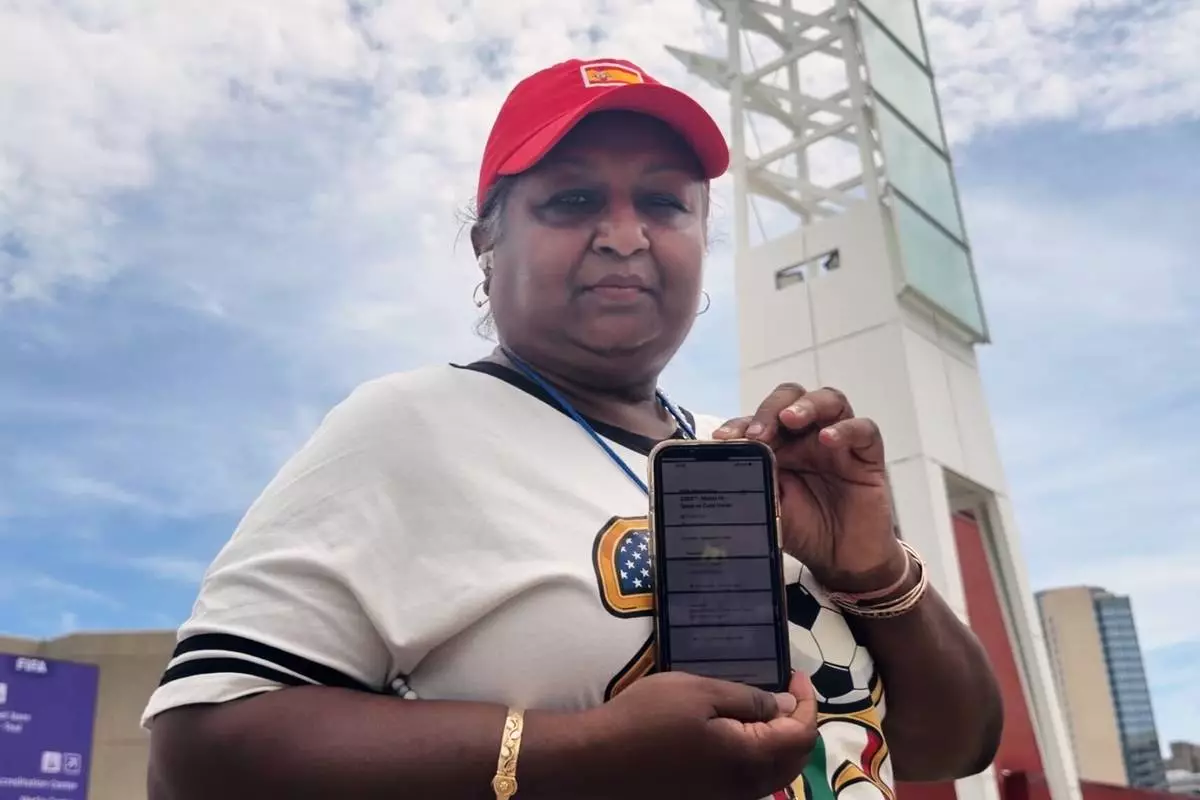
Bina Ramroop holds proof of the ticket she bought through StubHub for the World Cup Group H soccer match between Spain and Cape Verde in Atlanta on Monday, June 15, 2026. (AP Photo/Emilie Megnien)