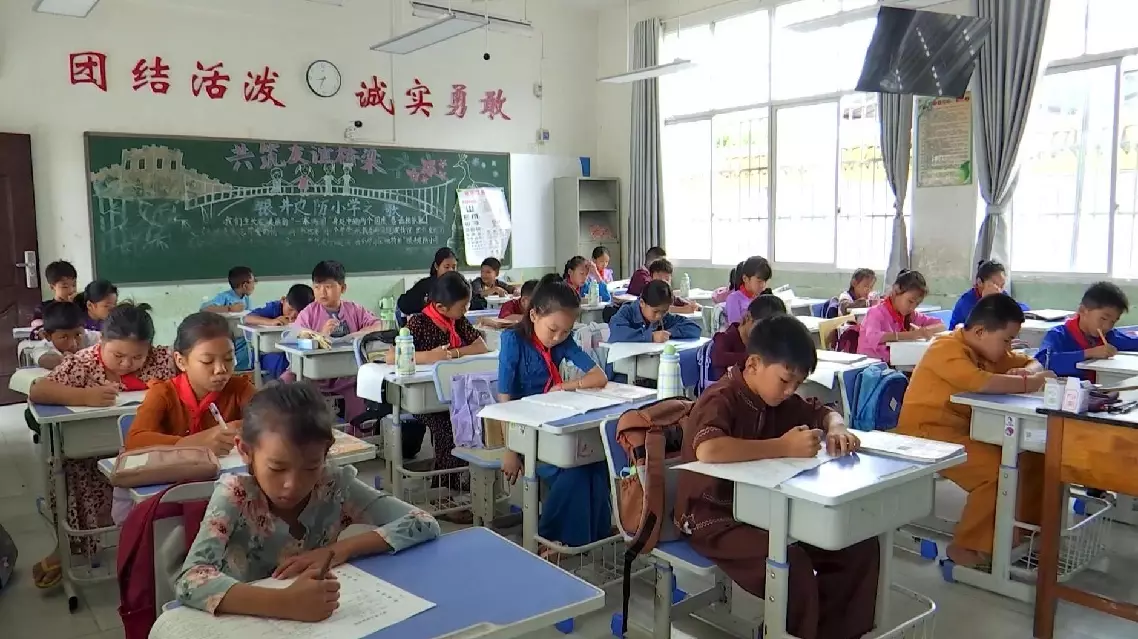
Chinese and Myanmar children sit side by side in the same classrooms at a border primary school, sharing what the two nations call a "Paukphaw" — or fraternal — kinship.
Yinjing Primary School is in Yinjing village in Ruili, a city in southwest China's Yunnan province, adjacent to Manhero village in Myanmar. Residents of the two villages share similar languages and customs.
Just 300 meters from the border, the school is permitted to admit students from Myanmar border villages. Of more than 100 students attending the school, students from the neighboring country now make up nearly a quarter.
Myanmar students pass through the border gate daily to attend classes. During Monday morning assemblies, students sing a school song that includes the Burmese word "Paukphaw".
Nang Yin May, a student from Myanmar, has been studying here for three years.
Since beginning her studies at the school, Nang has been introduced to classic writings from China's Tang period, from 618-907.
"I really love poetry from the Tang Dynasty, so I want to master Chinese. My dream is to stay in China and become a teacher so I can help and mentor other kids from Myanmar who want to study here, just like me," she said.
With help from border police, students like Nang can reach the school in less than half an hour.
"Every morning they arrive at the border gate at 7:40 a.m. We do some checks and distribute entry permits to them. It takes them 15 minutes to be cleared by customs and reach the school in 25 minutes in total," said Yang Xiao, a police officer at the Yinjing border checkpoint.
At first, though Nang was eager to learn Chinese, the unfamiliar environment presented challenges and left her feeling timid.
"When I first came here, I couldn't speak Chinese very fluently, so I didn't talk much and had no friends," the young pupil said.
That changed when two of her classmates, Xiang Lun and Men Wang, reached out to Nang. The three girls live in two different countries but speak the same Dai language. "She couldn't understand Chinese, so we translated it into the Dai language. Once, she couldn't solve a math problem because she didn't understand it, so we translated it into Dai for her," said Men.
From that point forward, thanks to their shared language, Nang was able to turn to classmates and teachers for help with difficult lessons and gradually integrate into school life.
The three girls are now best friends, embodying the Paukphaw friendship between the two countries.
Nang soon gained a firmer grasp on the Chinese language and quickly developed a love for reading. In particular, she enjoys the classic Chinese novel "Journey to the West." She likens bond with her two best friends to the four main characters in the book, who work together to overcome difficulties and never leave each other behind.
"I'm touched by the solidarity and friendship among the four characters — a master and three disciples. So when I encounter difficult problems, I discuss and solve them together with my friends, and we help each other out," she said.
The three girls will soon represent their school in a speech contest in Yunnan's Dehong Dai and Jingpo Autonomous Prefecture. In preparation, they help each other overcome fluency issues, looking forward to shining together on a larger stage.
Myanmar students find 'Paukphaw' friendship at border school in China