Skip to Content Facebook Feature Image

Regional partnership helps Fujian, Ningxia combine strengths in developing smart industries

China

China

China

Regional partnership helps Fujian, Ningxia combine strengths in developing smart industries

2026-06-19 17:32 Last Updated At:22:17

For three decades, China's coastal province of Fujian has partnered with landlocked drought-prone Ningxia Hui Autonomous Region in diverse industries, with smart agriculture and homegrown power-grid technologies now leading the charge.

The cooperation has drawn many companies in east China to Ningxia, boosting local development and offering job positions to local residents.

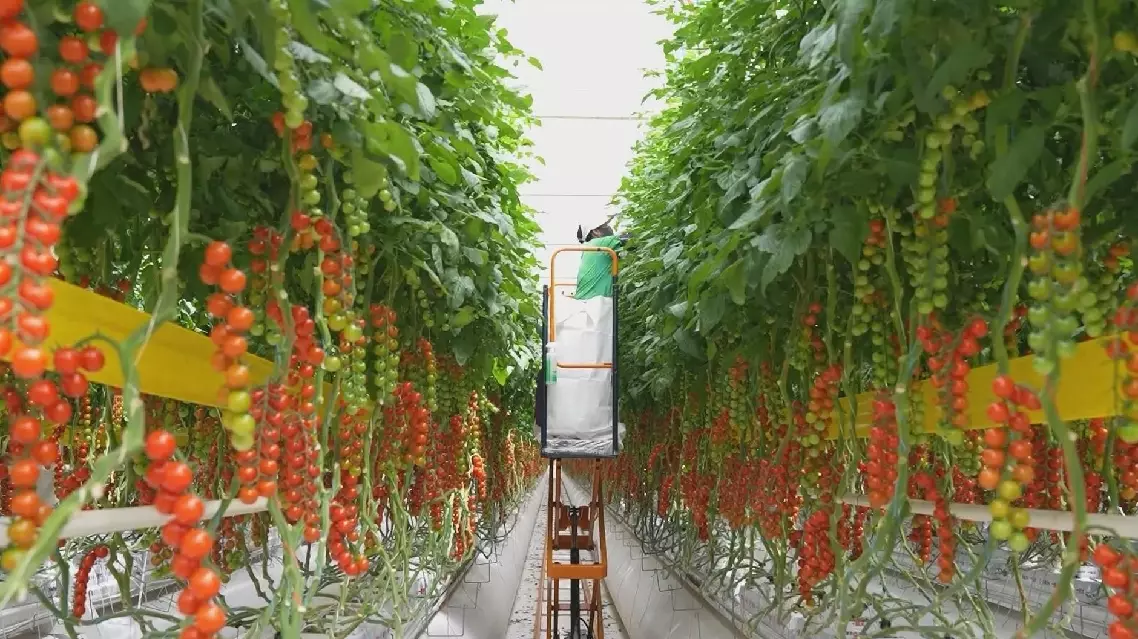
At a smart agriculture park in Minning Town, home to an industrial park jointly built by Fujian and Ningxia that has attracted 53 companies and generated over 1 billion yuan (about 147.72 million U.S. dollars) in output value, tomatoes are growing year-round under intelligent control.

Smart drip irrigation delivers nutrients directly to plant roots when light, temperature and humidity reach optimal levels. Rooftop vents open and close automatically, while rainwater is collected and recycled to cut waste.

The company chose Ningxia as its tomato growing base for its good natural environment, plenty of sunshine, and favorable policies.

"Ningxia has a good natural environment with abundant sunshine and good temperature-sunlight synchronization. In addition, the local government provides strong support for our project, offering substantial discounts on land use and natural gas prices," said Zhang Xulong, manager of the agricultural park.

The smart agriculture project is just one example of Fujian-Ningxia industrial collaboration.

The regional collaboration between Ningxia and Fujian, which has been shifting from one-way aid to shared growth, also helps local firms in Ningxia expand across China.

On the power-transmission front, a Ningxia local company called Huahe Technology has developed a distinctive niche.

The firm produces integrated protective insulation devices that guard against bird damage, ice buildup, and high winds, which are common causes of power-line failures.

The company also independently developed an insulator-inspection robot that can be deployed via drone, eliminating the need for crews to climb high-voltage towers.

Huahe Technology itself is a product of the Fujian-Ningxia partnership -- its brand trademark is held by a Fujian-based firm, while its research and development and manufacturing are rooted in Ningxia, embodying the integration of eastern capital and western resources.

"Our company's integrated protective insulation devices and robotic products are used in the operation, maintenance, and repair of high-voltage transmission lines in China. We have extensive cooperation with companies in northwest, northeast, and east China. Our anti-icing spraying robot project in Handan, Hebei Province, has shown good performance," said Yang Jianhua, production director of Huahe Technology.
Regional partnership helps Fujian, Ningxia combine strengths in developing smart industries


Regional partnership helps Fujian, Ningxia combine strengths in developing smart industries
Myanmar President Min Aung Hlaing has lauded the achievements of China's modernization drive, noting that its development model offers valuable lessons for Myanmar to learn from.

He made the comments in an interview with China Media Group in Beijing on Wednesday, during his five-day state visit to China which ended on Friday. The trip marked his 13th visit to the country and his first since assuming the office of president.

During his extensive past tours, Min Aung Hlaing visited multiple Chinese provinces and cities, gaining firsthand insight into the nation's sweeping modernization efforts.

"Since entering the new era, China has made remarkable progress, and this is clear for all to see. China is developing at a rapid pace, and I often see news reports about China's technological innovation. China's younger generation is diligent and enterprising. They are the main force driving the country's development. I have visited many provinces and cities in China, and development achievements can be seen across the country, not only in the places you mentioned. In addition, China's development is relatively balanced. For example, Beijing, Shanghai, Chongqing and Guangzhou are roughly on par in terms of development, with only slight differences among them. Therefore, China's development model is worth learning from," said Min Aung Hlaing.

He outlined a wide array of high-value sectors ripe for expanded partnership, including advanced engineering, electronics, aerospace, agriculture, and industrial manufacturing.

"China offers valuable lessons for Myanmar in many fields. Infrastructure development is one key area where the two sides should focus their cooperation. Besides, China has advanced engineering, electronics, aerospace, seed breeding, and industrial manufacturing - all of which offer significant cooperation opportunities. We should continue to broaden the scope of Myanmar-China cooperation, while also increasing investment between the two sides and expanding the scale of bilateral trade," said the president.

China has been Myanmar's largest trading partner for many years, as well as its largest source of imports and most important source of investment. Bilateral trade reached 19.4 billion U.S. dollars in 2025, up 19.1 percent year on year, according to official data.

Myanmar president hails China's modernization achievements, calls for expanded cooperation

Myanmar president hails China's modernization achievements, calls for expanded cooperation

Recommended Articles