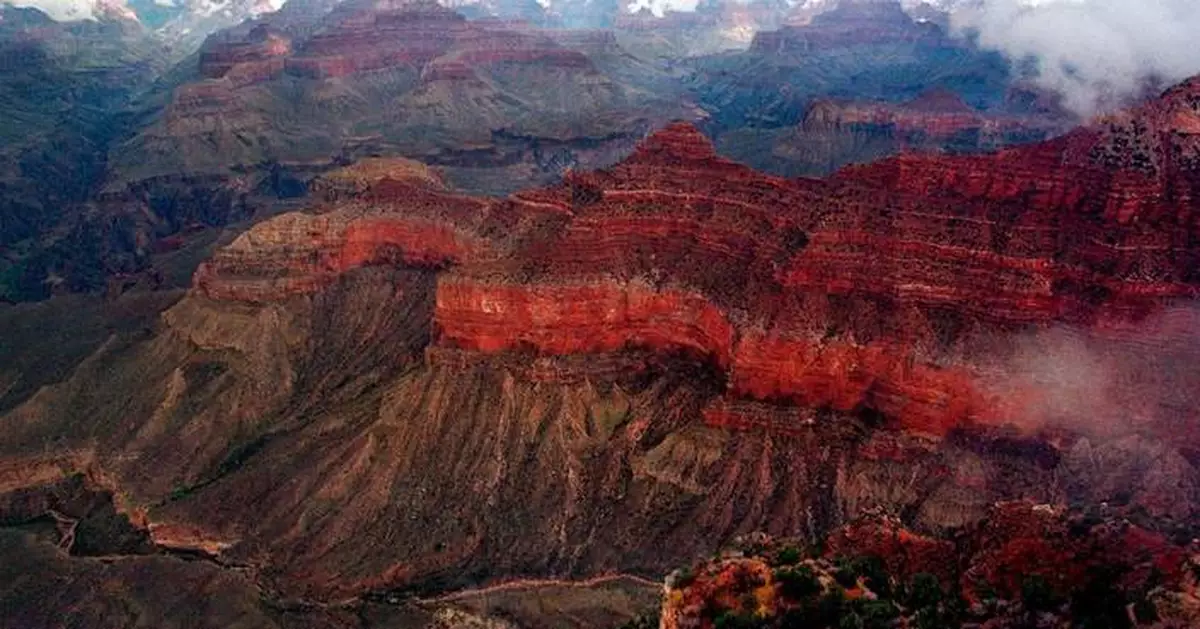
GRAND CANYON NATIONAL PARK, Ariz. (AP) — Visitors to Grand Canyon National Park are being warned about extreme heat that will plague the popular destination early next week after a recent increase in heat-related incidents in the inner canyon, including the deaths of three hikers.
The U.S. National Weather Service issued an extreme heat watch at the Grand Canyon for midday Monday through Tuesday, forecasting temperatures that could reach or exceed 110 degrees Fahrenheit (43 degrees Celsius) at the low-elevation Phantom Ranch.
Hikers are “strongly advised” to avoid hiking in the middle of the day, the U.S. National Park Service said in a release this week following a “recent influx of heat-related incidents.”
An extreme heat watch was in effect on June 16 when two hikers, aged 67 and 68, were found dead on the North Kaibab Trail, which NPS describes as the most difficult of the major inner canyon trails. NPS said they appear to have succumbed to symptoms of heat-related illness.
A third person, 72, died June 12 along the South Kaibab Trail after becoming ill from the heat, NPS said.
About 90 miles (145 kilometers) south, Oak Creek Canyon visitors and residents were evacuated late Friday as a wildfire burned hundreds of acres just north of Sedona, Arizona.
Much of the western U.S. from the Rockies to the Pacific Coast were getting above-average temperatures Saturday and anticipating even hotter weather early next week. Officials also warned the prolonged dry, hot weather and relatively low humidity increased the risk of fire danger throughout the area.
Park and weather officials alike emphasize to Grand Canyon visitors that hiking conditions can be deceiving. Temperatures at the rim of the Grand Canyon are often 20 to 25 degrees F cooler than what hikers will experience at the bottom of the canyon.
“It's just a hot place at the bottom of the Grand Canyon,” said Justin Johndrow, a meteorologist with the National Weather Service office in Flagstaff, Arizona. Johndrow warned that the region is approaching the hottest period of the year before the rain during monsoon season later in the summer offers some relief from the heat.
Hikers may have cooler temperatures and an easier time going downhill to start the descending trails, but they face an intense climb of thousands of feet in elevation and much hotter bottom-of-the-canyon temperatures to get back up. Those conditions can cause heat illness symptoms to sneak up on visitors.
“That’s very strenuous even on a mild day," Johndrow said of the hike back up to the rim. "Throw in temperatures of 105 to 110 degrees and that causes some pretty bad problems.”
Park officials advised visitors to avoid strenuous hiking in the middle of the day.
A federal interagency team and at least a dozen local agencies were working to combat the fire burning roughly 500 acres (202 hectares) of very steep and rough terrain near Oak Creek Canyon, said Dick Fleishman, fire information officer with the southwest area complex incident management team.
The fire is concentrated in the Red Rock-Secret Mountain wilderness area about seven miles north of Sedona, Arizona, but it has started to creep into the Coconino National Forest. Firefighters are working to contain the burn, prevent it from moving toward Oak Creek Canyon, where residents and visitors have been evacuated, or Sedona, and prepare for the possibility that it does.
Fleishman said the steep slope where the fire is burning, the property at risk nearby, the heat firefighters are working in and the risk of post-fire flooding caused by rain rushing down the slope are among the reasons the Pocket Fire is particularly concerning.
“This fire ramped up in complexity quickly," he said. “We want to try and keep it as small a footprint as possible."
About 30 miles (48 kilometers) of the adjacent state highway was closed in both directions. Evacuations were issued for visitors and residents near Oak Creek Canyon, which attracts millions of visitors each year.
“For June 20," Fleishman said of his drive through the area, “I've never seen it that quiet.”
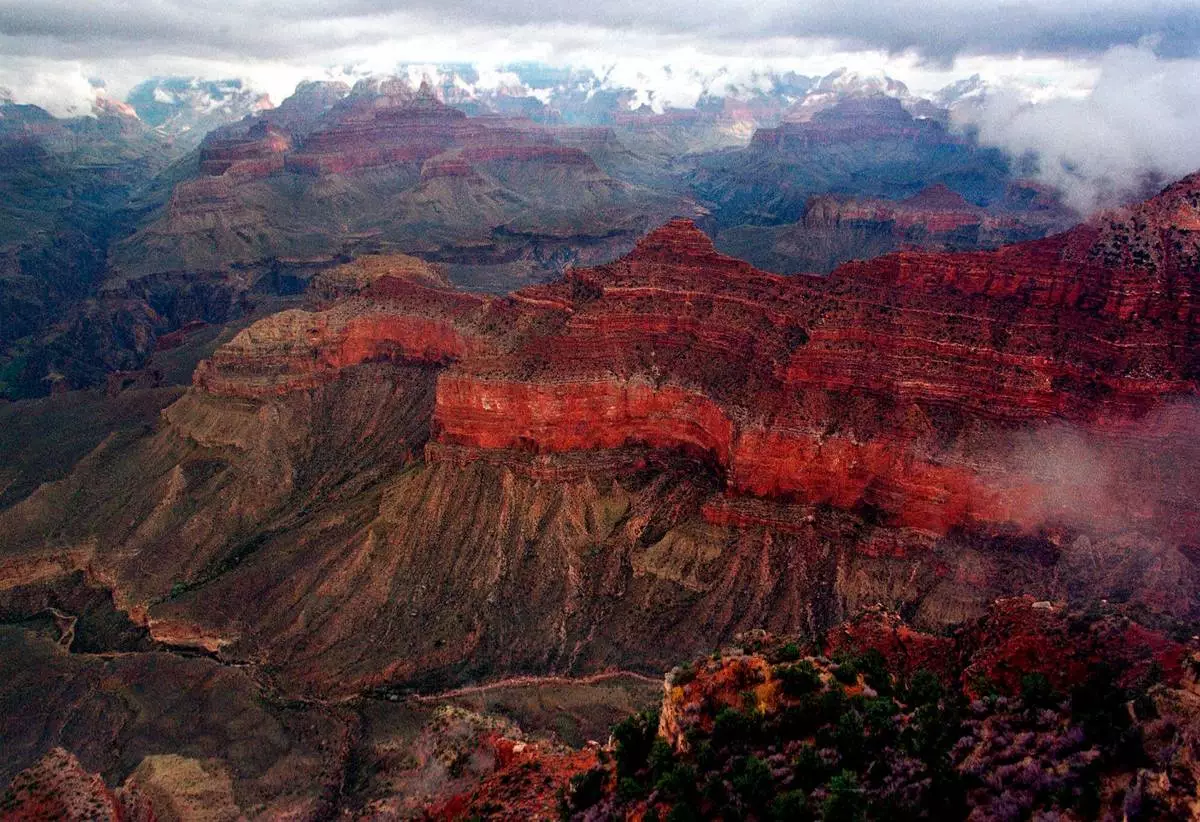
FILE - The Kaibab Trail, running right to left at center, at Grand Canyon National Park on Jan. 20, 2001. (AP Photo/Matt York, File)
The early results are in: This U.S men's national team is for real in this World Cup.
With a quick and creative offensive attack producing goals in front of stadium-shaking home crowds, the Americans have already won their group and booked their place in the knockout round. A final group stage match against Turkey in Los Angeles awaits before the pressure ramps up again.
The question now is just how far can they go? The optimism and expectations of a deep run in the tournament are rising quickly.
The American players seem eager to embrace what might have seemed inconceivable for a big nation with a relatively shallow pedigree in international soccer.
“I don’t think it’s ridiculous to say that we want to win it,” U.S. defender Chris Richards said after Friday's 2-0 win over Australia. “We want to lift a trophy by the end of this.”
Few would have predicted this kind of quick success, said striker Folarin Balogun, who scored twice in the opener against Paraguay.
“You know, (if) someone said before the tournament ‘Two games and you’re through to the knockouts,’ I think we all would have took it,” Balogun said. “We’re delighted.”
The first two matches saw the U.S. attack Paraguay and Australia with an energy, skill and creativity on offense rarely seen by the Americans in the World Cup.
The U.S. has won consecutive World Cup matches for the first time since 1930. And the six goals in the first two matches are one short of the team record for a World Cup.
The architect is coach Mauricio Pochettino, an Argentine who was best known for his European club stints with Tottenham, Chelsea and Paris Saint-German. He had never coached a national team until he was hired by the U.S. in 2024 with an eye on this year's World Cup.
As a co-host, the U.S. was an automatic qualifier for the tournament, allowing Pochettino more time to experiment and craft the lineup he wanted. He was blunt earlier this month when he said the U.S. does not have any players that rank among the top 100 in the world.
But the lineup he has put on the field the first two matches has been rock solid and maybe even better than expected. The players credit him with instilling a tougher, more resilient mindset.
Pochettino said after the win over Australia, he could feel the fan support reverberating throughout the stadium in Seattle.
“Today, even if I'm not American, after the game I was emotional," Pochettino said. “It was an amazing and perfect connection between the energy from the stands and the team. This makes us feel very proud.”
Because the U.S. has already won its group, Pochettino could experiment with his lineup for the match with Turkey on June 25. And it could provide extra rest for star midfielder Christian Pulisic, who missed the match with Australia because of a calf injury.
Pulisic, who plays for AC Milan, is considered the United States' best player, but his absence also allowed the U.S. to show off some depth in the lineup.
With Pulisic out, Pochettino started striker Ricardo Pepi, and Pepi combined with Balogun on the run that created the first goal of the match in the 11th minute.
“We know how vital Christian is to the team and how much he can contribute in the game,” said Alex Freeman, who scored the second goal against Australia. “For us it was, we have Ricardo Pepi, who came in and had an amazing game. I think that just shows how (good) our roster is.”
Still, the U.S. will want Pulisic's steady hand and creative playmaking as they get deeper in the tournament.
He has scored 33 goals in 87 international appearances, including the game winner against Iran in the 2022 World Cup that sent the U.S. to the round of 16.
The U.S. will enjoy the home support for as far as they can go in the tournament. It can be considerable.
The U.S. is co-host of the tournament with Canada and Mexico. Since 1930, the host nation has won the World Cup six times, most recently France in 1998.
When Mexico hosted in 1970 and 1986, it reached the quarterfinals both times. In 2002, co-host South Korea reached the semifinals. Host Russia reached the quarterfinals in 2018.
The U.S. finished third in the inaugural World Cup in Uruguay in 1930. Its best finish in the modern era of soccer was the quarterfinals in 2002.
When the U.S. hosted the World Cup in 1994, the underdog Americans played in front of huge crowds and slugged their way through the group stage before being eliminated by Brazil.
Back then, just reaching the knockout round was the goal and a huge achievement for a group of players that punched above their weight.
The expectations this time are for much more, and growing with every goal in the back of the net.
“I think people can see what we’re capable of as a team,” Pepi said.
AP World Cup: https://apnews.com/hub/fifa-world-cup
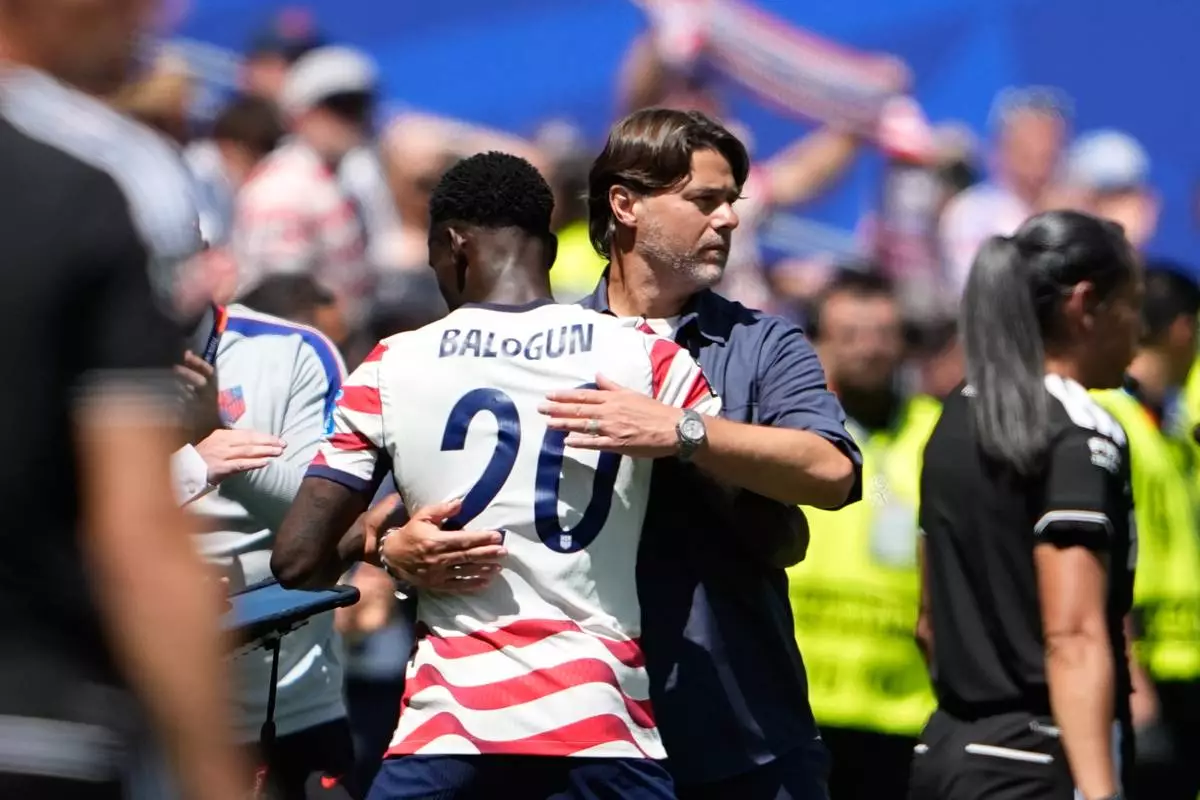
United States head coach Mauricio Pochettino embraces United States' Folarin Balogun after he was substituted during the World Cup Group D soccer match between the United States and Australia in Seattle, Friday, June 19, 2026. (AP Photo/Lindsey Wasson)

United States head coach Mauricio Pochettino reacts after the World Cup Group D soccer match between the United States and Australia in Seattle, Friday, June 19, 2026. (AP Photo/Ted S. Warren)

US fans react after the World Cup Group D soccer match between the United States and Australia in Seattle, Friday, June 19, 2026. (AP Photo/Ted S. Warren)

United States' Joe Scally (23) and Alex Freeman (16) react after the World Cup Group D soccer match between the United States and Australia in Seattle, Friday, June 19, 2026. (AP Photo/Ted S. Warren)