Speech by FS at Hong Kong Investment Funds Association 19th Annual Conference
Following is the speech by the Financial Secretary, Mr Paul Chan, at the Hong Kong Investment Funds Association (HKIFA) 19th Annual Conference today (June 22):
Sam (Chairman of the HKIFA, Mr Sam Yu), Kelvin (Chairman of the Securities and Futures Commission, Dr Kelvin Wong), distinguished guests, ladies and gentlemen,
Good morning. It is a pleasure to join you at the Annual Conference of the Hong Kong Investment Funds Association - and what a special occasion it is, as we celebrate the Association's 40th anniversary. My heartfelt congratulations.
Forty years ago, the founders of this Association came together with a simple purpose: to give this industry a collective voice, shared standards, and a platform to engage with regulators. Four decades on, that purpose has been more than fulfilled. The HKIFA has grown into one of the most respected industry bodies in the region, and the industry it represents has grown with it - from a local marketplace to a global hub for cross-border capital.
Global capital allocation is undergoing a fundamental realignment, and this hub is where the flows are converging. In my conversations with investors around the world over the past two years, I have sensed a marked change: not mere optimism or pessimism, but a systematic reassessment. Many institutions have recognised that their allocation to this region has long been low. At the same time, China's leading technology enterprises are accelerating their integration into global market supply chains and industrial bases, generating real and substantial demand for international capital.
The convergence of these two forces has placed Hong Kong in an unprecedented position. But we must be candid: This position was not driven by external factors alone. It rests on the institutional foundations Hong Kong has built over decades - the common law system, an internationally respected regulatory framework, and professional market intermediaries - all operating within a constitutional framework that preserves our distinctive role, plus the steadfast support of the Central Authorities. In this fast-changing environment, the world is entrusting us with a new task, and our responsibility is to prove ourselves worthy of it.
The markets have already cast their vote. Last year, net fund inflows to Hong Kong-domiciled funds reached some $350 billion, and the momentum has carried into the first quarter of this year, with nearly $100 billion more. When the Securities and Futures Commission publishes its latest survey in July, I am confident we will see another encouraging set of numbers.
These numbers reflect something important. Hong Kong is no longer simply a marketplace for global capital to pass through. We are becoming their trusted steward. Then, what market conditions must exist for global investors to continue to increase their allocations here?
The answer spans multiple dimensions. First, the breadth and depth of investment products. Over the past two years, the number of exchange-traded products (ETPs) listed in Hong Kong has grown from fewer than 180 to more than 240, with assets under management approaching $650 billion, placing us firmly among the world's top three ETF markets. Several of these products even rank as the largest of their kind globally. This is not merely numerical growth; it means global investors can now allocate to gold, technology, cross-border indices, and even digital assets through Hong Kong, at a lower risk premium.
Second, the reliability and efficiency of financial infrastructure. We are advancing the establishment of an International Central Securities Depository that supports multi-asset custody, cross-collateralisation and cross-border settlement. The significance of this work lies not in the technology itself, but also in the efficiency of capital deployment that it will enable.
We also introduced several legislative amendments over the past few years to further enhance the competitiveness of our fund regimes, with generous tax concessions. I hope you would make good use of it.
Third, the continued deepening of connectivity. We have established collaboration with 20 exchanges worldwide, and are expanding dual listings and cross-border product offerings with more jurisdictions. Every move to collaborate reduces the institutional friction of cross-border capital allocation. We also spare no efforts in enhancing existing connect schemes. For example, as announced last week, with the support of the Central Authorities, treasury bond futures will be launched in August, complementing Bond Connect and Swap Connect to form a more complete risk-management toolkit for RMB assets. These arrangements are designed to give international investors hedging and pricing options when allocating capital to RMB assets.
Separately, the global reassessment of China's technological capabilities is not merely a valuation adjustment; it is a cognitive reframing. International investors start to understand more China's innovation ecosystem, and Hong Kong, with its international connectivity and familiarity with the developments on the Mainland, is uniquely positioned to provide that connection function.
This unique connection is most powerfully manifested in the Greater Bay Area. This region combines frontier research, abundant application scenarios, advanced manufacturing, and an international capital market. Such a combination is uncommon anywhere in the world. Hong Kong's role is to serve as the professional intermediary between this ecosystem and global capital.
And our role is not just a platform for them to raise funds for their global expansion, but also to help them align their corporate governance with international standards and best practices, gain greater recognition from investors and enhance their global visibility.
Ladies and gentlemen, as we broaden our product offerings, enhance our infrastructure, deepen our connectivity, and mobilise capital to support technology innovation, we are in fact doing one thing: building a credible bridge between global capital and Chinese technological innovation. The value of this bridge is ultimately not measured just by the size or ranking of our market, but by something more fundamental - trust.
That trust rests on a judiciary exercising powers independently, transparent regulations, and professional intermediaries that investors rely on when they choose Hong Kong. In choosing Hong Kong, they are not just choosing a market by geographical location; they are choosing a set of predictable behavioural standards. And it is the daily practice of those standards - in every product you list, every allocation you recommend, every project you commit to - that will define this industry's future.
That future began 40 years ago, when the founders established this Association to represent the industry. Today, you can be proud of the confidence you have inspired. I trust that the expertise, professionalism and integrity you bring to your work will continue to shape Hong Kong's position in the global financial system.
On this important milestone, I once again congratulate the Hong Kong Investment Funds Association on 40 remarkable years. I wish you continued success in many more decades ahead. Have a rewarding and fruitful conference. Thank you.
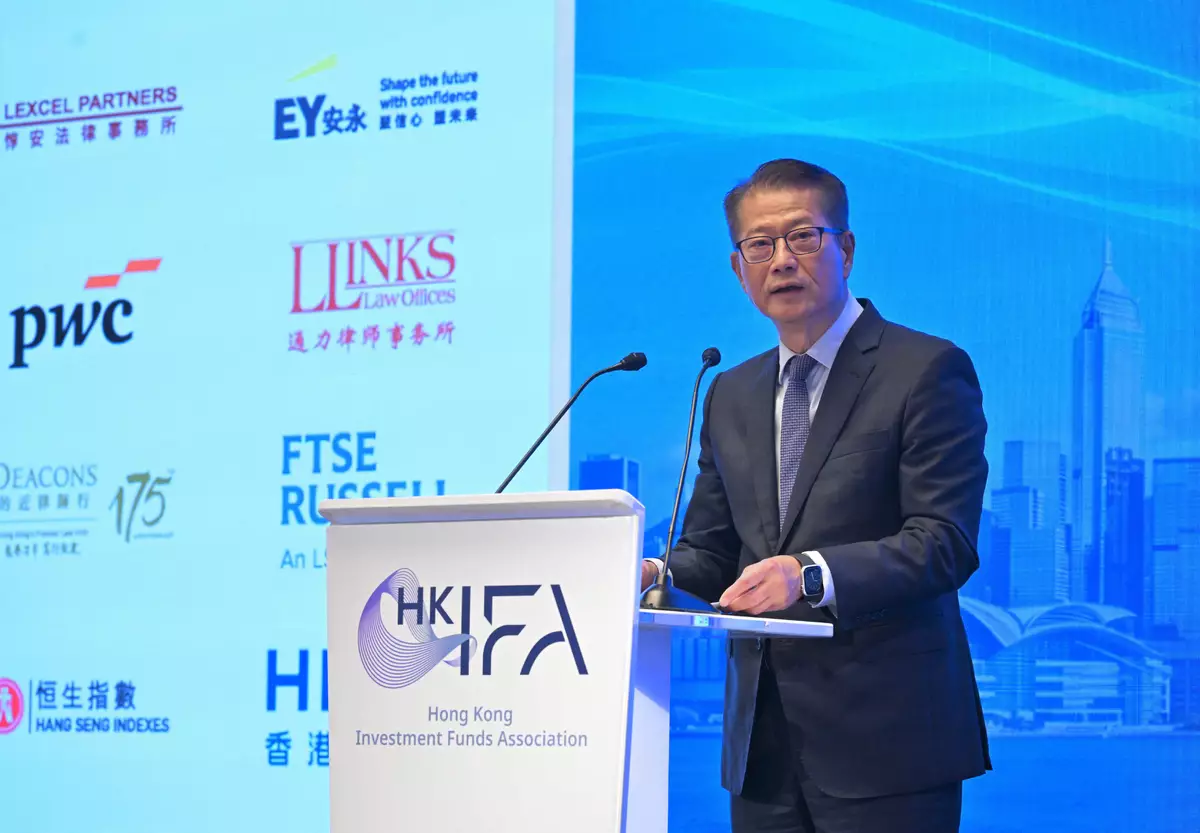
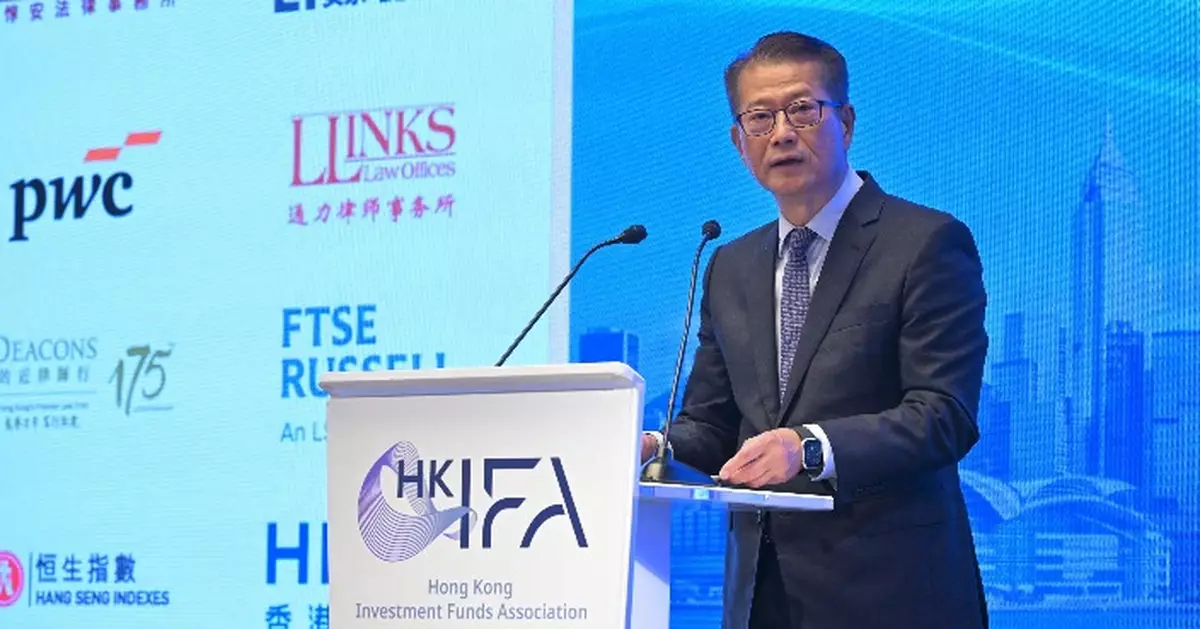
The Financial Secretary, Mr Paul Chan, speaks at the Hong Kong Investment Funds Association 19th Annual Conference today (June 22). Source: HKSAR Government Press Releases
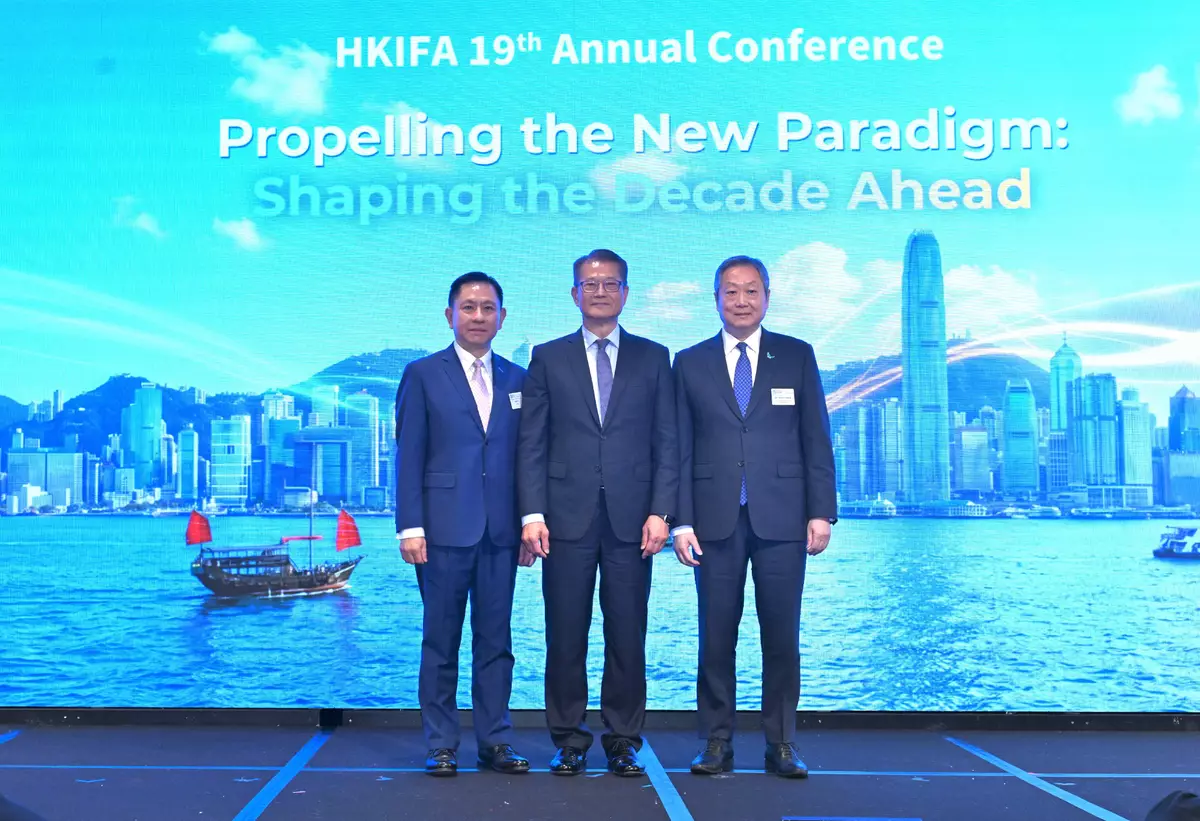
The Financial Secretary, Mr Paul Chan, attended the Hong Kong Investment Funds Association (HKIFA) 19th Annual Conference today (June 22). Photo shows Mr Chan (centre), with the Chairman of the HKIFA, Mr Sam Yu (left), and the Chairman of the Securities and Futures Commission, Dr Kelvin Wong (right), at the event. Source: HKSAR Government Press Releases