Skip to Content Facebook Feature Image

Former South Korean justice minister gets 25-year prison term for role in martial law declaration

News

Former South Korean justice minister gets 25-year prison term for role in martial law declaration
News

News

Former South Korean justice minister gets 25-year prison term for role in martial law declaration

2026-06-22 17:49 Last Updated At:17:50

SEOUL, South Korea (AP) — A former South Korean justice minister was sentenced to 25 years in prison on Monday after a court found him guilty of helping ousted President Yoon Suk Yeol carry out his brief declaration of martial law in 2024.

The Seoul Central District Court said it was clear Park Sung-jae played a key role in Yoon’s attempted power grab following the declaration of martial law on Dec. 3, 2024, including ordering ministry officials to assess detention capacities at correctional facilities to prepare for arrests of politicians.

Park also instructed officials to consider sending prosecutors to Yoon’s martial law command to support possible investigations into the former conservative leader’s political opponents and his unsubstantiated claims about liberal-led election fraud. Park also ordered immigration authorities to be prepared to impose travel bans, the court said.

Yoon’s martial law, which followed a yearslong standoff with liberals controlling the legislature, lasted only about six hours before lawmakers broke through a blockade of soldiers Yoon dispatched to the National Assembly and voted to overturn it, forcing Yoon’s Cabinet to lift the measure.

Judge Lee Jin-gwan said Park abandoned his responsibility to uphold the constitution and law by taking part in Yoon’s authoritarian push. He described Yoon’s martial law decree as a “self-coup” by an incumbent leader seeking to monopolize power. He said Park’s role would have been critical had Yoon succeeded in suppressing and removing his political opponents and preventing the legislature from demanding the lifting of martial law.

Park had denied the charges, saying he was merely carrying out duties required during a national emergency. Park’s lawyers didn’t immediately say whether they would appeal.

Yoon was impeached and suspended from office on Dec. 14, 2024, before being formally removed by the Constitutional Court in April 2025. He was arrested in July 2025, and multiple criminal trials are ongoing.

The Seoul court earlier sentenced Yoon to life in prison on rebellion charges. In a separate case, Yoon received a 30-year term for allegedly ordering drone flights over Pyongyang in October 2024 to manufacture tensions with North Korea and justify declaring martial law at home. Yoon has appealed both verdicts.

Park is the latest of several members of Yoon’s Cabinet to receive prison sentences for their roles in the martial law imposition.

Former Defense Minister Kim Yong Hyun received a 30-year term for his central role in mobilizing the military to enforce martial law and seeking the arrests of Yoon’s political opponents, as well as a separate 30-year sentence for planning drone flights over Pyongyang.

Ex-Prime Minister Han Duck-soo was initially sentenced to 23 years on charges that included attempting to lend procedural legitimacy to Yoon’s decree by securing its approval through a formal Cabinet meeting, but an appeals court later reduced his sentence to 15 years.

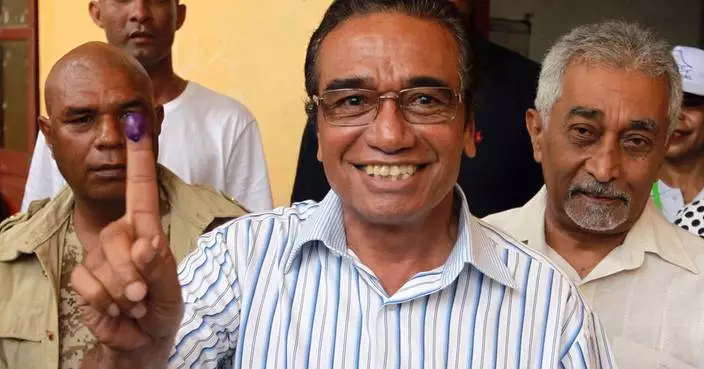
Former South Korean Justice Minister Park Sung-jae arrives for his trial at the Seoul Central District Court in Seoul, South Korea, Monday, June 22, 2026. (Kim Ju-hyung/Yonhap via AP)

Former South Korean Justice Minister Park Sung-jae arrives for his trial at the Seoul Central District Court in Seoul, South Korea, Monday, June 22, 2026. (Kim Ju-hyung/Yonhap via AP)
BUNIA, Congo (AP) — Confirmed cases in the Ebola outbreak in eastern Congo have reached 1,003, including 254 deaths, officials said, as tracing those who had been in contact with patients remains a major challenge.

A total of 100 people have recovered in the outbreak concentrated in the Ituri province since it was declared on May 15, Congo’s Ministry of Health said Sunday. At least 365 patients are in hospitals or in isolation, it said.

The Ebola outbreak caused by the rare Bundibugyo virus, which has no vaccines or treatment, was the worst ever in its first month. Officials admit there could be far more cases they still don’t know about and that the peak of the outbreak is still ahead.

Contact tracing remains a key issue for local authorities, who have only achieved a 55% coverage rate, the ministry said.

“If you want to control an outbreak, especially Ebola outbreak, you must know the index case. We don’t have confidence on when this outbreak started,” the Africa Centers for Disease Control and Prevention Director-General Dr. Jean Kaseya told The Associated Press last week.

Officials also are yet to identify the patient zero and trace more than 35,000 people who have come in contact with infected individuals as of last week, authorities said.

That’s partly because eastern Congo is also battling ongoing violence from rebels. In Ituri, attacks by the Islamic State group-backed Allied Democratic Force have cut off access to many villages and forced people to flee their homes, including those sheltering in overcrowded camps and others constantly on the move.

More than a month into the outbreak, officials believe the disease continues to outpace response efforts and no one knows its true scale.

At the Kigonze displacement camp in Bunia, the capital of Ituri province, camp officials said Friday that 10 people had died last week in unusual circumstances, raising the fear of a possible outbreak in the camp of over 20,000 displaced people.

There had been no Ebola case confirmed at the site, camp officials said, but added that the death rate was unprecedented and called for investigation.

The U.N. refugee agency has said at least 2 million people forcibly displaced from their homes, including over 320,000 refugees, live in areas at risk of Ebola in Congo.

In a statement on Friday, the agency said it was “deeply concerned by the accelerating spread” of the virus and “the growing risks it poses to displaced communities across the region.”

“If a disease or epidemic were to spread among the thousands of people living at this (Kizonge) site, it would be a real catastrophe given our already very precarious living conditions,” said Charité Banza, a civil society leader in Ituri.

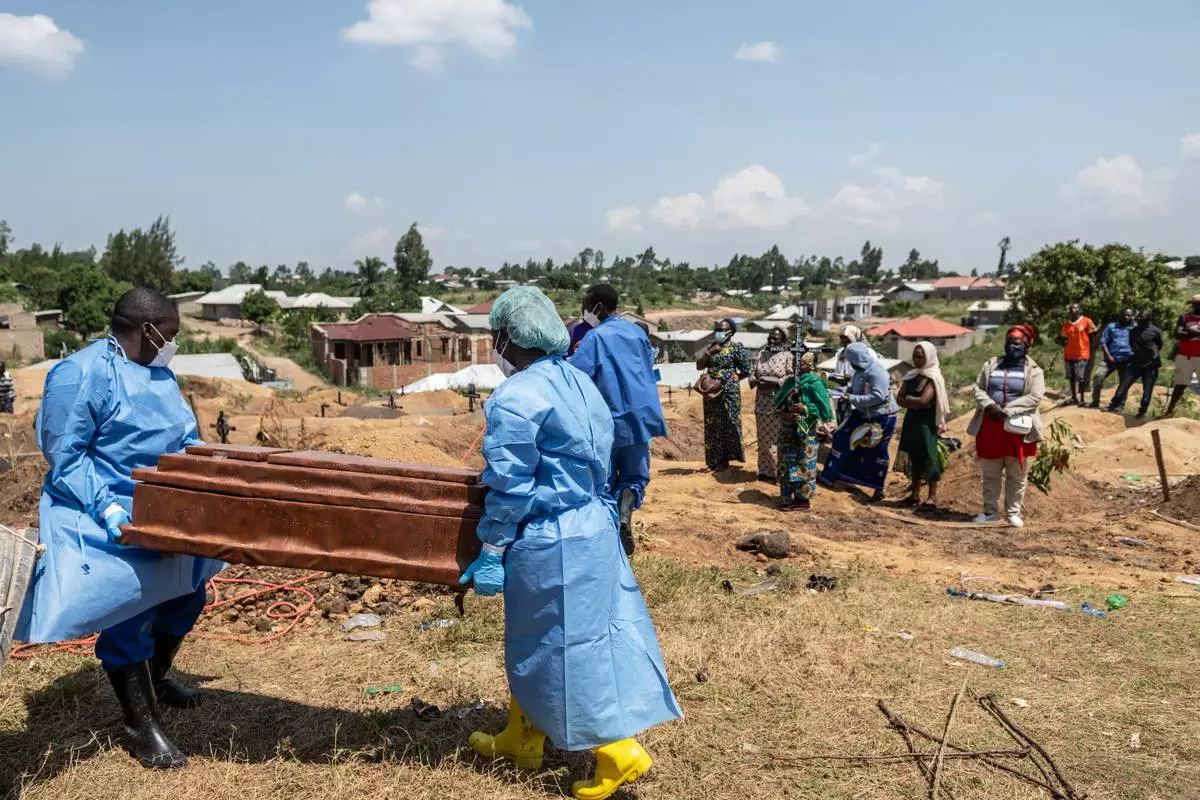
Red Cross workers prepare to bury Vanisa Anifa, a 6-month-old orphaned girl who died of Ebola, at the Bigo Cemetery, in Bunia, Congo, Friday, June 19, 2026. (AP Photo/Moses Sawasawa)

Red Cross workers prepare to bury Vanisa Anifa, a 6-month-old orphaned girl who died of Ebola, at the Bigo Cemetery, in Bunia, Congo, Friday, June 19, 2026. (AP Photo/Moses Sawasawa)

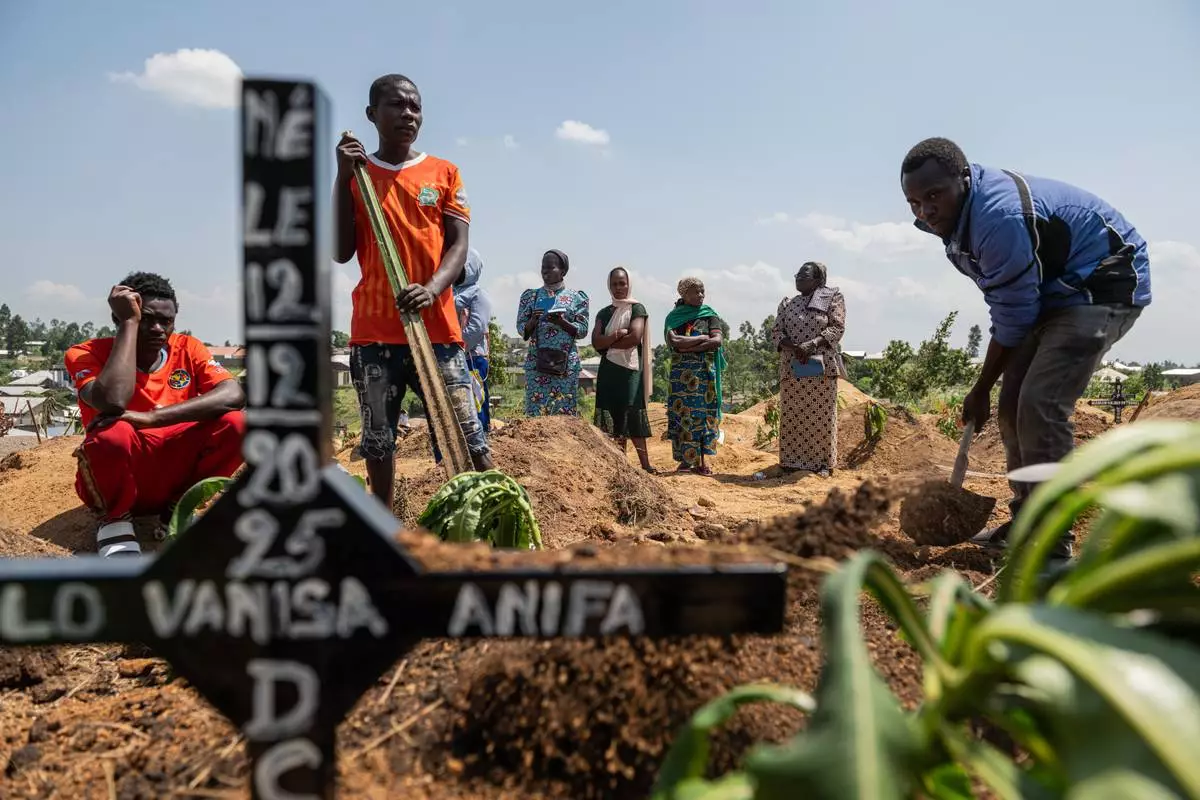
Relatives of Vanisa Anifa, a 6-month-old orphaned girl who died of Ebola, attend her burial, in Bunia, Congo, Friday, June 19, 2026. (AP Photo/Moses Sawasawa)

Relatives of Vanisa Anifa, a 6-month-old orphaned girl who died of Ebola, attend her burial, in Bunia, Congo, Friday, June 19, 2026. (AP Photo/Moses Sawasawa)

Recommended Articles